If you’ve ever traveled internationally and exchanged money at the airport, you’ve participated in the foreign exchange market. Forex trading takes this concept and transforms it into a dynamic financial market where trillions of dollars change hands daily. But what exactly is forex trading, and how does it work?
Forex trading, short for foreign exchange trading, is the buying and selling of currencies with the goal of making a profit from changes in their exchange rates. It’s the largest and most liquid financial market in the world, with an average daily trading volume exceeding $7.5 trillion. Unlike stock markets that have specific opening and closing times, the forex market operates 24 hours a day, five days a week, across major financial centers worldwide.
In this comprehensive guide, you’ll learn everything you need to know about forex trading as a beginner. We’ll explain how the currency market works, who participates in it, the basic terminology you need to understand, and the fundamental concepts that drive currency prices. Whether you’re considering forex trading as a potential income source or simply want to understand this fascinating market, this guide will give you a solid foundation.
What is Forex Trading?
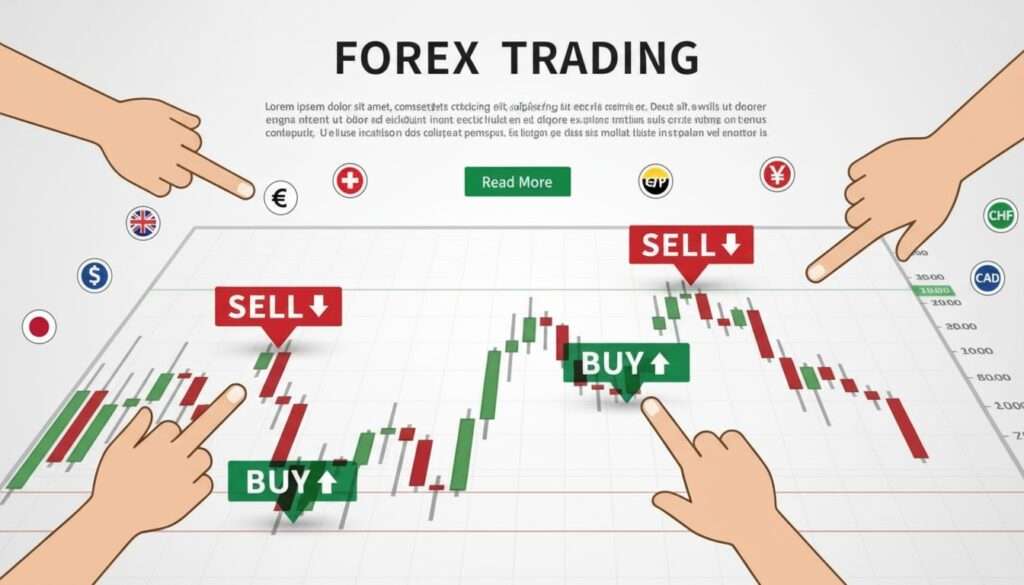
Forex trading is the simultaneous buying of one currency and selling of another. Currencies are traded in pairs, such as EUR/USD (Euro/US Dollar) or GBP/JPY (British Pound/Japanese Yen). When you trade forex, you’re essentially betting on the strength of one currency against another.
How Currency Pairs Work

Every forex trade involves a currency pair. The first currency listed is called the “base currency,” and the second is the “quote currency.” The exchange rate tells you how much of the quote currency you need to buy one unit of the base currency.
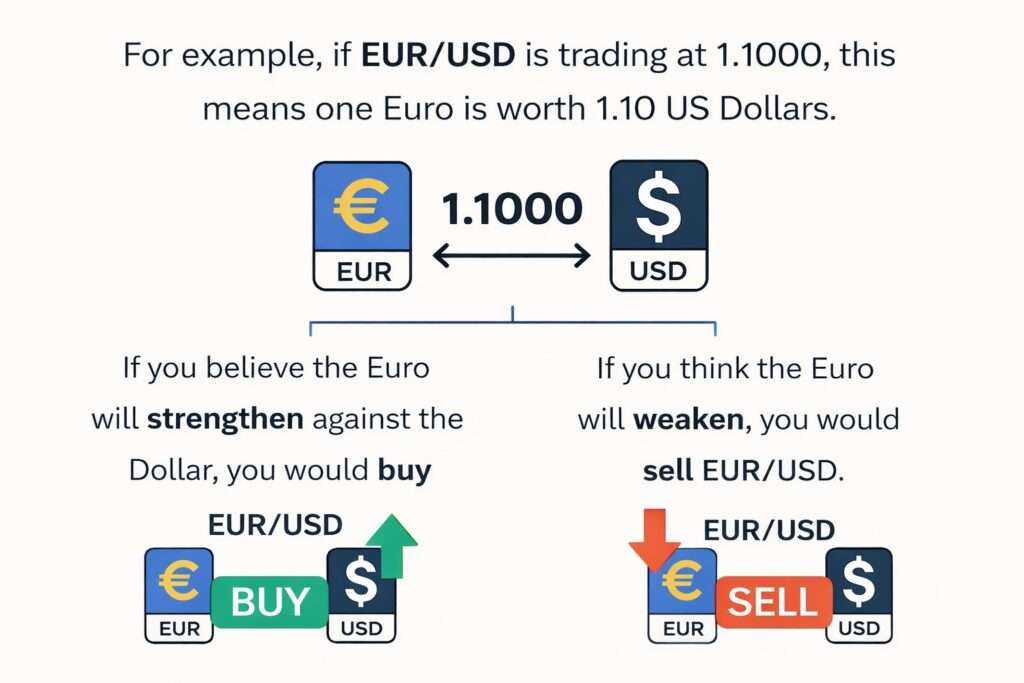
For example, if EUR/USD is trading at 1.1000, this means one Euro is worth 1.10 US Dollars. If you believe the Euro will strengthen against the Dollar, you would buy EUR/USD. If you think the Euro will weaken, you would sell EUR/USD.
Why People Trade Forex
Traders participate in the forex market for several reasons:
Speculation and Profit: The primary reason most individual traders enter the forex market is to profit from exchange rate fluctuations. By correctly predicting whether a currency will rise or fall against another, traders can generate returns.
Hedging: Businesses and investors use forex trading to protect themselves against currency risk. For example, a US company expecting payment in Euros three months from now might use forex markets to lock in the current exchange rate.
International Trade: Companies engaged in international business need to exchange currencies to pay suppliers or receive payments from customers in different countries.
Diversification: Investors add forex trading to their portfolios to diversify beyond stocks, bonds, and commodities.
The History of Forex Trading
Understanding the history of forex trading helps explain why the market operates the way it does today.
The Gold Standard Era
For much of modern history, currency values were tied to gold through the gold standard. Countries agreed to convert paper money into a fixed amount of gold, which created stable but inflexible exchange rates.
Bretton Woods Agreement (1944-1971)
After World War II, 44 nations signed the Bretton Woods Agreement, which pegged currencies to the US Dollar, and the Dollar to gold at $35 per ounce. This system created stable exchange rates but limited flexibility as economies grew and changed at different rates.
The Modern Forex Market (1971-Present)
In 1971, President Nixon ended the Dollar’s convertibility to gold, effectively ending the Bretton Woods system. This created the floating exchange rate system we have today, where currency values are determined by market forces of supply and demand.
The modern forex market truly began to take shape in the 1990s with the advent of electronic trading platforms. What was once the exclusive domain of banks and large institutions became accessible to individual retail traders. Today’s forex market is characterized by high liquidity, advanced technology, and participation from traders worldwide.
How the Forex Market Works
The forex market operates differently from stock or commodity markets in several important ways.
Decentralized Market Structure
Unlike stock exchanges that have a central physical location, the forex market is decentralized. It exists as a global network of banks, brokers, and traders connected electronically. Trading happens directly between participants through what’s called the “interbank market.”
This decentralized structure has several implications:
- No Central Exchange: There’s no single forex exchange like the New York Stock Exchange for stocks
- Over-the-Counter (OTC) Trading: Forex trades happen directly between parties electronically
- Multiple Price Quotes: Different brokers may offer slightly different prices for the same currency pair
- Global Access: Anyone with internet connection can access forex markets through a broker
24-Hour Trading Sessions
The forex market operates 24 hours a day during the business week because it follows the sun around the world through different financial centers:
Sydney Session: Opens at 5:00 PM EST (Sunday) Tokyo Session: Opens at 7:00 PM EST London Session: Opens at 3:00 AM EST New York Session: Opens at 8:00 AM EST
The market closes Friday at 5:00 PM EST and reopens Sunday at 5:00 PM EST. The overlap between London and New York sessions (8:00 AM to 12:00 PM EST) typically sees the highest trading volume and volatility.
Market Participants
Several types of participants create the forex market’s massive daily volume:
Central Banks: National banks like the Federal Reserve, European Central Bank, and Bank of Japan influence currency values through monetary policy and sometimes direct market intervention.
Commercial Banks: Major banks facilitate currency exchange for clients and conduct proprietary trading. They form the core of the interbank market.
Institutional Investors: Hedge funds, pension funds, and investment firms trade currencies as part of their investment strategies.
Corporations: Multinational companies exchange currencies for international business operations.
Retail Traders: Individual traders access the market through brokers, trading for profit or portfolio diversification.
Brokers: Forex brokers provide platforms and access to the market for retail traders, earning money through spreads or commissions.
Major Currency Pairs
Currencies are traded in pairs, and not all pairs are created equal. Understanding the major, minor, and exotic currency pairs helps traders focus on the most liquid and stable markets.
The Eight Major Currencies
Eight currencies dominate forex trading:
- USD – United States Dollar
- EUR – Euro
- JPY – Japanese Yen
- GBP – British Pound Sterling
- CHF – Swiss Franc
- CAD – Canadian Dollar
- AUD – Australian Dollar
- NZD – New Zealand Dollar
Major Currency Pairs
Major pairs all include the US Dollar paired with one of the other major currencies. These pairs offer the tightest spreads and highest liquidity:
- EUR/USD – Euro/US Dollar (most traded pair)
- USD/JPY – US Dollar/Japanese Yen
- GBP/USD – British Pound/US Dollar (nicknamed “Cable”)
- USD/CHF – US Dollar/Swiss Franc (nicknamed “Swissie”)
- AUD/USD – Australian Dollar/US Dollar (nicknamed “Aussie”)
- USD/CAD – US Dollar/Canadian Dollar (nicknamed “Loonie”)
- NZD/USD – New Zealand Dollar/US Dollar (nicknamed “Kiwi”)
Minor and Exotic Pairs
Minor Pairs (or Cross Currency Pairs) don’t include the US Dollar but feature other major currencies:
- EUR/GBP, EUR/JPY, GBP/JPY, EUR/AUD, etc.
Exotic Pairs include one major currency and one from an emerging or smaller economy:
- USD/TRY (Turkish Lira), EUR/HUF (Hungarian Forint), USD/MXN (Mexican Peso)
Exotic pairs typically have wider spreads, lower liquidity, and higher volatility than major pairs.
Essential Forex Trading Terminology
To understand forex trading, you need to know the language traders use.
Pip (Point in Percentage)
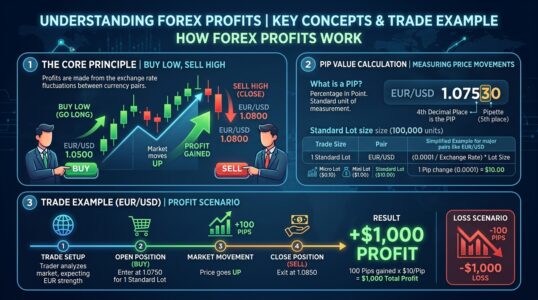
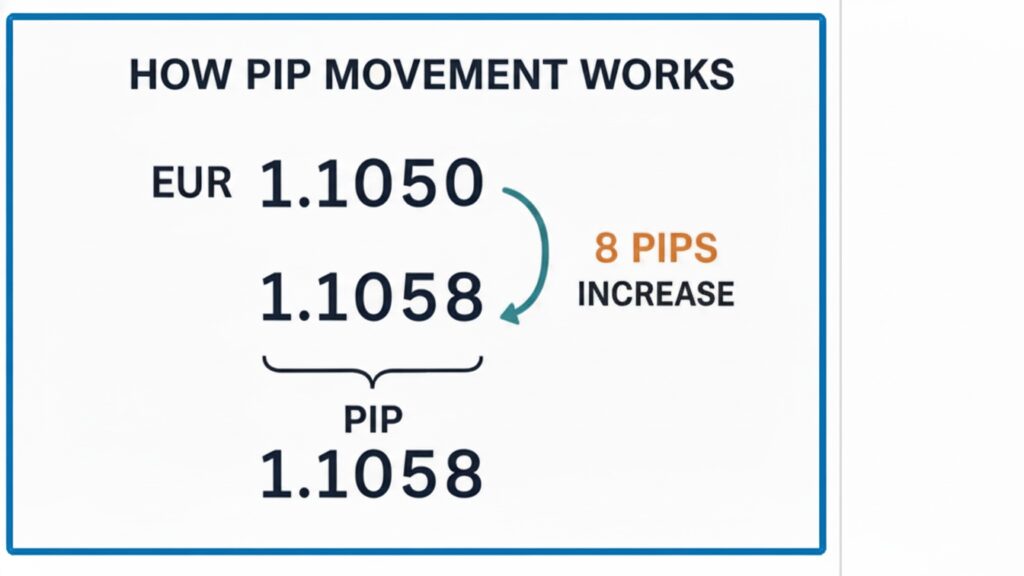
A pip is the smallest price movement in a currency pair. For most pairs, a pip is 0.0001. For example, if EUR/USD moves from 1.1000 to 1.1001, it has moved one pip.
Example: Larger Pip Movement in Real Trading
Building on that single-pip example, let’s see a more realistic trade:
- You buy EUR/USD at 1.1050
- Later, the price moves to 1.1058
- Price difference: 0.0008
Result: 8 pips of movement
This 8-pip movement represents potential profit (if you bought) or loss (if you sold). The actual dollar amount depends on your position size (lot size), which we’ll cover next.
For yen-based pairs, a pip is 0.01 because the yen trades at different values. If USD/JPY moves from 110.00 to 110.01, it has moved one pip.
Lot Size
Currencies are traded in standardized units called lots:
- Standard Lot: 100,000 units of base currency
- Mini Lot: 10,000 units of base currency
- Micro Lot: 1,000 units of base currency
- Nano Lot: 100 units of base currency (not all brokers offer)
Lot size determines how much each pip movement is worth in your account currency.
Spread
The spread is the difference between the bid price (what you can sell for) and the ask price (what you can buy for). For example, if EUR/USD shows a bid of 1.1000 and an ask of 1.1002, the spread is 2 pips.
Spreads are how many brokers earn money. Tighter spreads mean lower trading costs for you.
Leverage and Margin
Leverage allows you to control a large position with a relatively small amount of capital. For example, 100:1 leverage means you can control $100,000 with just $1,000 in your account.
Margin is the amount of money required in your account to open and maintain a leveraged position. If you want to trade one standard lot ($100,000) with 100:1 leverage, you need $1,000 in margin.
While leverage can magnify profits, it equally magnifies losses. Proper risk management is essential when using leverage.
Long and Short Positions
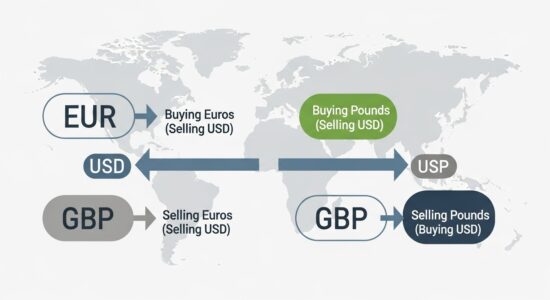
Going Long: Buying a currency pair because you expect the base currency to strengthen against the quote currency. If you buy EUR/USD, you’re long Euros and short Dollars.
Going Short: Selling a currency pair because you expect the base currency to weaken against the quote currency. If you sell EUR/USD, you’re short Euros and long Dollars.
In forex, you can profit whether markets are rising or falling, as you’re always buying one currency and selling another.
What Moves Currency Prices?
Understanding the forces that drive currency values helps you make informed trading decisions.
Economic Indicators
Economic data releases significantly impact currency values:
Interest Rates: Higher interest rates typically strengthen a currency by attracting foreign investment seeking better returns. Central bank rate decisions are among the most important forex events.
Gross Domestic Product (GDP): Strong GDP growth suggests a healthy economy, which tends to support currency strength.
Employment Data: Job growth and unemployment rates reflect economic health. In the US, the Non-Farm Payroll report released monthly is a major market-moving event.
Inflation Rates: Moderate inflation is normal, but high inflation can weaken a currency. Central banks monitor inflation closely when setting policy.
Trade Balance: A trade surplus (exports exceed imports) generally supports currency strength, while deficits can weaken a currency.
Consumer Confidence: Higher confidence typically leads to increased spending and economic growth, supporting currency values.
Central Bank Policy
Central banks like the Federal Reserve, European Central Bank, and Bank of Japan have enormous influence over currency values through:
- Interest Rate Decisions: Raising or lowering benchmark rates
- Quantitative Easing: Buying assets to inject money into the economy
- Forward Guidance: Communicating future policy intentions
- Direct Intervention: Buying or selling currencies to influence exchange rates
Traders closely watch central bank meetings, statements, and speeches from officials.
Political Events and Sentiment
Political stability, elections, policy changes, and geopolitical events affect currency values:
- Elections and changes in government
- Trade agreements or disputes
- Military conflicts or tensions
- Brexit-type events affecting economic relationships
Market Sentiment and Risk Appetite
Currency movements don’t always follow economic logic. Market sentiment and risk appetite play important roles:
Risk-On Environment: When investors feel confident, they tend to buy higher-yielding currencies from countries like Australia and New Zealand, and sell safe-haven currencies like the Japanese Yen and Swiss Franc.
Risk-Off Environment: During uncertainty or crisis, investors flee to safe-haven currencies, strengthening the Yen, Franc, and US Dollar while weakening commodity currencies.
How to Start Forex Trading
Getting started in forex trading involves several important steps.
1. Education First
Before risking real money, invest time in education:
- Learn forex basics, terminology, and concepts
- Understand technical and fundamental analysis
- Study risk management principles
- Read books and take online courses
- Follow market news and analysis
2. Choose a Reputable Broker
Selecting the right broker is crucial. Look for:
Regulation: Choose brokers regulated by respected authorities like the FCA (UK), ASIC (Australia), or NFA/CFTC (US).
Trading Costs: Compare spreads, commissions, and any other fees.
Platform Quality: The trading platform should be user-friendly, stable, and offer the tools you need.
Customer Service: Responsive support when you need help.
Minimum Deposit: Some brokers require substantial deposits; others allow you to start small.
Execution Quality: Fast, reliable order execution without excessive slippage.
3. Open a Demo Account
Most brokers offer free demo accounts with virtual money. Use a demo account to:
- Practice executing trades without risk
- Test strategies in real market conditions
- Learn the trading platform features
- Build confidence before trading real money
Spend several weeks or months trading demo until you’re consistently profitable.
4. Develop a Trading Plan
A trading plan is your roadmap for success. It should include:
- Trading goals and objectives
- Risk management rules (maximum risk per trade, daily loss limits)
- Trading strategies and setups you’ll use
- Currency pairs you’ll focus on
- Trading schedule (which sessions you’ll trade)
- Record-keeping and performance review process
5. Start Small with Real Money
When you transition to live trading:
- Start with a small account you can afford to lose
- Trade micro or mini lots initially
- Risk only 1-2% of your account per trade
- Focus on consistency, not huge profits
- Keep a trading journal to track and learn from your trades
6. Continuous Learning and Improvement
Successful forex traders never stop learning:
- Review your trades regularly
- Stay updated on market news and analysis
- Adapt strategies as markets change
- Learn from both wins and losses
- Consider mentorship or trading communities
Risks of Forex Trading
Forex trading offers opportunities but comes with significant risks you must understand.
Leverage Risk
Leverage is a double-edged sword. While 100:1 leverage lets you control $100,000 with $1,000, a 1% adverse move wipes out your entire investment. Many new traders are drawn to high leverage without understanding the risks, leading to rapid account losses.
Market Volatility
Currency prices can move rapidly due to unexpected news, economic data, or geopolitical events. Even experienced traders can face significant losses during extreme volatility.
Counterparty Risk
Because forex is decentralized and unregulated in some jurisdictions, there’s risk that your broker could fail or act unethically. This is why choosing a well-regulated broker is essential.
Emotional and Psychological Challenges
Trading psychology is often the biggest challenge:
- Fear and greed drive poor decisions
- Revenge trading after losses compounds problems
- Overconfidence after wins leads to excessive risk
- Lack of discipline abandons trading plans
Information Overload
The 24-hour forex market generates constant news, data, and analysis. New traders often struggle with information overload, leading to analysis paralysis or impulsive decisions.
The Reality of Losses
Most forex traders lose money, especially in their first year. Industry estimates suggest that 70-90% of retail forex traders lose money over time. This doesn’t mean forex trading is impossible, but it highlights the importance of education, practice, and realistic expectations.
Advantages of Forex Trading
Despite the risks, forex trading offers several advantages that attract millions of participants:
High Liquidity
With over $7.5 trillion in daily volume, the forex market offers unmatched liquidity. You can enter and exit positions quickly, even with large trades, and there’s always a buyer or seller available.
24-Hour Market Access
The ability to trade any time during the business week offers flexibility for people with day jobs or those who prefer trading specific sessions.
Low Transaction Costs
Compared to stock trading, forex transaction costs are relatively low. Many brokers offer commission-free trading with only the spread as the cost.
Accessibility
You can start forex trading with a relatively small account. Some brokers allow accounts as small as $100, though starting with more capital is advisable.
Two-Way Trading Opportunities
Unlike stocks where profiting from declines requires complex strategies, forex lets you easily profit from both rising and falling markets by buying or selling currency pairs.
No Central Exchange Manipulation
The decentralized nature and massive size of the forex market make it nearly impossible for any single entity to manipulate prices for extended periods.
Common Forex Trading Strategies
Successful traders use various strategies based on their goals, time commitment, and risk tolerance.
Day Trading
Day traders open and close positions within a single trading day, avoiding overnight risk. They typically:
- Make multiple trades per day
- Focus on short-term price movements
- Use technical analysis and price action
- Require time to monitor markets actively
- Need quick decision-making skills
Swing Trading
Swing traders hold positions for several days to weeks, aiming to profit from medium-term price swings. This approach:
- Requires less time than day trading
- Combines technical and fundamental analysis
- Involves overnight and weekend risk
- Focuses on trending markets
- Suits traders with day jobs
Position Trading
Position traders take a long-term view, holding trades for weeks, months, or even years. They:
- Focus primarily on fundamental analysis
- Require patience and discipline
- Accept larger temporary drawdowns
- Need substantial capital to withstand volatility
- Trade less frequently
Scalping
Scalpers make dozens or hundreds of very short-term trades, holding positions for seconds to minutes. Scalping:
- Requires intense focus and quick reactions
- Needs very tight spreads and fast execution
- Generates many small profits (and losses)
- Is extremely time-demanding
- Works best in highly liquid pairs during active sessions
Fundamental vs. Technical Analysis
Forex traders use two main approaches to analyze markets and make trading decisions.
Fundamental Analysis
Fundamental analysis examines economic conditions, central bank policies, political events, and other factors that affect currency values. Fundamental traders:
- Study economic calendars for data releases
- Analyze interest rate differentials between countries
- Monitor central bank statements and meetings
- Consider geopolitical events and news
- Take a longer-term perspective on currency values
Key fundamental factors include GDP growth, employment data, inflation rates, trade balances, interest rate decisions, and political stability.
Technical Analysis
Technical analysis studies price charts, patterns, and indicators to predict future movements based on historical behavior. Technical traders:
- Identify support and resistance levels
- Recognize chart patterns like head and shoulders, triangles, and flags
- Use indicators like moving averages, RSI, MACD, and Fibonacci retracements
- Analyze candlestick patterns
- Focus on price action and market sentiment
Many traders combine both approaches, using fundamental analysis to identify which currencies to trade and technical analysis to time specific entries and exits.
Risk Management in Forex Trading
Proper risk management is the difference between long-term success and account destruction.
Position Sizing
Never risk more than 1-2% of your account on a single trade. If you have a $10,000 account, your maximum risk per trade should be $100-200. This ensures that a string of losses won’t devastate your account.
Stop-Loss Orders
Always use stop-loss orders to limit potential losses. A stop-loss automatically closes your position if the price moves against you by a specified amount. Never trade without a stop-loss, and never move a stop-loss further away to give a losing trade “more room.”
Risk-to-Reward Ratio
Aim for trades where potential profit exceeds potential loss. A minimum 1:2 risk-to-reward ratio means you risk $100 to potentially make $200. This allows you to be profitable even if you win less than half your trades.
Avoid Over-Leveraging
Just because your broker offers 500:1 leverage doesn’t mean you should use it. High leverage magnifies losses as much as profits. Consider using leverage of 10:1 or 20:1 instead of the maximum available.
Diversification
Don’t put all your capital in a single trade or currency pair. Diversifying across different pairs (that aren’t highly correlated) reduces your overall portfolio risk.
Emotional Discipline
Stick to your trading plan regardless of emotions. Don’t revenge trade after losses, don’t overtrade after wins, and don’t abandon your strategy during drawdowns.
Forex Trading Costs and Fees
Understanding all costs involved in forex trading helps you calculate true profitability.
Spreads
The spread (difference between bid and ask prices) is the primary cost for most forex traders. Major pairs typically have spreads of 0.5-3 pips, while exotic pairs can have spreads of 10+ pips. Tighter spreads mean lower costs.
Commissions
Some brokers charge commissions per trade instead of or in addition to spreads. For example, a broker might charge $3 per lot traded. Commission-based accounts often have tighter spreads.
Swap Rates (Overnight Financing)
If you hold a position overnight, you’ll either pay or receive a swap (also called rollover). This reflects the interest rate differential between the two currencies. You pay swap when you’re long the lower-yielding currency and short the higher-yielding currency.
Inactivity Fees
Some brokers charge monthly fees if you don’t trade for a certain period. Check your broker’s fee schedule.
Withdrawal Fees
While deposits are usually free, some brokers charge fees for withdrawals, especially for certain payment methods.
Conversion Fees
If your account is in a different currency than your deposits/withdrawals, currency conversion fees may apply.
Tax Considerations
Forex trading profits may be taxable, and the rules vary by country.
United States
In the US, forex traders can choose between two tax treatments:
Section 1256: 60% of profits taxed at long-term capital gains rate (lower), 40% at short-term rate (higher).
Section 988: All profits taxed as ordinary income.
Traders must elect out of Section 988 treatment before the start of the tax year to use Section 1256.
United Kingdom
In the UK, forex trading profits may be subject to Capital Gains Tax if you exceed the annual allowance. Spread betting profits are generally tax-free but aren’t eligible for capital loss offsets.
Australia
Australian forex traders pay tax on profits as either business income or capital gains, depending on trading frequency and intent.
Other Countries
Tax treatment varies widely. Some countries don’t tax forex profits at all, while others tax them as regular income. Consult a tax professional familiar with your country’s regulations.
Keep detailed records of all trades, including dates, pairs, entry/exit prices, profit/loss, and fees. This makes tax reporting much easier.
Frequently Asked Questions
Q: How much money do I need to start forex trading?
A: Many brokers allow accounts as small as $100-500, but starting with $1,000-5,000 is more realistic for proper risk management. With a very small account, you can’t properly diversify or take multiple positions while maintaining low risk per trade. Remember that most traders lose money initially, so only deposit what you can afford to lose completely.
Q: Can I make a living from forex trading?
A: It’s possible but extremely difficult and requires substantial capital, extensive experience, and exceptional discipline. To generate meaningful income, you need a large enough account that conservative risk management still produces sufficient profits. For example, averaging 2% monthly return on a $100,000 account yields $2,000/month, but the same return on $5,000 only produces $100/month. Most successful full-time traders spent years learning their craft while maintaining other income sources.
Q: What are the best currency pairs for beginners?
A: Beginners should start with major pairs like EUR/USD, USD/JPY, or GBP/USD. These pairs offer the tightest spreads, highest liquidity, and most available information and analysis. They also tend to be less volatile than exotic pairs, making them more forgiving for new traders learning the ropes.
Q: How long does it take to become profitable in forex?
A: Most traders need at least 6-12 months of serious study and practice before achieving consistent profitability, and many take several years. There’s no shortcut. Plan on spending significant time learning on a demo account before risking real money, then start small when you transition to live trading. The learning curve is steep, and the majority of traders never become consistently profitable.
Q: Is forex trading gambling?
A: Forex trading becomes gambling if you trade without analysis, risk management, or a plan—essentially betting on random price movements. However, when approached systematically with proper education, analysis, and risk management, forex trading is informed speculation based on analysis of economic factors and price behavior. The key difference is that gambling relies purely on chance, while skilled traders use analysis to find trades with positive expected value.
Q: What’s the difference between a dealing desk and no dealing desk broker?
A: Dealing desk (DD) brokers, also called market makers, take the opposite side of your trades and may have conflicts of interest. No dealing desk (NDD) brokers connect you directly to liquidity providers without trading against you. NDD brokers can be either STP (Straight Through Processing) or ECN (Electronic Communication Network). ECN brokers generally offer the best execution and tightest spreads but may charge commissions.
Q: Should I use automated trading systems or robots?
A: Automated systems (expert advisors or EAs) can be useful for experienced traders who understand what the system does and can monitor its performance. However, most commercial EAs sold online perform poorly in real trading despite attractive backtests. If you’re a beginner, focus on learning to trade manually first. Understand the market before attempting to automate strategies. No robot can replace the judgment and adaptability of an experienced trader.
Q: What’s the best time to trade forex?
A: The best trading times depend on your strategy and the pairs you trade. The London-New York overlap (8:00 AM – 12:00 PM EST) typically offers the highest volume and volatility, especially for EUR/USD and GBP/USD. However, high volatility isn’t always better—it can also increase risk. Some strategies work better during quieter Asian hours. Avoid trading during major holidays when liquidity is thin and spreads widen.
Q: How important is the choice of forex broker?
A: Extremely important. Your broker directly affects your trading costs, execution quality, and the safety of your funds. Choose a broker regulated by a reputable authority, with competitive spreads, reliable execution, good customer service, and a solid reputation. Poor broker choice can undermine even the best trading strategy through high costs, execution problems, or worse—fraud and bankruptcy.
Q: What leverage should I use as a beginner?
A: Use low leverage regardless of what your broker offers. Even though brokers may offer 100:1 or 500:1 leverage, beginners should use 10:1 or 20:1 maximum. Remember that leverage magnifies both profits and losses. High leverage makes it extremely easy to blow up your account with a few bad trades. Focus on learning and consistency with low leverage before considering higher amounts.
Forex trading offers an accessible entry into financial markets with the potential for profit, portfolio diversification, and the intellectual challenge of analyzing global economic forces. However, it’s not a guaranteed path to wealth, and the risks are substantial. Most traders lose money, especially those who approach it casually without proper education and risk management.
Success in forex trading requires:
- Education: Understanding how markets work, what drives currency prices, and how to analyze opportunities
- Practice: Spending significant time on demo accounts before risking real money
- Discipline: Following your trading plan and risk management rules even when emotions push you to deviate
- Patience: Accepting that becoming profitable takes time, often years of learning and refinement
- Realistic Expectations: Understanding that consistent small gains compound over time, while chasing huge profits typically leads to losses
- Capital Preservation: Protecting your trading capital through proper position sizing, stop-losses, and risk management
If you’re serious about forex trading, commit to ongoing education, start with a demo account, develop and test a trading plan, and only risk money you can afford to lose. Approach it as a business requiring investment in learning and development, not as a get-rich-quick opportunity.
The forex market will be here tomorrow, next month, and next year. There’s no rush. Take the time to learn properly, and you’ll be better positioned for long-term success in this challenging but potentially rewarding market.
New to Forex Trading?
If you’re just getting started, we recommend beginning with our complete beginner guide that explains how forex trading works, key concepts, and what every new trader should know.
Beginner Forex Trading Guide: What Is Forex Trading?
Next Steps After Learning Forex Basics
If you’re new to forex trading, these guides will help you build a solid foundation:
- Forex Risk Management – Complete Guide
- Technical Analysis in Forex – Complete Guide
- Fundamental Analysis in Forex – Complete Guide
- MT4 Beginner’s Guide
Legal Disclaimer:
Forex trading involves substantial risk of loss and is not suitable for all investors. The information provided in this article is for educational purposes only and should not be considered investment advice. Past performance is not indicative of future results. Before trading forex, carefully consider your financial situation, investment objectives, level of experience, and risk tolerance. You should be aware of all the risks associated with foreign exchange trading and seek advice from an independent financial advisor if you have any doubts. Never invest money you cannot afford to lose.