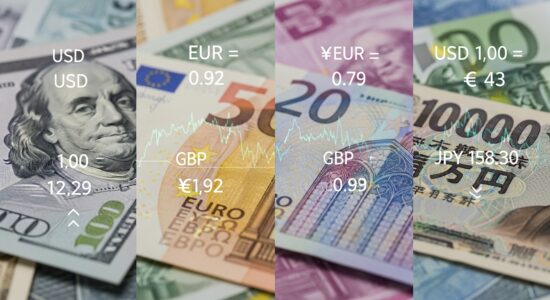
There is something almost poetic about the idea of making money by selling money. Most people work to earn money, save money, spend money. Forex traders do something different — they trade money itself, buying one currency and selling another, and pocketing the difference when prices move in their favor.
It sounds circular. But it works, and it works at a scale most people never imagine. The foreign exchange market trades over $7.5 trillion every single day, dwarfing every other financial market on earth. Banks, hedge funds, corporations, and governments all participate. So do individual traders sitting at home with a laptop and an internet connection, trading the same prices at the same hours.
So how exactly do you make money selling money?
Every Forex Trade Is a Buy and a Sell Simultaneously
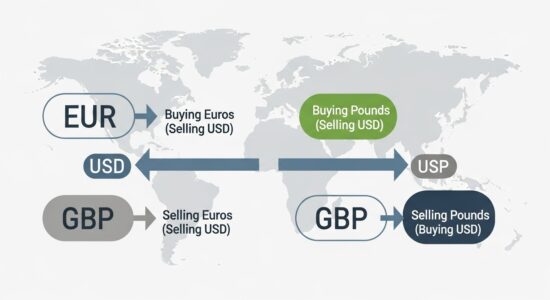
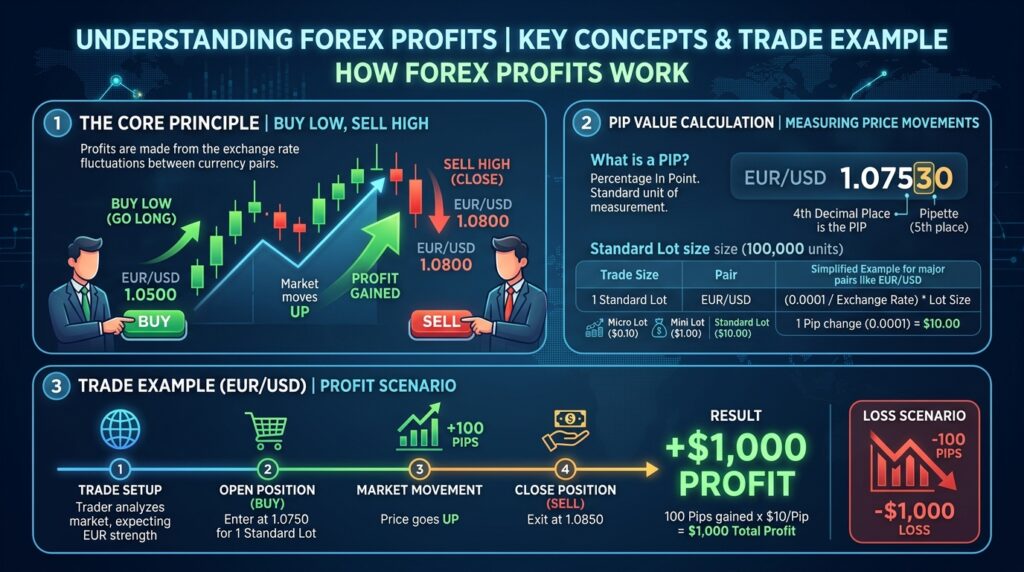
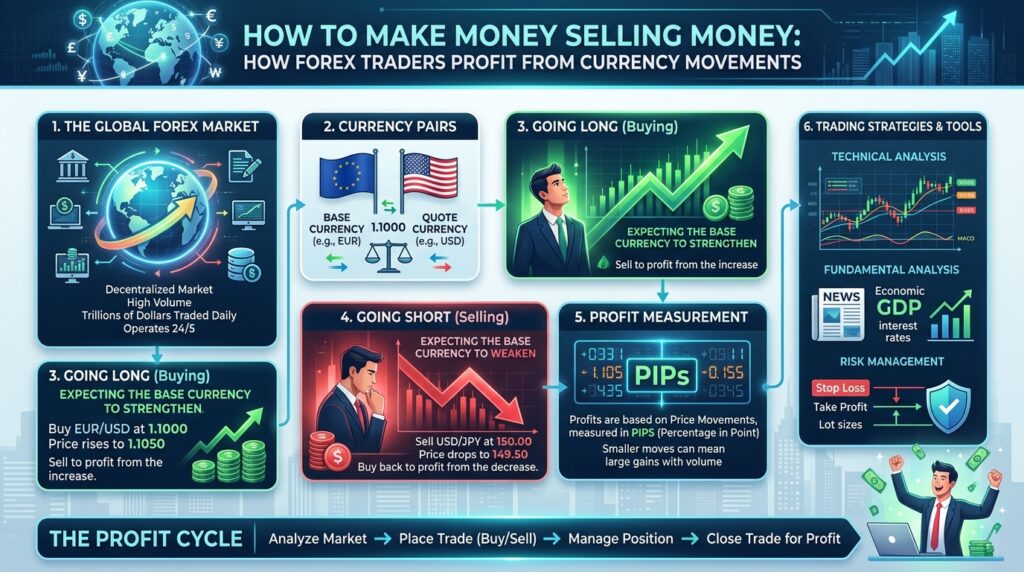
When you trade forex, you never buy just one currency. You always trade a pair — EUR/USD, GBP/JPY, AUD/USD. Every single trade involves buying one currency and selling another at the same time. If you buy EUR/USD, you are buying euros and selling dollars. If the euro then rises against the dollar, your position becomes profitable. When you close the trade, you sell those euros back at the higher price and keep the difference.
That difference is measured in pips — the standard unit of price movement in forex. For most pairs, one pip equals a move of 0.0001 in the exchange rate. On a standard lot of 100,000 currency units, each pip is worth roughly $10. A 50-pip move means $500. That is the basic arithmetic of how small price movements turn into real money, and it scales up or down depending on the lot size you trade.
You Can Profit Whether the Market Goes Up or Down
This is what sets forex apart from most other markets. With stocks, you make money when prices rise. Betting against a stock is possible but involves borrowed shares, fees, and mechanics that most retail investors find cumbersome. In forex, going short — selling a currency you expect to weaken — is exactly as simple as going long. If you think the dollar is going to lose ground against the euro, you sell USD and buy EUR. If you are right, you profit. No extra steps, no borrowed instruments, no complications.
That two-directional freedom matters enormously in practice. Currency markets do not trend steadily upward the way growth stocks sometimes appear to. They move up, they move down, they consolidate, they reverse. A trader who can only profit from rising prices is working with half the available opportunities. Forex traders work both sides of every move.
What the Spread Costs You
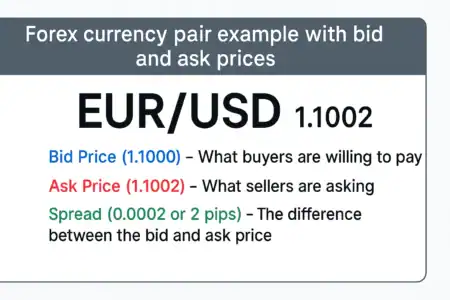
Every trade has a cost, and in forex that cost is the spread — the gap between the buy price and the sell price. If EUR/USD shows a bid of 1.1000 and an ask of 1.1002, the spread is two pips. The moment you enter the trade you are already two pips behind. The market needs to move at least that far in your favor before you break even.
On major pairs like EUR/USD, spreads are typically very tight — often under one pip with a good ECN broker during peak hours. That tightness is one reason experienced traders focus on the majors, particularly while learning. The lower the spread, the less the market needs to move before your trade becomes profitable.
Leverage: Powerful and Dangerous in Equal Measure
Forex offers some of the highest leverage available to retail traders, and it is responsible for more losses than any other single factor in this market. Leverage lets you control a large position with a small deposit — at 50:1, a $1,000 account can control a $50,000 position. The potential for amplified gains is real.
So is the potential for amplified losses. A 1% adverse price move on a 100:1 leveraged position wipes out the entire deposit. This is not a rare edge case. It happens to real traders regularly. The traders who survive and eventually profit are not the ones chasing the highest leverage ratios — they are the ones who use leverage conservatively and size their positions to ensure no single trade can cause serious damage to their account.
What Actually Moves Currency Prices
Making money selling money consistently requires understanding what drives exchange rates. They are not random, even when short-term moves feel that way.
Central bank policy is the dominant force. When the Federal Reserve raises interest rates, the dollar typically strengthens as global capital flows toward higher yields. When the European Central Bank signals it will hold rates low, the euro tends to weaken. The interest rate differential between two countries shapes long-term currency trends more powerfully than almost anything else.
Economic data creates shorter-term volatility. Jobs reports, inflation figures, GDP readings, and trade balances all release on a schedule and can move pairs by dozens of pips within seconds if the numbers surprise the market. Political events add another layer — elections, trade disputes, geopolitical tensions, and central bank leadership changes all carry weight in currency markets.
US forex trading is regulated by the CFTC and NFA. UK and European brokers fall under the oversight of the FCA and equivalent national regulators. Trading with a properly regulated broker is not optional — the protections matter when things go wrong.
The Discipline That Separates Winners from Everyone Else
The mechanics of forex are learnable. Most people who study them seriously can understand how the market works within a few months. What is harder — and what ultimately determines whether someone makes money or loses it — is discipline.
Proper risk management is the foundation. Most experienced traders risk no more than 1-2% of their account on any single trade. On a $5,000 account that means $50-$100 maximum risk per trade. It sounds conservative because it is, deliberately. The goal is to survive losing streaks — which happen to every trader without exception — without threatening the account. Capital preservation comes first. Profit follows from staying in the game long enough to let an edge play out.
Technical analysis gives you the framework to make entry and exit decisions systematically rather than by instinct. Learning to read price charts, identify support and resistance, and recognize patterns that tend to precede directional moves transforms trading from guesswork into something with a repeatable process behind it.
Choosing the right broker matters too. Regulation, execution quality, spreads, and platform reliability all affect your results. Our guide on how to choose a forex broker covers every criterion worth evaluating before you open an account. Once you have a broker in mind, our review of the best forex trading platforms will help you find the right environment to execute your trades.
Can You Actually Make Money Selling Money in Forex?
Yes — but the honest version of that answer includes context that often gets left out of the conversation.
The majority of retail forex traders lose money, particularly in their first year. Industry estimates consistently put the figure somewhere between 70 and 80 percent. That is not an argument against trading forex. It is an argument for taking the preparation seriously before risking real capital.
The traders who build consistent profitability are not exceptionally smart or unusually lucky. They are more disciplined than average. They treat losses as information rather than failure. They keep records, review their trades honestly, and keep improving their process. They start small and scale up only after demonstrating results over time. And they start on a demo account — practicing the mechanics, testing a strategy, and building confidence before a single dollar of real money is on the line.
Making money selling money is a genuine concept, not a gimmick. The forex market is the largest and most accessible financial market in the world, it trades around the clock, and it offers opportunity in both directions of price movement. The opportunity is real. So is the difficulty. The traders who understand both of those things at the start give themselves a far better chance than those who only hear about one of them.
Disclaimer: Forex trading involves significant risk of loss and is not suitable for all investors. Leverage can work against you as well as for you. You should only trade with capital you can afford to lose. This content is for educational purposes only and does not constitute investment advice.