Learn How to Make Fast Money by Learning diffrent Strategies in Forex Trading and Different Investment Options
What is a Lot in Forex Trading
A lot in forex trading is the standardized unit size for a currency transaction. Just as you buy eggs by the dozen or gasoline by the gallon, you trade currencies in lots. What is a lot in forex and why does it matter? Because lot size directly determines how much each pip of price movement is worth and how much capital you’re risking on each trade.
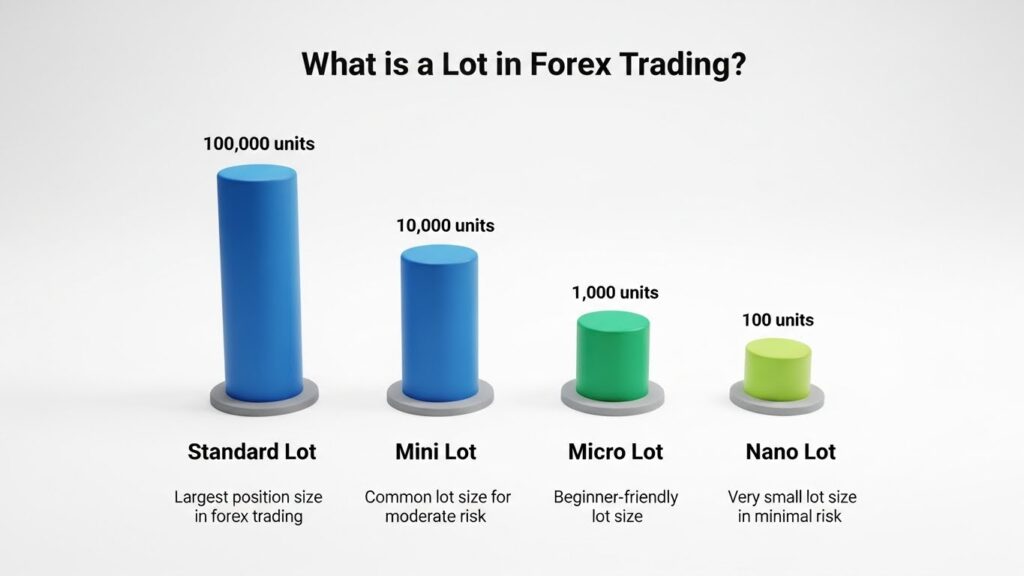
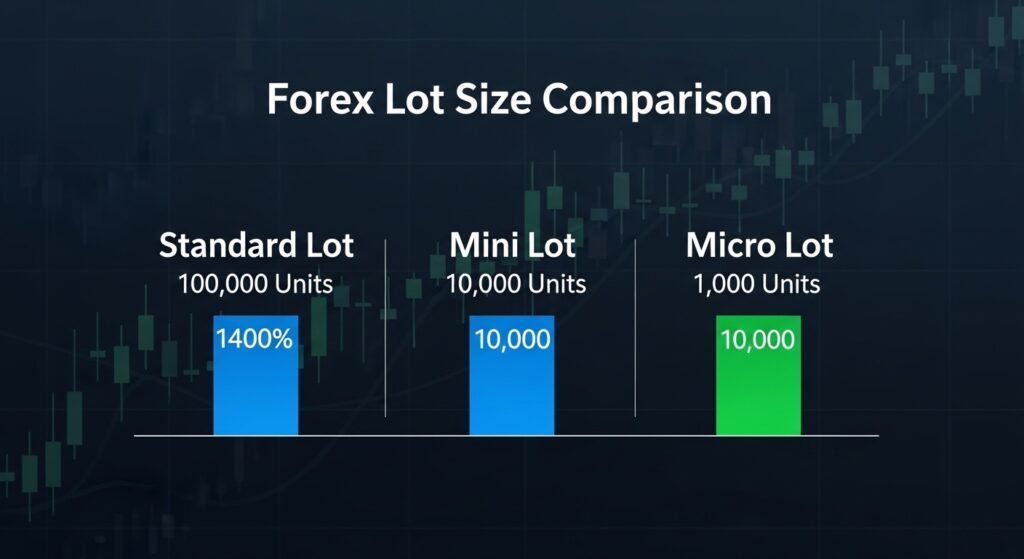
When you place a forex trade, you’re not buying individual currency units—you’re trading in standardized lot sizes. These lots come in three main sizes: standard lots (100,000 units), mini lots (10,000 units), and micro lots (1,000 units). The lot size you choose determines your position’s exposure to market movements and directly impacts your potential profits and losses.
New traders often confuse lot size with the dollar amount they’re risking, but these are different concepts. Your lot size determines your pip value—how much money you make or lose per pip of movement. A larger lot means each pip is worth more, while a smaller lot reduces the value of each pip movement.
This comprehensive guide explains everything you need to know about forex lots: what they are, the different lot sizes available, how to calculate pip values for each lot type, how lot size affects your risk, and most importantly, how to choose the appropriate lot size for your trading account and strategy.
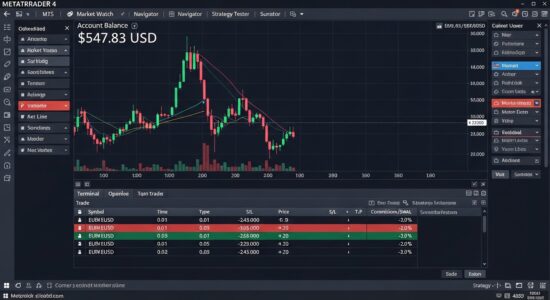
Understanding what is a lot in forex is the essential first step before placing any trade on the MetaTrader platform
A lot is the standard contract size for trading currencies in the forex market. It represents a specific number of currency units that you buy or sell in a single transaction.
The Basic Concept
When you trade forex, you’re always trading currency pairs—buying one currency while simultaneously selling another. The lot size determines how many units of the base currency (the first currency in the pair) you’re trading.
For example, if you buy 1 standard lot of EUR/USD:
You’re buying 100,000 euros
You’re simultaneously selling the equivalent amount in U.S. dollars
Each pip of movement equals $10 of profit or loss
The lot size standardizes trading across the global forex market. Whether you’re trading with a broker in New York, London, or Tokyo, a standard lot always represents 100,000 units of the base currency.
Why Lots Matter
Lot sizes exist to:
Standardize Trading: Everyone in the market uses the same lot size definitions, creating consistency and making it easier to understand position sizes and calculate risk.
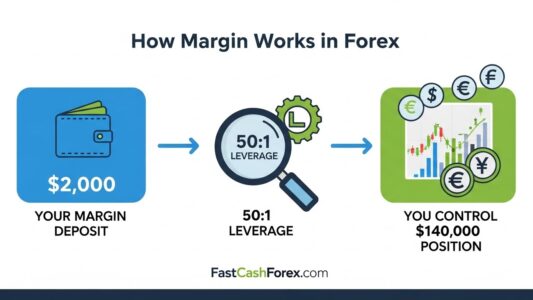
Enable Leverage: By trading in lots rather than individual currency units, traders can use leverage to control large positions with relatively small amounts of capital. A standard lot might represent $100,000 worth of currency, but you don’t need $100,000 in your account to trade it.
Simplify Pip Value Calculations: Each lot size has a predictable pip value, making it easy to calculate potential profits and losses before entering trades.
Allow Flexible Position Sizing: The three main lot sizes (standard, mini, micro) plus the ability to trade fractional lots gives traders precise control over their position sizes and risk exposure.
The Commodity Futures Trading Commission regulates forex trading in the United States and requires brokers to clearly disclose lot sizes, pip values, and how leverage affects position sizing.
Understanding Standard Lots
A standard lot is the original and largest commonly used lot size in forex trading, representing 100,000 units of the base currency.
Standard Lot Specifications
Size: 100,000 units of the base currency Common Usage: Professional traders, institutional accounts, experienced retail traders Typical Pip Value (for USD pairs): $10 per pip Margin Required (varies by leverage): $1,000-$3,333 depending on leverage ratio
How Standard Lots Work
When you buy 1 standard lot of EUR/USD at 1.0850:
You control 100,000 euros
The notional value is approximately $108,500 (100,000 × 1.0850)
Each pip movement (0.0001) equals $10
A 50-pip profit = $500 gain
A 50-pip loss = $500 loss
For Japanese yen pairs (quoted to two decimal places), the pip value differs slightly due to the yen’s lower value. For USD/JPY at 149.50:
1 standard lot = 100,000 U.S. dollars
Each pip movement (0.01) equals approximately $6.68 at current rates
Pip value fluctuates with the exchange rate for yen pairs
Calculating Pip Value for Standard Lots
For pairs where USD is the quote currency (EUR/USD, GBP/USD, AUD/USD): Pip Value = 0.0001 × 100,000 = $10 per pip
For pairs where USD is the base currency (USD/JPY, USD/CHF, USD/CAD): Pip Value = (0.01 or 0.0001 / Current Exchange Rate) × 100,000
This means pip values for non-USD quote pairs fluctuate with the exchange rate, while USD-quote pairs maintain constant $10 per pip values.
Traders with accounts of $10,000+ who can maintain proper risk management
Experienced traders comfortable with larger position sizes
Traders using 1-2% risk per trade who have sufficient capital for standard lot position sizes
Professional and institutional traders
Standard lots may be inappropriate for:
Beginners with small accounts (under $5,000)
Traders who cannot afford $10+ per pip risk
Those testing new strategies who need smaller position sizes
Traders with limited capital who would be overleveraged
Understanding Mini Lots
A mini lot represents one-tenth of a standard lot, making it more accessible for retail traders with smaller accounts.
Mini Lot Specifications
Size: 10,000 units of the base currency Common Usage: Intermediate traders, smaller retail accounts Typical Pip Value (for USD pairs): $1 per pip Margin Required (varies by leverage): $100-$333 depending on leverage ratio
How Mini Lots Work
When you buy 1 mini lot of GBP/USD at 1.2650:
You control 10,000 British pounds
The notional value is approximately $12,650 (10,000 × 1.2650)
Each pip movement equals $1
A 50-pip profit = $50 gain
A 50-pip loss = $50 loss
This 10:1 reduction in pip value compared to standard lots makes mini lots ideal for traders who want meaningful exposure without the larger capital requirements of standard lots.
Advantages of Mini Lots
Lower Capital Requirements: You can maintain proper risk management with smaller account balances. A trader risking 2% of a $2,000 account ($40) can use a 40-pip stop loss with 1 mini lot.
Better Risk Control: Smaller pip values allow more precise position sizing. Instead of jumping from 0 to $10 per pip (standard lot), you can trade in $1 increments.
Suitable for Learning: New traders can gain experience with real money at more manageable risk levels before graduating to standard lots.
Flexibility: You can trade multiple mini lots to create custom position sizes (e.g., 3 mini lots = 30,000 units = $3 per pip).
Calculating Spread Costs with Mini Lots
Spread costs scale proportionally with lot size. If EUR/USD has a 2-pip spread:
A micro lot is the smallest standard lot size, representing one-tenth of a mini lot or one-hundredth of a standard lot.
Micro Lot Specifications
Size: 1,000 units of the base currency Common Usage: Beginners, very small accounts, testing strategies Typical Pip Value (for USD pairs): $0.10 per pip Margin Required (varies by leverage): $10-$33 depending on leverage ratio
How Micro Lots Work
When you buy 1 micro lot of USD/JPY at 149.50:
You control 1,000 U.S. dollars
The notional value is approximately $1,000
Each pip movement equals approximately $0.10
A 50-pip profit = $5 gain
A 50-pip loss = $5 loss
Benefits of Micro Lots
Minimal Risk Exposure: With only $0.10 per pip, even a 100-pip loss represents just $10, making micro lots ideal for learning and testing.
Accessible for Small Accounts: Traders with $100-$500 accounts can still maintain proper risk management using micro lots.
Strategy Testing: Test new strategies with real money but minimal risk before scaling up to larger lot sizes.
Psychological Comfort: New traders can experience real trading emotions without the stress of larger financial exposure.
Limitations of Micro Lots
Small Absolute Returns: A excellent 100-pip winning trade generates only $10 profit, which may feel unsatisfying despite the good percentage return.
Transaction Costs Impact: Spread costs represent a larger percentage of potential profits. A 2-pip spread equals 2% of a 100-pip target profit.
Less Broker Availability: Some brokers don’t offer micro lots or charge higher spreads on micro lot accounts.
Temptation to Overtrade: The small position sizes might tempt traders to take excessive trades or use poor risk management.
Who Should Trade Micro Lots?
Micro lots are ideal for:
Complete beginners learning forex trading
Accounts under $1,000
Traders testing new strategies without significant risk
Anyone wanting to gain experience before progressing to larger sizes
Comparing Lot Sizes Side-by-Side
Understanding the differences between lot sizes helps you choose the right one for your account and strategy.
Lot Size Comparison Table
Lot Type
Units
Pip Value (USD pairs)
50-Pip Move
Typical Account Size
Risk Level
Standard
100,000
$10/pip
$500
$10,000+
High
Mini
10,000
$1/pip
$50
$1,000-$10,000
Medium
Micro
1,000
$0.10/pip
$5
$100-$1,000
Low
Example Scenario: Same Trade, Different Lot Sizes
EUR/USD Trade:
Entry: 1.0850
Exit: 1.0900
Movement: 50 pips profit
Results by lot size:
1 Standard lot: 50 pips × $10 = $500 profit
1 Mini lot: 50 pips × $1 = $50 profit
1 Micro lot: 50 pips × $0.10 = $5 profit
The trade outcome is identical (50 pips), but the dollar profit scales with lot size. This demonstrates why larger accounts can trade standard lots while smaller accounts require mini or micro lots to maintain equivalent risk percentages.
Fractional Lots and Custom Position Sizes
Most modern brokers allow trading fractional lots, giving you precise control over position sizes.
What Are Fractional Lots?
Fractional lots let you trade amounts smaller than one standard lot with precision to two decimal places. For example:
0.01 lots = 1 micro lot (1,000 units)
0.10 lots = 1 mini lot (10,000 units)
0.50 lots = 5 mini lots (50,000 units)
1.00 lots = 1 standard lot (100,000 units)
2.35 lots = 235,000 units
Why Fractional Lots Matter
Precise Risk Management: Calculate exactly how many lots you need to risk a specific dollar amount. If you need $3.50 per pip, trade 3.5 mini lots (0.35 standard lots).
Scaling Strategies: Gradually build or reduce positions. Enter with 0.50 lots, add 0.25 lots at first profit target, add another 0.25 lots at second target.
Optimal Position Sizing: Match your position size exactly to your risk parameters without rounding up or down to whole lots.
Knowing what is a lot in forex directly determines how much money you risk on every single trade.
Lot size is one of the three key variables in risk management, along with stop loss distance and account balance.
The Risk Equation
Dollar Risk = Lot Size × Pip Value × Stop Loss Distance
Example 1: Conservative Risk
Lot size: 1 mini lot ($1 per pip)
Stop loss: 30 pips
Risk: 1 × $1 × 30 = $30
Example 2: Aggressive Risk
Lot size: 5 standard lots ($50 per pip)
Stop loss: 30 pips
Risk: 5 × $10 × 30 = $1,500
Same stop loss distance, but the larger lot size creates 50× more risk ($1,500 vs $30).
The 1-2% Risk Rule
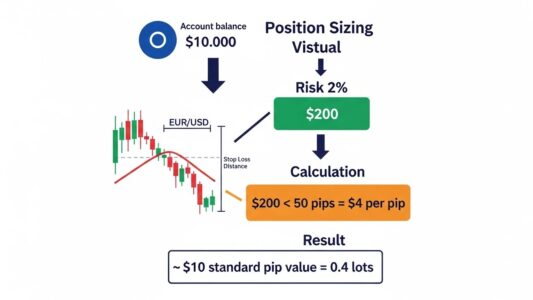
Professional traders typically risk 1-2% of their account balance per trade. Lot size must be calculated to maintain this risk level.
For a $10,000 account risking 2% ($200) with a 50-pip stop:
Required pip value: $200 ÷ 50 pips = $4 per pip
Position size: 4 mini lots (0.4 standard lots)
The National Futures Association emphasizes that proper position sizing relative to account size is critical for risk management and long-term trading success.
Overleveraging Through Lot Size
Many traders blow their accounts by trading lot sizes too large for their capital. Even with a broker offering high leverage, using excessive lot sizes creates unsustainable risk.
Danger Zone Example:
Account: $1,000
Position: 1 standard lot (100,000 units)
Pip value: $10
A 100-pip adverse move = $1,000 loss = Entire account gone
This represents 100% risk on a single trade—a recipe for failure even if the trader has a 70% win rate.
Safe Example:
Account: $1,000
Position: 1 micro lot (1,000 units)
Pip value: $0.10
A 100-pip adverse move = $10 loss = 1% of account
This keeps risk manageable and allows the trader to survive inevitable losing streaks.
Lot size and leverage work together to determine your margin requirements and account exposure.
How Leverage Affects Lot Size Trading
Leverage is expressed as a ratio (1:30, 1:50, 1:100) showing how much market exposure you can control relative to your capital. Higher leverage allows you to trade larger lot sizes with less margin.
Example: Trading 1 Standard Lot EUR/USD (100,000 units at 1.0850 = $108,500 notional value)
With 1:30 Leverage:
Required margin: $108,500 ÷ 30 = $3,617
With 1:50 Leverage:
Required margin: $108,500 ÷ 50 = $2,170
With 1:100 Leverage:
Required margin: $108,500 ÷ 100 = $1,085
Higher leverage reduces the capital you need to trade the same lot size, but it doesn’t reduce your risk. The $10 per pip exposure remains constant regardless of leverage.
The Leverage Trap
High leverage enables trading lot sizes disproportionate to your account size, creating dangerous situations:
Scenario: $1,000 account with 1:500 leverage
Maximum position: 5 standard lots (500,000 units)
Pip value: $50 per pip
A mere 20-pip adverse move = $1,000 loss = Account wiped out
Just because your broker allows this position doesn’t mean you should take it. Leverage is a tool that amplifies both gains and losses—use it carefully.
Choosing correctly based on what is a lot in forex and your account size is the foundation of sound risk management.
Selecting appropriate lot sizes based on your account balance and risk tolerance is crucial for long-term success.
Lot Size Guidelines by Account Balance
These are general recommendations assuming 1-2% risk per trade:
$100-$500 Accounts:
Primary lot size: Micro lots (1,000 units)
Pip value: $0.10
Typical position: 1-5 micro lots
Risk per trade: $1-$5
$500-$2,000 Accounts:
Primary lot size: Micro lots, transitioning to mini lots
Pip value: $0.10-$1
Typical position: 5-10 micro lots or 1-2 mini lots
Risk per trade: $5-$20
$2,000-$10,000 Accounts:
Primary lot size: Mini lots
Pip value: $1
Typical position: 2-10 mini lots
Risk per trade: $20-$100
$10,000+ Accounts:
Primary lot size: Mini lots or standard lots
Pip value: $1-$10
Typical position: 1-5 standard lots or equivalent in mini lots
Risk per trade: $100-$200
The Position Sizing Formula
To calculate appropriate lot size for any trade:
Step 1: Determine your dollar risk
Account balance × Risk percentage = Dollar risk
Example: $5,000 × 2% = $100
Step 2: Measure your stop loss distance in pips
Example: 50 pips
Step 3: Calculate required pip value
Dollar risk ÷ Stop loss pips = Required pip value
$100 ÷ 50 pips = $2 per pip
Step 4: Determine lot size
$2 per pip = 2 mini lots (0.2 standard lots)
This systematic approach ensures every trade risks the same percentage regardless of stop loss distance or currency pair.
The Financial Conduct Authority requires regulated brokers to provide risk warnings and position sizing tools to help traders manage their exposure appropriately.
Practicing with Different Lot Sizes
Before trading real money with various lot sizes, practice on a demo account to understand how different sizes affect your trading.
Demo Account Lot Size Practice
Set your demo account balance to match your planned real account size. If you’ll fund $2,000, practice with a $2,000 demo—not a $100,000 demo that creates unrealistic expectations.
Practice Exercise:
Week 1: Trade only micro lots (1,000 units)
Notice how slowly the balance moves
Observe that 100-pip winners generate small absolute profits
Experience minimal emotional pressure
Week 2: Trade only mini lots (10,000 units)
Notice increased balance fluctuations
Feel slightly more engagement with positions
Observe that losses become more meaningful
Week 3: Trade standard lots (100,000 units) if appropriate for account size
Experience significant balance swings
Feel heightened emotional responses
Understand why this requires larger accounts
This progression helps you find the lot size that provides meaningful exposure without excessive stress.
You take unnecessary risks because consequences seem minimal
The right lot size creates meaningful exposure while allowing you to follow your trading plan without excessive emotional interference.
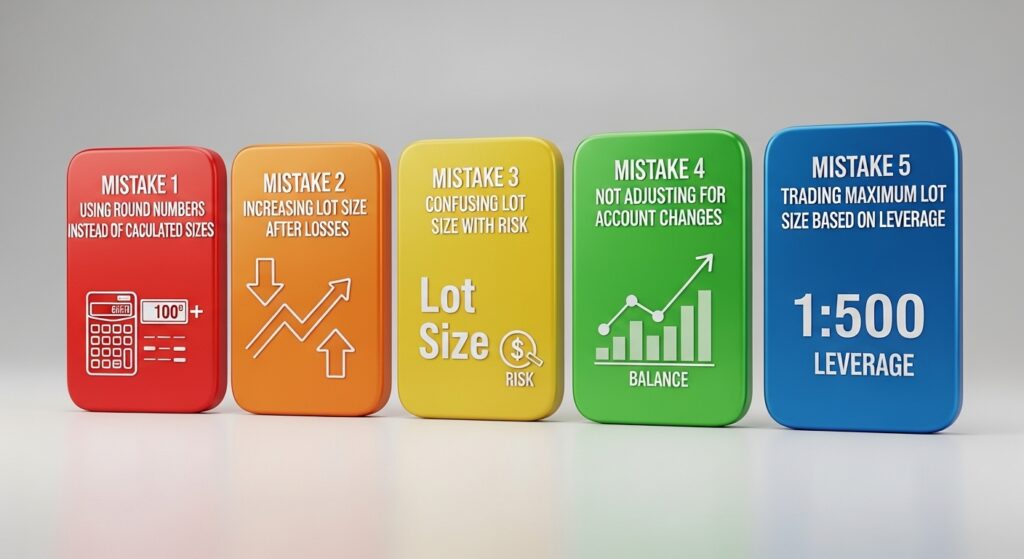
Common Lot Size Mistakes
Most beginner mistakes trace back to not fully understanding what is a lot in forex and how it relates to leverage.
Avoid these errors that undermine profitable trading:
Mistake 1: Using Round Numbers Instead of Calculated Sizes
Error: Always trading “1 standard lot” or “5 mini lots” regardless of stop loss distance or pair traded.
Why It’s Wrong: Different trades have different stop loss distances. Trading the same lot size means inconsistent risk—sometimes risking 1%, sometimes 5%.
Solution: Calculate required lot size for each trade based on your risk percentage and specific stop loss distance.
Mistake 2: Increasing Lot Size After Losses
Error: Losing trades trigger emotional responses leading traders to “double down” with larger positions to recover losses quickly.
Why It’s Wrong: This revenge trading or martingale approach accelerates losses and leads to account blow-ups.
Solution: Maintain consistent lot sizes based on your plan. Never increase size to chase losses.
Mistake 3: Confusing Lot Size with Risk
Error: Thinking “I’m trading small lots, so I have small risk” while using very tight stops that get hit frequently.
Why It’s Wrong: A micro lot with a 5-pip stop that fails repeatedly causes death by a thousand cuts. A standard lot with a proper 50-pip stop might represent better risk management.
Solution: Focus on total dollar risk per trade (lot size × pip value × stop distance), not just lot size alone.
Mistake 4: Not Adjusting for Account Changes
Error: Continuing to trade the same lot sizes as your account grows or shrinks.
Why It’s Wrong: As your account grows, your previous lot sizes become too conservative. As it shrinks (during drawdowns), your lot sizes become too aggressive.
Solution: Recalculate appropriate lot sizes monthly based on current account balance.
Mistake 5: Trading Maximum Lot Size Based on Leverage
Error: Using the maximum lot size your leverage allows rather than what your risk management dictates.
Why It’s Wrong: High leverage lets you trade lot sizes that can destroy your account with small adverse moves.
Solution: Ignore maximum available leverage. Calculate lot size based on your risk management rules (1-2% risk per trade).
Lot Size Across Different Currency Pairs
Pip values vary slightly across currency pairs, affecting lot size decisions.
USD as Quote Currency (Most Consistent)
EUR/USD, GBP/USD, AUD/USD, NZD/USD:
Standard lot: $10 per pip (always)
Mini lot: $1 per pip (always)
Micro lot: $0.10 per pip (always)
These pairs maintain constant pip values regardless of exchange rate, simplifying calculations.
USD as Base Currency (Variable Pip Value)
USD/JPY, USD/CHF, USD/CAD:
Pip value fluctuates with exchange rate
Standard lot USD/JPY at 149.50: ~$6.69 per pip
Standard lot USD/JPY at 160.00: ~$6.25 per pip
Calculate current pip value before entering trades in these pairs to ensure accurate risk assessment.
Cross Pairs (No USD)
EUR/GBP, EUR/JPY, GBP/JPY, AUD/NZD:
Pip values depend on both currencies and your account currency
More complex calculations required
Slightly less predictable pip values
Most trading platforms display current pip values for each pair, eliminating manual calculation needs.
Advanced Lot Size Techniques
Experienced traders use sophisticated lot size management:
Scaling In and Out
Rather than entering full position immediately, scale in with partial lots:
Enter 0.3 lots at initial signal
Add 0.3 lots if trade moves 20 pips in your favor
Add final 0.4 lots if trade moves 40 pips in your favor
This reduces risk if your timing is imperfect while still capturing large moves when correct.
Risk-Adjusted Lot Sizing by Pair
Some traders adjust lot sizes based on pair volatility:
Lower lot sizes on volatile pairs (GBP/JPY)
Standard lot sizes on moderate pairs (EUR/USD)
Slightly higher lot sizes on calm pairs (EUR/CHF)
This maintains consistent dollar risk despite different typical price movements across pairs.
Portfolio-Based Lot Sizing
When trading multiple pairs simultaneously, consider total exposure:
Three 0.3-lot positions = 0.9 lots total exposure
Ensure combined positions don’t exceed your total risk tolerance
Consider correlation between pairs when calculating total risk
Conclusion
Understanding what is a lot in forex is one of the most important concepts any trader needs to master before going live
Understanding lot sizes is fundamental to successful forex trading. A lot represents the standardized contract size—100,000 units for a standard lot, 10,000 units for a mini lot, and 1,000 units for a micro lot. The lot size you trade determines your pip value and directly affects your potential profits, losses, and risk exposure.
Choose your lot size based on your account balance, risk tolerance, and trading strategy—not on what your leverage allows or what seems exciting. Small accounts should trade micro lots, intermediate accounts should use mini lots, and only well-capitalized accounts should trade standard lots while maintaining proper risk management.
Calculate your lot size for each trade based on your risk percentage and stop loss distance rather than trading arbitrary round numbers. This ensures consistent risk across all trades regardless of stop loss placement or currency pair traded. Most successful traders risk only 1-2% of their account per trade, and lot size is the variable they adjust to maintain this consistent risk.
Practice with different lot sizes on a demo account to understand how each affects your emotional state and decision-making. The right lot size provides meaningful exposure without causing excessive stress or tempting you to deviate from your trading plan.
Remember that larger lot sizes aren’t better—they’re just larger. A micro lot trader with proper risk management will outperform a standard lot trader with poor risk management. Focus on consistent percentage returns and appropriate position sizing for your account, and let your lot size naturally increase as your account grows over time.