Automated Forex Trading transforms how traders approach forex markets by executing trades based on predefined rules without human intervention. Expert Advisors (EAs) run on trading platforms like MetaTrader 4 and MetaTrader 5, analyzing markets, identifying opportunities, and managing positions 24/7 with perfect discipline.
Understanding automated forex trading is essential for modern forex traders. Whether you want to automate your existing strategy, eliminate emotional trading decisions, or trade multiple pairs simultaneously, Expert Advisors provide systematic approaches that manual trading cannot match.
This comprehensive guide covers everything you need to master automated forex trading: what Expert Advisors are and how they work, the benefits and risks of automation, types of trading systems you can build, getting started with algorithmic trading, programming fundamentals in MQL4 and MQL5, building and optimizing your own EAs, testing strategies properly, and avoiding common automation mistakes.
What Is Automated Forex Trading?
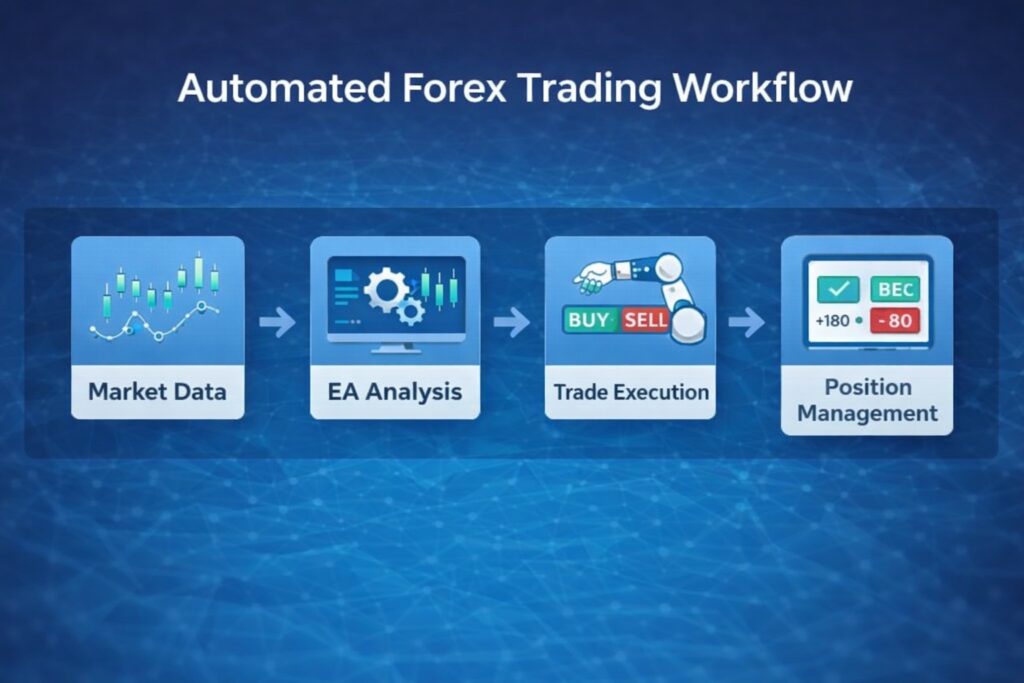
Automated forex trading uses computer programs (Expert Advisors) to execute trades based on predetermined criteria. These systems monitor price movements, analyze market conditions, identify trading opportunities, and execute orders without requiring trader intervention.
Expert Advisors operate on trading platforms—primarily MetaTrader 4 (MT4) and MetaTrader 5 (MT5)—reading price data, applying technical indicators, recognizing patterns, and managing open positions according to programmed rules.
Key Components of Automated Forex Trading:
Trading Logic: The strategy rules that determine when to enter and exit trades (crossover signals, support/resistance breaks, pattern recognition, etc.)
Risk Management: Position sizing, stop-loss placement, take-profit levels, maximum drawdown limits—all enforced automatically
Execution System: Order placement, modification, and closure mechanisms that interact with the broker’s trading server
Monitoring: Performance tracking, error handling, and system health checks that ensure the EA operates correctly
Unlike manual trading where emotions, fatigue, and human error affect decisions, automated systems execute strategies with perfect consistency and discipline.
Why Use Expert Advisors?
Eliminates Emotional Trading
Fear and greed destroy trading accounts. Expert Advisors follow rules without hesitation, never second-guessing entries or holding losing positions hoping they’ll recover. Emotional discipline becomes automatic.
24/7 Market Monitoring
Forex markets trade around the clock. EAs never sleep, monitoring all sessions and executing trades during Asian, European, or American hours without requiring your presence.
Perfect Execution Consistency
Manual traders apply strategies inconsistently—skipping trades when uncertain, adjusting stop-losses impulsively, taking profits too early. Expert Advisors execute every signal exactly as programmed, maintaining statistical edge.
Simultaneous Multi-Pair Trading
Managing multiple currency pairs manually is overwhelming. A single EA can monitor and trade 10+ pairs simultaneously, capturing opportunities across the entire forex market.
Backtesting Capability
Before risking real capital, test strategies on years of historical data. Identify what works, optimize parameters, and approach live trading with data-driven confidence rather than hope.
Speed and Efficiency
EAs analyze data and execute orders in milliseconds—critical for scalping strategies or trading breakouts where seconds matter.
Removes Fatigue Factor
Trading requires focus and energy. After hours watching charts, decision quality deteriorates. Expert Advisors maintain peak performance indefinitely without fatigue.
Types of Expert Advisors
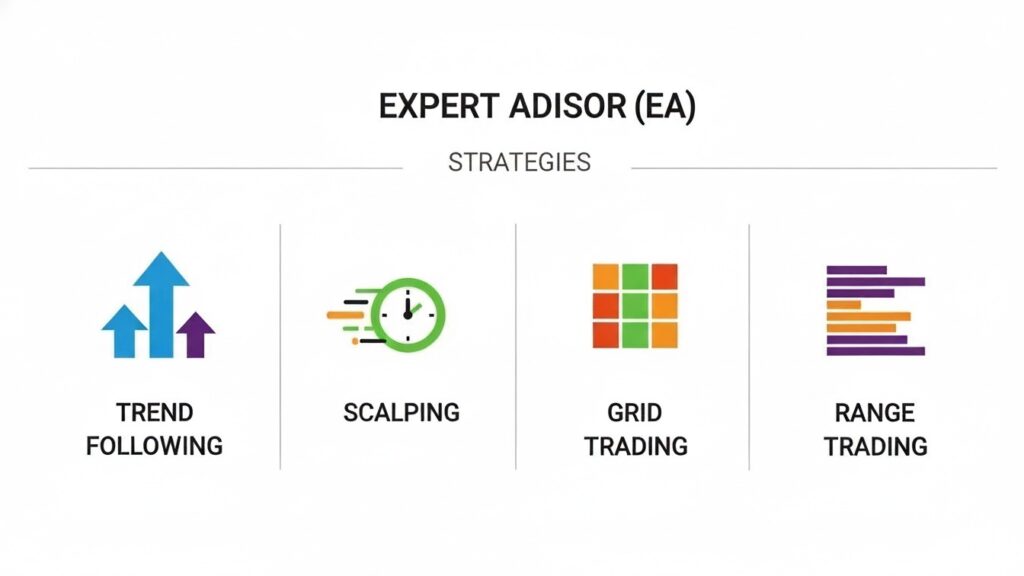
Different EA types serve different trading approaches and market conditions.
Trend Following EAs
Identify and trade with established market trends using indicators like moving averages, MACD, or ADX. These systems work excellently in trending markets but struggle during consolidation.
Best For: Swing trading, position trading, traders who want to ride major market moves
Range Trading EAs
Trade support and resistance bounces in consolidating markets. Buy at support, sell at resistance, profit from oscillation between boundaries.
Best For: Markets with clear ranges, sideways price action, mean reversion strategies
Breakout EAs
Identify consolidation patterns and trade the breakout in either direction. Capture explosive moves that follow tight consolidation periods.
Best For: Volatility traders, those seeking high reward-to-risk setups
Scalping EAs
Execute many small trades targeting 5-15 pips profit. High win rate but requires tight spreads and fast execution.
Best For: Active trading, multiple trades daily, traders with low-spread brokers
Grid and Martingale EAs
Place multiple orders at predetermined intervals. Grid systems establish positions above and below entry. Martingale doubles position size after losses.
Warning: Extremely risky. Can produce consistent profits then catastrophic losses. Requires enormous capital reserves.
News Trading EAs
React to economic data releases, capturing immediate volatility spikes. Require millisecond execution speeds and special broker conditions.
Best For: Experienced traders who understand event-driven volatility
Multi-Strategy EAs
Combine multiple approaches—trend following in trending markets, range trading in consolidation. Adapt to changing conditions automatically.
Best For: Traders seeking all-market-condition solutions
Getting Started with Automated Forex Trading
Step 1: Understand Algorithmic Trading Fundamentals
Before programming, master algorithmic trading concepts: what makes strategies profitable, how to translate manual trading rules into code, proper backtesting methodology, and realistic expectations.
Our Algorithmic Trading Basics Guide provides comprehensive introduction to these concepts.
Step 2: Choose Your Trading Platform
MetaTrader 4 (MT4): Most popular, extensive EA library, simpler programming language (MQL4), perfect for beginners
MetaTrader 5 (MT5): More advanced, faster backtesting, object-oriented programming (MQL5), better for complex systems
Start with MT4 unless you need MT5’s specific advantages. Most brokers support both platforms.
Step 3: Learn from Existing EAs
Before building your own, study how professional EAs work. Download free EAs from MQL4/MQL5 code bases, analyze their structure, understand their logic, and identify what makes them effective.
Step 4: Define Your Strategy Clearly
Successful automation requires crystal-clear strategy rules. Ambiguous criteria like “strong support” or “oversold conditions” need precise definitions. Define exact entry conditions, exit rules, position sizing, and risk parameters.
Step 5: Learn Programming Fundamentals
You don’t need to be a professional programmer, but understanding MQL4 or MQL5 basics is essential. Start with simple scripts, progress to indicators, then tackle Expert Advisors.
Step 6: Start Simple
Your first EA should implement basic strategy—perhaps a moving average crossover or RSI overbought/oversold system. Master simple automation before attempting complex multi-indicator systems.
Step 7: Test Thoroughly
Never deploy untested EAs on live accounts. Backtest on historical data, forward test on demo accounts for weeks, then start with small real money positions.
Programming Fundamentals
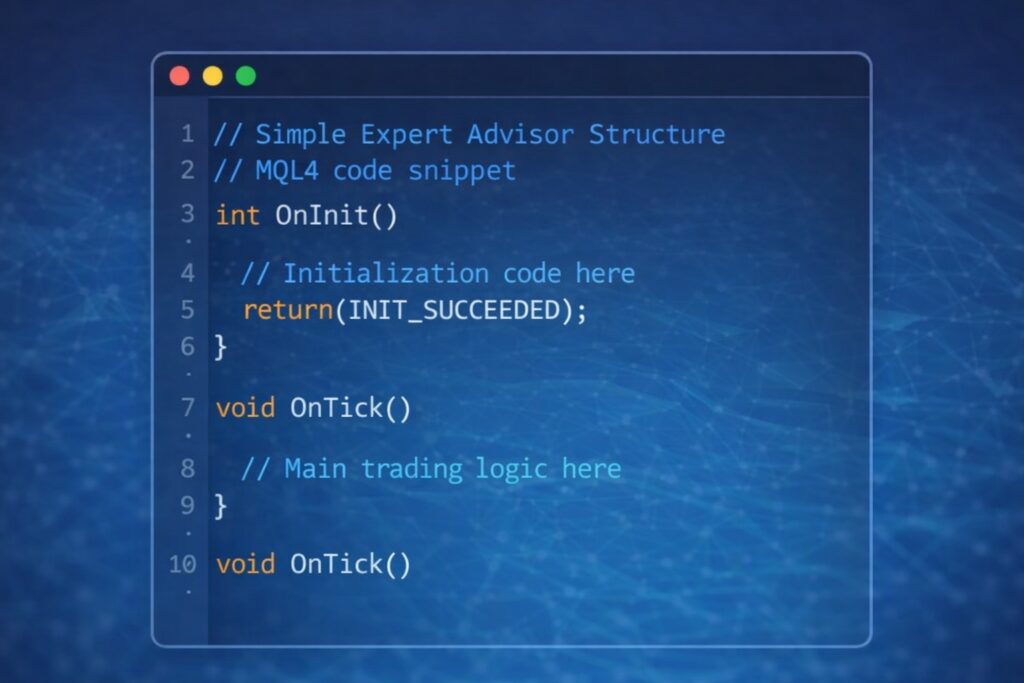
Understanding MQL4 and MQL5 programming languages is crucial for creating and customizing Expert Advisors.
MQL4 vs MQL5: Which to Learn?
MQL4 Advantages:
- Simpler syntax, easier learning curve
- Larger community and more resources
- More free EAs and indicators available
- Sufficient for most trading strategies
MQL5 Advantages:
- More powerful programming features
- Faster backtesting and optimization
- Object-oriented programming support
- Better for complex algorithmic systems
Recommendation: Start with MQL4 if you’re new to programming. Transition to MQL5 when you need advanced features.
Core Programming Concepts
Variables and Data Types: Store information (prices, indicator values, trade counts)
Conditional Statements: Execute code based on conditions (if price crosses MA, then buy)
Loops: Repeat actions (check all open positions, analyze multiple timeframes)
Functions: Reusable code blocks (calculate position size, check trading hours)
Event Handlers: Respond to market events (OnTick for every price change, OnTimer for scheduled actions)
Essential Programming Resources
Our detailed programming guides walk you through from absolute beginner to competent EA developer:
MQL4 Programming: Complete Beginner’s Guide – Start here if you’ve never programmed before. Learn MQL4 syntax, basic structures, and create your first simple EA.
MQL5 Programming Guide: From MQL4 to Advanced Automation – Comprehensive MQL5 tutorial covering object-oriented programming, advanced features, and migration from MQL4.
Building Effective Expert Advisors
Creating profitable EAs requires more than programming knowledge—you need systematic development methodology.
EA Development Process
1. Strategy Definition
Document exact entry and exit rules, risk parameters, position sizing logic, and expected performance metrics. Vague strategies produce vague results.
2. Code Structure Planning
Design your EA architecture before writing code. Plan initialization procedures, main trading logic flow, order management system, and error handling.
3. Implementation
Write code incrementally. Build basic framework first, add entry logic, implement exit rules, incorporate risk management, then add refinements.
4. Unit Testing
Test each component individually. Verify indicator calculations, check order placement logic, confirm risk management works correctly.
5. Integration Testing
Test the complete EA on demo accounts. Monitor for programming errors, logic flaws, or unexpected behavior.
6. Optimization
Use historical data to find optimal parameter settings. Balance curve-fitting risk against performance improvement.
7. Forward Testing
Run optimized EA on new data it hasn’t seen. This validates that optimization didn’t overfit historical patterns.
8. Live Deployment
Start with small position sizes on live accounts. Monitor closely for weeks before scaling up.
Key EA Components to Master
Order Management: Opening, modifying, and closing positions correctly. Handle order errors, retry failed orders, track position tickets.
Risk Management: Calculate position sizes based on account balance and risk percentage. Set appropriate stop-losses and take-profits.
Trade Filtering: Avoid trading during news, respect spread limits, honor maximum trades per day, check for conflicting signals.
Performance Tracking: Monitor win rate, average profit, drawdown, consecutive losses. Implement automatic shutdown if performance degrades.
Our Building Your First Expert Advisor: Step-by-Step Guide walks through creating a complete, functional EA from scratch with detailed code examples and explanations.
Testing and Optimization
Proper testing separates profitable EAs from account-destroying disasters.
Backtesting Methodology
Testing strategies on historical data reveals how they would have performed in the past. Quality backtesting requires understanding proper methodology.
Essential Backtesting Principles:
Use Quality Data: Tick data provides most accurate results. Minute data acceptable for longer timeframes. Never use insufficient data.
Test Sufficient Period: Minimum 5-10 years of data covering multiple market conditions—trends, ranges, high volatility, low volatility.
Model Realistic Conditions: Include spreads, commissions, slippage, execution delays. Unrealistic testing produces unrealistic expectations.
Avoid Curve Fitting: Don’t over-optimize parameters to fit historical data perfectly. Curve-fit strategies fail in live trading.
Validate Across Markets: Test on multiple currency pairs. Strategy should work on more than one pair.
Our How to Backtest Trading Strategies guide provides comprehensive backtesting methodology with practical examples.
Optimization Without Overfitting
Optimization finds best parameter values for your strategy. But over-optimization (curve fitting) creates systems that perform perfectly on historical data but fail in live trading.
Optimization Best Practices:
Limit Parameters: Fewer parameters reduce curve-fitting risk. Simple systems with 2-3 parameters are more robust than complex ones with 10+.
Use Walk-Forward Analysis: Optimize on one data period, test on the next. Repeat this process across entire dataset. Only parameters that work consistently across all periods are reliable.
Prioritize Consistency: Prefer steadily profitable parameters over those showing spectacular results in some periods and losses in others.
Forward Testing
After backtesting and optimization, run your EA on demo account using current market data. Forward testing validates that your system works on data it hasn’t seen during development.
Forward test minimum 1-3 months before live deployment. Monitor for programming errors, unexpected behavior, and performance consistency with backtest results.
Risk Management in Automated Forex Trading
EAs execute trades without emotional hesitation—which makes risk management absolutely critical.
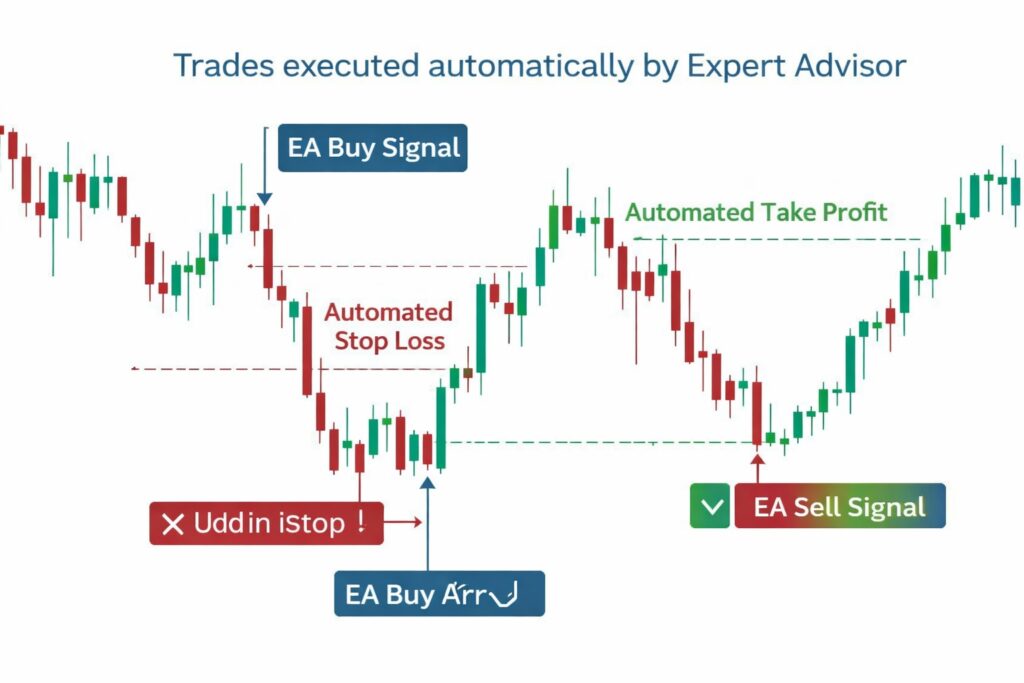
Position Sizing
Fixed Lot Size: Trade same size regardless of account balance. Simple but doesn’t scale with account growth.
Percentage Risk: Risk fixed percentage (1-2%) of account per trade. Position size adjusts automatically as account grows or shrinks.
Fixed Fractional: Trade constant percentage of account. Compounds gains aggressively but also compounds losses.
Volatility-Based: Adjust position size based on Average True Range. Smaller positions during high volatility, larger during low volatility.
Stop-Loss Implementation
Every EA trade must have stop-loss. Never rely on “mental stops” or manual intervention. Program automatic stop-loss placement based on:
- Fixed pip distance
- ATR multiples
- Support/resistance levels
- Percentage of account balance
Maximum Drawdown Limits
Implement automatic EA shutdown if drawdown exceeds predetermined threshold. For example, pause trading if account drops 15% from peak equity.
Daily/Weekly Trade Limits
Limit maximum trades per day or week. Prevents runaway losses during abnormal market conditions or EA malfunctions.
Maximum Spread Filters
Don’t trade when spreads widen excessively. Include spread checks before opening positions.
Common Automated Forex Trading Mistakes
Avoid these errors that destroy EA traders’ accounts.
Mistake 1: No Backtesting
Deploying untested EAs is gambling. Always backtest thoroughly before risking real money.
Mistake 2: Curve-Fitting
Over-optimizing creates perfect historical performance but terrible forward results. Keep systems simple and robust.
Mistake 3: Insufficient Forward Testing
Backtest success doesn’t guarantee live success. Forward test on demo accounts for weeks before going live.
Mistake 4: Ignoring Slippage and Spreads
Testing with zero spreads and instant fills creates unrealistic expectations. Model real trading conditions.
Mistake 5: Over-Leveraging
Automated forex trading doesn’t reduce risk. Don’t increase leverage just because the EA is “doing the work.”
Mistake 6: Poor VPS Setup
Running EAs on home computers risks power outages and internet disconnections. Use Virtual Private Server (VPS) for 24/7 reliability.
Mistake 7: No Monitoring
“Set and forget” fails. Monitor EA performance daily. Check for errors, unusual behavior, or changing market conditions.
Mistake 8: Trusting Vendor Claims
Commercial EAs showing spectacular results are often scams or over-optimized systems. Verify performance independently.
Mistake 9: Starting Too Large
Begin with minimum position sizes on live accounts. Scale up only after weeks of successful performance.
Mistake 10: No Kill Switch
Implement automatic shutdown if performance degrades, drawdown exceeds limits, or errors accumulate.
Complete Automated Trading Resource Library
Master every aspect of automated forex trading with these comprehensive guides:
Getting Started:
Automated Forex Trading: Complete Beginner’s Guide – Everything you need to understand before building or buying Expert Advisors: benefits, risks, realistic expectations, and how automated forex
trading works.
Algorithmic Trading Basics: Getting Started with Automated Strategies – Introduction to algorithmic trading concepts, strategy development, and transitioning from manual to automated forex trading.
Programming and Development:
MQL4 Programming: Your Complete Beginner’s Guide – Learn MQL4 from scratch: syntax, functions, indicators, and building your first simple Expert Advisor with detailed examples.
MQL5 Programming Guide: From MQL4 to Advanced Automation – Complete MQL5 tutorial covering object-oriented programming, advanced features, and migration from MQL4 for experienced developers.
Building Your First Expert Advisor: Step-by-Step Guide – Practical, hands-on tutorial creating a functional EA from concept to completion with full code examples and explanations.
Testing and Optimization:
How to Backtest Trading Strategies – Comprehensive backtesting methodology: using Strategy Tester, interpreting results, avoiding curve-fitting, and validating strategies properly.
Optimizing Expert Advisor Settings: Complete Guide – Advanced optimization techniques: walk-forward analysis, genetic algorithms, preventing overfitting, and finding robust parameters.
Expert Advisors & Trading Bots
- Expert Advisors: Complete Forex Guide – Understanding Expert Advisors, how they work, and their role in automated forex trading
- Types of Expert Advisors – Different categories of EAs including trend-following, scalping, grid trading, and hedging systems
- How to Choose a Forex Trading Bot – Essential criteria for selecting reliable automated forex trading bots
- Best Forex Trading Robots Review – Comprehensive reviews of popular forex robots
Trading Platforms & Setup
- MT4 Tutorial: Beginner’s Guide – Complete MetaTrader 4 tutorial covering installation, navigation, and using Expert Advisors
- MT5 Tutorial: Beginner’s Guide – MetaTrader 5 platform guide with advanced features
- Setting Up Automated Forex Trading – Step-by-step guide to configuring your first automated forex trading system
Advanced Automation Topics
- AI in Forex Trading Guide – How artificial intelligence transforms automated forex trading
- Copy Trading vs Expert Advisors – Comparing automated systems with social trading approaches
- VPS for Forex Trading Guide – Why you need a Virtual Private Server for 24/7 EA operation
Your Path to Automated Forex Trading Success
Automated forex trading offers compelling advantages: emotionless execution, 24/7 market monitoring, perfect consistency, and the ability to trade multiple pairs simultaneously. But success requires proper approach—learning programming fundamentals, building strategies systematically, testing thoroughly, and managing risk appropriately.
Start your automated forex trading journey by understanding the fundamentals. Read our Automated Forex Trading Guide and Algorithmic Trading Basics to build foundational knowledge.
Next, learn programming. Begin with MQL4 Programming Guide if you’re new to coding. Work through basic examples, understand syntax and structure, then progress to building simple indicators and scripts.
When ready to create your first EA, follow our Building Your First Expert Advisor tutorial step-by-step. Start with simple strategy—maybe a moving average crossover or RSI system. Master the basics before attempting complex multi-indicator systems.
Test your EA thoroughly using proper methodology from our Backtesting Guide. Then optimize carefully following principles in our Optimization Guide.
Finally, deploy on demo account for weeks of forward testing before risking real capital. Start small, monitor closely, and scale up only after proving consistent profitability.
Automated forex trading is powerful but not magic. It requires effort, learning, testing, and discipline. But for traders willing to invest time mastering these skills, Expert Advisors provide systematic approaches to forex trading that manual methods cannot match.
Begin your automated forex trading education today with our complete resource library above. Take it step-by-step, master each component, and build the skills that transform trading from emotional guesswork into systematic execution.
Traders using automated forex trading systems in the US should review algorithmic trading guidelines from the CFTC and NFA, while international traders can refer to the FCA. The official MQL4 documentation and MQL5 documentation at MetaQuotes are the authoritative references for EA development.