Gold trading is one of the most popular ways to diversify a forex portfolio. As a safe-haven asset with global demand, gold offers trading opportunities that behave differently from currency pairs — driven by inflation fears, geopolitical tensions, central bank policy, and shifts in the US dollar. This complete guide covers everything you need to know about gold trading, from understanding the XAU/USD pair to practical strategies and risk management.

What Is Gold Trading?
Gold trading means speculating on the price of gold without physically buying or storing it. In the forex and CFD markets, gold is traded as the symbol XAU/USD — the price of one troy ounce of gold measured in US dollars.
When you trade XAU/USD, you are taking a position on whether gold will rise or fall against the dollar. If you believe gold will increase in price, you buy (go long). If you expect a decline, you sell (go short).
Gold is not a currency pair in the traditional sense, but it trades on the same platforms and follows many of the same principles as forex trading. Most forex brokers offer XAU/USD alongside their standard currency pairs, making it accessible to anyone with a trading account.
According to the World Gold Council, gold trades an estimated $130 billion per day across global markets, making it one of the most liquid commodities available to retail traders.
Why Trade Gold?
Gold attracts traders for several reasons that set it apart from standard forex pairs:
Safe-haven demand. During times of geopolitical uncertainty, financial crises, or market panic, investors move money into gold. This creates strong directional moves that technical traders can exploit.
Inflation hedge. Gold tends to rise when inflation increases purchasing power of fiat currencies. Central bank policy decisions — particularly from the Federal Reserve — directly affect gold prices.
Dollar correlation. Gold has a well-established inverse relationship with the US dollar. When the dollar weakens, gold typically rises, and vice versa. This makes gold a useful hedge and a source of confirmation signals for USD trades.
High volatility. Gold regularly moves 15–25 USD per day, sometimes more during major events. This volatility creates opportunities for both day traders and swing traders.
24-hour trading. Like forex, gold trades around the clock during the business week, giving traders flexibility across different time zones.
Understanding the XAU/USD Chart
Gold is quoted in US dollars per troy ounce. If XAU/USD is trading at 2,350.00, one ounce of gold costs $2,350.
Pip value: For gold, a 1-pip movement equals $0.01 per contract. However, most brokers quote gold to two decimal places, and the typical lot size means each $1 move equals $100 per standard lot.
Spread: Gold typically has a wider spread than major currency pairs — usually $0.20–$0.50 during liquid hours, widening to $1.00 or more during low-liquidity periods.
Margin requirements: Gold requires higher margin than most currency pairs due to its price level. Check your broker’s margin requirements before sizing positions.
For accurate pip and position calculations, use our Pip Value Calculator and Position Size Calculator.
What Moves Gold Prices?
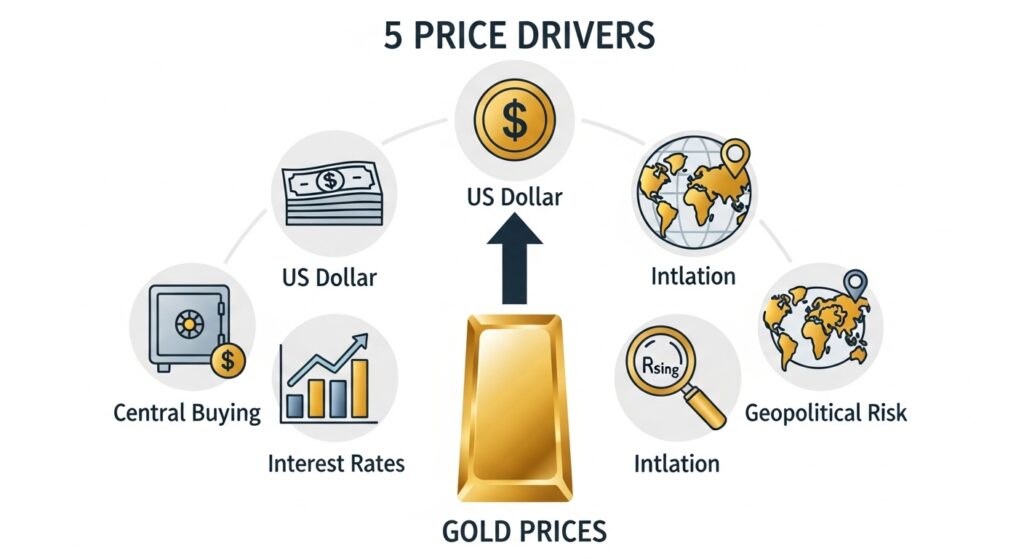
Understanding gold’s key drivers is essential before placing any trades.
US Dollar Strength
The most consistent driver of gold prices is the US dollar. Because gold is priced in dollars globally, a stronger dollar makes gold more expensive for international buyers, reducing demand and pushing the price down. A weaker dollar does the opposite.
Monitor the DXY (US Dollar Index) alongside your XAU/USD chart. When they diverge, it often signals a pending correction in one or the other.
Interest Rates and Federal Reserve Policy
Gold pays no interest or dividend. When interest rates rise, yield-bearing assets like bonds become more attractive compared to gold, putting downward pressure on price. When rates fall or the Fed signals a dovish pivot, gold tends to rally.
Fed meeting decisions and statements from the Federal Open Market Committee (FOMC) are among the highest-impact events for gold traders. Mark these on your calendar every session.
Inflation Data
Gold is historically viewed as a store of value against inflation. When CPI (Consumer Price Index) or PCE data comes in higher than expected, gold often spikes as traders anticipate currency debasement. Conversely, cooling inflation can reduce gold’s appeal.
Geopolitical Risk
Wars, sanctions, banking crises, and political instability drive safe-haven flows into gold. These moves can be sharp and fast. During major geopolitical events, gold can move $50–$100 in a single session.
Central Bank Buying
According to the World Gold Council, central banks globally have been net buyers of gold for over a decade. Large purchases by central banks in China, Russia, India, and other nations provide structural support for gold prices over the long term.
Supply and Demand
Global mine production and recycled gold supply affect the long-term price, though these factors move slowly. More relevant to short-term traders are positioning data from the CFTC’s Commitment of Traders (COT) report, which shows how large speculators are positioned in gold futures.
Gold Trading Strategies
1. Trend Following on the Daily Chart
Gold trends well on higher timeframes. The daily chart often shows clear multi-week or multi-month trends driven by macro factors like interest rate expectations.
Setup:
- Identify the prevailing trend using the 50-day and 200-day moving averages
- Look for pullbacks to the 50-day MA during uptrends
- Enter on a bullish rejection candle at the MA with a stop below the swing low
- Target the previous high or a 2:1 risk-reward ratio
This strategy works best when aligned with a clear macro narrative — for example, a Fed rate-cut cycle typically supports a gold uptrend.
2. Support and Resistance Breakout
Gold respects key round numbers and historical levels exceptionally well. Major levels like $2,000, $2,100, $2,200, and $2,500 act as strong support and resistance zones.
Setup:
- Mark key round numbers and previous swing highs/lows on the daily chart
- Wait for a clean break and close above resistance on the 4-hour chart
- Enter on the retest of the broken level from above
- Stop below the retest candle low
- Target the next major level
3. Correlation Trade with the Dollar
When strong USD-driving data (NFP, CPI, Fed decision) is released, gold typically moves sharply in the opposite direction.
Setup:
- Identify a high-impact USD event on the economic calendar
- Wait 5–10 minutes after the release for the initial spike to settle
- Trade gold in the direction opposite to the dollar’s confirmed move
- Use tight stops as volatility is elevated
This is an advanced strategy. Review our Forex Risk Management guide before trading news events.
4. Asian Session Range Play
Gold often consolidates during the Asian session (10 PM–7 AM GMT) before making a directional move at the London open.
Setup:
- Identify the high and low of the Asian session range
- Wait for a break at the London open (7 AM–8 AM GMT)
- Enter on the breakout candle close
- Stop inside the range (5–8 USD)
- Target 15–20 USD
Risk Management for Gold Traders
Gold’s higher price level and wider spreads require adjusted risk management compared to standard forex pairs.
Position sizing. Because gold moves in dollars rather than pips in the traditional sense, use our Position Size Calculator to calculate your lot size based on your account size, risk percentage, and stop loss distance in dollars.
Stop loss placement. Gold can spike aggressively on news. Place stops at logical technical levels — beyond swing highs/lows or key support/resistance — not at arbitrary dollar distances. Minimum 15–20 USD stop during volatile sessions.
Risk per trade. Never risk more than 1–2% of account equity on any single gold trade. Gold’s volatility means positions can move against you quickly.
Spread awareness. The wider spread on gold compared to EUR/USD means your breakeven point is higher. Factor the spread into your target calculation.
The Commodity Futures Trading Commission (CFTC) and the National Futures Association (NFA) regulate gold CFD brokers in the US. Always trade with a regulated broker. In the UK, the Financial Conduct Authority (FCA) provides equivalent oversight.
Best Times to Trade Gold
Like forex pairs, gold has periods of higher and lower liquidity throughout the day.
London session (7 AM–4 PM GMT): Gold becomes more active as European traders enter. Often produces the first directional move of the day.
New York session (1 PM–10 PM GMT): The overlap between London and New York (1 PM–4 PM GMT) is the most liquid period for gold, with the tightest spreads and strongest volume. Major US economic releases during this window create the biggest price moves.
Asian session (10 PM–7 AM GMT): Generally quiet for gold. Useful for identifying range boundaries ahead of London but not ideal for directional trading.
Avoid: Thin liquidity periods like late Friday afternoon, public holidays in major financial centers, and the minutes immediately surrounding high-impact news releases unless you are specifically trading the event.
Choosing a Broker for Gold Trading
Not all brokers offer competitive gold trading conditions. Look for:
- Tight spreads — under $0.50 during London/New York overlap
- No dealing desk execution — ECN or STP for fair pricing
- Regulation — CFTC/NFA (US), FCA (UK), or ASIC (Australia)
- Competitive margin — check leverage offered on XAU/USD
- MT4 or MT5 support — standard platforms for gold charting and execution
See our How to Choose a Forex Broker guide for a full evaluation framework.
Gold vs. Silver Trading
Gold and silver are closely correlated precious metals, but silver is more volatile and more sensitive to industrial demand. The gold-to-silver ratio (how many ounces of silver equal one ounce of gold) is a useful tool for identifying relative value between the two metals.
For traders interested in silver, see our Silver Trading guide.
Common Gold Trading Mistakes
Trading against the macro trend. Gold moves with macro forces. Shorting gold during a Fed rate-cut cycle or buying during aggressive rate hikes fights structural momentum and reduces win rates dramatically.
Ignoring the dollar. Failing to monitor DXY while trading XAU/USD means missing the primary driver of gold’s price. Always have both on your screen.
Undersizing stops. Gold’s volatility punishes tight stops. Stops placed too close get taken out by normal market noise before the trade has a chance to develop.
Overtrading during news. Spreads widen significantly around high-impact events. Many retail traders lose on gold trades simply because the spread expansion negates their profit before price moves in their direction.
Ignoring session timing. Trading gold during the Asian session on a breakout strategy that requires London/New York volume leads to false signals and poor fills.
Next Steps
Build your gold trading knowledge with these related guides:
- Technical Analysis in Forex: Complete Guide
- Forex Risk Management: Complete Guide
- Silver Trading: Complete Guide
- How to Choose a Forex Broker
- Forex Trading Strategies: Complete Guide
- Forex Education Hub
Legal Disclaimer: Gold trading involves substantial risk of loss and is not suitable for all investors. The information in this article is for educational purposes only and does not constitute investment advice. Past performance is not indicative of future results.