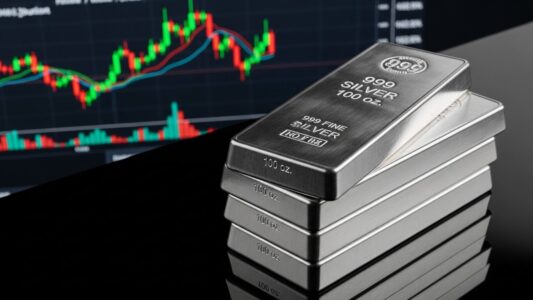
Silver trading offers forex and CFD traders one of the most dynamic and potentially rewarding commodity markets available. Traded as XAG/USD — the price of one troy ounce of silver in US dollars — silver combines the safe-haven characteristics of gold with powerful industrial demand drivers, creating a market that moves faster and further than gold on a percentage basis. This complete guide covers everything you need to know about silver trading, from understanding the XAG/USD pair to proven strategies, risk management, and the key differences between silver and gold as trading instruments.
What Is Silver Trading?
Silver trading means speculating on the price of silver without physically owning it. In the forex and CFD markets, silver trades as XAG/USD — XAG being the internationally recognized symbol for silver (from the Latin argentum).
Like gold trading, you take a position on whether silver will rise or fall against the US dollar. Buy (go long) if you expect silver to increase in price. Sell (go short) if you expect a decline.
Silver trades on the same platforms as forex pairs and gold, making it accessible to any trader with a standard forex or CFD account. Most brokers offer XAG/USD alongside XAU/USD and major currency pairs.
According to the Silver Institute, global silver demand reached over one billion ounces in recent years, driven by both investment demand and industrial consumption — making it one of the most actively traded commodities globally.
Silver vs. Gold: Key Differences for Traders
Understanding how silver differs from gold is essential before placing your first trade.
Higher volatility. Silver regularly moves 2–4% in a single day compared to gold’s 0.5–1.5%. This creates larger profit opportunities but also larger losses if risk management is not disciplined.
Lower price, larger percentage moves. At $25–35 per ounce versus gold’s $2,000+, silver’s lower price means the same dollar move represents a much larger percentage change. A $1 move in silver is 3–4% versus 0.05% for gold.
Industrial demand driver. Approximately 50% of silver demand comes from industrial applications — electronics, solar panels, medical devices. This means silver responds to economic growth cycles in ways gold does not. Silver tends to underperform gold during recessions and outperform during economic expansions.
Gold-silver ratio. The ratio of gold’s price to silver’s price (currently 70–90:1 historically) is a key tool for silver traders. When the ratio is high, silver is cheap relative to gold and often poised to outperform. When the ratio compresses, silver has run faster than gold.
Less liquidity than gold. Silver’s market is smaller than gold’s, meaning spreads are wider and large positions can move the market more easily during thin periods.
What Moves Silver Prices?
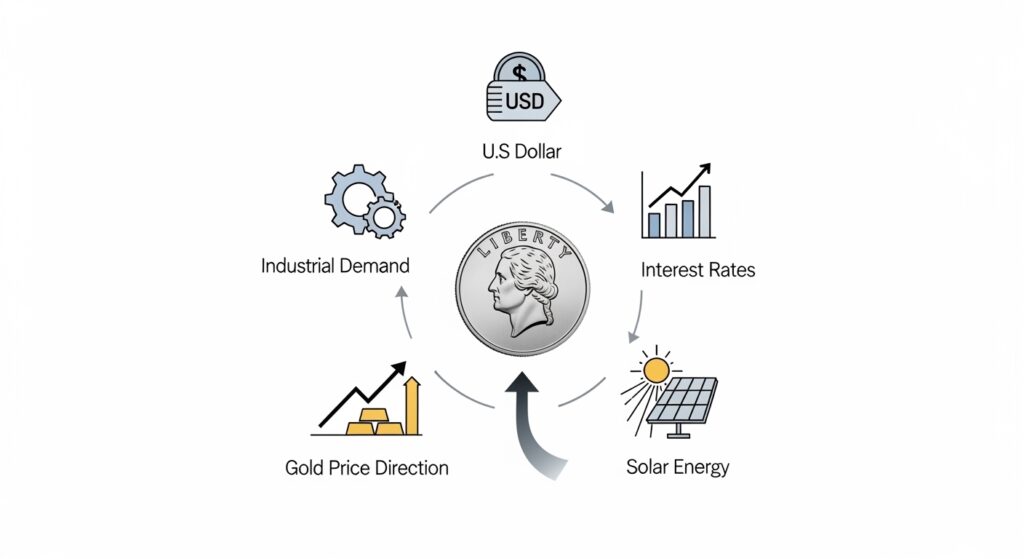
US Dollar Strength
Like gold, silver is priced in US dollars globally. A stronger dollar makes silver more expensive for international buyers, reducing demand and pushing prices lower. A weaker dollar supports silver prices. Monitor the DXY (US Dollar Index) alongside your XAG/USD chart at all times.
Industrial Demand and Economic Data
Unlike gold, silver has a strong economic cycle component. When manufacturing PMI data, industrial production figures, and GDP growth are strong, silver demand increases and prices tend to rise. When economic data weakens, silver can fall sharply even if gold holds steady.
Key economic releases to watch: US ISM Manufacturing PMI, China manufacturing data (China is the world’s largest silver consumer), global GDP growth figures.
Federal Reserve Policy and Interest Rates
Like all precious metals, silver is sensitive to Federal Reserve decisions. According to the Federal Reserve, rate hikes strengthen the dollar and reduce the appeal of non-yielding assets like silver. Rate cuts or dovish signals support silver prices. FOMC meeting decisions are among the highest-impact events for silver traders.
Solar Energy Demand
Silver is a critical component in photovoltaic solar panels, with each panel containing approximately 20 grams of silver. The global solar energy expansion creates structural demand growth for silver that supports prices over the medium to long term. Monitor solar installation data and government renewable energy policies as leading indicators.
Gold Price Direction
Silver rarely moves independently of gold. When gold rises, silver typically follows — often with larger percentage moves. When gold sells off, silver usually falls harder. Many traders use gold’s direction as a leading indicator for silver entries and exits.
Inflation and Safe-Haven Demand
Like gold, silver benefits from inflation fears and periods of market stress. However, silver’s safe-haven demand is less consistent than gold’s — during severe market crashes, silver sometimes sells off alongside risk assets before recovering as a safe haven.
Supply Constraints
According to the Silver Institute, approximately 70% of silver is mined as a byproduct of copper, zinc, and gold mining. This means silver supply is not responsive to silver price alone — when base metal mining slows, silver supply can tighten regardless of silver’s price, creating potential supply squeezes.
Reading the XAG/USD Chart
Silver is quoted in US dollars per troy ounce. If XAG/USD is trading at 30.00, one ounce of silver costs $30.
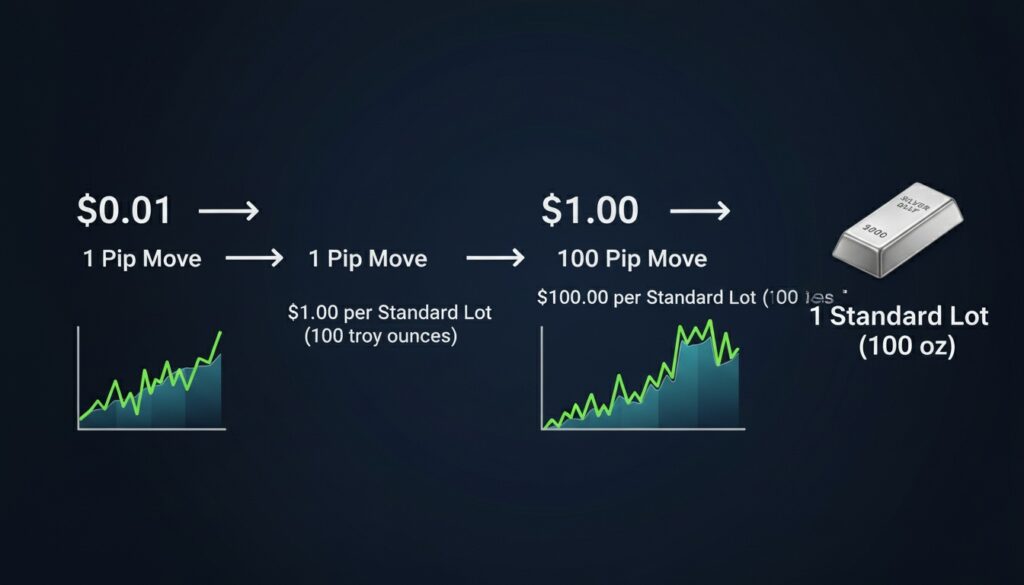
Pip value: For silver, each $0.01 move equals $1 per standard lot (100 troy ounces). A $1 move in silver equals $100 per standard lot.
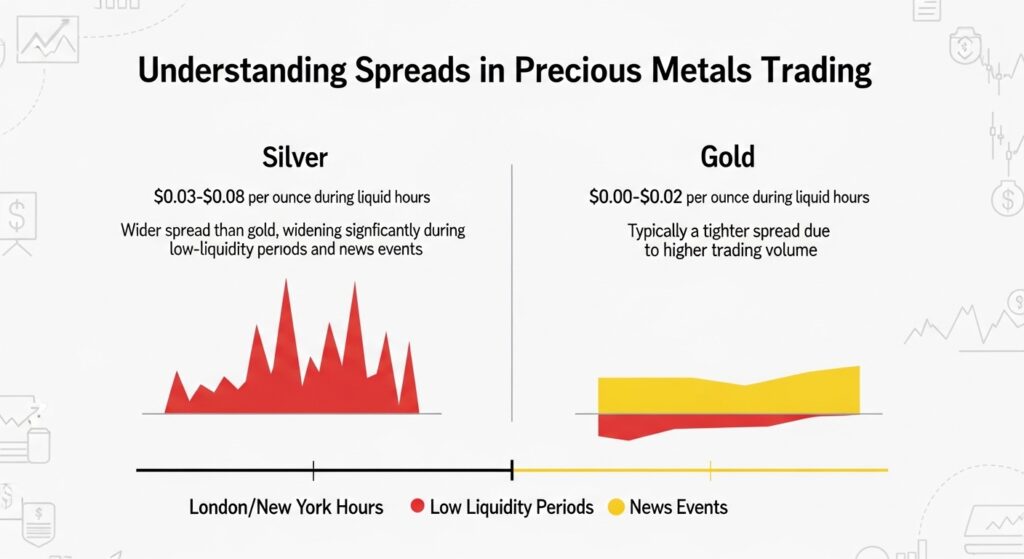
Spread: Silver typically has a wider spread than gold — usually $0.03–$0.08 per ounce during liquid London/New York hours, widening significantly during low-liquidity periods and news events.
Volatility: Silver’s daily range is typically 2–5x larger than gold’s on a percentage basis. Average True Range (ATR) on the daily chart is usually $0.50–$1.50 per ounce.
Margin: Silver requires less absolute margin than gold due to its lower price, but its higher percentage volatility means risk management is equally critical.
Use our Position Size Calculator and Pip Value Calculator to calculate accurate position sizes for silver trades.
Silver Trading Strategies
1. Gold-Silver Ratio Trade
The most distinctively silver strategy uses the gold-silver ratio as a directional signal.
Setup:
- Calculate the ratio: Gold price ÷ Silver price
- When ratio exceeds 85–90: Silver is historically cheap relative to gold → look for long silver setups
- When ratio falls below 60: Silver has outperformed significantly → consider reducing long exposure
- Combine with technical confirmation on the XAG/USD daily chart before entering
This strategy works best as a medium-term trade held over days to weeks rather than intraday.
2. Trend Following with Moving Averages
Silver trends strongly during bull and bear cycles driven by macro factors.
Setup:
- Use the 20-day and 50-day EMAs on the daily chart to identify trend direction
- In uptrend (price above both EMAs): Look for pullbacks to the 20 EMA on the 4-hour chart
- Enter on a bullish rejection candle at the 20 EMA
- Stop: 15–20 cents below the rejection candle low
- Target: Previous swing high or 2:1 risk-reward
Avoid this strategy during choppy, sideways markets — silver can whipsaw aggressively between support and resistance during consolidation phases.
3. Breakout from Key Levels
Silver respects major round numbers and previous swing highs/lows extremely well.
Setup:
- Identify major resistance levels on the daily chart (e.g., $30, $32, $35)
- Wait for a clean daily close above resistance
- Enter on the retest of the broken level on the 4-hour chart
- Stop: $0.30–$0.50 below the retest low
- Target: Next major level ($2–5 away depending on market conditions)
Major silver breakouts — especially above multi-year resistance levels — can produce 20–30% moves. Be patient and wait for confirmed closes above key levels before entering.
4. Economic Data Plays
Silver’s industrial demand component means it reacts strongly to economic data surprises.
Setup:
- Identify high-impact economic releases: US ISM Manufacturing, China PMI, NFP, Fed decisions
- Wait 5–10 minutes after release for initial volatility to settle
- Strong economic data → potential long silver (increased industrial demand expectation)
- Weak economic data → potential short silver (reduced industrial demand)
- Combine with dollar direction for confirmation
This is an advanced strategy requiring fast execution and strict risk management. Review our Forex Risk Management guide before attempting.
5. Silver-Gold Divergence Trade
When gold and silver diverge in direction, they typically realign within hours to days.
Setup:
- Monitor both XAU/USD and XAG/USD simultaneously
- When gold rises but silver lags significantly → look for long silver entry
- When gold falls but silver holds up unusually well → look for short silver entry
- Enter in the direction of the expected realignment
- Stop: Beyond the recent swing high/low of the lagging metal
- Target: Realignment with gold’s move
Risk Management for Silver Traders
Silver’s higher volatility compared to gold and currency pairs demands careful risk management.
Never risk more than 1% per trade. Silver’s volatility means a 2% account risk can wipe out a significant portion of your account during a sudden spike. Keep risk per trade at 1% maximum.
Use wider stops than you think necessary. Silver’s intraday volatility regularly creates $0.50–$1.00 spikes that reverse quickly. Stops placed too close get triggered by noise before the trade develops. Minimum $0.30–$0.50 stop distance during normal conditions; $0.50–$1.00 during high-volatility sessions.
Position sizing. Use our Position Size Calculator for every silver trade. The formula: Risk Amount ÷ (Stop Distance × $1 per cent) = Lot size.
Beware of news spikes. Silver can move $1–3 in seconds during major economic releases or geopolitical events. Either step aside during high-impact news or significantly reduce position size.
Monitor spread costs. Silver’s wider spread compared to currency pairs means your break-even point is higher. Always factor spread into your target calculations.
The Commodity Futures Trading Commission (CFTC) and National Futures Association (NFA) regulate silver CFD brokers in the US. Always trade with a regulated broker. In the UK the Financial Conduct Authority (FCA) provides equivalent oversight.
Best Times to Trade Silver
London session (7 AM–4 PM GMT): Silver becomes active as European traders enter. Often produces the day’s first directional move, particularly on economic data days.
London/New York overlap (1 PM–5 PM GMT): The highest liquidity period for silver, with the tightest spreads and strongest volume. Major US data releases during this window produce the largest silver price moves.
Asian session (10 PM–7 AM GMT): Silver can be active during the Asian session due to China’s importance as the world’s largest silver consumer. Watch for Chinese economic data releases during this session.
Avoid: Late Friday afternoons, major holidays in the US, UK, or China, and the immediate period around high-impact news unless you are specifically trading the event.
Silver vs. Gold: Which Should You Trade?
Both offer excellent trading opportunities but suit different trader profiles.
Trade silver if:
- You prefer larger percentage moves and accept higher volatility
- You want to trade macro economic cycles (industrial demand)
- You’re comfortable with wider stops and larger intraday ranges
- You’re looking for bigger potential gains (and are prepared for bigger losses)
Trade gold if:
- You prefer smoother, more predictable price action
- You want tighter spreads and deeper liquidity
- You’re primarily trading safe-haven and dollar correlation themes
- You’re newer to commodity trading
Many experienced traders trade both, using gold for more reliable technical setups and silver for higher-conviction macro trades where they want more leverage on the move.
For more on gold trading see our Gold Trading guide.
Choosing a Broker for Silver Trading
Look for these features when selecting a broker for XAG/USD trading:
- Tight spreads — under $0.05 per ounce during London/New York overlap
- ECN or STP execution — no dealing desk intervention
- Regulation — CFTC/NFA (US), FCA (UK), or ASIC (Australia)
- MT4 or MT5 — standard platforms with full charting capability
- No restrictions on silver trading — confirm broker allows commodity CFD trading
See our How to Choose a Forex Broker guide for a complete evaluation framework.
Common Silver Trading Mistakes
Underestimating volatility. Traders coming from currency pairs are often caught off guard by silver’s speed and range. Positions that seem reasonably sized in forex terms can produce outsized losses in silver.
Trading against the gold trend. Silver almost never sustains a move that contradicts gold’s direction. If gold is trending down, silver longs are low-probability trades regardless of silver’s technical setup.
Ignoring industrial demand signals. Trading silver purely as a precious metal without watching economic data and manufacturing output misses a significant driver. Weak global manufacturing data is a genuine headwind for silver.
Stops too tight. Silver’s intraday noise regularly reaches $0.50–$1.00 during active sessions. Stops placed $0.10–$0.20 from entry in silver will be triggered by random volatility constantly.
Overtrading during low-liquidity. During the Asian session or around market holidays, silver spreads widen significantly and false breakouts are common. Stick to London/New York overlap for most trading activity.
Next Steps
Build your silver trading knowledge with these related guides:
- Gold Trading: Complete Guide to Trading XAU/USD
- Technical Analysis in Forex: Complete Guide
- Forex Risk Management: Complete Guide
- How to Choose a Forex Broker
- Forex Trading Strategies: Complete Guide
- Forex Education Hub
Legal Disclaimer: Silver trading involves substantial risk of loss and is not suitable for all investors. The information in this article is for educational purposes only and does not constitute investment advice. Past performance is not indicative of future results.