Learn How to Make Fast Money by Learning diffrent Strategies in Forex Trading and Different Investment Options
How to Choose a Forex Broker: Complete Guide
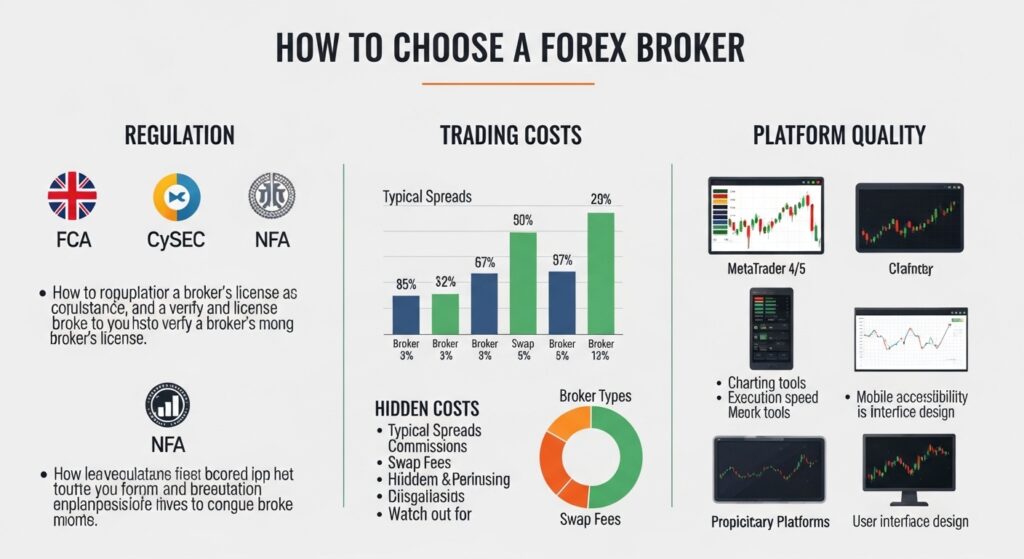
With thousands of forex brokers operating globally, how do you identify which one deserves your trust and your capital? How to choose a forex broker guide walks you through every essential factor to consider when choosing a forex broker.
Monetary Authority of Singapore (MAS) – https://www.mas.gov.sg
Each regulatory body maintains different standards, with jurisdictions like the US, UK, and Switzerland typically offering the strongest oversight and client protections.
What Regulation Provides
Regulated brokers must meet specific requirements:
Capital adequacy – Maintaining minimum capital reserves
Segregated accounts – Keeping client funds separate from operational funds
Regular audits – Submitting to independent financial reviews
Compensation schemes – Participating in investor protection funds
Transparent reporting – Disclosing financial information
Verification Steps
Don’t simply trust a broker’s claim to be regulated:
Check the regulator’s website – Most regulators maintain searchable databases of licensed firms
Verify the license number – Match the broker’s stated registration number with regulatory records
Review disciplinary history – Check for past violations or sanctions
Confirm the regulated entity – Ensure you’ll be trading through the regulated company, not an offshore affiliate
Evaluate Trading Costs
Trading costs directly impact your profitability. Two traders using identical strategies can achieve dramatically different results based solely on their broker’s cost structure.
Spread vs Commission Models
Brokers use two primary pricing structures:
Spread-Based Pricing
No separate commission charged
Broker’s compensation built into wider spreads
Simpler fee structure
Typically costs more for active traders
Commission-Based Pricing
Tighter spreads offered
Separate per-trade commission charged
More transparent pricing
Usually more cost-effective for frequent trading
Hidden Fees to Watch For
Beyond spreads and commissions, brokers may charge:
Deposit and withdrawal fees – Costs for moving money in and out
Inactivity fees – Monthly charges if you don’t trade
Currency conversion fees – Charges for non-base currency transactions
Premium data fees – Extra costs for advanced charts or data
Guaranteed stop fees – Charges for guaranteed stop-loss orders
Cost Comparison Strategy
To accurately compare broker costs:
Identify your typical trade size – Calculate based on your account size and risk management
Estimate your trading frequency – Determine how many trades you’ll place monthly
Calculate total monthly costs – Include all applicable fees
Compare across multiple brokers – Look at your total cost, not just advertised spreads
For example, a broker advertising 0.5 pip spreads with a $7 commission may actually cost less than a broker offering 1.2 pip spreads with no commission, depending on your position sizes.
Assess Platform Quality
Your trading platform is your primary tool. Platform quality affects your ability to analyze markets, execute trades, and manage positions effectively.
Platform Features That Matter
Essential platform capabilities include:
Charting and Analysis
Multiple timeframes
Drawing tools and indicators
Customizable chart layouts
Economic calendar integration
Order Management
One-click trading
Multiple order types
Stop-loss and take-profit settings
Position modification capabilities
Usability
Intuitive interface design
Quick order execution
Stable performance
Mobile platform availability
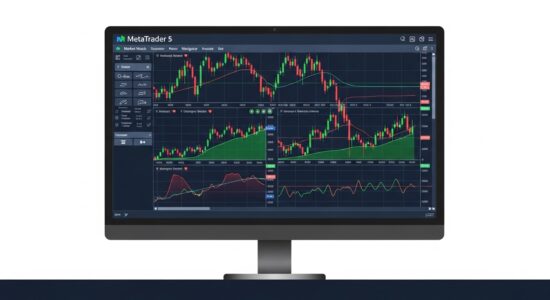
MetaTrader 4 and MetaTrader 5
Most forex brokers offer MetaTrader platforms, the industry standards for retail forex trading.
MetaTrader 4 (MT4)
Established and reliable
Huge library of indicators and expert advisors
Smaller file size and resource requirements
Limited to forex and CFD trading
MetaTrader 5 (MT5)
More advanced charting tools
Additional timeframes
More order types available
Supports stocks and futures
Proprietary Platforms
Some brokers develop their own trading platforms. Proprietary platforms can offer unique advantages but require evaluation:
Are they available across devices? – Desktop, web, and mobile versions
Do they offer adequate charting? – Professional-grade analysis tools
Is historical performance data available? – Verifying platform stability
Can you test before committing? – Demo account availability
Demo Testing
Always test a broker’s platform with a demo account before depositing real money:
Open a demo account – Most brokers provide free demos
Trade your actual strategy – Use the timeframes and methods you’ll use live
Test order execution – Place trades during high-volatility periods
Evaluate stability – Check for disconnections or freezing
Try mobile versions – Test any mobile apps you’ll use
Review Execution Quality
Execution quality determines whether your trades fill at your intended prices or suffer from slippage and rejections.
Understanding Execution Models
Brokers operate using different execution models:
Market Maker (Dealing Desk)
Broker takes the opposite side of your trades
May result in conflicts of interest
Fixed spreads typically offered
Instant execution at quoted prices
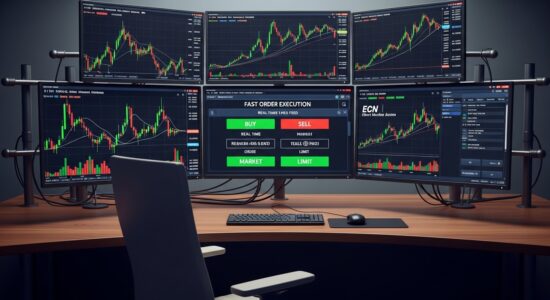
Electronic Communication Network (ECN)
Your orders matched with other participants
Variable spreads based on market liquidity
No conflict of interest
Direct market access
Straight Through Processing (STP)
Orders passed to liquidity providers
Variable spreads
No dealing desk intervention
Fast execution speeds
Execution Speed
Fast execution becomes critical during volatile markets when prices change rapidly:
Order-to-execution time – Milliseconds matter during news releases
Slippage frequency – How often trades fill away from your requested price
Requote occurrences – How frequently the broker rejects your price and offers a different one
Testing Execution Quality
Assess execution during your demo testing:
Place trades during news events – High volatility tests execution quality
Monitor fill prices – Compare your requested price with your actual fill
Track order rejections – Note how often orders are rejected or requoted
Test during different sessions – Execution quality may vary by time of day
Consider Available Instruments
While all forex brokers offer currency pairs, the range and diversity of available instruments varies significantly.
Currency Pair Selection
Verify the broker offers the pairs you want to trade:
Major Pairs
EUR/USD, GBP/USD, USD/JPY, USD/CHF
Tightest spreads and highest liquidity
Minor Pairs
EUR/GBP, EUR/AUD, GBP/JPY
Slightly wider spreads than majors
Exotic Pairs
USD/TRY, EUR/MXN, USD/ZAR
Wider spreads and lower liquidity
Additional Instruments
Many forex brokers offer trading beyond currencies:
Indices – S&P 500, FTSE 100, DAX
Commodities – Gold, silver, oil
Cryptocurrencies – Bitcoin, Ethereum
Individual stocks – Company shares as CFDs
Trading multiple instrument types through one broker can simplify account management and potentially reduce costs.
Evaluate Leverage Options
Leverage allows you to control larger positions with less capital, but it amplifies both gains and losses.
Leverage Regulations
Maximum leverage varies by jurisdiction:
United States – 50:1 for major pairs, 20:1 for minors
European Union – 30:1 for major pairs, 20:1 for minors
Australia – 30:1 for major pairs
Offshore jurisdictions – Often 500:1 or higher
Higher leverage isn’t necessarily better. Excessive leverage is a primary cause of trading account losses.
Choosing Appropriate Leverage
Your optimal leverage depends on:
Your trading strategy – Scalpers may use higher leverage than swing traders
Your risk management – Lower leverage reduces risk on each trade
Your experience level – Beginners should use conservative leverage
Most professional traders use leverage far below their broker’s maximum offering.
Examine Deposit and Withdrawal Processes
Easy account funding and withdrawal is essential for practical trading.
Payment Methods
Brokers typically support multiple funding methods:
Bank wire transfers – Widely accepted but slower (2-5 days)
Credit and debit cards – Faster processing (instant to 1 day)
E-wallets – PayPal, Skrill, Neteller (instant to 24 hours)
Cryptocurrency – Bitcoin, USDT (instant to 2 hours)
Key Considerations
When evaluating payment processes:
Deposit Requirements
Minimum deposit amounts
Processing time for different methods
Any deposit fees charged
Withdrawal Policies
Withdrawal processing time
Any withdrawal fees or limits
Identity verification requirements
Withdrawal method restrictions
Red Flags
Be wary of brokers with:
Unreasonably long withdrawal processing times (over 5 business days)
Excessive withdrawal fees
Complicated withdrawal requirements
Reports of withdrawal difficulties
Review Customer Support Quality
Quality customer support becomes invaluable when you encounter account issues or technical problems.
Support Availability
Consider the broker’s support options:
Live chat – Immediate assistance for urgent issues
Phone support – Direct communication for complex problems
Email support – Detailed explanations for non-urgent matters
Support hours – 24/5 during market hours, or 24/7?
Testing Support Quality
Before opening an account, test the broker’s support:
Contact with pre-sale questions – Gauge response time and helpfulness
Trading signals – Notifications of potential trade opportunities
Islamic Accounts
For traders following Sharia law, Islamic (swap-free) accounts eliminate overnight interest charges while maintaining compliance with religious principles.
Making Your Final Decision
After researching multiple brokers, synthesize your findings to make an informed choice.
Creating Your Broker Comparison
Develop a comparison spreadsheet including:
Regulatory status – License numbers and regulatory bodies
Trading costs – Total monthly cost for your trading volume
Platform offerings – Available platforms and their features
Execution quality – Your demo testing results
Available instruments – Confirmation they offer your preferred markets
Support quality – Your experience testing their support
Reputation score – Overall impression from your research
Starting with a Small Deposit
Even after thorough research, consider starting with a minimal deposit:
Fund your account – Deposit only the broker’s minimum required amount
Place small trades – Execute several trades using your actual strategy
Test withdrawals – Request a small withdrawal to verify the process
Evaluate overall experience – Assess execution, support, and platform performance
Increase funding – Only deposit more after confirming your satisfaction
When to Switch Brokers
Don’t hesitate to change brokers if:
Execution quality deteriorates
Withdrawal problems arise
Better alternatives become available
Your trading needs change
Common Mistakes to Avoid
New traders often make these broker selection errors:
Choosing Based on Bonuses Many brokers offer deposit bonuses to attract customers. These bonuses typically come with restrictive terms making them difficult to withdraw. Focus on trading conditions rather than promotional offers.
Ignoring Regulation Unregulated or loosely-regulated brokers may offer attractive trading conditions but provide no protection if problems arise. Always prioritize proper regulation.
Overlooking Trading Costs Narrow spreads can be misleading if the broker charges high commissions or hidden fees. Calculate your total trading costs accurately.
Skipping Demo Testing Don’t assume all platforms and execution are equal. Always test with a demo account before committing real capital.
Following Others’ Recommendations Blindly What works for another trader may not suit your needs. Conduct your own research based on your specific requirements.
Conclusion
Choosing a forex broker requires careful evaluation of multiple factors. Start with regulation and safety, then assess costs, platform quality, and execution. Test thoroughly with demo accounts, research the broker’s reputation, and begin with small deposits when going live.
The right broker provides reliable execution, competitive costs, and strong regulatory protection while supporting your specific trading style. Take the time to choose wisely—your broker selection significantly impacts your trading success.
Remember that you’re not locked into your first choice. As you gain experience and your trading needs evolve, reassess your broker periodically to ensure they continue meeting your requirements. Your capital deserves to be with a broker that earns your trust and supports your trading goals.
COPY THE ABOVE TEXT DIRECTLY INTO WORDPRESS – IT’S COMPLETE AND READY!