Learn How to Make Fast Money by Learning diffrent Strategies in Forex Trading and Different Investment Options
ECN Forex Brokers: Complete Guide to Electronic Communication Network Trading
Electronic Communication Network (ECN) Forex brokers provide direct market access, connecting traders to liquidity providers without dealing desk intervention. This creates a transparent trading environment with competitive spreads and fast execution.
An ECN broker operates as a bridge between market participants. When you place a trade through an ECN broker, your order goes directly into a pool of liquidity from banks, financial institutions, and other traders. The best available price is matched automatically.
Key Characteristics:
The broker acts as an intermediary, not a counterparty to your trades. This means the broker has no conflict of interest – they earn through commissions, not from your losses.
Prices come from multiple liquidity providers competing for your order. This creates tight spreads, often starting from 0.0 pips during liquid market conditions.
All participants see the same market depth information, showing buy and sell orders at various price levels. This transparency is a hallmark of true ECN trading.
How ECN Brokers Work
When you submit an order through an ECN broker, the following process occurs:
Order Submission: Your buy or sell order enters the ECN network with your specified price and volume.
Price Aggregation: The ECN system collects prices from all connected liquidity providers – typically 10-20 major banks and financial institutions.
Best Execution: The system automatically matches your order with the best available price from the liquidity pool.
Confirmation: Your trade executes at the matched price, and you receive immediate confirmation.
The entire process happens in milliseconds. Quality ECN forex brokers maintain execution speeds under 100 milliseconds even during high volatility.
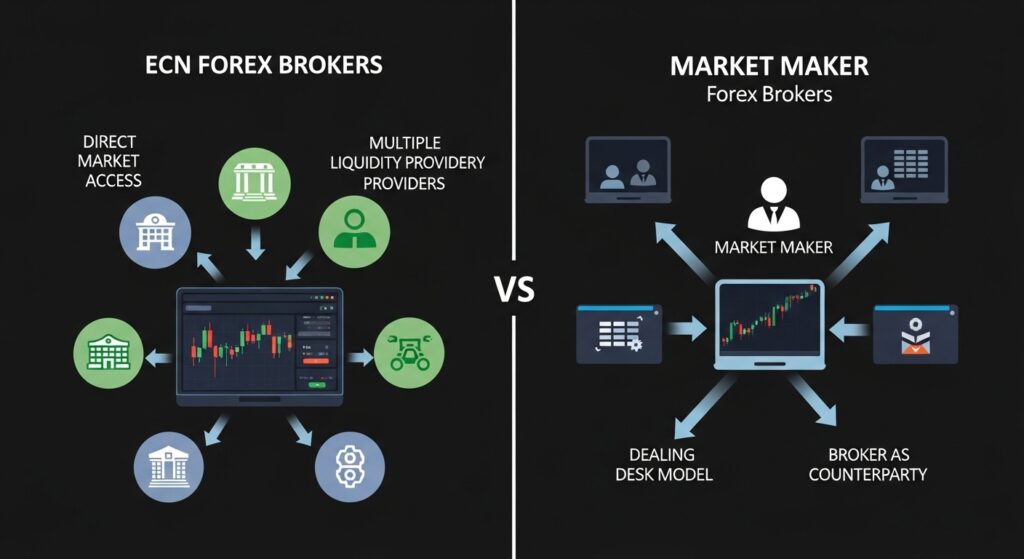
ECN vs Market Maker Brokers
Understanding the difference between ECN and market maker brokers is essential for choosing the right broker type.
Market Maker Brokers:
Market makers create their own internal market. When you place a trade, the broker takes the opposite position. They profit from the spread between buy and sell prices.
Fixed spreads remain constant regardless of market conditions. While this provides predictability, spreads are often wider than ECN spreads during normal market hours.
Dealing desk intervention can occur. Market makers may requote prices during volatile periods or reject orders that conflict with their risk management.
ECN Forex Brokers:
No dealing desk means no conflict of interest. The broker simply facilitates trades between market participants and charges a commission.
Variable spreads reflect real market conditions. Spreads can be extremely tight (0.0-0.5 pips) during liquid hours but may widen during news releases or illiquid periods.
Direct market access provides transparency. You see actual market depth and can place orders that interact with real liquidity.
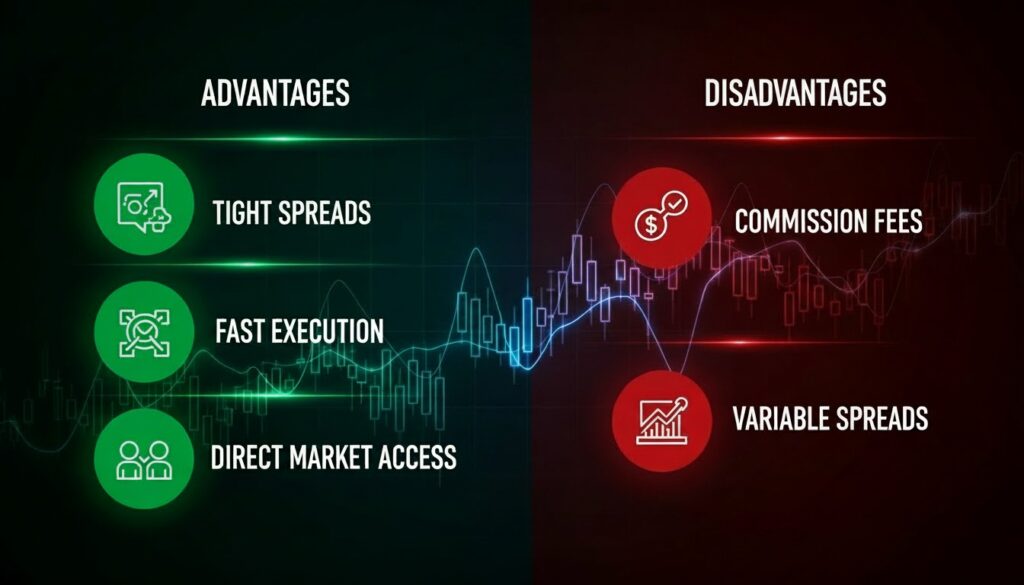
Advantages of ECN Forex Brokers
Tighter Spreads
ECN forex brokers offer the tightest spreads in the industry. Major pairs like EUR/USD often trade with spreads from 0.0 to 0.3 pips during liquid market hours. This significantly reduces trading costs for active traders.
For scalpers and day traders making dozens of trades daily, tight spreads can mean the difference between profit and loss. Saving even 0.5 pips per trade adds up quickly.
No Conflict of Interest
Since ECN brokers earn through commissions rather than trading against you, they want you to succeed. More trading volume means more commission income for the broker.
This alignment of interests creates a healthier trading relationship. Your broker benefits when you trade profitably and continue trading long-term.
Fast Execution
ECN technology provides near-instantaneous execution. Quality ECN forex brokers process orders in under 100 milliseconds, with many achieving execution times of 10-50 milliseconds.
Fast execution is critical during volatile markets. News releases and economic data can move markets by 50-100 pips in seconds. Faster execution means you get the price you see when you click.
Market Depth Visibility
ECN platforms display Level II pricing, showing multiple price levels and the volume available at each level. This transparency helps you understand market liquidity and make better trading decisions.
Seeing market depth reveals where major buy and sell orders sit. This information can help identify support and resistance levels and potential price movements.
Scalping Allowed
Most ECN forex brokers welcome scalping strategies. Since they earn commissions on each trade, high-frequency trading actually benefits them.
Market makers often restrict scalping because it increases their risk. ECN brokers have no such restrictions, making them ideal for short-term trading strategies.
Disadvantages of ECN Brokers
Commission Costs
ECN forex brokers charge commissions on top of the spread. Typical commissions range from $3 to $7 per round turn (per lot traded).
For low-frequency traders making just a few trades per month, commission costs may exceed the savings from tighter spreads. Market maker brokers with zero commissions might be more cost-effective for occasional traders.
Variable Spreads
Spreads widen during low liquidity periods and major news releases. While spreads might be 0.2 pips during normal hours, they can spike to 3-5 pips during news events.
Traders must account for this variability in their strategies. Stop losses placed too tight might get triggered by temporary spread widening.
Higher Minimum Deposits
ECN accounts typically require higher minimum deposits than standard accounts. Minimums of $200-$1,000 are common, compared to $10-$50 for basic market maker accounts.
This higher barrier to entry can exclude beginners or traders with limited capital.
More Complex Pricing
Understanding total trading costs requires calculating both spread and commission. Some traders find this more complicated than simple spread-only pricing.
Additionally, different trade sizes incur different commission rates, requiring careful calculation of costs per trade.
How to Identify a True ECN Broker
Many brokers claim to be “ECN” or “STP” (Straight Through Processing) without meeting true ECN standards. Here is how to verify genuine ECN brokers:
Check Regulation
True ECN brokers hold licenses from tier-1 regulators. Look for regulation from ASIC , FCA , or CySEC.
Verify the license number on the regulator’s official website. Legitimate brokers display their license prominently and welcome verification.
Examine Spread and Commission Structure
Real ECN brokers offer spreads from 0.0 pips and charge transparent commissions. Be skeptical of brokers claiming ECN status while charging only spreads with no commission.
Review commission rates. Typical ECN commissions range from $2-$7 per lot per side. Unusually high commissions may indicate the broker is adding markup beyond standard ECN pricing.
Test Execution Quality
Open a demo account and test execution during volatile periods. True ECN brokers maintain fast execution even during news releases, though spreads may widen.
Check for requotes. ECN brokers should not requote prices since they match your order directly to liquidity providers.
Request Proof of Liquidity Providers
Reputable ECN brokers disclose their liquidity providers. Top ECN brokers connect to 10-20 tier-1 banks including JP Morgan, Citibank, Deutsche Bank, and others.
If a broker refuses to name their liquidity providers or claims proprietary arrangements, treat this as a red flag.
Review Market Depth
True ECN platforms display Level II pricing showing market depth. If the platform only shows single bid/ask prices without depth information, the broker may not offer genuine ECN access.
Top ECN Brokers
Several brokers offer legitimate ECN trading with strong regulation and competitive conditions:
IC Markets provides true ECN access with regulation from ASIC and CySEC. Raw spreads start from 0.0 pips with $3.50 commission per side per lot.
Pepperstone offers ECN trading on their Razor account with ASIC and FCA regulation. Commissions are $3.50 per side with spreads from 0.0 pips.
FP Markets delivers ECN execution with ASIC regulation and access to deep liquidity pools. Their Raw account features 0.0 pip spreads and $3 per side commissions.
ECN brokers offer advantages for active traders seeking tight spreads and fast execution. Market makers may be better for beginners or low-frequency traders due to simpler pricing and lower minimum deposits. Your choice depends on trading style and experience level.
Do ECN brokers allow hedging?
Yes, most ECN brokers allow hedging since they simply pass your orders to liquidity providers. Market makers often restrict hedging due to their risk management requirements.
What is the difference between ECN and STP brokers?
ECN brokers connect all participants in one network where orders can match with other traders. STP (Straight Through Processing) brokers route orders to liquidity providers but do not create a unified order matching system. Both offer no dealing desk execution, but ECN provides more transparency.
Can I use Expert Advisors with ECN brokers?
Yes, ECN brokers fully support automated trading and Expert Advisors. Fast execution and low latency make ECN brokers ideal for algorithmic trading strategies.
Why do spreads widen on ECN accounts?
ECN spreads reflect real market conditions. During low liquidity periods (late night hours, holidays) or high volatility events (major news releases), fewer buyers and sellers participate, creating wider spreads. This is normal market behavior, not broker manipulation.
Conclusion
ECN forex brokers provide the most transparent and cost-effective trading environment for active forex traders. Direct market access, tight spreads, and fast execution make ECN brokers the preferred choice for scalpers, day traders, and anyone executing high trade volumes.
However, commission costs and variable spreads mean ECN trading is not ideal for everyone. Beginners or occasional traders may find market maker brokers more suitable until they develop consistent trading strategies.
When choosing an ECN broker, verify regulation, test execution quality, and calculate total costs including both spreads and commissions. The brokers listed in our MT5 broker guide offer legitimate ECN access with strong regulatory oversight.
For those ready to open an ECN account, proper risk management remains essential. Even the best broker and tightest spreads cannot compensate for poor trading decisions or inadequate risk controls.