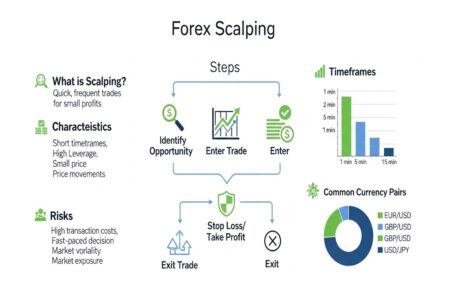
Most scalping guides talk about targeting 10-20 pips per trade, but there’s an even faster, more consistent approach: 2-5 pip scalping. This ultra-short-term strategy involves taking tiny profits multiple times per hour, and it’s perfect for traders starting with small accounts of $100-500.

Before diving into scalping methods, it helps to understand what are pips in forex trading.
The beauty of 2-5 pip scalping is its simplicity and frequency. Instead of waiting for perfect 15-pip moves, you capture the constant market “breathing”—the small 2-5 pip oscillations that happen dozens of times per hour during active trading sessions. With the right broker, strategy, and discipline, you can realistically make $5-20 per day starting with just $100.
Here’s the math: With a $100 account and 0.01 lots (micro lots), each pip equals approximately $0.10. Target 3 pips per trade = $0.30 profit. Execute 20 successful trades per day = $6.00. Do this consistently, compound your growth, and within weeks you’re trading larger sizes and making more per pip.
This isn’t get-rich-quick. It’s get-consistent-cash-flow-quick. You’re not trying to hit home runs—you’re collecting singles and doubles all day long. The strategy works because you’re taking profits before the market has a chance to reverse against you. You’re in and out in seconds to minutes, grabbing your 2-5 pips and moving to the next trade.
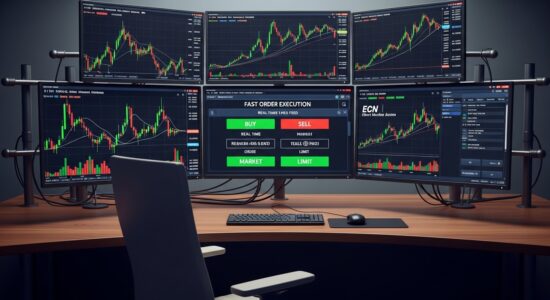
However, 2-5 pip scalping demands specific conditions: an ECN broker with spreads under 1 pip, instant execution, focus during high-liquidity sessions, and emotional discipline to execute the same simple pattern dozens of times without deviation. You also need realistic expectations—this won’t turn $100 into $10,000 overnight, but it can generate consistent daily income that compounds steadily.
In this comprehensive guide, you’ll learn the exact 2-5 pip scalping strategy, how to calculate position sizes for small accounts, which brokers support micro lot scalping, the best times and currency pairs, precise entry and exit techniques with visual examples, risk management for high-frequency trading, and the psychology of executing 20+ trades per day. Whether you’re starting with $100 or $500, this guide provides a realistic path to consistent daily profits through micro scalping.
Why 2-5 Pip Scalping Works
The Constant Market Oscillation
Even in trending markets, price doesn’t move in a straight line—it oscillates up and down in small waves. These 2-5 pip movements happen constantly:
During London-NY Overlap:
- EUR/USD might move from 1.0850 to 1.0855 (5 pips up)
- Then back to 1.0852 (3 pips down)
- Then to 1.0857 (5 pips up)
- These oscillations repeat dozens of times per hour
Your Edge: While other traders wait for 20-pip moves, you’re capturing these tiny, frequent oscillations. You’re not predicting trend direction—you’re exploiting the market’s natural breathing pattern.
This constant oscillation is the foundation that makes 2-5 pip scalping viable even during slow market conditions.
Perfect for Small Accounts
Why 2-5 Pips Works with $100:
Low Risk Per Trade:
- Stop-loss: 5-8 pips
- With $100 account, 2% risk = $2
- $2 risk / 5 pips = $0.40 per pip
- Position size: 0.04 lots (micro)
- This is manageable for small accounts
High Frequency Compensates:
- Smaller profit per trade ($0.30-0.50)
- But 15-25 trades per day
- Total daily profit: $5-15
- 5-15% daily growth on $100 account
High Win Rate Potential
2-5 Pip Targets = Higher Win Rate:
- Targeting 20 pips: Maybe 50-60% win rate (price must move far)
- Targeting 3 pips: Often 65-75% win rate (price just needs to tick up slightly)
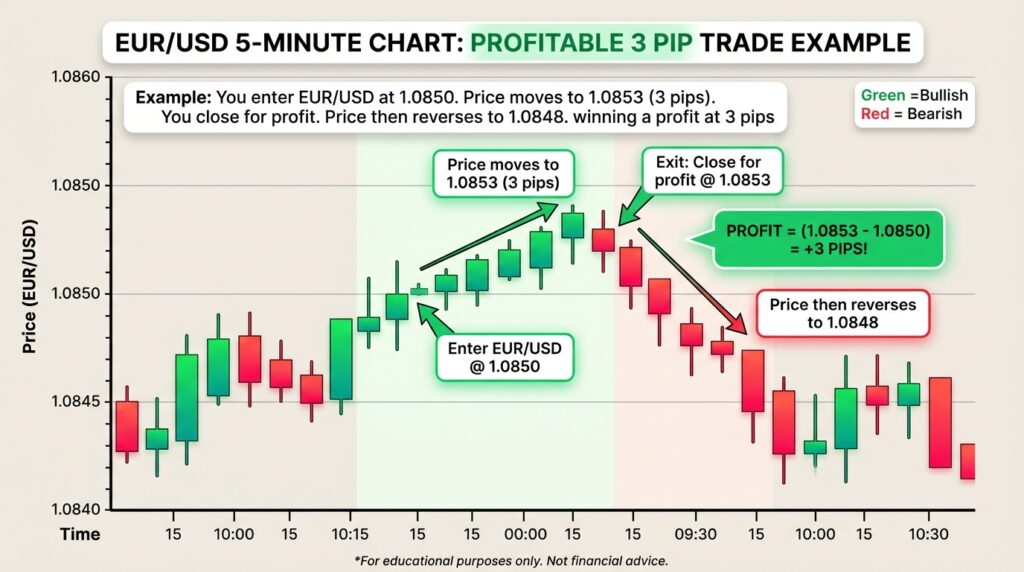
Example:
- You enter EUR/USD at 1.0850
- Price moves to 1.0853 (3 pips)
- You close for profit
- Price then reverses to 1.0848
- You still won because you took profit at 3 pips
If you’d waited for 15 pips, you’d have lost. The smaller target saved you.
Quick In and Out
Time in Trade:
- Average: 30 seconds to 3 minutes
- Less exposure to sudden reversals
- Less emotional attachment
- Less stress (you’re not holding hoping)
The Math: Turning $100 into Daily Income
Understanding Micro Lots
Lot Sizes:
- Standard lot: 100,000 units, 1 pip = $10
- Mini lot: 10,000 units, 1 pip = $1
- Micro lot: 1,000 units, 1 pip = $0.10
- Nano lot: 100 units, 1 pip = $0.01 (some brokers)
For $100 Account: Use 0.01 to 0.05 lots (micro lots)
Daily Profit Scenarios
Conservative Scenario (0.01 lots):
- 1 pip = $0.10
- Target: 3 pips per trade = $0.30
- 15 successful trades per day = $4.50
- 5 losing trades (5 pips each) = -$2.50
- Net daily profit: $2.00 (2% daily)
Moderate Scenario (0.03 lots):
- 1 pip = $0.30
- Target: 3 pips per trade = $0.90
- 20 successful trades = $18.00
- 7 losing trades (5 pips each) = -$10.50
- Net daily profit: $7.50 (7.5% daily)
Aggressive Scenario (0.05 lots):
- 1 pip = $0.50
- Target: 4 pips per trade = $2.00
- 25 successful trades = $50.00
- 10 losing trades (6 pips each) = -$30.00
- Net daily profit: $20.00 (20% daily)
Compounding Growth
Starting with $100:
Week 1: $100 → $120 (average $4/day) Week 2: $120 → $145 (growing position size slightly) Week 3: $145 → $175 Month 1: $100 → $180
After 3 Months: $100 could become $400-600 with consistent 3-5% daily average and compounding
The Key: Don’t withdraw profits initially—reinvest to grow position size, which increases profit per pip.
Broker Requirements for 2-5 Pip Scalping
Must-Have Features
1. Micro Lot Support:
- Must allow 0.01 lot positions minimum
- Some brokers: 0.1 lot minimum (too large for $100 account)
2. Ultra-Tight Spreads:
- EUR/USD: 0.0-0.5 pips
- GBP/USD: 0.5-1.0 pips
- With 3-pip target, 1-pip spread takes 33% of profit
- 0.2-pip spread only takes 6%
3. Instant Execution:
- No delays (scalping requires speed)
- No requotes
- Execution under 50 milliseconds ideal
4. ECN or STP Model:
- Not dealing desk (market maker)
- Direct market access
- True interbank spreads
5. No Scalping Restrictions:
- Some brokers prohibit scalping (check terms)
- Must allow closing trades within seconds/minutes
6. Low Minimum Deposit:
- $50-100 minimum
- Some brokers require $500+ (skip these)
For detailed broker selection, see our complete How to Choose a Forex Broker guide.
Recommended Broker Types
ECN Brokers:
- Raw spreads (0.0-0.3 pips)
- Small commission per trade ($0.20-0.50 per lot)
- Worth it for tight spreads
Example Calculation:
- Spread: 0.2 pips (vs. 1.5 pips standard)
- Saves 1.3 pips per trade
- 20 trades = 26 pips saved daily
- Commission: $0.40 per round trip on 0.01 lot
- 20 trades = $8 commission
- Net savings: ~18 pips ($1.80 daily on 0.01 lots)
The Best Currency Pairs
EUR/USD (The King)
Why It’s Perfect:
- Tightest spreads (0.0-0.5 pips with ECN)
- Highest liquidity (instant fills)
- Smooth, predictable oscillations
- Active 24 hours
Best Sessions:
- London-NY overlap (8 AM – 12 PM EST)
- 2-5 pip scalping movements every few minutes
See our complete EUR/USD Trading Guide for pair-specific strategies.
GBP/USD (Higher Volatility)
Pros:
- Larger movements (easier to catch 5 pips)
- Good liquidity
- Clear price action
Cons:
- Slightly wider spreads (0.5-1.2 pips)
- More volatile (can move against you faster)
Best For: Slightly larger accounts ($200+)
Review our GBP/USD Trading Guide for more details.
USD/JPY (Smooth Mover)
Pros:
- Very tight spreads
- Smooth trends
- Active during Asian and US sessions
Cons:
- Pip value calculated differently
- Slightly less volatile than EUR/USD
See our UUSD/JPY Trading Guide: How to Trade “The Gopher”SD/JPY Trading Guide for specific strategies.
Focus on ONE Pair
Recommendation: Start with EUR/USD exclusively
Why:
- Master one pair’s behavior
- Don’t split attention
- EUR/USD offers enough trades per session
- Once consistent, add GBP/USD
The 2-5 Pip Scalping Strategy
Setup Requirements
Timeframe: 1-minute chart (primary)
Indicators:
- 5 EMA (Exponential Moving Average) – Red
- 20 EMA – Blue
- Optional: Stochastic (5,3,3) for confirmation
For more on indicators, see our Technical Analysis Forex: Complete Trading GuideTechnical Analysis Guide.
Trading Sessions:
- London-NY overlap (8 AM – 12 PM EST) – Best
- London open (3-5 AM EST) – Good
- Avoid Asian session (too slow for EUR/USD)
Entry Rules (Long Example)
Step 1: Wait for Setup
- 5 EMA crosses above 20 EMA
- Or price bouncing off 20 EMA while above it
Step 2: Confirm Momentum
- Price makes bullish candle
- Stochastic crosses up from below 20 (optional)
Step 3: Enter
- Enter LONG at market order
- Immediately place stop-loss: 5 pips below entry
- Immediately place take-profit: 3 pips above entry
Step 4: Exit
- Take profit hits at +3 pips: Close automatically
- OR close manually when 5 EMA crosses back below 20 EMA
- If stop hits: Accept loss, move to next trade
Entry Rules (Short Example)
Same Logic, Opposite Direction:
- 5 EMA crosses below 20 EMA
- Price rejects from 20 EMA while below it
- Bearish candle forms
- Enter SHORT at market
- Stop: 5 pips above entry
- Target: 3 pips below entry
The Simple Pattern
You’re Looking For:
- Quick EMA cross or bounce
- Enter immediately
- Target 3 pips
- Stop 5 pips
- Exit and repeat
This happens 20-40 times during London-NY overlap on EUR/USD
Position Sizing for Small Accounts
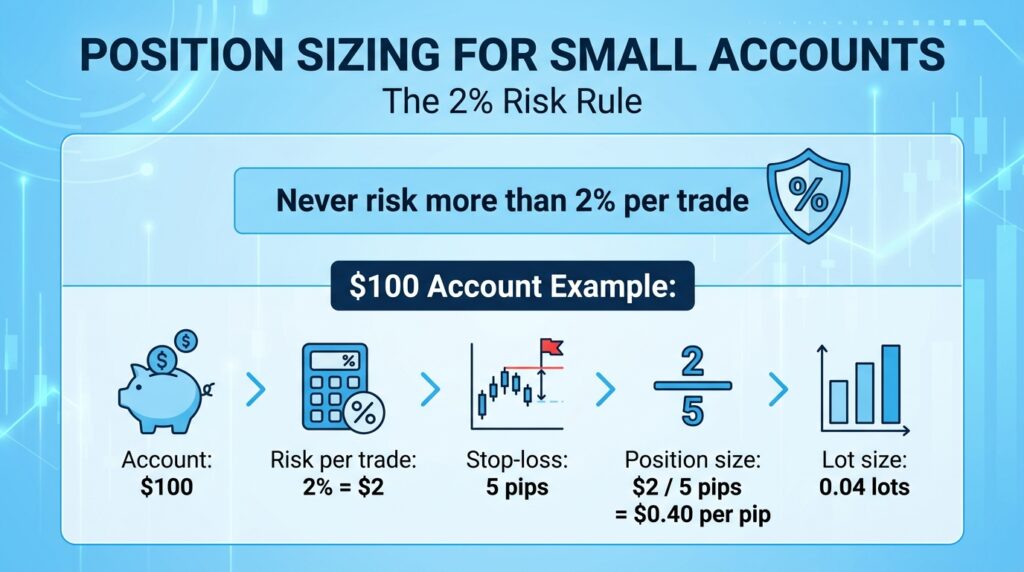
The 2% Risk Rule
Never risk more than 2% per trade
$100 Account Example:
- Account: $100
- Risk per trade: 2% = $2
- Stop-loss: 5 pips
- Position size: $2 / 5 pips = $0.40 per pip
- Lot size: 0.04 lots
$200 Account:
- Risk: $4
- Stop: 5 pips
- Position size: $0.80 per pip = 0.08 lots
$500 Account:
- Risk: $10
- Stop: 5 pips
- Position size: $2 per pip = 0.20 lots
For complete position sizing strategies, see our Risk Management Guide.
Starting Conservative
First Week:
- Use 0.01 lots regardless of account size
- Focus on execution, not profit
- Build confidence and consistency
- Track win rate
Week 2-4:
- If win rate >60%, increase to proper 2% risk
- Still conservative until proven
Month 2+:
- Full 2% risk if consistently profitable
- Compound by increasing lot size as account grows
When to Increase Size
Indicators You’re Ready:
- 60%+ win rate over 100+ trades
- Following strategy without deviation
- Comfortable with execution
- Account growing steadily
How to Increase:
- Don’t double overnight
- Increase by 0.01-0.02 lots at a time
- Every time account grows 20-30%, recalculate position size
Risk Management
Stop-Loss Discipline
Hard Rules:
- Every trade has stop-loss before entering
- Stop: 5-8 pips maximum
- Never move stop further away
- Never hope trade reverses—accept loss
Daily Loss Limit
Critical for Survival:
- Set maximum daily loss: 6% of account
- $100 account = $6 max loss per day
- Hit limit? STOP trading for the day
- Prevents revenge trading spiral
Example:
- Trade 1: -$0.50
- Trade 2: -$0.50
- Trade 3: -$0.50
- Trade 4: +$0.30
- Trade 5: -$0.50
- Trade 6: -$0.50
- Total: -$2.20 of $6 limit
- Can continue
- But if you hit -$6, STOP immediately
Maximum Trades Per Day
Prevent Overtrading:
- Set maximum: 25-30 trades per day
- After 25 trades, STOP even if winning
- Quality > quantity
- Fatigue kills performance
Take Breaks
After Every 5 Trades:
- 5-minute break
- Stand up, stretch
- Clear mind
- Prevents fatigue mistakes
For complete risk management strategies, review our Risk Management Guide.
The Trading Routine
Pre-Market (10 minutes before session)
7:50 AM EST (if trading 8 AM – 12 PM):
- Check economic calendar (ForexFactory.com)
- Any major news 8:30 AM? (NFP, CPI, etc.)
- If yes, wait until after news settles
- Open EUR/USD 1-minute chart
- Add 5 EMA and 20 EMA
- Ensure spreads are tight (check broker)
- Mental preparation: “I will follow my plan exactly”
See our Economic Indicators Guide for understanding major news events.
During Trading Session
8:00 AM – 12:00 PM EST:
Step 1: Watch for 5 EMA cross or bounce off 20 EMA Step 2: When setup appears, execute immediately:
- Enter at market
- Place stop (5 pips)
- Place target (3 pips) Step 3: Walk away—don’t watch tick by tick Step 4: Trade hits target or stop Step 5: Journal the trade quickly (use our Trading Journal Guide) Step 6: Move to next setup
Repeat 15-25 times
Post-Session (15 minutes)
12:15 PM EST:
- Close all charts
- Journal session:
- Total trades
- Wins/losses
- Pips gained/lost
- Mistakes made
- Calculate daily profit/loss
- Update trading stats spreadsheet
- Identify lessons
- Prepare for tomorrow
Incorporate this into your complete Trading Plan.
Common Mistakes
Mistake #1: Moving Target to 10+ Pips
The Greed Trap:
- Trade at +3 pips (your target)
- “It’s moving! Let me get 10 pips!”
- Don’t move target
- Price reverses
- You lose
Solution: Close at 3 pips EVERY TIME. No exceptions.
Mistake #2: Not Using Stop-Loss
The Disaster:
- “I’ll close manually if it goes against me”
- Trade moves -5 pips
- “It’ll come back…”
- Now -15 pips
- Account blown
Solution: Stop-loss BEFORE entering, ALWAYS.
Mistake #3: Revenge Trading
The Pattern:
- Lose 3 trades in a row (-$1.50)
- “I need to make it back NOW”
- Take bad setups
- Lose more
Solution: After 3 losses, 15-minute break. MANDATORY.
See our for managing emotions.
Mistake #4: Trading Wrong Times
Low Liquidity:
- Trading at 2 AM EST (dead market)
- Spreads widen
- Price choppy
- Losses accumulate
Solution: Only trade London-NY overlap (8 AM-12 PM EST)
Mistake #5: Too Many Pairs
Attention Split:
- Watching EUR/USD, GBP/USD, USD/JPY simultaneously
- Miss setups on all
- Poor execution
Solution: EUR/USD ONLY until consistently profitable
Mistake #6: Overleveraging
The Killer:
- $100 account
- Using 0.10 lots (10x too large)
- One 5-pip loss = -$5 (5% account)
- Three losses = -15%
- Account destroyed
Solution: Strict 2% risk, proper position sizing
Mistake #7: Ignoring Spreads
Hidden Cost:
- Broker spread: 2 pips
- Target: 3 pips
- Actually need 5-pip move to profit 3 pips
- Win rate tanks
Solution: ECN broker with <0.5 pip spreads
For more mistakes to avoid, see our complete trading guide
The Psychology
The mental demands of 2-5 pip scalping are different from longer timeframe trading — repetition and emotional detachment are essential.
Executing 20+ Trades Daily
Mental Challenges:
- Repetitive (boring after trade 15)
- Each loss stings (even if small)
- Temptation to deviate
Mindset Shift:
- You’re a machine
- Emotions don’t exist
- Setup appears → Execute → Next
- Think: “I’m collecting $0.30 payments all day”
Accepting Losses
Reality:
- Even with 70% win rate, 30% lose
- 20 trades = 6-7 losses expected
- This is normal, not failure
Reframe:
- Losses are cost of business
- A $0.50 loss bought you data
- Still profitable if system works
Staying Disciplined
The Key:
- Follow exact same pattern every trade
- No thinking during execution
- Setup = Enter
- Target hit = Close
- Stop hit = Accept
Mantra: “I am a 3-pip collecting machine”
For comprehensive mental strategies, review our Trading Psychology Guide.
Frequently Asked Questions
Q: Can I really make $5-20 daily with $100? A: Yes, but with caveats. You need an ECN broker with tight spreads (<0.5 pips), you must trade during high-liquidity hours (London-NY overlap), execute 15-25 trades with 65%+ win rate, and strictly follow 2% risk management. Not every day will be profitable—some days you’ll lose $2-5. But averaged over a week, $5-20 daily is realistic. The math works: 0.01 lots, 3-pip target, 20 winning trades = $6. However, most beginners take 2-4 weeks to achieve consistency.
Q: What’s the best timeframe for 2-5 pip scalping? A: 1-minute chart is optimal for 2-5 pip scalping. It shows enough price detail to catch small oscillations while providing 20-40 setups during a 4-hour session. Some traders use tick charts (100-200 tick) for even more granularity. 5-minute charts work but provide fewer setups (5-10 per session), making it harder to accumulate 20 trades. Start with 1-minute, move to tick charts once experienced if desired.
Q: How long does it take to turn $100 into $1,000? A: With conservative 3-5% daily average and compounding, $100 can grow to $1,000 in 3-6 months. However, this assumes: consistent 65%+ win rate, reinvesting all profits, no withdrawals, no major losing streaks, and gradually increasing position size as account grows. Most traders hit plateaus, have drawdown weeks, and take longer. Realistic timeline: 6-12 months for most disciplined scalpers. Rushing leads to overleveraging and blown accounts.
Q: Do I need to watch the screen constantly? A: Yes, 2-5 pip scalping requires active screen monitoring during your trading session. You’re looking for 15-25 setups over 4 hours, so you need to be alert. However, you’re NOT watching every tick—you’re watching for EMA crosses or bounces. When no setup exists, you wait. Most scalpers trade in 2-hour focused blocks with breaks, rather than 8 hours straight. If you can’t dedicate focused screen time, consider swing trading or longer-timeframe day trading instead.
Q: What if I can’t trade during London-NY overlap (8 AM-12 PM EST)? A: This is problematic because that’s when EUR/USD has optimal liquidity, tight spreads, and frequent 2-5 pip oscillations. Alternatives: (1) Trade London open (3-5 AM EST) if possible—still decent, (2) Trade NY afternoon (2-4 PM EST)—fewer setups but workable, (3) Consider USD/JPY during Asian session (9 PM-12 AM EST)—less ideal but possible. If none work, 2-5 pip scalping may not suit your schedule. Consider 4-hour timeframe swing trading you can check 2-3x daily instead.
Q: Should I use 2-pip or 5-pip targets? A: Start with 3-pip targets—it’s the sweet spot. 2-pip targets have issues: spreads take larger percentage (0.5-pip spread = 25% of 2-pip profit), you need even higher win rate (70%+), and some brokers’ spread fluctuations can negate profits. 5-pip targets are safer but provide fewer winning trades (price must move further). As you gain experience, adjust based on your statistics: if win rate >70%, try 2-pip targets; if win rate <60%, use 4-5-pip targets.
Q: How many pips per day should I target? A: Aim for 30-50 pips daily with 2-5 pip scalping strategy. This requires: 10-15 winning trades at 3 pips each (30-45 pips), minus 5-7 losing trades at 5 pips each (-25-35 pips), net 30-50 pips daily. With 0.01 lots, that’s $3-5 profit. Don’t set rigid pip targets—focus on executing quality setups and let pips accumulate naturally. Some days yield 60 pips, others 20 pips, some lose. Weekly average matters more than daily.
Q: What spread is too wide for 2-5 pip scalping? A: Above 1 pip is problematic according to forex trading experts. With 3-pip target and 1-pip spread, you need 4-pip move to profit 3 pips—that’s 33% harder. Ideal: 0.0-0.5 pips (ECN brokers). Acceptable: 0.5-0.8 pips (decent brokers). Avoid: 1.5+ pips (standard market maker brokers)—you’ll struggle to profit consistently. Check spreads during your trading hours (they widen during low liquidity). If EUR/USD spread exceeds 1 pip regularly during London-NY overlap, switch brokers immediately.
Q: Can I use this strategy on GBP/USD or USD/JPY? A: Yes, but with adjustments. GBP/USD: More volatile (easier to get 5 pips, but can reverse faster), wider stops needed (6-8 pips), wider spreads (0.8-1.5 pips), better for slightly larger accounts ($200+). USD/JPY: Excellent alternative, tight spreads, smooth price action, good during Asian session (9 PM-12 AM EST), pip value calculated differently (check broker). Start with EUR/USD until profitable, then test others on demo before going live.
Q: What if my broker doesn’t allow micro lots? A: You need a different broker. Brokers requiring 0.1 lot minimum are unsuitable for $100-500 accounts—that’s 10x too large for proper risk management. Many ECN brokers offer 0.01 lots or even 0.001 lots (nano). Research brokers specifically advertising “micro accounts” or “start with $50.” If stuck with current broker short-term, wait until account reaches $500 minimum before scalping with 0.1 lots, or withdraw and switch brokers. See our Broker Selection Guide.
Conclusion
2-5 pip scalping offers a realistic path to daily income for traders starting with small accounts of $100-500. By targeting tiny profits multiple times per hour during high-liquidity sessions, you can generate consistent $5-20 daily that compounds into significant account growth over months.
The strategy’s success depends on specific conditions: an ECN broker with spreads under 0.5 pips, trading EUR/USD during London-NY overlap (8 AM-12 PM EST), using micro lots (0.01-0.05) with strict 2% risk per trade, targeting 3-pip profits with 5-pip stops, and executing 15-25 trades per session with 65%+ win rate.
This isn’t glamorous trading. You’re not hunting 100-pip moves or trying to predict major trends. You’re collecting $0.30-0.50 profits repeatedly, like a machine. It’s boring, repetitive, and demands intense focus during trading hours. But it works because you’re exploiting the market’s constant oscillation, taking profits before reversals, and compounding small consistent gains.
The challenges are real: execution fatigue after 15-20 trades, emotional control through losing streaks, discipline to close at 3 pips when trade is running, and accepting that many days you’ll make just $3-7. But for traders willing to start small, follow a simple system, and compound patiently, 2-5 pip scalping provides a legitimate entry point to forex trading without requiring thousands in starting capital.
Start with $100, find an ECN broker, practice on demo for 1-2 weeks, then go live with 0.01 lots. Track every trade, maintain your statistics, and focus on consistency over profits. Within 2-3 months of disciplined execution, you’ll have grown your account, increased your position size, and built the foundation for long-term scalping success. The math works—now execute it.
Combine this strategy with proper Risk Management, solid Trading Psychology, and a complete Trading Plan for maximum success.
Ready to master scalping? Explore our complete forex education series:
Legal Disclaimer:
Forex trading involves substantial risk of loss and is not suitable for all investors. Scalping strategies, including 2-5 pip scalping, carry high risks due to frequent trading, leverage, and rapid decision-making requirements. The profit examples provided ($5-20 daily from $100 account) are illustrative and not guarantees of performance. Many traders lose money, especially when starting. Past performance and hypothetical results do not indicate future success. Spreads, commissions, and slippage significantly impact profitability in scalping. Before attempting 2-5 pip scalping or any forex trading, carefully consider your financial situation, risk tolerance, and experience level according to guidance from regulatory bodies like the CFTC and NFA. Never invest money you cannot afford to lose completely. This article is for educational purposes only and should not be considered investment advice. Seek guidance from a licensed financial advisor if you have any doubts.