Learn How to Make Fast Money by Learning diffrent Strategies in Forex Trading and Different Investment Options
How to Create a Forex Trading Journal and Track Your Trades
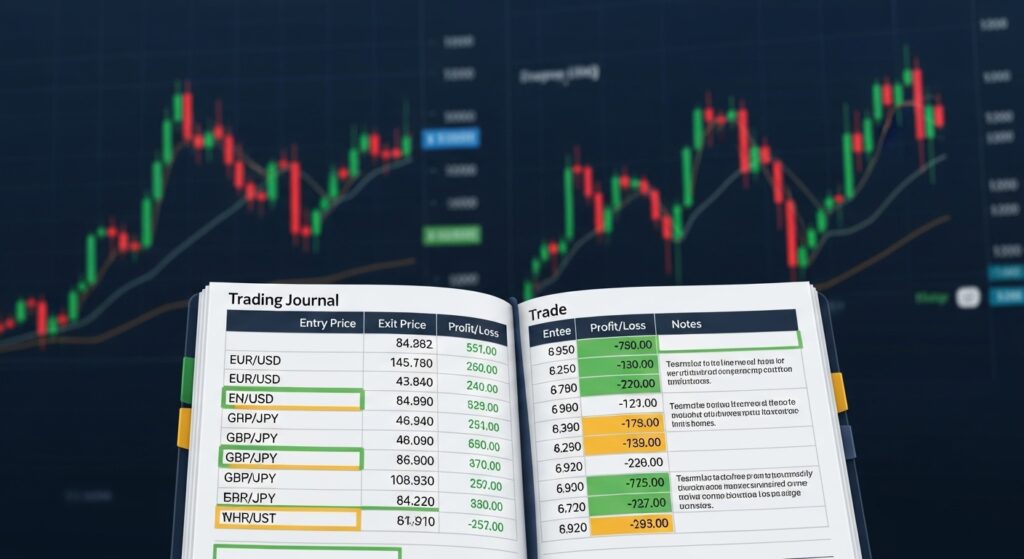
Every professional trader maintains a detailed forex trading journal. Not because it’s fun or easy, but because forex trading journal is the single most powerful tool for systematic improvement.
Your forex trading journal transforms trading from gambling into a data-driven profession. It reveals patterns in your behavior, identifies what’s working, exposes costly mistakes, and provides the objective feedback necessary for continuous improvement.
Without a journal, you’re flying blind—unable to distinguish luck from skill, repeating the same errors indefinitely, and wondering why consistent profitability remains elusive. With a comprehensive forex trading journal and regular review process, you gain the insights that separate professional traders from perpetual strugglers.
This guide shows you exactly how to create and maintain a forex trading journal that drives improvement. You’ll learn what to track, how to analyze your data, and how to use insights to systematically enhance your trading performance.
Keeping a forex trading journal is recommended by leading trading educators including Investopedia. US forex trading is regulated by the CFTC and NFA, while UK brokers are overseen by the FCA
The benefits of journaling extend far beyond simple record-keeping.
Identifies Patterns in Your Trading
Human memory is notoriously unreliable, especially regarding our own behavior. You might believe you follow your trading plan consistently, but your forex trading journal reveals the truth.
After 50-100 logged trades, clear patterns emerge:
Which setups produce your best results
What market conditions suit your strategy
When emotions override your plan
Which currency pairs you trade most profitably
What times of day you make your best decisions
How often you actually follow your rules
According to research published in the Journal of Behavioral Finance, traders who maintain detailed journals improve their performance significantly faster than those who don’t.
Provides Objective Performance Feedback
Emotions distort perception. After a few winning trades, you feel like a genius. After losses, you question everything. Your forex trading journal cuts through emotional noise with objective data.
Rather than asking “Am I a good trader?” you can answer specific questions with evidence:
What’s my actual win rate over the last 100 trades?
Am I achieving my target risk-reward ratios?
Is my strategy profitable in current market conditions?
Which specific rules violations cost me the most money?
Accelerates Learning and Improvement
Every trade provides learning opportunities, but most traders forget the lessons within hours. Your forex trading journal preserves these insights and allows you to build on them systematically.
By reviewing your forex trading journal regularly, you:
Learn from both winners and losers
Identify which errors you repeat most frequently
Test whether changes to your approach improve results
Trading forums overflow with opinions about what works and what doesn’t. Your forex trading journal provides personalized data about what works specifically for you.
Maybe breakout trades work brilliantly for others but produce mediocre results for you. Perhaps you excel at range-bound conditions but struggle in strong trends. Your forex trading journal reveals your unique edge—the specific circumstances where you have genuine competitive advantage.
Essential Elements to Track
A comprehensive forex trading journal captures both quantitative metrics and qualitative observations about each trade.
Pre-Trade Information
Date and Time
Record when you entered the trade. This allows analysis of whether certain times of day or days of week produce better results.
Currency Pair
Which pair did you trade? After sufficient trades, you’ll discover which pairs suit your style best.
Market Context
Describe the broader market environment:
Is the pair trending or ranging?
What’s the higher timeframe bias?
Are we in high or low volatility conditions?
Any major news events pending?
Setup Type
Categorize each trade by setup pattern. Examples:
Trend continuation
Breakout
Reversal
Range bounce
News-driven
Consistent categorization reveals which setups you execute most profitably.
Trade Mechanics
Entry Price and Time
Exact price where you entered and the precise timestamp.
Position Size
Number of lots or units traded. This should align with your risk management plan based on stop-loss distance.
Stop-Loss Price
Where did you place your stop? Record both the price level and the rationale for placement (previous swing low, support level, ATR-based, etc.).
Take-Profit Target(s)
Your intended exit price(s). If using multiple targets, record each one separately.
Risk Amount
How much money (in your account currency) did you risk on this trade? This should be consistent across trades unless your account size has changed significantly.
Potential Reward
How much did you stand to make if the trade hit your target? Calculate this before entry, not after.
Risk-Reward Ratio
The ratio of potential reward to risk. Example: risking $100 to make $200 = 1:2 ratio. Record your planned ratio at entry.
Entry Justification
Why Did You Take This Trade?
Document your reasoning in detail:
What specific setup criteria were met?
Which technical indicators confirmed the trade?
What was the fundamental backdrop?
How did this align with your trading plan?
This written rationale serves two purposes: It forces you to clarify your thinking before entering, and it provides data for later analysis about which reasoning produces the best results.
Screenshot of Entry Setup
Capture a chart screenshot at the moment of entry showing:
The timeframe you used for entry decision
All relevant support/resistance levels
Indicators you relied upon
Your entry point, stop, and target marked clearly
Visual records often reveal patterns your written notes miss. Years later, these screenshots help you remember the exact market context.
Emotional State
How Did You Feel When Entering?
Document your psychological state honestly:
Confident and calm
Anxious or fearful
Excited or eager
Frustrated or angry
Neutral
After reviewing many trades, you’ll discover whether your emotional state at entry correlates with trade outcomes. Many traders find their best trades come from a calm, neutral state, while excitement or frustration often precedes losses.
Post-Trade Information
Exit Price and Time
Where and when did you actually exit? Record all partial exits if you scaled out of the position.
Exit Reason
Why did you close the trade?
Hit target
Hit stop-loss
Manually closed before target (why?)
Moved stop to breakeven and got stopped
Time-based exit
News event approaching
Technical invalidation
Actual Profit/Loss
Record both pip/point gain/loss and monetary amount. Include commission and spread costs in your calculation.
Actual Risk-Reward
What risk-reward ratio did this trade actually achieve? Compare this to your planned ratio to assess execution quality.
Trade Management Notes
Did You Adjust Your Stop?
If you moved your stop-loss, document:
When and why you moved it
Where you moved it to
Whether the move was planned (per your trading plan) or emotional
Did You Adjust Your Target?
If you changed your take-profit level, record the reason and whether this was a planned adjustment or reactive decision.
Position Scaling
If you added to the position or scaled out partially, document each action with time, price, and reasoning.
Post-Trade Analysis
What Went Well?
Identify positive aspects of this trade:
Followed the plan precisely
Remained emotionally disciplined
Entered at an optimal price
Managed the position effectively
Let winners run as planned
What Went Wrong?
Acknowledge mistakes honestly:
Entered before all criteria were met
Exited too early due to fear
Didn’t follow predetermined stop
Position size calculation error
Emotional decision overrode plan
Lessons Learned
What will you do differently based on this trade? This is the most valuable journal section—it transforms experience into actionable improvement.
Trade Grade (Optional)
Some traders rate each trade on execution quality (A through F), independent of profit/loss. An “A” trade that loses money still represents good trading if you followed your plan perfectly.
Forex Trading Journal Format Options
You can maintain your journal using various tools, each with advantages and disadvantages.
Spreadsheet Journals
Advantages:
Highly customizable
Free (Google Sheets, Excel)
Allows easy calculation of performance metrics
Can create charts and graphs automatically
Full control over structure and fields
Disadvantages:
Requires setup time
No built-in chart screenshot integration
Manual data entry can be tedious
Limited mobile functionality
Best For: Traders comfortable with spreadsheets who want complete customization.
Dedicated Forex Trading Journal Software
Popular options include Edgewonk, TraderSync, and TradingDiary Pro.
Advantages:
Purpose-built for trading
Automatic metric calculations
Chart screenshot integration
Professional analysis reports
Often sync with broker accounts
Disadvantages:
Subscription costs ($10-30/month typically)
Less customization than spreadsheets
Learning curve for new software
Dependent on company staying in business
Best For: Traders who want comprehensive features and don’t mind paying for convenience.
Paper Journals
Advantages:
No technology required
Some traders think better writing by hand
Can’t lose data to computer crashes
Forces deliberate reflection
Disadvantages:
No automatic calculations
Difficult to analyze trends across many trades
Hard to reorganize or search
Screenshots require printing
Best For: Technophobic traders or those who prefer analog methods.
Hybrid Approach
Many successful traders use combinations:
Spreadsheet for trade data and metrics
Paper journal for psychological observations and lessons
Screenshot folder organized by date
Monthly written reviews in document files
Best For: Traders who want quantitative precision combined with qualitative depth.
Key Metrics to Calculate
Raw trade data becomes useful through calculated metrics that measure performance.
Win Rate
Formula: (Number of Winning Trades ÷ Total Trades) × 100
Example: 45 winners out of 100 trades = 45% win rate
What It Reveals: How often you’re right. However, win rate alone doesn’t determine profitability—a 35% win rate with 1:3 risk-reward ratio is profitable, while a 60% win rate with 1:2 risk-reward loses money.
Average Win vs. Average Loss
Formula:
Average Win = Total Profit from Winners ÷ Number of Winning Trades
Average Loss = Total Loss from Losers ÷ Number of Losing Trades
Example: $2,500 profit from 45 winners = $55.56 average win $3,000 loss from 55 losers = $54.55 average loss
What It Reveals: Whether your wins are larger than your losses. Profitable traders typically have average wins significantly larger than average losses, or high win rates if wins and losses are similar sizes.
Profit Factor
Formula: Gross Profit ÷ Gross Loss
Example: $2,500 in total wins ÷ $3,000 in total losses = 0.83 profit factor
A profit factor above 1.0 indicates profitability. Professional traders target 1.5-2.0 or higher.
What It Reveals: Overall trading efficiency. This metric combines win rate and risk-reward into a single number.
Expectancy
Formula: (Win Rate × Average Win) – (Loss Rate × Average Loss)
This shows your average expected profit/loss per trade. Positive expectancy is required for long-term profitability.
Maximum Drawdown
Definition: The largest peak-to-valley decline in your account balance during a specific period.
Example: Your account grows from $10,000 to $12,000, then drops to $10,500 before recovering. Maximum drawdown = $1,500 (12.5% of the peak).
What It Reveals: The worst-case scenario you’ve experienced. Helps you assess whether your risk management adequately protects capital.
According to the Commodity Futures Trading Commission, understanding drawdown characteristics is essential for evaluating trading system viability.
Recovery Factor
Formula: Net Profit ÷ Maximum Drawdown
Example: $5,000 net profit ÷ $1,500 max drawdown = 3.33 recovery factor
Higher is better. A recovery factor above 3.0 indicates you’re earning well relative to the risk you’re taking.
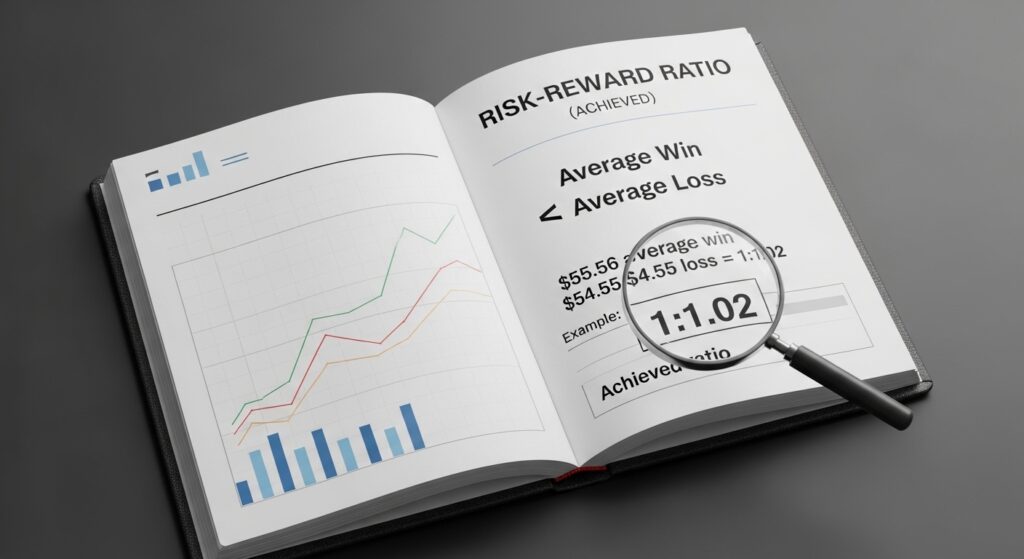
Risk-Reward Ratio (Achieved)
Formula: Average Win ÷ Average Loss
Example: $55.56 average win ÷ $54.55 average loss = 1:1.02 achieved ratio
Compare this to your planned risk-reward ratios. If you plan 1:2 trades but achieve 1:1, you’re exiting winners too early or letting losers run.
How to Review Your Journal
Creating the journal is only half the process—regular review transforms data into improvement.
Daily Review (5 Minutes)
Complete immediately after closing your trading platform:
Questions to Ask:
Did I follow my trading plan today?
Which rules did I break, if any?
What was my emotional state during each trade?
What’s one thing I did well today?
What’s one thing I’ll improve tomorrow?
Action: Make brief notes about any patterns you noticed or concerns to address.
Weekly Review (30-60 Minutes)
Complete every weekend:
Calculate Weekly Metrics:
Win rate for the week
Profit/loss for the week
Number of trades taken
Adherence to plan percentage
Analyze Patterns:
Review each trade from the past week
Identify your best trade and why it worked
Identify your worst trade and what went wrong
Note any repeated mistakes
Action Plan:
Choose one specific behavior to improve next week
Set a concrete goal (e.g., “Wait for confirmation candle before every entry”)
Monthly Review (1-2 Hours)
Complete at month’s end:
Comprehensive Performance Analysis:
Calculate all key metrics for the month
Compare to previous months
Assess progress toward yearly goals
Identify strongest and weakest currency pairs
Determine which setups produced best results
Deep Pattern Analysis:
Group trades by type and analyze each category separately
Examine your emotional patterns across the month
Review your best winning streak and worst losing streak
Calculate metrics by time of day and day of week
Action Plan:
Adjust your trading plan based on data (if warranted)
Set specific goals for next month
Decide whether to change position sizing or leverage
Quarterly Review (2-3 Hours)
Complete every three months:
Strategic Assessment:
Is your trading strategy working?
Are you profitable overall?
What’s your average monthly return?
How does your performance compare to your goals?
Major Decision Points:
Should you continue with your current strategy?
Is it time to increase position sizes?
Do you need additional education or mentoring?
Should you adjust your trading timeframe or style?
Action Plan:
Make significant adjustments to your approach if data supports it
Set goals for next quarter
Identify your top improvement priority for the next 90 days
Sample Journal Entry
Here’s what a complete journal entry looks like:
Trade #73
Date: November 15, 2024 Time: 09:30 EST Pair: EUR/USD Direction: Long
Market Context: Daily timeframe shows established uptrend, pullback to 20 EMA. 4-hour shows bullish divergence on RSI at key support zone (1.0750-1.0760). Low volatility conditions—ATR below 20-day average.
Setup Type: Trend continuation – Pullback to EMA in uptrend
Emotional State: Calm and confident. Setup matches my exact criteria. No pressure to take this trade—waited patiently for 2 days for the pullback to complete. Feeling neutral about outcome; more focused on execution than result.
Exit Information:
Exit Price 1: 1.0820 (55 pips, 50% of position) Exit Time 1: November 16, 14:20 EST Exit Reason 1: Took 50% off at near-target as planned, moved stop to breakeven on remainder
Exit Price 2: 1.0845 (80 pips, remaining 50%) Exit Time 2: November 17, 10:15 EST Exit Reason 2: Hit revised target after strong continuation. Didn’t quite reach full target but took profit when momentum stalled.
Actual Profit: $337.50 (after spread) Actual Risk-Reward Achieved: Approximately 1:2.25
Position Management: Moved stop to breakeven after first target hit as planned. This protected profits on remainder of position. Considered letting it run to full 1:3 target but took profit when 15-minute chart showed potential reversal pattern.
Post-Trade Analysis:
What Went Well: Identified clean setup, waited for confirmation, managed position according to plan. Took 50% at first target (1.0820), moved stop to breakeven on remainder, let it run to near full target. Textbook trade.
What Went Wrong: Nothing significant. Could have held final 50% slightly longer as momentum continued, but taking near full target was correct per plan.
Lessons: When all criteria align and execution is disciplined, trades work. Trust the process. Continue waiting for A+ setups only.
Trade Grade: A (Perfect plan adherence)
This level of detail across 50-100 trades reveals invaluable patterns impossible to identify otherwise.
Common Journaling Mistakes
Avoid these errors that undermine journal effectiveness:
Incomplete Entries
Recording only wins, forgetting to log during busy periods, or skipping sections creates incomplete data that produces misleading analysis.
Solution: Make journaling non-negotiable. Complete your entry immediately after taking the trade, not hours or days later when memory has faded.
Dishonest Entries
Omitting mistakes, exaggerating adherence to rules, or rationalizing poor decisions defeats the journal’s entire purpose.
Solution: Remember that your journal is for your eyes only. Brutal honesty is required. You can’t fix problems you won’t acknowledge.
No Regular Review
Creating entries without ever reviewing them wastes the journal’s value. The insights come from pattern analysis, not just record-keeping.
Solution: Schedule non-negotiable weekly and monthly review sessions. Put them on your calendar like any other important appointment.
Focusing Only on Wins/Losses
Obsessing over profit/loss while ignoring process quality (did you follow your plan?) trains you to focus on outcomes rather than execution.
Solution: Grade trades on process adherence, not just profitability. An “A” trade that loses money is still excellent trading.
Analysis Paralysis
Over-complicating your journal with too many metrics, excessive detail, or complex analysis can make journaling feel overwhelming.
Solution: Start simple. Track the basics, then add complexity only if additional data proves useful.
Using Journal Insights for Improvement
Your journal’s ultimate purpose is driving systematic improvement. Here’s how to translate insights into better trading.
Identify Your Most Profitable Setups
After sufficient trades (50+), calculate win rate and average profit for each setup type you trade.
Example:
Breakout trades: 35% win rate, average $75 per trade
Trend continuation: 55% win rate, average $125 per trade
Reversal trades: 30% win rate, average $50 per trade
Action: Focus on trend continuation setups, reduce or eliminate reversal trades.
Discover Your Optimal Trading Times
Calculate performance metrics by hour of day and day of week.
Example: You discover you’re consistently profitable trading during London session (3am-7am EST) but lose money during afternoon sessions.
Action: Only trade during London session, avoid afternoon trading.
Recognize Emotional Patterns
Review your emotional state entries across all trades.
Example: You notice that trades taken when feeling “excited” have a 25% win rate, while trades taken when feeling “neutral” have a 65% win rate.
Action: Implement a rule: If you feel excited about a trade, wait 15 minutes and reassess whether it still meets all criteria.
Identify Repeated Mistakes
Count how often you make specific errors.
Example: Your journal shows you exit winning trades too early in 40% of trades, costing you an average of $75 per occurrence.
Action: Create a rule: Place take-profit orders at planned targets and don’t manually close unless technical invalidation occurs.
Optimize Position Sizing
Analyze your results at different position sizes.
Example: With 0.5 lots, your average profit is $150 per winning trade with manageable stress. At 1.0 lots, average profit is $300 but stress causes emotional mistakes that reduce overall profitability.
Action: Stick to 0.5 lots until consistent profitability is well-established, even if growth feels slow.
The Financial Conduct Authority notes that proper record-keeping and self-analysis are characteristics that distinguish professional traders from casual participants.
Conclusion
Your forex trading journal represents the most powerful tool in your trading arsenal beyond your strategy itself. It transforms trading from gambling into a systematic, data-driven profession.
Start today. Don’t wait for the “perfect” journal system—begin with a simple spreadsheet tracking basic trade details. Refine your system over time as you discover what data matters most for your improvement.
The traders who keep detailed journals and analyze them regularly improve systematically. Those who don’t remain stuck making the same mistakes indefinitely, wondering why trading is so difficult.
Remember: You can’t improve what you don’t measure. Your journal provides the measurements that enable continuous improvement. Commit to journaling every trade, reviewing regularly, and implementing insights—your future profitable self will thank you.