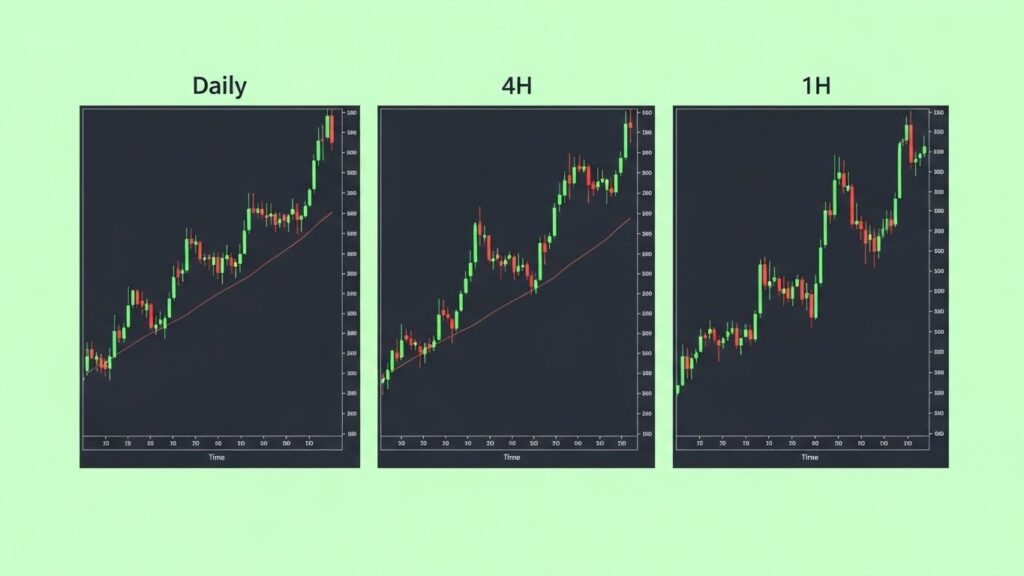
One of the most powerful yet underutilized techniques in forex trading is multiple timeframe analysis. This approach transforms average traders into consistently profitable ones by providing context that single-timeframe analysis cannot offer.
Most struggling traders make decisions based solely on one timeframe—typically a lower one like the 5-minute or 15-minute chart. They enter trades that look perfect on their chosen timeframe, only to get stopped out as larger timeframe trends overpower their positions. They’re essentially making strategic decisions with tactical information.
Multiple timeframe analysis solves this problem by providing a complete market perspective. You identify the larger trend, find high-probability zones within that trend, and execute entries with precise timing. This approach dramatically improves trade selection, increases win rates, and helps you avoid costly mistakes.
This comprehensive guide teaches you exactly how to implement multiple timeframe analysis in your trading. You’ll learn which timeframes to use, how to analyze each one, how to combine insights across timeframes, and how to apply this approach to actual trade setups.
Multiple timeframe analysis is the practice of examining the same currency pair across different timeframes to improve trade accuracy and confidence.
Multiple timeframe analysis (MTFA) is the practice of analyzing the same currency pair across different time periods to gain comprehensive market perspective before making trading decisions.
Rather than relying on a single chart view, you examine how price behaves on longer-term charts (weekly, daily) for overall direction, medium-term charts (4-hour, 1-hour) for trade setup identification, and shorter-term charts (15-minute, 5-minute) for precise entry and exit timing.
Why Multiple Timeframe Analysis Works
Markets move in fractal patterns—similar structures repeat across different timeframes. A downtrend on the daily chart contains smaller uptrends on the 1-hour chart, which themselves contain even smaller downtrends on the 5-minute chart.
Trading without considering multiple timeframes is like reading individual words without understanding the sentence they form. You might know what each word means, but you miss the complete message.
The Core Principle
The fundamental rule of multiple timeframe analysis is simple: Higher timeframes control lower timeframes.
A strong daily uptrend will eventually overpower bearish patterns on the 15-minute chart. Conversely, a convincing 15-minute bullish signal means little if the daily chart shows a powerful downtrend.
By aligning your trades with higher timeframe momentum, you work with market forces rather than against them.
Selecting Your Timeframes
Choosing appropriate timeframes depends on your trading style and how long you typically hold positions.
The Three-Timeframe System
Most traders find success using three timeframes with a 4:1 or 6:1 ratio between each level.
Higher Timeframe (Trend Direction) Determines overall market bias and major support/resistance zones.
Middle Timeframe (Setup Identification) Identifies specific trade setups within the context of the higher timeframe trend.
The Commodity Futures Trading Commission (https://www.cftc.gov) notes that understanding different timeframe perspectives is crucial for informed trading decisions.
Avoid These Timeframe Selection Mistakes
Using Too Many Timeframes Analyzing five or six timeframes creates information overload and analysis paralysis. Stick to three maximum.
Insufficient Separation Between Timeframes Using 15-minute, 30-minute, and 1-hour charts provides too little differentiation. These timeframes are too similar to offer genuinely different perspectives. Maintain at least a 4:1 ratio.
Mixing Conflicting Trading Styles Don’t analyze monthly charts for day trading or 5-minute charts for position trading. Your timeframes must align with your holding period.
The Top-Down Analysis Approach
Multiple timeframe analysis works best using a top-down approach — starting with the highest timeframe to establish direction, then drilling down for entry.
The most effective way to use multiple timeframe analysis follows a systematic top-down process, starting with the highest timeframe and working downward.
Drop to your middle timeframe to find specific trade opportunities within the higher timeframe context.
Wait for Price to Reach Key Levels
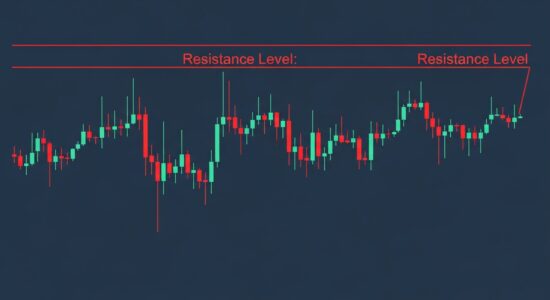
Patience is critical here. Don’t force trades when price is in the middle of nowhere. Wait for price to reach one of your marked support/resistance zones from the higher timeframe analysis.
Look for Setup Patterns
Once price reaches a key level, watch for recognizable patterns:
In Trending Markets: Pullback patterns, continuation flags, consolidation breakouts
In Ranging Markets: Support/resistance bounces, reversal candlestick patterns
Confirm Alignment with Higher Timeframe
Before proceeding, verify that your potential trade direction aligns with the higher timeframe bias. If you’re looking at a bullish setup on the 4-hour chart but the daily chart shows a strong downtrend, reconsider or skip the trade.
Step 3: Lower Timeframe Analysis (Entry Timing)
Move to your lowest timeframe for precise entry, stop-loss placement, and initial profit targets.
Use the lower timeframe to identify logical stop-loss placement:
Below recent swing lows (for long positions)
Above recent swing highs (for short positions)
Beyond chart pattern boundaries
At levels that invalidate your trade thesis
Set Initial Targets
Identify nearby resistance (for longs) or support (for shorts) on the lower timeframe where you might encounter obstacles. This helps you secure partial profits or prepare for potential reversals.
Step 4: Execution and Management
Enter the trade when your lower timeframe provides confirmation. Monitor price behavior across all three timeframes:
Higher timeframe: Ensures the overall bias remains intact
Middle timeframe: Confirms the setup is developing as expected
Lower timeframe: Provides exit signals or opportunities to add to positions
Practical Trading Strategies Using Multiple Timeframes
Let’s examine specific strategies that demonstrate multiple timeframe analysis in action.
Strategy 1: Trend Following with Pullbacks
This strategy trades retracements within established trends—one of the highest-probability setups in trading.
Setup Requirements:
Higher Timeframe (Daily): Established uptrend
Price above 50-period and 200-period moving averages
Series of higher highs and higher lows
Clear upward trajectory
Middle Timeframe (4-Hour): Pullback to support
Price retraces to key support (previous resistance, moving average, Fibonacci level)
Pullback shows signs of exhaustion (decreasing momentum, smaller candles)
Entry: When 1-hour chart shows bullish reversal pattern at the 4-hour support level
Stop-Loss: Below the 4-hour support zone (typically 30-50 pips depending on pair volatility)
First Target: Previous 4-hour swing high
Second Target: Previous daily swing high
Risk-Reward: Minimum 1:2, often 1:3 or better
Example:
EUR/USD daily chart shows a clear uptrend—price at 1.1050, well above the 50-day MA at 1.0950 and 200-day MA at 1.0850. Price has formed higher highs and higher lows for three weeks.
On the 4-hour chart, EUR/USD pulls back to 1.0980, a previous resistance level that now serves as support. This level also aligns with the 50% Fibonacci retracement of the recent rally from 1.0900 to 1.1050. Price forms a bullish engulfing candle at 1.0980.
Dropping to the 1-hour chart, you see that price has formed higher lows over the past four hours at 1.0975, 1.0980, 1.0982. A bullish pin bar forms at 1.0985 with a 15-pip wick below.
Entry: 1.0990 (above the 1-hour pin bar) Stop-Loss: 1.0960 (below 4-hour support zone) = 30 pips First Target: 1.1050 (previous 4-hour swing high) = 60 pips = 1:2 Second Target: 1.1100 (daily resistance) = 110 pips = 1:3.67
Strategy 2: Range Trading at Major Levels
This approach trades bounces from established support and resistance in ranging markets.
Setup Requirements:
Higher Timeframe (Weekly): Defined range
Clear support and resistance levels
Price oscillating between boundaries for several weeks
No strong directional bias
Middle Timeframe (Daily): Approach to boundary
Price reaches support (for longs) or resistance (for shorts)
Multiple tests of the level showing it’s holding
Signs of exhaustion in the move toward the boundary
Entry: When 4-hour chart confirms reversal at weekly support/resistance
Stop-Loss: Beyond the weekly boundary (accounting for false breaks)
Target: Opposite side of the range or significant level between boundaries
Risk-Reward: Usually 1:2 to 1:4 in established ranges
According to the Financial Conduct Authority (https://www.fca.org.uk), traders should understand how price behaves differently in trending versus ranging market conditions.
Strategy 3: Breakout Trading with Multiple Timeframe Confirmation
Trading breakouts with multiple timeframe confirmation dramatically improves success rates.
Setup Requirements:
Higher Timeframe (Daily): Consolidation pattern
Price consolidating in a defined pattern (triangle, rectangle, flag)
Decreasing volatility as consolidation continues
Clear breakout level established
Middle Timeframe (4-Hour): Breakout occurs
Price breaks decisively through consolidation boundary
Strong momentum accompanies breakout
Volume increases (if available)
Lower Timeframe (1-Hour): Pullback and retest
After initial breakout, price pulls back to test broken level
Broken resistance becomes support (or vice versa for bearish breaks)
Level holds on retest with rejection
Trade Execution:
Entry: On 1-hour confirmation that broken level holds as new support/resistance
Stop-Loss: Beyond the retested level
Target: Measured move from consolidation pattern or next major resistance/support
Example:
GBP/USD has been consolidating in a triangle on the daily chart between 1.2800 (resistance) and 1.2650 (support) for three weeks. The triangle apex is approaching.
Price breaks above 1.2800 on the 4-hour chart with a strong bullish candle closing at 1.2825. Volume noticeably increases (if tracking volume).
After moving to 1.2845, price pulls back to 1.2805 on the 1-hour chart, retesting the broken 1.2800 resistance as new support. A bullish pin bar forms at 1.2803 with the wick touching 1.2797.
Entry: 1.2810 (above the 1-hour pin bar, confirming support holds) Stop-Loss: 1.2775 (below the retest low) = 35 pips Target: 1.2950 (measured move: 150-pip triangle height added to breakout point) = 140 pips = 1:4
Strategy 4: Counter-Trend Trading at Extremes
While generally trading with the trend is advisable, multiple timeframe analysis can identify low-risk counter-trend opportunities at extremes.
Setup Requirements:
Higher Timeframe (Daily): Overextended trend
Price far from moving averages (more than 2-3 standard deviations)
RSI showing extreme readings (above 80 or below 20)
Trend running without significant pullbacks for extended period
Middle Timeframe (4-Hour): Exhaustion signals
Momentum divergence (price making new extremes but RSI failing to)
Decreasing size of candles in trend direction
Increasing wicks showing rejection at extremes
Lower Timeframe (1-Hour): Reversal confirmation
Clear reversal patterns forming
Trend in opposite direction beginning on lower timeframe
Price breaking minor trend lines
Trade Execution:
Entry: When 1-hour chart confirms reversal
Stop-Loss: Beyond recent extreme high/low (keep tight—counter-trend trades are risky)
Target: Return to value (major moving averages on daily chart, middle of recent range)
Critical Warning: Counter-trend trading is inherently risky. The trend may resume despite exhaustion signals. Use smaller position sizes and wider risk-reward requirements (minimum 1:3).
Advanced Multiple Timeframe Techniques
Once you’ve mastered basic multiple timeframe analysis, these advanced concepts further refine your approach.
Timeframe Correlation Analysis
Different currency pairs exhibit different timeframe correlation characteristics.
EUR/USD: Shows strong correlation across timeframes. Daily and weekly trends dominate lower timeframe noise. Higher timeframe analysis is especially valuable.
GBP/USD: More volatile with larger lower timeframe movements. Requires patience as lower timeframes can diverge from higher timeframes temporarily before realigning.
USD/JPY: Demonstrates very clean timeframe alignment. Excellent pair for learning multiple timeframe analysis due to clear fractal patterns.
Exotic Pairs: Less reliable timeframe correlation due to lower liquidity. Stick to major pairs when developing your multiple timeframe analysis skills.
Dynamic Timeframe Adjustment
Rather than using fixed timeframes regardless of conditions, adapt based on current market volatility.
Low Volatility Periods:
Use closer timeframe ratios (daily/4-hour/1-hour instead of weekly/daily/4-hour) because price movements are compressed. Tighter timeframe analysis provides necessary detail.
High Volatility Periods:
Expand timeframe separation (weekly/daily/4-hour instead of daily/4-hour/1-hour) because lower timeframes become too noisy. Greater separation filters out excessive volatility.
Use Average True Range (ATR) to assess current volatility and adjust your timeframes accordingly. When ATR is significantly above average, move to higher timeframes.
Multiple Timeframe Fibonacci Analysis
Fibonacci retracements become significantly more powerful when applied across multiple timeframes.
Process:
Draw Fibonacci retracement on higher timeframe from major swing low to high
Draw Fibonacci retracement on middle timeframe from intermediate swing low to high
Draw Fibonacci retracement on lower timeframe from minor swing low to high
Look for Fibonacci Confluence Zones:
Areas where multiple Fibonacci levels from different timeframes converge create extremely high-probability support/resistance zones.
Example:
Daily chart Fibonacci: 61.8% retracement at 1.1190 4-hour chart Fibonacci: 50% retracement at 1.1185 1-hour chart Fibonacci: 38.2% retracement at 1.1195
Confluence zone: 1.1185-1.1195 becomes a powerful support area where three different timeframe Fibonacci levels cluster.
Indicator Confluence Across Timeframes
Using the same indicator across multiple timeframes creates powerful confirmation signals.
This pattern suggests a pullback is concluding. Lower timeframes are reaching oversold while higher timeframes remain neutral, indicating the retracement is exhausting itself and the trend may resume.
Moving Average Example:
Weekly price: Above 50 SMA (uptrend) Daily price: At 50 SMA (pullback to moving average) 4-hour price: Bouncing off 50 SMA (reversal forming)
When all three timeframe 50 SMAs align at the same price level, the confluence creates extremely strong support/resistance.
The National Futures Association (https://www.nfa.futures.org) emphasizes that proper use of technical analysis across timeframes is a hallmark of professional trading.
Common Multiple Timeframe Analysis Mistakes
Most traders applying multiple timeframe analysis make the same errors, and recognizing them early prevents significant losses.
Avoid these frequent errors that undermine the effectiveness of multiple timeframe analysis.
Mistake 1: Trading Against Higher Timeframe Trend
The Error: Taking long trades because the 15-minute chart looks bullish while the daily chart shows a clear, strong downtrend.
Why Traders Do This: Lower timeframe patterns are visually compelling and create urgency. The temptation to trade “what’s happening now” overrides the discipline to respect larger trends.
The Cost: Higher timeframe trends eventually overpower lower timeframe counter-moves, resulting in stopped-out positions and consistent losses.
How to Avoid: Make it an absolute rule: Never trade against the higher timeframe trend. If the daily chart shows a downtrend, only look for short setups on lower timeframes, regardless of how appealing long setups appear.
Mistake 2: Using Too Many Timeframes
The Error: Analyzing five, six, or more timeframes, creating overwhelming amounts of potentially contradictory information.
Why Traders Do This: Belief that more information leads to better decisions, or fear of missing something important.
The Cost: Analysis paralysis where you’re unable to make trading decisions because different timeframes show conflicting signals. Opportunities pass while you’re stuck analyzing.
How to Avoid: Limit yourself to three timeframes maximum. The three-timeframe system provides complete market perspective without information overload.
Mistake 3: Insufficient Timeframe Separation
The Error: Using timeframes too close together, such as 15-minute, 30-minute, and 1-hour charts.
Why Traders Do This: Not understanding that similar timeframes provide similar perspectives rather than genuinely different viewpoints.
The Cost: You think you’re getting multiple perspectives, but you’re really seeing the same information slightly differently. This creates false confidence.
How to Avoid: Maintain minimum 4:1 ratio between timeframes. If using 1-hour charts, your next timeframe up should be 4-hour or daily, not 2-hour.
Mistake 4: Forcing Timeframe Alignment
The Error: Convincing yourself that timeframes align when they don’t, seeing what you want to see rather than what’s actually there.
Why Traders Do This: Wanting to take a trade you’ve already decided on emotionally, then using multiple timeframe analysis to justify it rather than to evaluate it objectively.
The Cost: Taking low-probability trades disguised as high-probability ones, leading to preventable losses.
How to Avoid: Be brutally honest about timeframe alignment. If timeframes don’t clearly align, don’t trade. There will always be another opportunity where alignment is obvious.
Mistake 5: Overcomplicating the Analysis
The Error: Requiring perfect alignment of multiple indicators across all timeframes before entering trades.
Why Traders Do This: Seeking certainty in an uncertain environment, trying to eliminate all risk before trading.
The Cost: You never enter trades because perfect setups don’t exist. Overcomplication leads to missed opportunities and mental exhaustion.
How to Avoid: Keep it simple. Check three timeframes, identify trend and key levels, wait for confirmation. Don’t add layers of unnecessary complexity.
Building Your Multiple Timeframe Analysis Routine
Building a structured routine around multiple timeframe analysis is what separates consistent traders from those who analyze inconsistently.
Develop a systematic approach to implementing multiple timeframe analysis consistently.
Pre-Market Analysis Routine
Step 1: Higher Timeframe Review (10 minutes)
Review weekly or daily charts for all pairs you trade:
Based on higher timeframe analysis, create a focused watchlist:
Pairs showing clear trends where pullbacks might offer entries
Pairs at major support/resistance where bounces might occur
Pairs showing breakout setups developing
Limit your watchlist to 3-5 pairs maximum. Quality over quantity.
Step 3: Alert Setup (5 minutes)
Set price alerts at key levels identified in your higher timeframe analysis:
Major support and resistance zones
Moving averages where pullbacks might end
Breakout levels for consolidation patterns
Let the market come to you rather than watching charts constantly.
Active Trading Routine
When Alert Triggers:
Check middle timeframe (2 minutes): Confirm price behavior at the key level. Is a setup forming?
If setup forming, check lower timeframe (3 minutes): Look for entry confirmation signals.
If confirmation present, execute trade (1 minute): Enter position with predetermined stop-loss and targets.
Total time from alert to trade: 6 minutes
This systematic approach prevents impulsive trading and ensures every trade receives proper multiple timeframe analysis.
Post-Market Review Routine
End of Day Review (15 minutes):
Review all trades taken today:
Did timeframes align properly?
Were entries based on solid lower timeframe confirmation?
Did higher timeframe trends play out as expected?
What worked well? What could improve?
Update your trading journal with multiple timeframe analysis notes for each trade. Over time, patterns will emerge showing which timeframe combinations work best for your style.
Conclusion
Multiple timeframe analysis is one of the most effective ways to filter out low-probability trades and align entries with the dominant market trend.
Multiple timeframe analysis transforms your trading by providing the context that single-timeframe analysis cannot offer. It helps you identify high-probability setups, avoid trades that fight larger trends, and enter positions with precise timing.
The key to successful implementation is systematic application. Don’t analyze multiple timeframes randomly or only when convenient. Make it your standard pre-trade checklist:
What’s the higher timeframe trend?
Where are we relative to major support/resistance?
Is there a setup forming on the middle timeframe?
Does the lower timeframe confirm entry?
When all answers align favorably, you have a high-probability trade. When they don’t align, wait for the next opportunity.
Start with three timeframes appropriate for your trading style. Master the basic top-down approach before exploring advanced techniques. With practice, multiple timeframe analysis becomes second nature—a fundamental skill that separates consistently profitable traders from those who struggle.
Remember that no analysis method eliminates risk or guarantees profits. Multiple timeframe analysis simply helps you make more informed decisions by seeing the complete market picture rather than a narrow slice of it.
For a complete overview of technical analysis and how this indicator fits into a broader trading strategy, see our Technical Analysis Complete Guide.
Traders applying multiple timeframe analysis should ensure their approach aligns with regulatory standards; US traders can review guidelines from the CFTC and NFA, while international traders can refer to the FCA.