Learn How to Make Fast Money by Learning diffrent Strategies in Forex Trading and Different Investment Options
MACD Indicator Guide
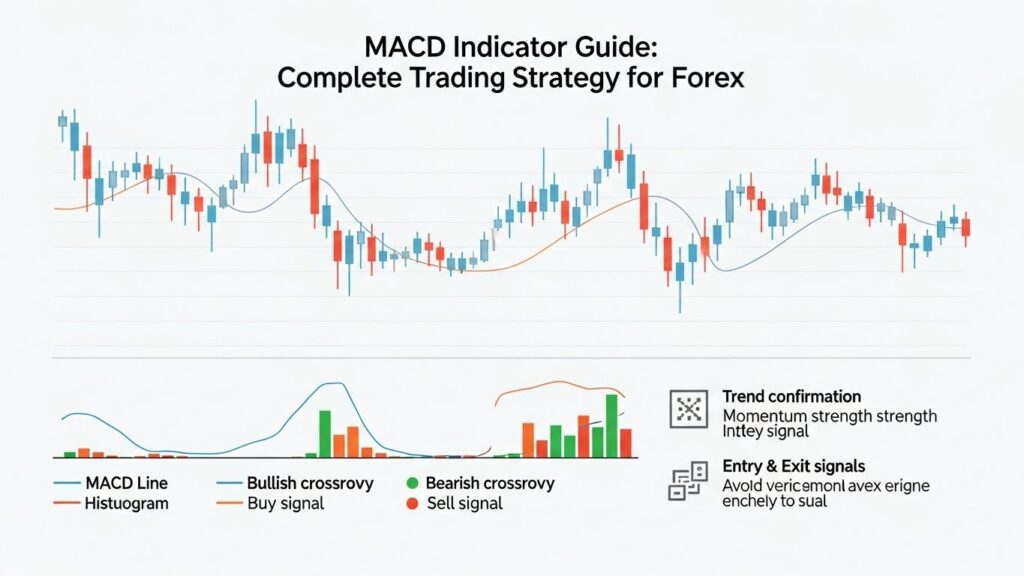
The Moving Average Convergence Divergence (MACD) is one of the most versatile and widely used technical indicators in forex trading. Developed by Gerald Appel in the late 1970s, MACD combines trend-following and momentum characteristics to help traders identify potential entry and exit points, gauge trend strength, and spot potential reversals.
This guide explains what MACD is, how to read its three components (MACD line, signal line, histogram), proven MACD trading strategies including crossovers and divergence, optimal settings for different trading styles, and how to combine MACD with other indicators for robust trade signals.
MACD is a momentum oscillator built from moving averages. Unlike oscillators that range between fixed boundaries (like RSI’s 0-100), MACD Indicator fluctuates above and below a zero line based on the convergence and divergence of two exponential moving averages.
The standard MACD uses three components calculated from closing prices:
MACD Line: The difference between a 12-period EMA and a 26-period EMA. This line shows the relationship between these two moving averages.
Signal Line: A 9-period EMA of the MACD Indicator line itself. This smooths the MACD line and generates trading signals when the two lines cross.
Histogram: The visual representation of the difference between the MACD Indicator line and signal line. Histogram bars grow taller as the lines diverge and shrink as they converge.
When the 12-period EMA rises above the 26-period EMA, the MACD Indicator line crosses above zero, indicating bullish momentum. When the 12-period EMA falls below the 26-period EMA, MACD Indicator crosses below zero, signaling bearish momentum.
Understanding the MACD Indicator Components
Each MACD component provides distinct information:
The MACD Line (Fast Line):
The MACD Indicator line represents the difference between short-term and long-term price momentum. When MACD Indicator is positive (above zero), short-term momentum exceeds long-term momentum, suggesting an uptrend. When MACD is negative (below zero), it indicates downtrend conditions.
The slope and direction of the MACD line reveal momentum strength. A steeply rising MACD line shows strong bullish momentum building. A rapidly falling MACD line indicates intensifying bearish pressure.
The Signal Line (Slow Line):
The signal line smooths the MACD line to filter out noise and generate clearer trading signals. Crossovers between the MACD line and signal line create the most common MACD Indicator trading signals.
When the MACD line crosses above the signal line, it generates a bullish signal. When MACD Indicator crosses below the signal line, it creates a bearish signal.
The Histogram:
The histogram visualizes the distance between the MACD line and signal line. Taller histogram bars indicate the lines are diverging, showing momentum is strengthening. Shrinking histogram bars show the lines are converging, suggesting momentum is weakening.
When histogram bars flip from negative to positive (crossing the zero line from below), it confirms a bullish MACD Indicator crossover. When bars flip from positive to negative, it confirms a bearish crossover.
Traders often watch for histogram peaks and valleys as early warnings that a MACD Indicator crossover signal may be approaching.
The Zero Line:
The zero line represents the point where the 12-period and 26-period EMAs are equal. MACD crossing above zero suggests the shorter-term average has crossed above the longer-term average, confirming an uptrend. MACD crossing below zero confirms a downtrend.
The zero line also acts as a trend filter. Many traders only take long positions when MACD is above zero and only take short positions when MACD is below zero.
MACD Crossover Trading Strategy
The most popular MACD Indicator strategy involves trading the crossovers between the MACD line and signal line:
Bullish Crossover (Signal Line Cross Up):
A bullish crossover occurs when the MACD line crosses above the signal line. This suggests bullish momentum is building and price may rise.
However, not all crossovers are equal. Crossovers that occur below the zero line are weaker signals, often just representing temporary bounces within downtrends. Crossovers above the zero line are stronger, confirming upward momentum within established uptrends.
How to trade bullish crossovers:
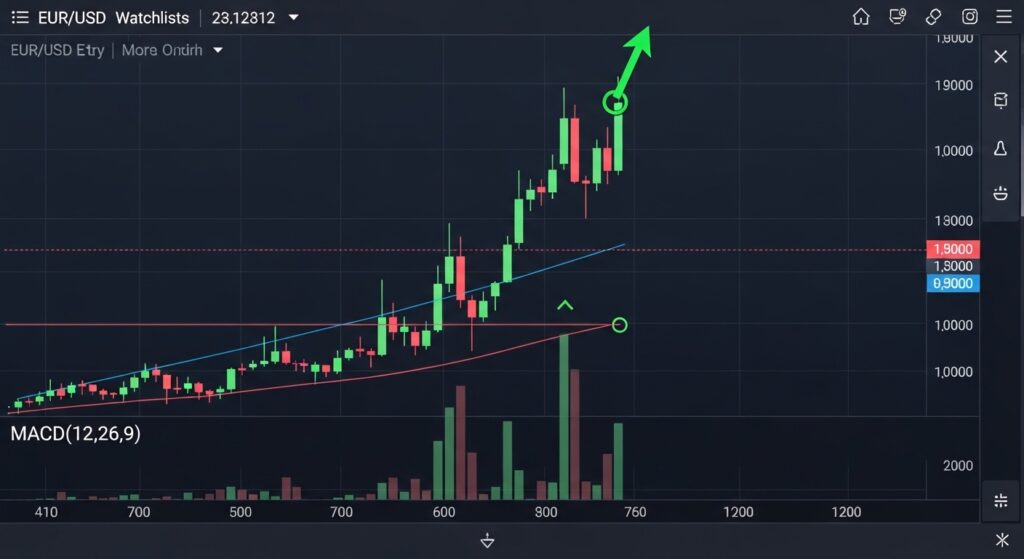
Wait for the MACD line to cross above the signal line. Confirm the crossover is complete (wait for the candle to close). Check that the histogram has turned positive.
For higher probability, enter when crossovers occur above the zero line or after MACD Indicator has already crossed above zero. Add confirmation from price action: look for breaks of resistance, bullish candlestick patterns, or bounces off support levels.
Enter long with stop loss below the recent swing low. Set target at the next resistance level or hold until a bearish crossover occurs.
Bearish Crossover (Signal Line Cross Down):
A bearish crossover occurs when the MACD line crosses below the signal line, suggesting bearish momentum is building.
Crossovers above the zero line are weaker, often representing pullbacks within uptrends. Crossovers below the zero line are stronger, confirming downward momentum within established downtrends.
How to trade bearish crossovers:
Wait for the MACD line to cross below the signal line. Confirm the crossover is complete and histogram has turned negative.
For higher probability, enter when crossovers occur below the zero line or after MACD has already crossed below zero. Add price confirmation: look for breaks of support, bearish reversal patterns, or rejections at resistance.
Enter short with stop loss above the recent swing high. Target the next support level or hold until a bullish crossover forms.
Crossover Limitations:
MACD crossovers lag price action because they’re based on moving averages. By the time a crossover forms, the move may be well underway. Crossovers also generate many false signals during choppy, sideways markets.
Always confirm crossovers with price action, support/resistance levels, or other indicators before entering trades.
MACD Divergence Strategy
MACD divergence between the indicator and price provides some of the most reliable reversal signals:
Bullish Divergence:
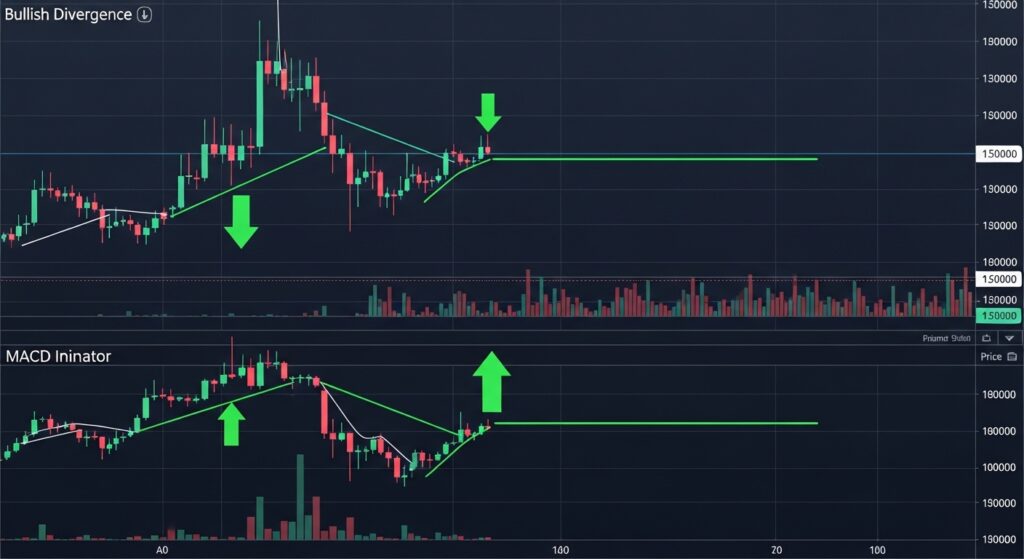
Bullish divergence occurs when price makes a lower low, but MACD Indicator makes a higher low. This shows that although price is declining, downward momentum is weakening.
Bullish divergence often precedes upward reversals. It reveals that sellers are losing strength even as price continues to fall.
How to trade bullish divergence:
Identify price making a lower low compared to a previous low. Confirm MACD made a higher low during the same period. Wait for confirmation: a bullish MACD Indicator crossover, a break above resistance, or a bullish candlestick reversal pattern.
Enter long on confirmation with stop loss below the divergence low. Target previous swing highs or major resistance levels.
Bearish Divergence:
Bearish divergence occurs when price makes a higher high, but MACD makes a lower high. This indicates that although price is rising, upward momentum is fading.
Bearish divergence often precedes downward reversals. It shows buyers are losing strength despite price continuing to advance.
How to trade bearish divergence:
Identify price making a higher high compared to a previous high. Confirm MACD made a lower high during this period. Wait for confirmation: a bearish MACD crossover, a break below support, or a bearish reversal candlestick.
Enter short on confirmation with stop loss above the divergence high. Target previous swing lows or major support levels.
Hidden Divergence:
Hidden divergence signals trend continuation rather than reversal:
Hidden bullish divergence: Price makes a higher low, MACD makes a lower low. This suggests the uptrend will continue after a pullback.
Hidden bearish divergence: Price makes a lower high, MACD makes a higher high. This suggests the downtrend will continue after a bounce.
Divergence Best Practices:
Divergence works best on higher timeframes (4-hour, daily, weekly). Divergence on short timeframes produces frequent false signals.
Always wait for price confirmation before entering. Divergence alone warns of potential reversal but doesn’t guarantee it.
Combine divergence with support/resistance levels for the highest probability setups. When bearish divergence forms at major resistance, or bullish divergence forms at major support, reversal probability increases significantly.
MACD Zero Line Cross Strategy
Trading MACD crosses of the zero line provides clear trend-following signals:
Bullish Zero Line Cross:
When MACD Indicator crosses above the zero line from below, it confirms that the 12-period EMA has crossed above the 26-period EMA. This signals the beginning of a potential uptrend.
Zero line crosses are lagging signals – by the time MACD crosses zero, the trend may be establishing. However, these signals filter out weak moves and keep you aligned with stronger trends.
Trading approach:
Enter long when MACD crosses above zero. Confirm with price action: ensure price is making higher highs and higher lows. Add confirmation from a rising moving average on the price chart.
Hold the position as long as MACD Indicator remains above zero. Exit when MACD crosses back below zero or when a bearish crossover occurs.
Bearish Zero Line Cross:
When MACD crosses below the zero line from above, it confirms the 12-period EMA has crossed below the 26-period EMA, signaling a potential downtrend.
Trading approach:
Enter short when MACD crosses below zero. Confirm price is making lower highs and lower lows. Check that price is below a declining moving average.
Hold the position while MACD Indicator stays below zero. Exit when MACD crosses back above zero or when a bullish crossover forms.
Combining with Crossovers:
For robust signals, combine zero line crosses with crossovers. For example, enter long when MACD Indicator has crossed above zero AND a bullish crossover occurs above the zero line. This provides multiple confirmations of upward momentum.
MACD Histogram Trading
The MACD histogram offers early signals before crossovers occur:
Histogram Divergence:
Watch for divergence between the histogram and price. When price makes a new high but the histogram makes a lower peak, it warns that momentum is fading despite price advances.
Similarly, when price makes a new low but the histogram makes a higher trough, it suggests downward momentum is weakening.
Histogram divergence often precedes MACD line divergence, providing earlier warning signals.
Histogram Peak Detection:
When the histogram reaches a peak and begins declining (bars getting shorter), it signals that the MACD line is converging toward the signal line. A bearish crossover may be approaching.
When the histogram reaches a trough and begins rising (bars getting taller from the negative side), it signals a potential bullish crossover ahead.
Traders use histogram peaks and troughs as advance warning to prepare for crossover signals.
Optimal MACD Settings
The standard MACD Indicator settings (12, 26, 9) work well for most traders, but settings can be adjusted:
Standard Settings (12, 26, 9):
These default settings balance responsiveness and reliability. The 12 and 26 periods roughly represent two and four weeks of trading, while the 9-period signal line smooths nicely.
For most forex traders, stick with standard settings. These are widely used, creating somewhat self-fulfilling signals as many traders worldwide watch the same levels.
Faster Settings (5, 13, 5 or 8, 17, 9):
Shorter periods make MACD more sensitive, generating earlier signals but more false signals.
Day traders and scalpers sometimes use faster settings for quicker responses on short timeframes. The tradeoff is increased whipsaws during choppy conditions.
Slower Settings (19, 39, 9 or 24, 52, 9):
Longer periods smooth MACD more, reducing false signals but creating later entries.
Position traders and swing traders might use slower settings to filter noise and focus on major trend changes. Signals arrive later but with higher reliability.
Testing and Optimization:
If you adjust MACD Indicator settings, test thoroughly on historical data before using live. Avoid over-optimization – settings that work perfectly on past data often fail in real-time.
Consider your trading timeframe when adjusting settings. Faster settings suit shorter timeframes (1-hour and below), while slower settings suit longer timeframes (daily and above).
MACD for Different Trading Styles
Apply MACD differently based on your trading timeframe:
Scalping (1-5 minute charts):
Standard MACD is too slow for scalping. Use faster settings like 5, 13, 5 for quicker signals.
Focus on MACD crossovers aligned with the higher timeframe trend. If the 15-minute or 1-hour chart shows an uptrend, take only bullish crossovers on the scalping timeframe.
Combine with price action and support/resistance for confirmation.
Day Trading (15-minute to 1-hour charts):
Standard MACD (12, 26, 9) works well on these timeframes. Trade crossovers and zero line crosses aligned with the daily trend direction.
Use MACD divergence on the 1-hour chart for potential reversal trades. These setups offer good risk-reward ratios for day trading.
Swing Trading (4-hour to daily charts):
MACD Indicator shines on daily charts for swing trading. Trade zero line crosses and divergence patterns.
Enter swing trades when MACD crosses above zero after being below for an extended period. These often mark the beginning of multi-day or multi-week trends.
Use MACD crossovers on the 4-hour chart for fine-tuning entries within the daily trend.
Position Trading (daily to weekly charts):
Focus on weekly MACD for major trend identification. Zero line crosses on weekly charts signal significant trend changes that can persist for months.
Combine weekly MACD signals with monthly chart context for the highest conviction position trades.
Common MACD Trading Mistakes
Avoid these frequent errors:
Trading Every Crossover:
Taking every MACD crossover without context leads to poor results. Many crossovers fail, especially in sideways markets.
Solution: Filter crossovers using trend context, support/resistance, and other confirmation factors. Only trade crossovers that align with the bigger picture.
Ignoring the Zero Line:
Many traders focus solely on crossovers while ignoring whether MACD is above or below zero. Crossovers below zero during downtrends often fail quickly.
Solution: Use the zero line as a trend filter. Favor long trades when MACD is above zero and short trades when below zero.
Using MACD Indicator Alone:
MACD is a momentum indicator derived from price, meaning it lags. Relying solely on MACD without price action analysis leads to late entries and false signals.
Solution: Combine MACD with support/resistance, candlestick patterns, and moving averages. Use MACD as confirmation, not as your only signal.
Expecting Immediate Results:
MACD signals don’t guarantee instant price movement. Sometimes signals need time to develop or fail entirely.
Solution: Be patient after entering on MACD signals. Use proper stop losses and give trades room to work.
Over-Optimizing Settings:
Constantly changing MACD settings searching for the perfect configuration leads to curve-fitting and poor real-time performance.
Solution: Stick with standard settings or test adjustments thoroughly before using them live. Accept that no settings work perfectly in all market conditions.
MACD with Other Indicators
Combine MACD with complementary indicators for robust signals:
MACD + Moving Averages:
Use the 50 and 200-period moving averages on the price chart to define trend direction. Only take MACD signals that align with the moving average trend.
For example, take MACD bullish crossovers only when price is above the 50 or 200 MA. Take MACD bearish crossovers only when price is below these moving averages.
MACD shows trend direction while RSI measures momentum extremes. Combine them for powerful confirmation.
Example: MACD bullish crossover above zero combined with RSI rising from 40-50 creates a strong long signal. MACD bearish crossover below zero with RSI falling from 50-60 confirms shorts.
The most powerful MACD signals occur at key support or resistance levels. MACD bullish divergence at major support creates high-probability reversal setups. MACD bearish divergence at major resistance warns of potential tops.
Use MACD to identify probable reversal zones, then look for candlestick reversal patterns for precise entries.
Example: MACD shows bullish divergence and crosses above its signal line. When a bullish engulfing pattern forms, this confirms the entry signal with clear risk defined by the pattern.
Place MACD (12, 26, 9) below the price chart. Add the 50-period moving average to the price chart for trend context.
Assume price has been in a downtrend, below the 50 MA, and MACD has been below the zero line for several weeks.
Entry Signal:
Price forms a higher low compared to the previous low, but MACD forms a higher low as well – this is bullish divergence. Price then breaks above the 50 MA, confirming the downtrend may be ending.
MACD line crosses above the signal line while both are still below zero, generating a bullish crossover. The histogram flips positive, confirming the signal.
Additionally, price forms a bullish pin bar (hammer) at a previous resistance level that now acts as support, providing candlestick confirmation.
Enter long on the close of the pin bar. Multiple confirmations align: MACD Indicator bullish crossover, divergence, 50 MA break, and bullish candlestick.
Stop Loss:
Place stop 20-30 pips below the pin bar low. This gives the trade breathing room while limiting risk.
Targets:
Set initial target at the next resistance level identified on the chart. If price reaches this target and MACD Indicator remains strong (still rising, no bearish crossover), consider holding for extended gains.
Exit fully when MACD Indicator generates a bearish crossover or crosses back below the zero line.
Trade Management:
Move stop to breakeven once profit equals initial risk. Trail stop under each new swing low as the uptrend develops.
If MACD crosses below its signal line while in profit, tighten the stop or exit partially to protect gains.
Risk Management:
Risk 1-2% of account capital. Calculate position size based on distance from entry to stop loss.
The MACD indicator combines trend-following and momentum characteristics to provide versatile trading signals. Its three components – MACD line, signal line, and histogram – work together to identify trend direction, momentum strength, and potential reversals.
MACD crossovers generate clear, objective trading signals, though they work best when filtered by context such as zero line position and price structure. MACD divergence between the indicator and price provides some of the most reliable early warning signals of potential reversals, especially on daily and weekly timeframes.
The standard MACD settings (12, 26, 9) work well for most traders across various timeframes. While adjustments are possible, avoid over-optimization and test any changes thoroughly before using them with real capital.
MACD Indicator works best as part of a complete trading system rather than as a standalone signal generator. Combine MACD with price action analysis, support and resistance levels, moving averages, and candlestick patterns for robust trade confirmation.
The indicator’s lagging nature means entries often come after trends begin, but this also filters out false moves and keeps traders aligned with established momentum. Use proper risk management, be patient with signals, and recognize that no indicator works perfectly in all market conditions.
Master MACD Indicator as one tool in your technical analysis toolkit, and you’ll have a reliable method for identifying high-probability trade setups aligned with market momentum. Read more on this and MACD description
For a complete overview of technical analysis and how this indicator fits into a broader trading strategy, see our Technical Analysis Complete Guide.