Support and resistance Trading are the foundation of technical analysis. Understanding these key levels is essential for identifying high-probability trade setups, placing accurate stop-losses, and setting realistic profit targets.
This guide covers everything you need to master support and resistance trading in forex.
Support and resistance trading is one of the most documented concepts in technical analysis, recognized by Investopedia. US forex trading is regulated by the CFTC and NFA, while UK brokers are overseen by the FCA
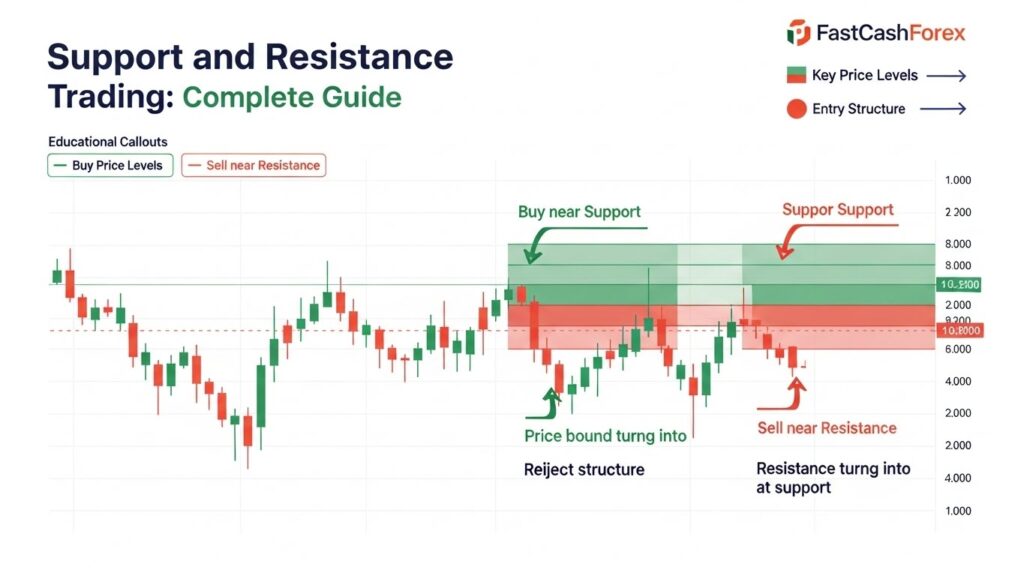
What Are Support and Resistance Trading?
Support: A price level where buying pressure is strong enough to prevent price from falling further.
Resistance: A price level where selling pressure is strong enough to prevent price from rising further.
The Psychology Behind Support and Resistance Trading
Why support holds:
- Buyers remember previous low prices
- Traders place buy orders at proven support
- Previous sellers regret their decision, want back in
- Creates concentration of buy orders
Why resistance holds:
- Sellers remember previous high prices
- Traders place sell orders at proven resistance
- Previous buyers want to breakeven or take profit
- Creates concentration of sell orders
KEY INSIGHT: Support and resistance exist because traders’ decisions create self-fulfilling prophecies at key price levels.
Types of Support and Resistance Trading
1. Horizontal Support and Resistance
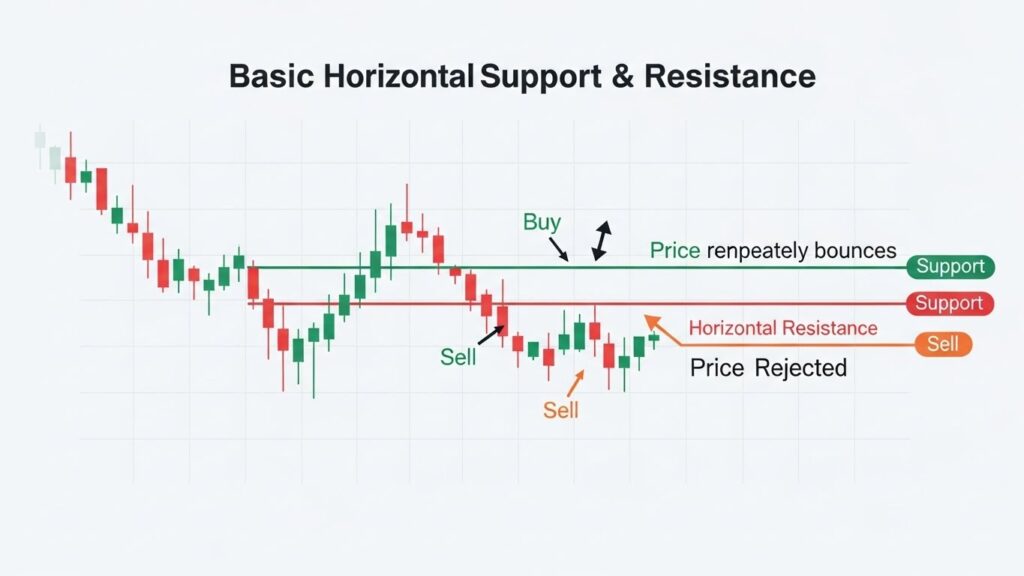
The most common and easiest to identify.
Characteristics:
- Form at specific price levels
- Price bounces multiple times at same level
- Become stronger with more touches
- Work across all timeframes
How to identify:
- Find obvious swing highs and swing lows
- Draw horizontal line at these levels
- Look for multiple touches at same price
- Mark levels that stopped price movement
Strength indicators:
- 2 touches: Potential level
- 3 touches: Confirmed level
- 4+ touches: Very strong level
- 5+ touches: Major level (often breaks on 6th touch)
2. Dynamic Support and Resistance (Moving Averages)
Support and resistance that moves with price.
Common dynamic levels:
- 50 EMA: Popular day trading level
- 200 EMA: Most respected long-term level
- 20 EMA: Short-term support/resistance
Trading dynamic S/R:
- In uptrends: Price bounces off MA (support)
- In downtrends: Price rejected by MA (resistance)
- Strength: Larger timeframe MA = stronger level
Best moving averages for S/R:
| MA Period | Best For | Timeframe |
|---|---|---|
| 20 EMA | Scalping | M5-M15 |
| 50 EMA | Day trading | M15-H1 |
| 100 EMA | Swing trading | H4-Daily |
| 200 EMA | Position trading | Daily-Weekly |
3. Trendlines
Diagonal support and resistance trading following trend direction.
Uptrend line:
- Connect two or more higher lows
- Acts as dynamic support
- Price bounces off trendline
Downtrend line:
- Connect two or more lower highs
- Acts as dynamic resistance
- Price rejected at trendline
Trendline rules:
- Minimum 2 points to draw
- 3 points confirm validity
- More touches = stronger line
- Never force a trendline (must be obvious)
4. Psychological Levels (Round Numbers)
Price levels ending in 00, 50, or major round numbers.
Examples:
- 1.1000, 1.1050, 1.1100 (EUR/USD)
- 110.00, 111.00 (USD/JPY)
- 1.3000, 1.3500 (GBP/USD)
Why they work:
- Traders naturally place orders at round numbers
- Large institutions use round numbers
- Stop-losses clustered at these levels
- Creates concentration of orders
Strength levels:
- x.x000: Strongest (major psychological level)
- x.x500: Strong (half-level)
- x.x50: Moderate
- x.x00: Minor
💡 TIP: Combine psychological levels with horizontal S/R for the strongest setups.
5. Pivot Points
Calculated support and resistance based on previous period’s price.
Standard pivot calculation:
Pivot = (High + Low + Close) ÷ 3
R1 = (2 × Pivot) - Low
S1 = (2 × Pivot) - High
Usage:
- Day traders use daily pivots
- Swing traders use weekly pivots
- Automatic levels, no subjectivity
- Widely watched by traders
Identifying Strong Support and Resistance
Not all S/R levels are equal. Focus on the strongest levels.
Characteristics of Strong Levels
1. Multiple Touches
- Price tested level 3+ times
- Each touch adds strength
- Eventually breaks (nothing holds forever)
2. Strong Reaction
- Price doesn’t slowly approach level
- Quick rejection or bounce
- Large candles at the level
3. High Volume
- Volume spike when price hits level
- Confirms strong buying/selling interest
- More reliable than low-volume levels
4. Confluence (Multiple Factors)
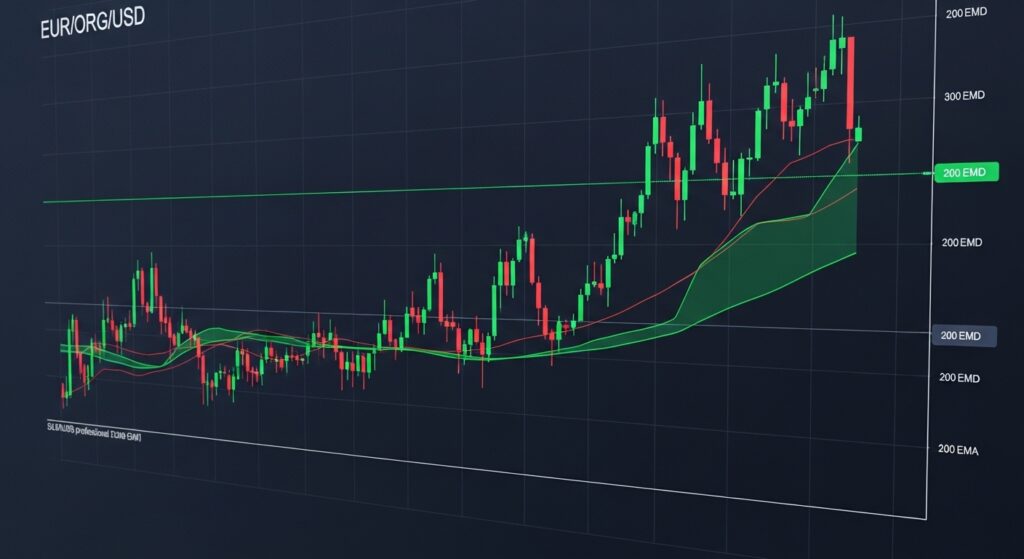
- Horizontal S/R + 200 EMA
- Fibonacci + psychological level
- Trendline + horizontal S/R
- Multiple factors = stronger level
5. Fresh vs. Tested Levels
- Fresh level: Not tested recently (stronger)
- Tested level: Multiple recent touches (weakening)
- General rule: 3rd or 4th test often breaks
How to Prioritize Support and Resistance Levels
Level importance ranking:
| Priority | Type | Example | Strength |
|---|---|---|---|
| 1 | Daily+ horizontal S/R | 3+ touches | Strongest |
| 2 | Weekly pivot points | Calculated levels | Very strong |
| 3 | 200 EMA on H4+ | Moving average | Strong |
| 4 | Major psychological | 1.1000, 1.2000 | Strong |
| 5 | H4 horizontal S/R | 2-3 touches | Moderate |
| 6 | 50 EMA on H1+ | Moving average | Moderate |
| 7 | Minor psychological | 1.1050, 1.1150 | Weak |
Focus your trading:
- Only trade highest-priority levels
- Ignore minor, weak levels
- Mark priority 1-3 levels on your chart
- Clean charts = clear decisions
Support and Resistance Trading Strategies
Strategy 1: The Bounce (Range Trading)
Trade price bouncing off support/resistance in ranging markets.
Setup requirements:
- Clear horizontal support and resistance
- Price ranging between levels (not trending)
- Level tested 2+ times
Entry rules:
At Support (Buy):
- Price approaches support
- Bullish confirmation candle (engulfing, hammer, pin bar)
- Enter at close of confirmation candle
- Stop-loss: 10-20 pips below support
- Take-profit: Near resistance or middle of range
At Resistance (Sell):
- Price approaches resistance
- Bearish confirmation candle (shooting star, bearish engulfing)
- Enter at close of confirmation candle
- Stop-loss: 10-20 pips above resistance
- Take-profit: Near support or middle of range
Best conditions:
- Clear range (minimum 100 pips)
- Low-volatility market
- Multiple touches at both levels
- No major news events
WARNING: Don’t trade bounces in strong trends. Use breakout strategies instead.
Strategy 2: The Breakout
Trade when price breaks through support or resistance.
True breakout characteristics:
- Strong momentum (large candle)
- Increased volume
- Candle closes beyond level (not just wick)
- No immediate return inside range
Breakout entry methods:
Method A: Aggressive (Enter on Break)
- Price breaks support/resistance
- Candle closes beyond level
- Enter immediately at close
- Stop-loss: Back inside range (below resistance, above support)
- Target: Distance of range projected forward
Method B: Conservative (Enter on Retest)
- Price breaks level
- Wait for pullback to broken level
- Old resistance becomes new support (or vice versa)
- Enter at retest
- Stop-loss: Same as aggressive
- Target: Same as aggressive
Breakout advantages:
| Aggressive Entry | Retest Entry |
|---|---|
| Higher win rate | Better R:R ratio |
| Catch full move | Miss some breakouts |
| More false signals | Fewer false signals |
| Tighter stops | Confirmed breakouts |
False breakout filters:
- Wait for candle close beyond level
- Require strong momentum candle
- Check volume (should be higher)
- Watch for quick return (sign of false break)
- Avoid trading in low volatility times
Strategy 3: Role Reversal

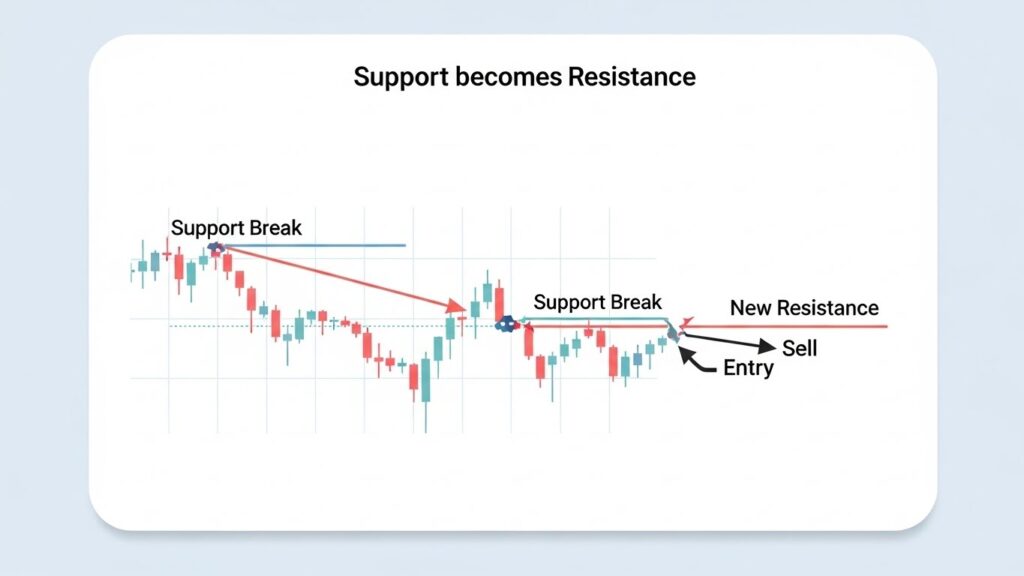
Trading when support becomes resistance (or vice versa).
The concept:
- Price breaks through support
- Old support becomes new resistance
- Sellers defend the broken level
- Creates high-probability short setup
Or the opposite:
- Price breaks through resistance
- Old resistance becomes new support
- Buyers defend the broken level
- Creates high-probability long setup
Entry rules:
- Identify strong S/R break
- Wait for price to return to broken level
- Watch for rejection (confirmation candle)
- Enter in direction of breakout
- Stop-loss: Beyond the broken level
- Target: Next S/R level
Why role reversal works:
- Trapped traders want to exit at breakeven
- New traders join at proven level
- Creates strong defense of the level
- High win-rate strategy
Strategy 4: Support and Resistance Trading Zones
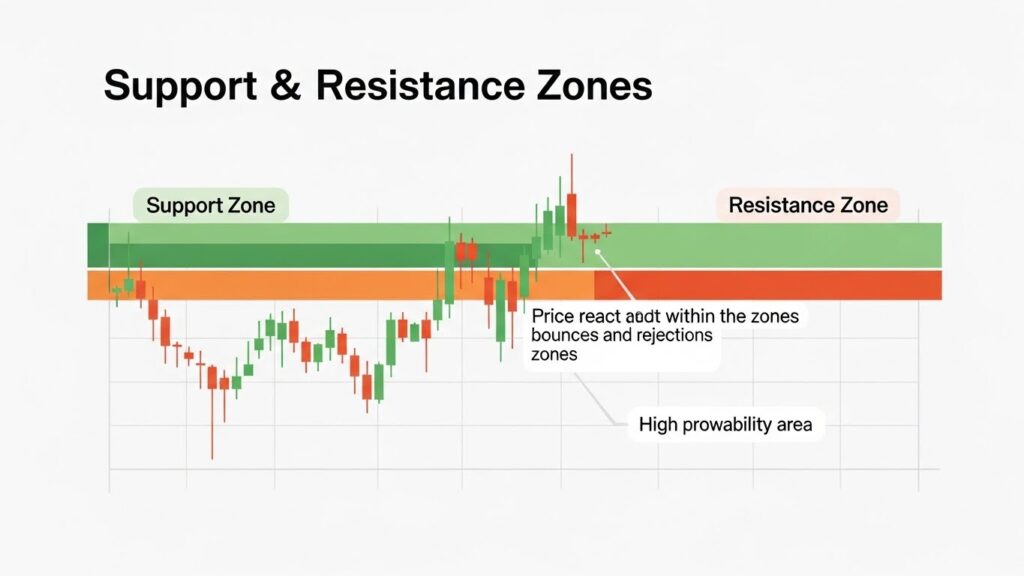
Trading areas rather than exact prices.
Zone concept:
- S/R rarely exact price
- Actually a zone of 10-30 pips
- Price finds support/resistance anywhere in zone
- More flexible, higher success rate
How to draw zones:
- Identify general S/R area
- Find highest high and lowest low in that area
- Draw rectangle connecting these
- Trade within the zone, not exact price
Zone trading rules:
- Enter when price enters zone
- Don’t wait for exact level
- Stop-loss: Beyond the zone
- Adjust for zone width (wider zone = wider stop)
Zone strength:
- Narrow zone (10-20 pips): Strong, precise level
- Medium zone (20-40 pips): Moderate strength
- Wide zone (40+ pips): Weak, avoid trading
Support and Resistance with Confluence
Combining multiple S/R factors creates highest-probability setups.
Types of Confluence
Technical Confluence:
- Horizontal S/R + Trendline
- Fibonacci + Horizontal S/R
- Moving Average + Psychological level
- Pivot Point + Horizontal S/R
Example – Triple Confluence:
- Horizontal support at 1.1000
- 200 EMA at 1.1005
- 61.8% Fibonacci at 1.0998
- Result: Extremely strong support zone (1.0995-1.1005)
Multi-timeframe Confluence:
- Daily S/R + H4 S/R at same level
- Weekly S/R respected on daily chart
- Higher timeframe = stronger level
How to use confluence:
- Mark only high-confluence levels
- Require 2+ factors minimum
- 3+ factors = premium setup
- Ignore isolated single-factor levels
BEST PRACTICE: Only trade S/R with at least 2 confluence factors. This filters out 80% of setups but increases win rate dramatically.

Support and Resistance Mistakes to Avoid
Common S/R Errors
1. Drawing Too Many Lines
- Error: Chart covered in 20+ S/R lines
- Result: Analysis paralysis, no clear levels
- Fix: Mark only 3-5 strongest levels per timeframe
2. Trading Every Touch
- Error: Trading every time price hits S/R
- Result: Overtrading, death by a thousand cuts
- Fix: Wait for confirmation, confluence, and quality setup
3. Ignoring Timeframe Context
- Error: Trading M15 S/R in strong daily trend
- Result: Constant stop-outs, small levels don’t matter
- Fix: Respect higher timeframe S/R first
4. Not Adjusting for Spread
- Error: Support at 1.1000, entry at 1.1000 with 2-pip spread
- Result: Actually entering at 1.1002 (not at support)
- Fix: Enter slightly inside S/R level to account for spread
5. Expecting Perfect Bounces
- Error: Wanting price to hit exact level
- Result: Missing trades, overthinking
- Fix: Use zones, not exact levels
6. No Confirmation
- Error: Entering immediately when price hits S/R
- Result: False signals, premature entries
- Fix: Wait for confirmation candle before entering
7. Moving Levels
- Error: Adjusting S/R lines to fit current price
- Result: Subjective, unreliable levels
- Fix: Mark levels once, never move them
The Reality of Support and Resistance Trading
What S/R CAN do:
- Identify high-probability areas
- Improve entry timing
- Help place stop-losses
- Define profit targets
- Frame trade setup
What S/R CANNOT do:
- Predict exact reversal points
- Work 100% of the time
- Replace risk management
- Guarantee wins
- Make money alone
TRUTH: Even the strongest support and resistance eventually break. Nothing holds forever. Your job is to trade probabilities, not certainties.
Multi-Timeframe Support and Resistance
Trading S/R across multiple timeframes increases accuracy.
The Multi-Timeframe Approach
Three-timeframe system:
- Higher timeframe (HTF): Daily or H4
- Trading timeframe (TF): H1 or H4
- Entry timeframe (LTF): M15 or M5
How it works:
- Identify HTF S/R (daily or H4)
- Wait for price to approach HTF level
- Drop to TF to watch price action
- Use LTF for precise entry timing
Example:
Daily chart (HTF):
- Strong resistance at 1.1200
- Price approaching resistance
H1 chart (TF):
- Bearish candlestick pattern forming
- RSI showing divergence
- Clear rejection from 1.1200
M15 chart (LTF):
- Enter on bearish engulfing candle
- Tight stop-loss above M15 high
- Target daily support below
Multi-Timeframe Rules
Priority order:
- Weekly S/R (strongest)
- Daily S/R (very strong)
- H4 S/R (strong)
- H1 S/R (moderate)
- M15 S/R (weak)
Trading rules:
- Never trade against weekly S/R
- Respect daily S/R at minimum
- Intraday S/R less important
- HTF trumps LTF always
Alignment strategy:
- Wait for LTF S/R near HTF S/R
- Trade only when both align
- Ignore LTF S/R between HTF levels
Support and Resistance Trading Checklist
Before trading any S/R setup:
Level Quality Check
- [ ] Level has 2+ touches
- [ ] Strong rejection/bounce in past
- [ ] On H4 timeframe or higher
- [ ] Clear and obvious (no forcing)
- [ ] Marked before price arrives
Confluence Check
- [ ] Minimum 2 confluence factors
- [ ] HTF S/R aligns with TF S/R
- [ ] Psychological level or Fibonacci
- [ ] Moving average confluence
- [ ] No conflicting nearby levels
Entry Requirements
- [ ] Price approaching level (not already there)
- [ ] Confirmation candle present
- [ ] Risk-reward minimum 1:2
- [ ] Stop-loss beyond the level
- [ ] Market conditions suitable
Trade Management
- [ ] Stop-loss placed before entry
- [ ] Take-profit at logical level
- [ ] Position size calculated
- [ ] No conflicting S/R ahead
- [ ] Plan for breakout scenario
Advanced Support and Resistance Concepts
Order Flow at S/R Levels
Understanding what happens at S/R:
At support:
- Above support: Limit buy orders stacked
- Below support: Stop-loss sell orders from longs
- At support: Battle between buyers and sellers
- Break below: Stop orders trigger, cascade begins
At resistance:
- Below resistance: Limit sell orders stacked
- Above resistance: Stop-loss buy orders from shorts
- At resistance: Battle between buyers and sellers
- Break above: Stop orders trigger, cascade begins
Support and Resistance Trading Strength Degradation
Levels weaken over time and touches.
Degradation factors:
- Each touch weakens the level
- Time since last touch (fresh > stale)
- Number of tests (3-4 = prime breaking point)
- Market conditions (strong trend > ranging)
General guideline:
- 1st touch: 80% hold probability
- 2nd touch: 70% hold probability
- 3rd touch: 60% hold probability
- 4th touch: 50% hold probability (coin flip)
- 5th touch: 40% hold probability (likely breaks)
Strategy adjustment:
- First 2-3 touches: Trade bounces
- 4th touch: Reduce position size
- 5th+ touch: Watch for breakout instead
Conclusion: Master the Basics First
are the foundation of technical analysis. Before studying complex indicators and patterns, master these key concepts.
Key Principles
The essentials:
- Horizontal S/R: Most reliable and simple
- Confluence: Multiple factors = stronger level
- Higher timeframe: Daily S/R > intraday S/R
- Confirmation: Wait for candle confirmation
- Risk management: Perfect S/R means nothing without stops
Remember:
- Clean charts beat cluttered charts
- 3-5 levels better than 20+ levels
- Quality setups beat quantity
- No level holds forever
- Probabilities, not certainties
Start simple:
- Mark only obvious daily horizontal S/R
- Add 200 EMA for dynamic S/R
- Wait for price to approach
- Confirm with candlestick pattern
- Trade with proper risk management
Master horizontal support and resistance first. Once profitable with basics, add confluence factors and advanced strategies.
The best S/R traders use simple, clean charts and trade only the obvious levels. Complexity comes from discipline and patience, not from adding more lines.
New to forex trading? Start with our beginner’s guide to build a solid foundation
For a complete overview of technical analysis and how this indicator fits into a broader trading strategy, see our Technical Analysis Complete Guide
Related Posts:




Powered by Contextual Related Posts