
Chart patterns in Forex a visual formations that appear on price charts and signal potential market reversals or continuations. These patterns reflect market psychology and help traders anticipate future price movements.
This comprehensive guide covers the most reliable and profitable forex chart patterns.
Understanding Chart Patterns in Forex
Chart patterns in forex are a core component of technical analysis. For additional pattern reference, the CMC Markets chart patterns guide and Investopedia are excellent resources.
Chart patterns form when price creates recognizable shapes that historically lead to specific outcomes. They work because:
Market psychology repeats:
- Fear and greed create predictable behaviors
- Traders react similarly to similar conditions
- Patterns become self-fulfilling prophecies
Supply and demand dynamics:
- Chart Patterns in forex show shifts in buying/selling pressure
- Accumulation and distribution phases
- Balance between bulls and bears
Two Types of Chart Patterns
1. Reversal Patterns
- Signal trend changes
- Form at tops or bottoms
- Examples: Head and Shoulders, Double Top/Bottom
2. Continuation Patterns
- Signal trend will continue
- Form during consolidations
- Examples: Flags, Pennants, Triangles
💡 KEY INSIGHT: Chart patterns work best on higher timeframes (H4, Daily, Weekly). Lower timeframes have more false patterns.
Reversal Patterns
These chart patterns in forex signal that the current trend is ending and a new trend may begin.
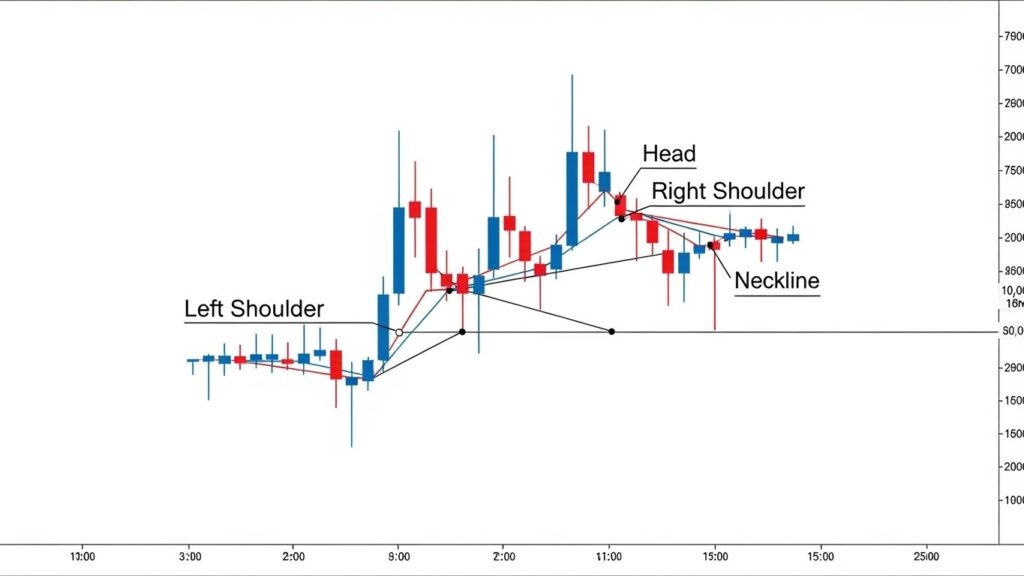
Head and Shoulders (Bearish Reversal)
The most reliable bearish reversal pattern.
Chart Patterns in forex structure:
- Left Shoulder: Price rises to peak, then falls
- Head: Price rises higher than left shoulder, then falls
- Right Shoulder: Price rises again (lower than head), then falls
- Neckline: Support line connecting lows
Trading the pattern:
- Entry: Break below neckline
- Stop-loss: Above right shoulder
- Target: Distance from head to neckline, projected downward
Confirmation signals:
- Volume decreases on right shoulder
- Clean, symmetrical shoulders
- Clear neckline (not jagged)
- Break occurs with volume increase
Success rate: 70-80% when properly identified
Inverse Head and Shoulders (Bullish Reversal)
Mirror image of Head and Shoulders, signals bullish reversal.
Pattern structure:
- Left Shoulder: Price falls to low, then rises
- Head: Price falls lower than left shoulder, then rises
- Right Shoulder: Price falls again (higher than head), then rises
- Neckline: Resistance line connecting highs
Trading the pattern:
- Entry: Break above neckline
- Stop-loss: Below right shoulder
- Target: Distance from head to neckline, projected upward
Best conditions:
- Forms after extended downtrend
- Clear, defined neckline
- Right shoulder volume lower than left
- Breakout with strong candle
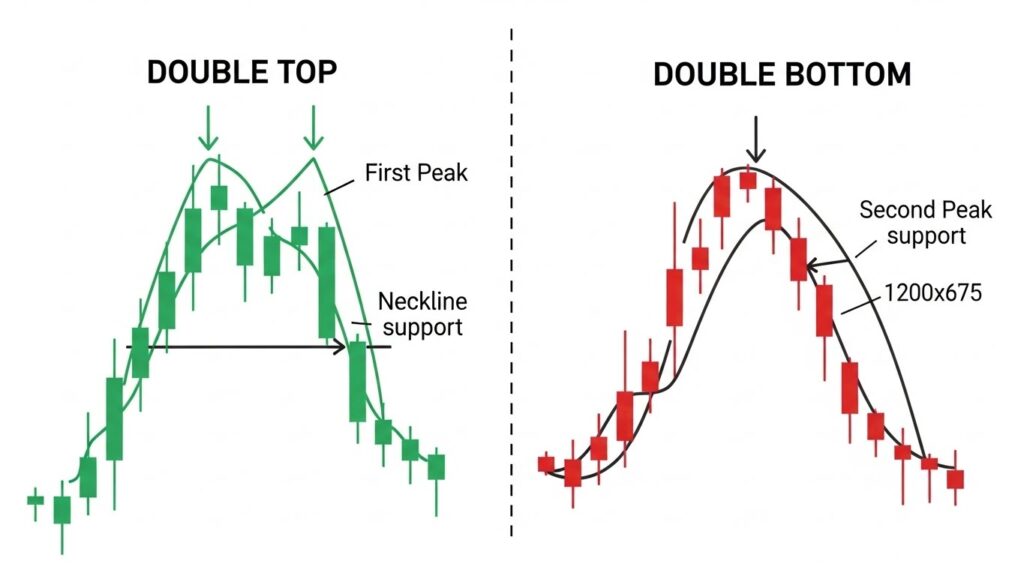
Double Top (Bearish Reversal)
Price tests resistance twice, fails both times, then reverses.
Pattern characteristics:
- Two peaks at approximately same level
- Valley between peaks (support level)
- Second peak often slightly lower than first
- Forms after uptrend
Pattern stages:
- First Peak: Price hits resistance, rejected
- Pullback: Price falls to support
- Second Peak: Price returns to resistance, rejected again
- Break: Price breaks below support level
Trading rules:
- Entry: Break below valley support (neckline)
- Stop-loss: Above second peak
- Target: Height of pattern projected downward
Confirmation requirements:
- Similar peak heights (within 2-3%)
- Minimum 10-15% decline between peaks
- Second peak lower volume than first
- Clean break below neckline
Common mistake: Trading before confirmation (break below support)
Double Bottom (Bullish Reversal)
Mirror of Double Top, signals bullish reversal.
Patterns characteristics:
- Two troughs at approximately same level
- Peak between troughs (resistance level)
- Second trough often slightly higher than first
- Forms after downtrend
Trading rules:
- Entry: Break above peak resistance (neckline)
- Stop-loss: Below second bottom
- Target: Height of pattern projected upward
Strongest signals:
- Clear downtrend before pattern
- Equal or nearly equal lows
- Significant rally between bottoms (10%+)
- Volume increases on breakout
💡 TIP: Double tops/bottoms need clear, defined necklines. If the middle support/resistance is unclear, the pattern is less reliable.
Triple Top and Triple Bottom
Extension of double tops/bottoms with three tests.
Triple Top:
- Three peaks at similar level
- Bearish reversal after uptrend
- Each peak rejected at resistance
- Break below support triggers sell
Triple Bottom:
- Three troughs at similar level
- Bullish reversal after downtrend
- Each trough supported at same level
- Break above resistance triggers buy
Trading approach:
- Same as double patterns
- Considered more reliable (more tests)
- Less common than double patterns
- Often leads to larger moves
Success rate: 75-85% with proper identification
Continuation Patterns
These chart patterns in forex indicate the current trend will resume after a brief consolidation.
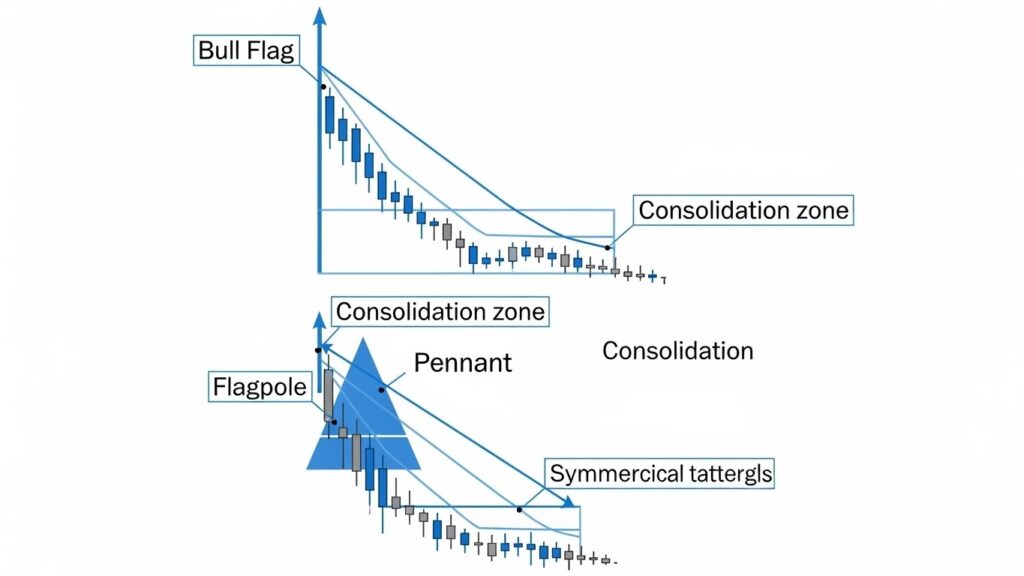
Flags (Bullish and Bearish)
Sharp price movement followed by brief rectangular consolidation.
Bullish Flag:
- Strong upward move (flagpole)
- Brief downward/sideways consolidation (flag)
- Consolidation channel slopes down slightly
- Breakout resumes uptrend
Bearish Flag:
- Strong downward move (flagpole)
- Brief upward/sideways consolidation (flag)
- Consolidation channel slopes up slightly
- Breakdown resumes downtrend
Trading flags:
- Entry: Break out of flag in trend direction
- Stop-loss: Opposite side of flag
- Target: Length of flagpole projected from breakout
Key characteristics:
- Forms in 1-3 weeks (short consolidation)
- Flag slopes against trend direction
- Low volume during consolidation
- Volume spike on breakout
High probability when:
- Strong, clear flagpole (minimum 100 pips)
- Tight, parallel consolidation
- Breaks within 1-3 weeks
- Occurs mid-trend (not at extreme)
Pennants
Similar to flags but triangular consolidation instead of rectangular.
Pattern characteristics:
- Strong directional move (flagpole)
- Converging trendlines (triangle)
- Consolidation lasts 1-3 weeks
- Breakout continues original trend
Difference from flags:
| Feature | Flag | Pennant |
|---|---|---|
| Shape | Rectangle | Triangle |
| Trendlines | Parallel | Converging |
| Duration | 1-4 weeks | 1-2 weeks |
| Reliability | High | Very high |
Trading approach:
- Same as flags
- Tighter consolidation = stronger breakout
- Wait for decisive break (avoid false breaks)
Wedges (Rising and Falling)
Converging trendlines that slope in one direction.
Rising Wedge (Bearish)
- Both trendlines slope upward
- Upper trendline less steep than lower
- Forms during uptrends
- Signals bearish reversal or correction
Falling Wedge (Bullish)
- Both trendlines slope downward
- Lower trendline less steep than upper
- Forms during downtrends
- Signals bullish reversal or bounce
Important distinction:
- In uptrend: Rising wedge = bearish (reversal pattern)
- In downtrend: Falling wedge = bullish (reversal pattern)
- Context matters for wedges
Trading wedges:
- Entry: Break of lower trendline (rising) or upper trendline (falling)
- Stop-loss: Opposite side of wedge
- Target: Height of wedge at widest point
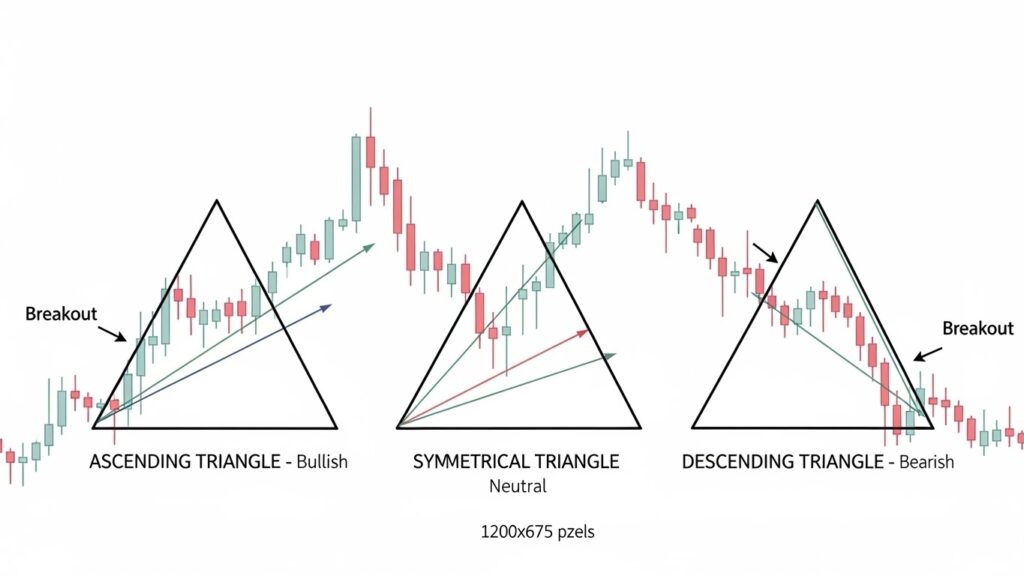
Triangle Patterns
Price consolidates between converging trendlines, indicating indecision.
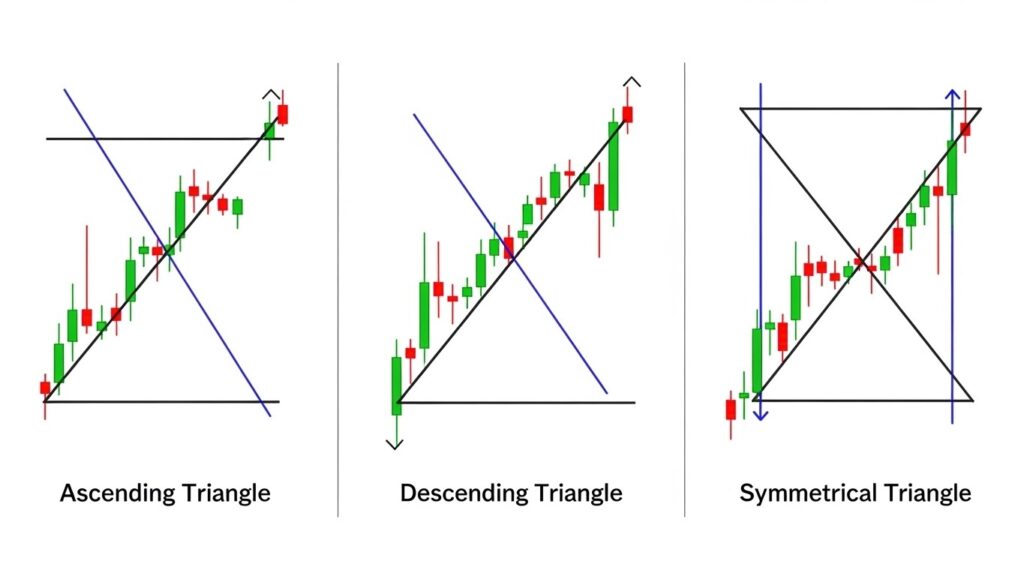
Symmetrical Triangle
Converging trendlines with lower highs and higher lows.
Pattern characteristics:
- Neutral pattern (can break either direction)
- Forms during consolidation
- Trendlines converge at similar angle
- Typically continuation pattern
Trading strategy:
- Direction: Follow the trend before triangle
- Entry: Break above/below triangle
- Stop-loss: Opposite side of triangle
- Target: Width of triangle projected from breakout
Confirmation signals:
- Breaks before reaching apex (70% of width)
- Volume decreases during consolidation
- Volume increases on breakout
- Clean, decisive break (not false break)
Ascending Triangle (Bullish)
Flat top resistance with rising support line.
Pattern characteristics:
- Horizontal resistance (supply level)
- Rising support (increasing demand)
- Typically bullish continuation
- Buyers becoming more aggressive
Trading approach:
- Entry: Break above horizontal resistance
- Stop-loss: Below most recent higher low
- Target: Height of triangle at widest point
Best conditions:
- Forms in uptrend
- Multiple tests of horizontal resistance (3-4)
- Each low higher than previous
- Volume contracts then expands on break
Success rate: 70-75% bullish breakouts
Descending Triangle (Bearish)
Flat bottom support with falling resistance line.
Pattern characteristics:
- Horizontal support (demand level)
- Falling resistance (decreasing buying interest)
- Typically bearish continuation
- Sellers becoming more aggressive
Trading approach:
- Entry: Break below horizontal support
- Stop-loss: Above most recent lower high
- Target: Height of triangle at widest point
Confirmation needed:
- Forms in downtrend
- Multiple tests of horizontal support
- Each high lower than previous
- Clean break with volume
Success rate: 65-70% bearish breakouts
WARNING: Triangles can break in either direction. Always wait for confirmed breakout before entering. False breaks are common.
Rectangle Patterns
Price oscillates between horizontal support and resistance.
Trading Range / Rectangle
Clear horizontal support and resistance with price bouncing between.
Pattern characteristics:
- Horizontal support and resistance
- Price ranges between levels
- Typically continuation pattern
- Shows consolidation before next move
Two trading approaches:
Method 1: Range Trading
- Buy at support
- Sell at resistance
- Trade bounces
- Exit before breakout
Method 2: Breakout Trading
- Wait for break above resistance or below support
- Enter on breakout
- Target: Height of range projected from break
- Stop: Opposite side of range
Rectangle rules:
- Minimum 2 touches each side
- Clear, horizontal levels
- At least 100 pips between support/resistance
- Forms over 2-4 weeks minimum
Breakout direction:
- Usually continues previous trend
- Look for volume clues
- Watch for false breaks
- Confirm with candle close beyond level
Chart Pattern Trading Rules
Pattern Validity Requirements
For reliable patterns:
- Clear Structure
- Pattern obvious and clean
- Trendlines touch multiple points
- No forcing or “seeing what you want”
- Appropriate Timeframe
- H4 minimum for reliability
- Daily and weekly most reliable
- M15/M5 too noisy (false patterns)
- Sufficient Size
- Minimum 100-200 pips height
- Larger patterns = more reliable
- Tiny patterns unreliable
- Volume Confirmation
- Decreased during pattern formation
- Increased on breakout
- Not always available in forex (use wisely)
- Trend Context
- Reversal patterns need clear trend before
- Continuation patterns need prior trend
- Pattern without context less reliable
Entry and Exit Rules
Entry timing:
Conservative (Higher success rate):
- Wait for candle close beyond pattern
- Enter on retest of broken level
- Miss some breakouts but fewer false signals
Aggressive (Catch full move):
- Enter on break of pattern
- Don’t wait for retest
- Higher false signal rate
Stop-loss placement:
- Beyond pattern boundary
- Account for spread and volatility
- Use ATR for appropriate distance
Take-profit targets:
- Method 1: Measured move (pattern height projected)
- Method 2: Next significant S/R level
- Method 3: Fixed R:R ratio (1:2 minimum)
Pattern Trading Mistakes
Common errors:
1. Seeing Patterns Everywhere
- Error: Finding patterns in every consolidation
- Fix: Pattern must be obvious to multiple traders
2. Trading Before Confirmation
- Error: Anticipating breakout
- Fix: Wait for clean candle close beyond pattern
3. Ignoring Failed Patterns
- Error: Holding losing trade hoping pattern “will work”
- Fix: Cut losses if pattern invalidated
4. Wrong Timeframe
- Error: Trading M15 patterns as if reliable
- Fix: Use H4+ for pattern trading
5. No Context
- Error: Trading pattern without checking trend
- Fix: Understand where pattern forms in bigger picture
6. Over-Reliance on Patterns
- Error: Trading patterns alone, ignoring everything else
- Fix: Combine with S/R, indicators, risk management
Advanced Pattern Trading
Multi-Timeframe Pattern Analysis
Approach:
- Higher timeframe (Daily): Identify major patterns
- Trading timeframe (H4): Confirm pattern structure
- Entry timeframe (H1): Time precise entry
Example:
- Daily: Head and Shoulders forming
- H4: Right shoulder complete, breaking neckline
- H1: Enter on retest of broken neckline
Pattern Combinations
Strongest setups combine multiple factors:
Example setup:
- Pattern: Ascending triangle (bullish)
- Location: At 61.8% Fibonacci retracement
- Confluence: 200 EMA nearby
- Indicator: RSI bullish divergence
- Result: Extremely high-probability setup
Failed Pattern Trading
When patterns fail, they often lead to strong moves in opposite direction.
Failed pattern rules:
- Pattern breaks one direction
- Quickly reverses back inside
- Becomes setup for opposite direction
- Often more powerful than original setup
Trading failed patterns:
- Identify false breakout
- Wait for return inside pattern
- Take position opposite to failed break
- Target opposite side of pattern
Pattern Success Rates
Understanding realistic expectations:
| Pattern | Success Rate | Avg Move | Best Timeframe |
|---|---|---|---|
| Head & Shoulders | 70-80% | 15-25% | Daily, Weekly |
| Double Top/Bottom | 65-75% | 10-20% | H4, Daily |
| Flags | 70-80% | 50-100% | All timeframes |
| Pennants | 75-85% | 50-100% | H4, Daily |
| Symmetrical Triangle | 55-65% | 10-15% | H4, Daily |
| Ascending Triangle | 70-75% | 15-25% | H4, Daily |
| Descending Triangle | 65-70% | 15-25% | H4, Daily |
| Rectangles | 60-70% | 10-20% | Daily, Weekly |
Key insights:
- No pattern works 100% of time
- Higher timeframes = higher success rates
- Larger patterns = more reliable
- Confirmation improves success rate
Pattern Trading Checklist
Before trading any chart pattern:
Pattern Identification
- [ ] Pattern clear and obvious
- [ ] Appropriate timeframe (H4+)
- [ ] Sufficient size (100+ pips)
- [ ] Proper structure (all components present)
- [ ] Fits category (reversal vs continuation)
Context Check
- [ ] Trend before pattern identified
- [ ] Pattern makes sense in context
- [ ] Not at extreme overextension
- [ ] S/R levels align
- [ ] No conflicting patterns
Confirmation Requirements
- [ ] Breakout candle close beyond pattern
- [ ] Volume increase on breakout (if available)
- [ ] No immediate return inside pattern
- [ ] Momentum confirms direction
- [ ] Risk-reward minimum 1:2
Trade Management
- [ ] Entry point defined
- [ ] Stop-loss beyond pattern
- [ ] Take-profit calculated
- [ ] Position size appropriate
- [ ] Plan for failed pattern
Conclusion: Patterns as Part of Strategy
Chart patterns in forex are powerful tools but not magic formulas. Success requires:
Essential principles:
- Higher timeframes: H4, Daily, Weekly most reliable
- Clear patterns: If questionable, it’s not a pattern
- Confirmation: Wait for breakout, don’t anticipate
- Context matters: Pattern + trend + S/R = best setups
- Risk management: No pattern eliminates need for stops
The reality:
- Patterns reflect mass psychology
- Work because traders act on them
- Not 100% accurate
- Require patience and discipline
- Part of complete trading system
Best approach:
- Master 3-4 patterns thoroughly
- Focus on high-probability setups
- Combine with S/R and indicators
- Always use risk management
- Track results and refine
Chart patterns in forex work when part of complete strategy. Don’t trade patterns in isolation. Combine pattern recognition with trend analysis, support/resistance, and proper risk management for consistent success.
Start simple. Master basics. Build from there.
For a complete overview of technical analysis and how this indicator fits into a broader trading strategy, see our Technical Analysis Complete Guide
Related Posts:






Powered by Contextual Related Posts