How to set stop loss and take profit? Stop loss and take profit orders are the two most critical risk management tools in forex trading. A stop loss automatically closes your position when price moves against you by a predetermined amount, limiting your loss. A take profit automatically closes your position when price reaches your profit target, locking in gains without requiring constant monitoring.

Every professional trader uses stop losses on every trade without exception. The difference between profitable traders and those who blow their accounts often comes down to disciplined stop loss usage. Without stop losses, a single trade can destroy months or years of profitable trading when the market moves sharply against you.
Take profit orders serve a different but equally important function—they remove emotion from profit-taking decisions and ensure you actually capture gains when your analysis proves correct. Many traders watch profits evaporate because they don’t take profit at logical levels, hoping for even larger gains that never materialize.
This comprehensive guide explains everything you need to know about stop losses and take profit orders: what they are, how to set stop loss and take profit correctly, optimal placement strategies for different trading styles, how to calculate proper sizes, common mistakes that cost traders money, and advanced techniques used by professionals.
What Are Stop Loss and Take Profit Orders
Stop loss and take profit orders are automated instructions that close your positions when certain price levels are reached.
how to set stop loss and take profit? Stop Loss Orders
A stop loss is a protective order placed on an open position that automatically closes the trade if price moves against you to a specified level. This limits your potential loss on the trade to a predetermined amount.
How it works:
- You buy EUR/USD at 1.0850
- You place a stop loss at 1.0800 (50 pips below entry)
- If price falls to 1.0800, your position automatically closes
- Your loss is limited to 50 pips regardless of how much further price falls
Without a stop loss, if EUR/USD continued falling to 1.0700, you’d lose 150 pips instead of just 50 pips. The stop loss protects you from catastrophic losses.
Take Profit Orders
A take profit order automatically closes your position when price reaches your profit target. This ensures you capture gains when your analysis proves correct.
How it works:
- You buy EUR/USD at 1.0850
- You place a take profit at 1.0950 (100 pips above entry)
- If price rises to 1.0950, your position automatically closes
- Your profit is locked in at 100 pips
Without a take profit, you might watch price reach 1.0950, hesitate to take profit hoping for more, then watch price reverse back down, turning a winning trade into a loser.
The Commodity Futures Trading Commission requires forex brokers to ensure traders understand order types including stop losses and take profits, as these are fundamental risk management tools.
For more on order mechanics, see our guide on forex order types explained.
Why Stop Losses Are Essential
Stop losses aren’t optional for serious traders—they’re mandatory for survival in forex markets.
Protection Against Catastrophic Losses
Markets can move violently and unpredictably. Without stop losses, what should be a manageable 30-pip loss can become a 300-pip account-destroying disaster.
Real Example: Swiss Franc Crisis (January 2015)
- EUR/CHF moved 3,000+ pips in minutes when Swiss National Bank removed currency peg
- Traders without stop losses lost entire accounts instantly
- Some accounts went negative, owing brokers money
- Traders with stop losses survived (though many experienced slippage)
While such extreme events are rare, smaller versions happen regularly around major news releases or during thin liquidity periods.
Enforced Discipline
Stop losses remove emotion from the most difficult trading decision—admitting you’re wrong and taking a loss. Without predetermined stop losses, traders rationalize holding losing positions, hoping for reversals that often don’t come.
Psychology Without Stop Loss:
- “It will come back”
- “Let me give it a bit more room”
- “I can’t take the loss now, I’ll wait”
- Position moves further against you
- Small loss becomes large loss
Psychology With Stop Loss:
- Stop triggers automatically
- Loss is predetermined and acceptable
- You move on to the next trade
- Emotions don’t interfere with risk management
Capital Preservation
Your trading capital is your business inventory. Stop losses ensure no single trade can destroy your business. Professional traders typically risk only 1-2% of capital per trade, enforced through proper stop loss placement.
Example: $10,000 Account
- Risk per trade: 1% = $100
- Stop loss: 50 pips
- Position size: $100 ÷ 50 pips = $2 per pip = 2 mini lots
Even if you have 10 consecutive losing trades (rare but possible), you’d lose only $1,000 (10%), leaving $9,000 to continue trading. Without stop losses, those same 10 trades could potentially destroy your entire account.
For comprehensive risk principles, review our forex risk management guide.
Portfolio Risk Management
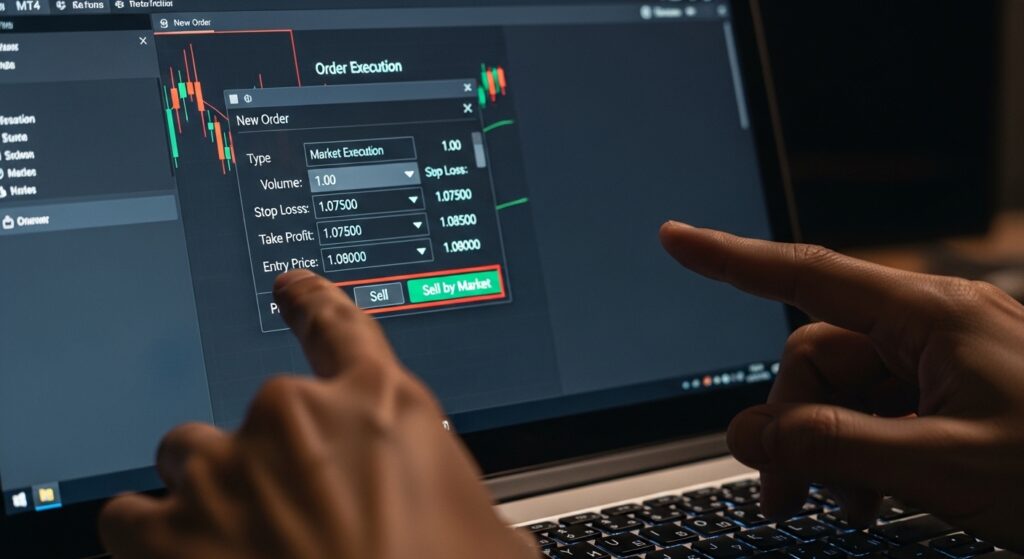
When trading multiple positions simultaneously, stop losses ensure your total portfolio risk stays within acceptable limits. Each position has a defined maximum loss, allowing you to calculate total portfolio exposure accurately.
The National Futures Association emphasizes that stop loss orders are a critical component of sound risk management for retail forex traders.
How to Calculate Stop Loss Distance
Determining the appropriate stop loss distance involves balancing several factors: your risk tolerance, market volatility, and technical analysis.
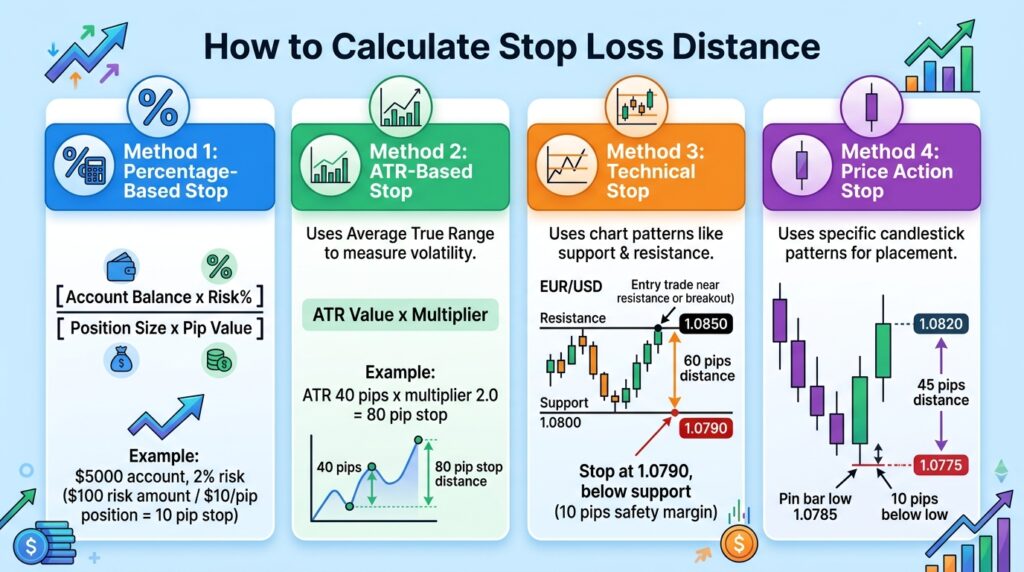
Method 1: Percentage-Based Stop Loss
Calculate stop loss based on the percentage of your account you’re willing to risk on the trade.
Formula: Stop Loss Distance (pips) = (Account Balance × Risk %) ÷ (Position Size × Pip Value)
Example:
- Account: $5,000
- Risk: 2% = $100
- Position: 1 standard lot EUR/USD
- Pip value: $10
Stop Loss = $100 ÷ (1 × $10) = 10 pips
This 10-pip stop might be too tight for most strategies. If so, you’d reduce position size:
With 50-pip stop: Position Size = $100 ÷ (50 pips × $10 per pip) = $100 ÷ $500 = 0.2 lots
This percentage-based approach ensures consistent risk across all trades regardless of pair or timeframe.
Understanding what is a lot in forex helps you adjust position sizes to achieve desired stop loss distances.
Method 2: ATR-Based Stop Loss
Average True Range (ATR) measures typical market volatility. Setting stops based on ATR ensures your stop accommodates normal price fluctuations without being too tight or too loose.
Formula: Stop Loss Distance = ATR × Multiplier (typically 1.5 to 2.5)
Example:
- EUR/USD 4-hour chart
- ATR = 40 pips
- Multiplier: 2.0
- Stop Loss = 40 × 2.0 = 80 pips
This approach adapts automatically to changing market conditions. During quiet periods, ATR decreases and stops tighten. During volatile periods, ATR increases and stops widen appropriately.
Method 3: Technical Stop Loss
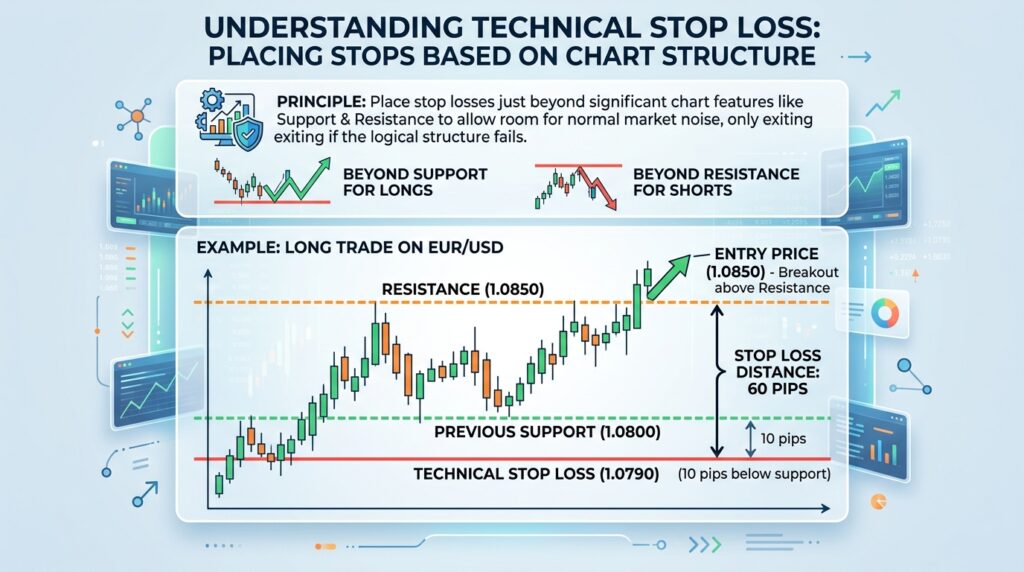
Place stops based on chart structure—just beyond support (for longs) or resistance (for shorts).
Example: Long Trade
- EUR/USD breaks above resistance at 1.0850
- Previous support sits at 1.0800
- Place stop at 1.0790 (10 pips below support)
- Stop distance: 60 pips from entry
This method uses market structure rather than arbitrary distances, placing stops where price movement would invalidate your trade thesis.
For technical level identification, see our support and resistance trading guide.
Method 4: Price Action-Based Stop Loss
Place stops beyond specific candlestick patterns or price action signals that triggered your entry.
Example: Pin Bar Entry
- Bullish pin bar forms at support (1.0800)
- Pin bar low: 1.0785
- Pin bar high: 1.0815
- Place stop at 1.0775 (10 pips below pin bar low)
- Entry at 1.0820 (above pin bar high)
- Stop distance: 45 pips
This protects against the price action signal failing while giving the trade room to develop.
Learn more about price action signals in our price action trading guide.
Stop Loss Placement Strategies
Different trading strategies and styles require different stop loss approaches.
Fixed Pip Stop Loss
Use the same pip distance for all trades regardless of pair or market conditions.
Example:
- Always use 30-pip stops for scalping
- Always use 50-pip stops for day trading
- Always use 100-pip stops for swing trading
Advantages:
- Simple and consistent
- Easy to calculate position sizes
- Clear risk per trade
Disadvantages:
- Doesn’t adapt to market volatility
- May be too tight during volatile periods
- May be too loose during calm periods
- Ignores technical levels
Best for: Beginners establishing initial discipline, high-frequency traders needing consistency.
Volatility-Adjusted Stop Loss
Adjust stop distance based on current market volatility using indicators like ATR or Bollinger Bands.
ATR Method:
- Calculate 14-period ATR
- Multiply by 1.5-2.5 depending on strategy
- Stop distance = ATR × Multiplier
Bollinger Bands Method:
- Long trades: Stop below lower Bollinger Band
- Short trades: Stop above upper Bollinger Band
- Distance adjusts automatically with volatility
Advantages:
- Adapts to market conditions
- Tighter stops during calm periods
- Wider stops during volatile periods
- Reduces false stop-outs
Disadvantages:
- More complex calculations
- Position size varies with volatility
- Requires ongoing adjustment
Best for: Intermediate to advanced traders, swing and position traders.
Chart Structure Stop Loss
Place stops beyond key support/resistance levels, trend lines, or chart patterns.
Support/Resistance:
- Long trade at 1.0850 with support at 1.0800
- Place stop at 1.0790 (beyond support)
- If support breaks, trade thesis invalidated
Trend Lines:
- Uptrend with trend line at 1.0820
- Place stop at 1.0810 (beyond trend line)
- Break of trend line signals potential reversal
Pattern-Based:
- Enter triangle breakout at 1.0880
- Stop below triangle support at 1.0850
- Pattern failure invalidates trade
Advantages:
- Logical placement based on market structure
- Stop placement has technical rationale
- Often provides good risk-reward ratios
Disadvantages:
- Stop distances vary widely by setup
- May be too tight or too loose for your risk tolerance
- Requires solid technical analysis skills
Best for: Technical traders, all timeframes, experienced traders.
Percentage of Entry Price
Set stops as a percentage of entry price rather than fixed pips.
Example:
- Entry: 1.0850
- Stop: 1% below entry = 1.0742
- Stop distance: 108 pips
Advantages:
- Scales with price level
- Consistent percentage risk
- Simple calculation
Disadvantages:
- Ignores market structure
- May not align with technical levels
- Can be too tight on high-priced pairs, too loose on low-priced pairs
Best for: Long-term position traders, algorithmic traders.
Take Profit Placement Strategies
While stop losses limit losses, take profit orders capture gains systematically.
Fixed Risk-Reward Ratio
Set take profit at a fixed multiple of your stop loss distance.
Common Risk-Reward Ratios:
- 1:1 (50-pip stop, 50-pip target)
- 1:2 (50-pip stop, 100-pip target)
- 1:3 (50-pip stop, 150-pip target)
Example:
- Entry: 1.0850
- Stop: 1.0800 (50 pips)
- 1:2 Risk-Reward
- Take Profit: 1.0950 (100 pips)
Advantages:
- Simple and consistent
- Ensures positive expectancy with decent win rate
- Easy to calculate and plan
Disadvantages:
- Ignores market structure
- May exit before trend fully extends
- May place targets at unrealistic levels
Best for: Beginners, systematic traders, scalpers and day traders.
Technical Level Take Profit
Place take profit at logical technical levels where price might reverse.
Resistance Levels:
- Long trade from 1.0850
- Previous resistance at 1.0950
- Place take profit at 1.0940 (slightly before resistance)
Fibonacci Levels:
- Trend from 1.0700 to 1.1000, retraces to 1.0850
- 161.8% extension at 1.1185
- Place take profit at 1.1180
Round Numbers:
- Entry at 1.0850
- Next major round number: 1.1000
- Place take profit at 1.0995 (just before)
Advantages:
- Based on likely reversal points
- Captures profits before reversal
- Uses market structure
Disadvantages:
- Requires technical analysis skill
- May exit too early in strong trends
- Targets vary widely by setup
Best for: Technical traders, swing and position traders.
The Financial Conduct Authority notes that proper profit-taking strategies are as important as stop loss placement for overall trading success.
Trailing Stop as Take Profit
Rather than fixed take profit, use a trailing stop that moves with price, capturing extended trends while protecting gains.
Example:
- Entry: 1.0850
- Initial stop: 1.0800 (50 pips)
- Price rises to 1.0900
- Trailing stop moves to 1.0850 (breakeven)
- Price rises to 1.0950
- Trailing stop moves to 1.0900 (50-pip profit locked)
- Price reverses to 1.0900
- Trailing stop triggers, exit with 50-pip profit
Advantages:
- Captures extended moves
- Locks in increasing profits automatically
- No predetermined limit on gains
Disadvantages:
- May exit prematurely during normal pullbacks
- Requires careful trailing distance selection
- More complex to manage
Best for: Trend traders, swing traders, traders comfortable with giving back some profits.
Partial Profit Taking
Rather than exiting entire position, take partial profits at multiple levels.
Example:
- Enter 3 mini lots at 1.0850
- Stop: 1.0800 (50 pips)
- Target 1: 1.0900 (50 pips) – Close 1 lot
- Target 2: 1.0950 (100 pips) – Close 1 lot
- Target 3: 1.1000 (150 pips) or trailing stop – Close final lot
Advantages:
- Guarantees some profit on partial position
- Allows remaining position to capture extended moves
- Reduces psychological pressure
- Improves average profit per trade
Disadvantages:
- More complex execution
- May reduce total profits if all targets hit
- Transaction costs multiply
Best for: Swing traders, position traders, larger accounts.
Setting Stop Loss and Take Profit in Your Platform
Most trading platforms make setting these orders straightforward, though the exact process varies by platform.
MetaTrader 4/5
When Opening a New Trade:
- Right-click chart and select “Trading” → “New Order”
- Select order type (market, pending)
- Enter position size (lots)
- Set “Stop Loss” price level
- Set “Take Profit” price level
- Click “Buy” or “Sell”
For Existing Open Position:
- Locate position in “Trade” tab at bottom
- Right-click position
- Select “Modify or Delete Order”
- Enter new stop loss and/or take profit levels
- Click “Modify”
Quick Method:
- Drag the dotted lines on the chart (red = stop loss, green = take profit)
cTrader
When Opening New Trade:
- Click “New Order” or click directly on chart
- Order window opens with current price
- Enter position size
- Set stop loss (pips or price)
- Set take profit (pips or price)
- Click “Buy Market” or “Sell Market”
For Existing Position:
- Find position in “Positions” panel
- Click position to expand details
- Modify stop loss and/or take profit fields
- Changes apply automatically
TradingView (with broker connection)
When Opening Trade:
- Click “Buy/Sell” on chart
- Order panel opens
- Set stop loss (can draw on chart)
- Set take profit (can draw on chart)
- Confirm order
For Existing Position:
- Locate position indicator on chart
- Drag stop loss or take profit line
- Or modify in positions panel
Important Settings:
Pips vs. Price: Some platforms let you enter stop/target in pips from entry, others require specific price levels. Know which your platform uses.
Spread Adjustment: Account for spread when setting stop loss. If EUR/USD has a 2-pip spread and you want a 50-pip stop on a long position, place it 52 pips from your entry price to account for spread.
Learn more about spread impact in our what is spread in forex guide.
Common Stop Loss Mistakes
Avoid these errors that undermine risk management and destroy accounts.
Mistake 1: Trading Without Stop Losses
Some traders believe they can monitor positions constantly and exit manually if needed. This almost always fails.
Why It’s Wrong:
- Emotions prevent taking losses
- Can’t watch positions 24/7
- Flash crashes happen in seconds
- Internet/power failures leave you unprotected
Solution: Never enter a trade without a predetermined stop loss in place.
Mistake 2: Moving Stops Further Away
When price approaches your stop, moving it further away to “give the trade more room” turns small losses into large ones.
Example:
- Entry: 1.0850, Stop: 1.0800 (50-pip risk)
- Price drops to 1.0805
- You move stop to 1.0750 (100-pip risk)
- Price drops to 1.0755
- You move stop to 1.0700 (150-pip risk)
- Finally stops out at 1.0700
- 150-pip loss instead of original 50-pip loss
Why It’s Wrong:
- Triples or quadruples your risk
- Shows lack of discipline
- If original stop placement was wrong, exit and re-enter with better setup
Solution: Never move stops away from entry. You can move stops to breakeven or toward entry to reduce risk, but never away to avoid loss.
Mistake 3: Stops Too Tight
Placing stops too close to entry causes frequent stop-outs on normal market noise.
Example:
- EUR/USD 4-hour chart, ATR = 40 pips
- Entry: 1.0850
- Stop: 1.0845 (5 pips)
- Normal 20-pip pullback stops you out
- Price then moves 100 pips in your intended direction
Why It’s Wrong:
- Normal volatility triggers stops
- Converts winning trades to losers
- Creates frustration and overtrading
Solution: Use ATR or technical levels to place stops beyond normal volatility. Accept that wider stops require smaller position sizes.
Mistake 4: Stops Too Wide
Conversely, excessively wide stops relative to your account size create overleveraged positions.
Example:
- Account: $1,000
- Stop: 200 pips
- Position: 1 mini lot = $1 per pip
- Risk: $200 = 20% of account
Why It’s Wrong:
- Single losing trade destroys 20% of capital
- Five losing trades = account blown
- Violates 1-2% risk rule
Solution: Calculate position size based on your stop loss distance to maintain 1-2% risk per trade. If 200-pip stops are necessary, reduce position size accordingly.
For proper position sizing, see our how to calculate position size guide.
Mistake 5: Forgetting Spread
Failing to account for spread when setting stops, especially on long positions.
Example:
- EUR/USD: Bid 1.0850, Ask 1.0852 (2-pip spread)
- You buy at Ask: 1.0852
- You set stop at 1.0850 (thinking it’s 2 pips)
- Stop triggers immediately because current Bid is already 1.0850
Why It’s Wrong:
- Stop triggers instantly before price moves
- Lose spread cost without giving trade a chance
Solution: On long positions, subtract spread from your intended stop level. For 50-pip stop with 2-pip spread, place stop 52 pips from entry.
Mistake 6: Stop Hunting Paranoia
Some traders avoid obvious stop levels, fearing “stop hunting” by brokers or large players.
Reality:
- Stop hunting exists but is overblown
- Price naturally tests obvious levels where many stops cluster
- Avoiding obvious technical levels often leads to arbitrary stop placement
Solution: Place stops at technically logical levels. If stopped out, price movement invalidated your trade thesis anyway. Focus on broker selection (choose regulated, reputable brokers) rather than paranoia about stop placement.
Mistake 7: Not Using Stop Loss Orders
Some traders try to use “mental stops”—price levels they promise themselves they’ll exit at manually.
Why It’s Wrong:
- Emotions override mental commitments
- Requires constant monitoring
- No protection during disconnections
- Easy to rationalize “giving it more room”
Solution: Always use actual stop loss orders placed in your platform.
Advanced Stop Loss Techniques
Experienced traders use sophisticated stop management strategies.
Break-Even Stops
Once your trade moves favorably, move your stop to entry (break-even), eliminating risk while allowing position to continue.
When to Move to Break-Even:
- After trade moves 1.5-2× your initial stop distance in your favor
- After passing first technical target
- Before major news events
Example:
- Entry: 1.0850
- Initial stop: 1.0800 (50 pips)
- Price moves to 1.0925 (75 pips profit = 1.5× stop distance)
- Move stop to 1.0850 (break-even)
- Worst case now: $0 loss instead of -$500
- Best case: Trade continues, profits accrue
Time-Based Stops
Exit positions after a specified time period regardless of profit/loss if they haven’t moved as expected.
Example:
- Day trade entry expecting 50-pip move within 4 hours
- After 4 hours, trade has moved only 10 pips
- Exit manually even though stop not hit
- Frees capital for better opportunities
Useful for:
- Day traders who close all positions by day end
- Swing traders who exit if thesis doesn’t play out within expected timeframe
- Avoiding dead capital in stagnant positions
Scaling Stops
Adjust stop distances based on how long you’ve held the position or how much profit has accrued.
Example:
- Entry: 1.0850, Stop: 1.0800 (50 pips)
- After 24 hours and 30-pip profit: Move stop to 1.0830 (20-pip risk)
- After 48 hours and 60-pip profit: Move stop to 1.0860 (10-pip profit locked)
- Continue tightening as position matures
Correlation-Based Stops
When trading multiple correlated pairs, use stops that account for correlation risk.
Example:
- Long EUR/USD and long GBP/USD (highly correlated)
- If EUR/USD stop hits, immediately exit GBP/USD too
- Prevents compounding losses on correlated positions
Volatility Contraction/Expansion Stops
Adjust stops when volatility changes significantly.
During Volatility Contraction:
- ATR decreases from 40 to 25 pips
- Tighten stops from 80 pips (2× old ATR) to 50 pips (2× new ATR)
During Volatility Expansion:
- ATR increases from 25 to 45 pips
- Widen stops from 50 pips to 90 pips
- Or exit positions if expansion indicates regime change
Stop Loss and Take Profit for Different Trading Styles
Optimal stop/target placement varies by trading approach.
Scalping
- Stop Loss: 5-15 pips
- Take Profit: 5-15 pips (1:1 risk-reward typically)
- Method: Fixed pip distances, very tight
- Rationale: Targeting small moves, rapid execution
Day Trading
- Stop Loss: 20-50 pips
- Take Profit: 40-100 pips (1:2 risk-reward common)
- Method: ATR-based or technical levels
- Rationale: Holding hours, needs room for intraday volatility
Swing Trading
- Stop Loss: 50-150 pips
- Take Profit: 100-300 pips (1:2 risk-reward common)
- Method: Technical structure (support/resistance)
- Rationale: Holding days-weeks, survives daily fluctuations
Position Trading
- Stop Loss: 150-500+ pips
- Take Profit: 500-2,000+ pips (1:3+ risk-reward)
- Method: Major support/resistance, percentage-based
- Rationale: Holding months, captures major trends
Calculating Risk with Stop Loss and Take Profit
Understanding the math behind stops and targets helps you optimize entries.
Risk-Reward Ratio Formula:
Risk-Reward = (Take Profit Distance) ÷ (Stop Loss Distance)
Example 1:
- Entry: 1.0850
- Stop: 1.0800 (50 pips risk)
- Target: 1.0950 (100 pips reward)
- Risk-Reward: 100 ÷ 50 = 2:1 (or 1:2 risk-reward)
Example 2:
- Entry: 1.0850
- Stop: 1.0820 (30 pips risk)
- Target: 1.0880 (30 pips reward)
- Risk-Reward: 30 ÷ 30 = 1:1
Break-Even Win Rate Calculation:
Required Win Rate = 1 ÷ (1 + Risk-Reward Ratio)
For 1:1 Risk-Reward: Required Win Rate = 1 ÷ (1 + 1) = 50% (Must win 50% of trades to break even)
For 1:2 Risk-Reward: Required Win Rate = 1 ÷ (1 + 2) = 33.3% (Must win only 33.3% of trades to break even)
For 1:3 Risk-Reward: Required Win Rate = 1 ÷ (1 + 3) = 25% (Must win only 25% of trades to break even)
This demonstrates why professional traders emphasize risk-reward ratios—better ratios allow profitability with lower win rates.
Position Size Based on Stop Loss:
Position Size = (Account Risk $) ÷ (Stop Loss Pips × Pip Value)
Example:
- Account: $10,000
- Risk: 2% = $200
- Stop: 40 pips
- Pip Value for 1 mini lot: $1
Position Size = $200 ÷ (40 × $1) = 5 mini lots (0.5 standard lots)
Understanding how to calculate pip value ensures accurate risk calculations.
Conclusion
Stop loss and take profit orders are non-negotiable components of successful forex trading. Stop losses protect your capital by limiting losses on individual trades, while take profit orders ensure you actually capture gains when your analysis proves correct.
Every single trade should have a stop loss placed immediately upon entry—no exceptions. The specific placement depends on your strategy, account size, and market conditions, but the stop must exist. Use technical levels, ATR multiples, or percentage-based methods to determine appropriate distances, ensuring your stop accommodates normal market volatility without being so wide that it creates overleveraged positions.
Take profit orders should balance realistic profit targets with technical analysis. Whether using fixed risk-reward ratios, technical levels, or trailing stops, have a predefined plan for exiting winning trades. Many traders excel at entering positions but fail at exits—systematic take profit placement solves this problem.
Calculate your position size based on your stop loss distance to maintain consistent 1-2% risk per trade. A 30-pip stop requires different position sizing than a 100-pip stop if you want to risk the same dollar amount. This discipline—adjusting position size to your stop distance—is what separates professionals from amateurs.
Avoid the common mistakes of trading without stops, moving stops away from entry, or using stops that are too tight or too wide for market conditions. Remember that stop losses are profit preservation tools—they keep you in the game by ensuring no single trade can destroy your account.
Master stop loss and take profit placement, and you’ve conquered one of the most critical aspects of forex trading. Combined with a solid strategy and proper risk management, disciplined use of these orders provides the foundation for long-term trading success.
Related Resources
- Forex Order Types Explained – Understanding all order types including stops
- Forex Risk Management Complete Guide – Risk principles and position sizing
- What is a Lot in Forex Trading – Position sizing for your stop distances
- How to Calculate Pip Value – Calculate dollar risk from pip distances
- Support and Resistance Trading – Technical levels for stop placement
- What is Spread in Forex Trading – Account for spread in stop placement
- Understanding Leverage in Forex – How stops protect leveraged positions
- Price Action Trading Complete Guide – Price action-based stop placement