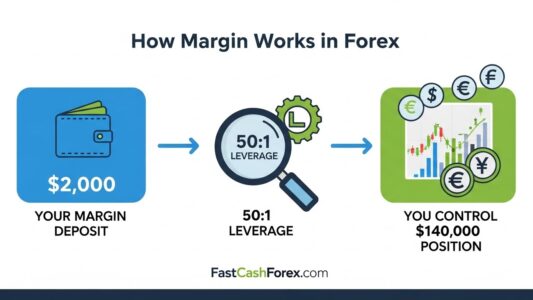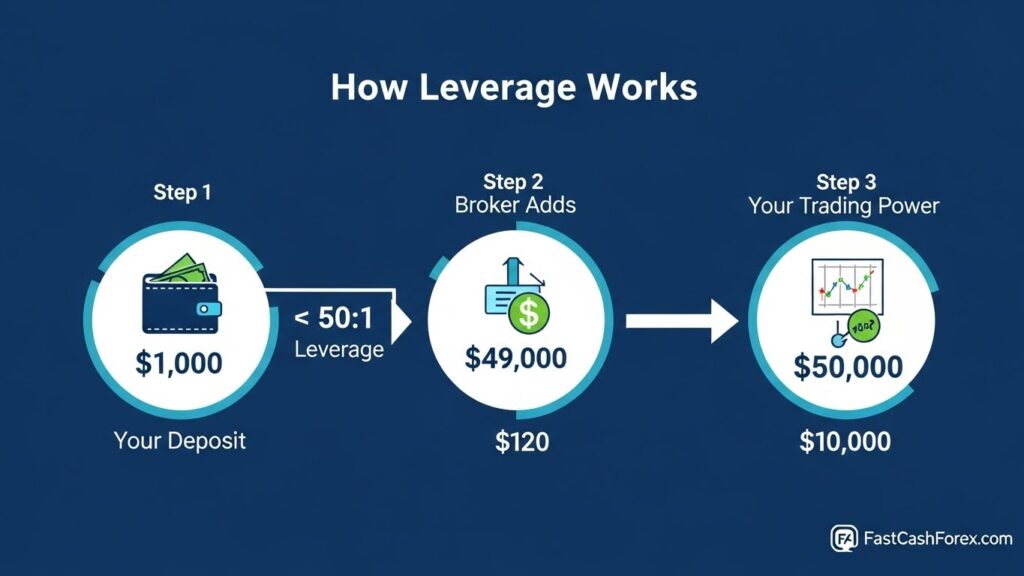
Leverage in forex trading allows you to control larger positions with less capital. In this guide, you’ll learn that understanding leverage in forex is essential for new traders, because it explains how small deposits can control large positions.
What Is Leverage in Forex Trading?
Leverage is borrowed capital from your broker that increases your market exposure. For example, with 1:30 leverage, every $1 of margin controls $30 of currency exposure. This amplification effect is what makes forex accessible to retail traders with limited capital—you don’t need $100,000 to trade a standard lot.
Think of leverage like a mortgage. When you buy a $300,000 house with a $30,000 down payment, you’re using 10:1 leverage. The bank provides the additional $270,000, and you control the entire property. If the house value increases to $330,000, you’ve made $30,000 profit on your $30,000 investment—a 100% return. Without leverage, you’d need the full $300,000 and your profit would represent only a 10% return.
Forex leverage works similarly. Your broker provides the capital to control large currency positions while you provide only a fraction as margin. The critical difference is that forex leverage is provided on every trade and doesn’t require loan applications or interest payments like traditional borrowing.
Why Traders Use Leverage
Traders use leverage for several compelling reasons that make forex trading accessible and potentially profitable.
Access Larger Positions with Less Upfront Capital
Without leverage, you’d need $100,000 to trade one standard lot (100,000 units) of EUR/USD. With 1:100 leverage, you need only $1,000 in margin to control that same $100,000 position. This accessibility allows traders with $1,000-$10,000 accounts to participate in markets previously reserved for large institutions and wealthy individuals.
Potentially Amplify Profits on Small Price Moves
Forex currency pairs often move 50-100 pips daily. On a $100,000 position, a 50-pip move equals $500 profit. Without leverage, you’d need $100,000 invested to generate that $500 (0.5% return). With leverage, that same $500 profit might require only $1,000 margin (50% return on margin).
This amplification transforms tiny forex price movements into meaningful profits for retail traders. A currency pair moving just 0.5% can generate 5%, 10%, or even 50% returns on your margin depending on your leverage level.
Flexibility for Short-Term Strategies Like Day Trading and Scalping
Day traders and scalpers target small, quick profits from multiple trades. Without leverage, the capital requirements for meaningful returns would be prohibitive. With leverage, a trader with $5,000 can trade multiple positions throughout the day, capturing dozens of small profits that accumulate to significant returns.
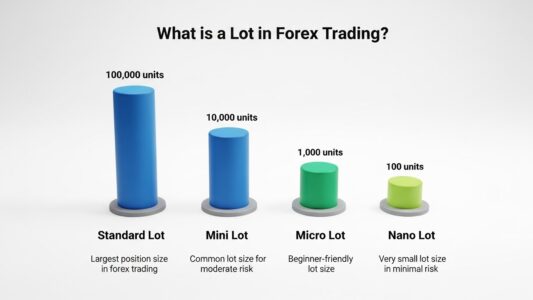
For understanding position sizing with leverage, see our guide on what is a lot in forex.
How Forex Leverage Works (With Examples)
Let’s examine exactly how leverage functions in real trading scenarios with concrete numbers.
Example: 1:30 vs 1:500
Below are simple comparisons showing how much margin you need at different leverage levels.
| Trade Size (Notional) | Leverage | Required Margin |
|---|---|---|
| $10,000 | 1:30 | $333.33 |
| $10,000 | 1:500 | $20.00 |
| $100,000 | 1:30 | $3,333.33 |
| $100,000 | 1:500 | $200.00 |
Tip: Required margin = Notional ÷ Leverage.
Detailed Example: Trading EUR/USD with Different Leverage
Scenario: You want to trade 1 standard lot of EUR/USD (100,000 euros)
- Current EUR/USD rate: 1.0850
- Notional value: €100,000 = $108,500 (€100,000 × 1.0850)
With 1:30 Leverage:
- Required margin: $108,500 ÷ 30 = $3,617
- Your account must have at least $3,617 available
- If EUR/USD moves 50 pips in your favor = $500 profit
- Return on margin: $500 ÷ $3,617 = 13.8% return
With 1:100 Leverage:
- Required margin: $108,500 ÷ 100 = $1,085
- Your account needs only $1,085 available
- Same 50-pip move = $500 profit
- Return on margin: $500 ÷ $1,085 = 46.1% return
With 1:500 Leverage:
- Required margin: $108,500 ÷ 500 = $217
- Your account needs only $217 available
- Same 50-pip move = $500 profit
- Return on margin: $500 ÷ $217 = 230% return
Notice that the absolute profit ($500) remains identical regardless of leverage. Leverage doesn’t change your dollar profit—it changes how much capital you need to hold the position and therefore your return on margin.
The Critical Point Risk Remains Constant
Here’s what many traders miss: Leverage changes your margin requirement, but not your risk exposure.
In all three leverage examples above:
- Position size: 1 standard lot (100,000 units)
- Pip value: $10 per pip
- If price moves 50 pips against you = $500 loss
Whether you’re using 1:30 or 1:500 leverage, losing 50 pips costs $500. Higher leverage didn’t increase your risk—your position size determines risk. The 1:500 leverage simply required less margin to hold that position.
Understanding margin trading clarifies the relationship between leverage and margin requirements.
Benefits of Using Leverage
When used properly, leverage provides significant advantages for forex traders.
Lower Capital Requirement to Open Positions
Leverage democratizes forex trading by reducing barriers to entry. A trader with $1,000 can control positions worth $30,000 (with 1:30) or $500,000 (with 1:500), accessing markets that would otherwise require institutional-level capital.
More Flexibility Across Pairs and Timeframes
With adequate leverage, you can diversify across multiple currency pairs simultaneously without requiring massive capital. A $10,000 account with 1:100 leverage can comfortably maintain 3-5 positions across different pairs, each properly sized according to risk management principles.
Capital Efficiency When Risk Is Controlled
Proper leverage use allows your capital to work harder. Instead of $100,000 sitting idle to trade one position, you might use $10,000 across ten positions (with 1:100 leverage), each with appropriate stop losses. Your capital efficiency increases dramatically while risk remains managed through proper position sizing.
For more on controlling risk with leverage, review our forex risk management guide.
Risks of Forex Leverage
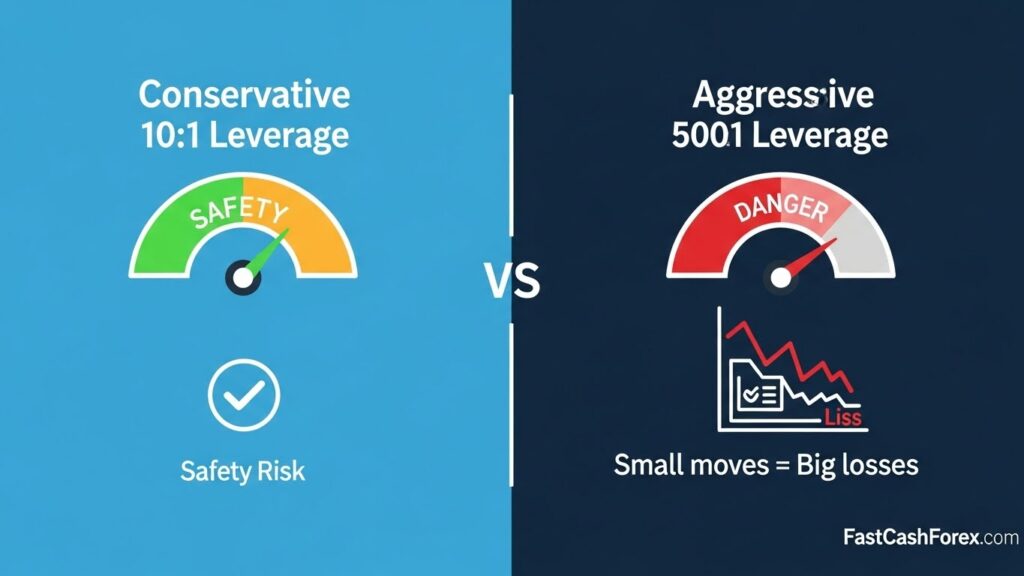
The same amplification that creates profit potential also magnifies losses. Understanding leverage in Forex risks is critical for survival.
Leverage Magnifies Losses as Well as Gains
This is the leverage double-edged sword. Just as a 50-pip favorable move with 1:500 leverage can generate 230% return on margin, a 50-pip adverse move generates a 230% loss on margin.
Real Example:
- Account: $1,000
- Leverage: 1:500
- Position: 1 standard lot EUR/USD
- Required margin: $217
- Free margin: $783
If EUR/USD moves just 78 pips against you:
- Loss: 78 pips × $10 = $780
- Remaining balance: $1,000 – $780 = $220
- You’ve lost 78% of your account on one trade
Without leverage, you couldn’t have taken this position with $1,000, preventing this catastrophic loss.
The Psychological Pressure of Leverage
High leverage creates intense psychological pressure. When you’re controlling $100,000 with $200 margin and see the position move 30 pips against you (-$300), the temptation to close the trade prematurely or move your stop loss becomes overwhelming. This emotional interference destroys disciplined trading.
Overleveraging: The Account Killer
The biggest danger isn’t leverage itself—it’s overleveraging by taking position sizes too large for your account. Many traders see high leverage as permission to use maximum position sizes, leading to account destruction.
Overleveraging Example:
- Account: $5,000
- Leverage: 1:500 (maximum $2.5 million position possible)
- Trader takes 10 standard lots = $1 million position
- Pip value: $100 per pip
- 50-pip adverse move = $5,000 loss = Account wiped out
The 1:500 leverage didn’t cause the problem—the trader’s decision to use 10 standard lots (200:1 effective leverage) caused the disaster.
For detailed position sizing to avoid overleveraging, see how to calculate position size.
Margin Calls & Stop-Outs
When leverage meets insufficient capital, margin calls and stop-outs protect you (and your broker) from negative balances.
What Is a Margin Call?
A margin call occurs when your equity falls below a certain percentage of your used margin (typically 100%). Your broker alerts you to either deposit more funds or close positions to reduce margin usage.
Example:
- Account balance: $5,000
- Used margin: $3,617 (one standard lot with 1:30 leverage)
- Open loss: -$2,000
- Equity: $5,000 – $2,000 = $3,000
- Margin level: ($3,000 ÷ $3,617) × 100 = 82.9%
If broker’s margin call level is 100%, you’d receive a margin call warning at this point.
What Is a Stop-Out?
A stop-out is the broker’s automatic closure of your positions when equity falls to a critical level (typically 20-50% of used margin). This forced liquidation prevents your account from going negative.
Example Continued:
- Margin call level: 100% (warning)
- Stop-out level: 50% (forced closure)
- Your equity continues falling to $1,808
- Margin level: ($1,808 ÷ $3,617) × 100 = 50%
- Broker automatically closes your position to prevent further losses
How to Avoid Margin Calls
- Use appropriate position sizes: Risk only 1-2% of your account per trade
- Always use stop losses: Limit maximum loss to a predefined amount
- Monitor margin level: Keep margin level above 200% by limiting used margin
- Maintain capital buffer: Don’t use all available margin—leave 60%+ free margin
- Reduce leverage: Use lower leverage ratios to naturally limit position sizes
Understanding how to set stop loss and take profit orders prevents margin call situations.
Leverage vs. Margin: What’s the Difference?
Many traders confuse leverage and margin, but they’re distinct concepts.
| Concept | Meaning | Quick Example |
|---|---|---|
| Leverage | Ratio of exposure to your own capital. | 1:30 means $1 controls $30. |
| Margin | Cash set aside as collateral to open/hold a trade. | $333.33 margin to control $10,000 at 1:30. |
Leverage Explained
Leverage is the multiplier your broker provides. It’s expressed as a ratio (1:30, 1:100, 1:500) showing how much market exposure you can control relative to your capital.
- 1:30 leverage: $1 of your money controls $30 of market exposure
- 1:100 leverage: $1 controls $100 of exposure
- 1:500 leverage: $1 controls $500 of exposure
Margin Explained
Margin is the actual dollars from your account that your broker “holds” as collateral while your position remains open. It’s calculated based on the leverage ratio:
Margin = Notional Value ÷ Leverage
When you close the position, the margin is released back to your available balance (plus or minus your profit/loss).
The Relationship
Higher leverage = Lower margin required = More available capital for other trades or cushion against losses.
Example Comparison: Trading $100,000 EUR/USD position:
- At 1:30 leverage: Need $3,333 margin (tie up more capital)
- At 1:100 leverage: Need $1,000 margin (tie up less capital)
- At 1:500 leverage: Need $200 margin (tie up minimal capital)
Your position size and risk remain identical—only the margin requirement changes.
Leverage Limits by Region (Overview)
Regulatory bodies worldwide have imposed leverage restrictions to protect retail traders from excessive risk.
United States
- Regulatory bodies: CFTC and NFA
- Maximum leverage: Often up to 1:50 for major FX pairs (retail)
- Restrictions: Very strict, among the most conservative globally
- Rationale: Protect retail traders from overleveraging
EU/UK
- Regulatory body: FCA and ESMA (European Securities and Markets Authority)
- Maximum leverage: Often up to 1:30 for retail clients on major pairs
- Restrictions: Tier system (1:30 for majors, 1:20 for non-majors, 1:10 for exotics)
- Rationale: Product intervention measures following retail trader losses
Australia
- Regulatory body: ASIC (Australian Securities and Investments Commission)
- Maximum leverage: Up to 1:30 for retail clients
- Restrictions: Aligned with European standards
Offshore Brokers
- Regulation: Often lightly regulated or registered in jurisdictions with minimal oversight
- Maximum leverage: Commonly 1:200 – 1:1000 (sometimes even higher)
- Higher risk: Less client protection, potential for broker malpractice
- Appeal: Attracts traders seeking higher leverage unavailable in regulated markets
Why Leverage Limits Exist
Regulators implement leverage caps after observing that retail traders using high leverage experience dramatically higher account failure rates. Studies show that traders using 1:100+ leverage lose money faster and more frequently than those using 1:30 or lower.
The restrictions aim to slow down potential losses, giving traders more time to correct mistakes before account destruction. While some experienced traders view these limits as restrictive, data supports that retail trader outcomes improve with lower leverage availability.
Smart Risk Management with Leverage
Leverage only becomes dangerous when combined with poor risk management. Here’s how to use leverage safely.
Position Sizing Basics
Risk a small, fixed percentage of account per trade (e.g., 1-2%). Calculate position size based on stop loss distance, not on maximum leverage available.
Formula: Position size ≈ (Account Risk $) ÷ (Stop-Loss in pips × Pip Value)
Example:
- Account: $10,000
- Risk tolerance: 1% = $100
- Stop loss: 50 pips
- Pip value (standard lot): $10
Position size = $100 ÷ (50 × $10) = 0.2 standard lots
This calculation ignores leverage entirely—you size positions based on risk, not available leverage.
The 1-2% Rule
Professional traders rarely risk more than 1-2% of their account on any single trade. This ensures survival through inevitable losing streaks.
Why It Works:
- With 1% risk per trade, you can survive 50 consecutive losses before account depletion
- With 2% risk per trade, you can survive 25 consecutive losses
- With 10% risk per trade, you’re destroyed after 10 losses
The math is unforgiving—aggressive risk-taking eventually leads to ruin. Conservative risk-taking provides longevity.
Practical Tips
- Use stop-loss orders and respect them: Never trade without stops, never move stops to avoid losses
- Avoid max leverage: Pick a leverage level aligned with your strategy, not the maximum offered
- Keep a trading journal to track outcomes and drawdowns: Document every trade including position size and leverage used
- Monitor margin level: Keep free margin above 60% of account balance
- Scale position sizes with account growth: Recalculate position sizes monthly as account grows or shrinks
For comprehensive risk management principles, review our forex risk management complete guide.
How Much Leverage Should You Use?
There’s no single “correct” leverage level—optimal leverage depends on your experience, account size, and trading strategy.
Beginners: Start Small (1:10–1:20)
Why low leverage for beginners:
- Forces smaller position sizes, reducing risk of account destruction
- Provides time to learn without catastrophic mistakes
- Creates psychological comfort during learning phase
- Builds discipline around risk management
Example:
- Account: $5,000
- Leverage: 1:20
- Maximum position: $100,000 (1 standard lot approximately)
- Realistic position with 1% risk and 50-pip stop: 0.1 lots
- Even at maximum leverage, position sizes remain conservative
Starting with low leverage creates good habits. You learn proper position sizing and risk management without the temptation to overtrade.
Intermediate: Moderate Leverage (1:20–1:50)
As you gain experience and demonstrate consistent profitability:
- Increased flexibility for multiple simultaneous positions
- Adequate leverage for most retail strategies
- Still provides significant safety margin
- Balances accessibility with protection
Experienced Traders: Use Higher Leverage Only with Strict Risk Controls
Experienced traders with proven track records might use 1:100–1:200 leverage, but they maintain strict position sizing discipline. High leverage provides capital efficiency without increasing actual risk because position sizes are always calculated based on risk percentage, not maximum leverage.
Example: Experienced Trader
- Account: $50,000
- Leverage: 1:100
- Maximum theoretical position: $5 million
- Actual positions used: 3-5 standard lots maximum (based on 1% risk rule)
- Effective leverage: ~10:1, though 100:1 is available
The high leverage isn’t being “used” in the sense of taking maximum positions—it simply provides flexibility and capital efficiency.
Key Principle: Effective Leverage vs. Available Leverage
Available Leverage: What your broker offers (1:30, 1:100, 1:500)
Effective Leverage: What you actually use based on your open positions
Most professional traders maintain effective leverage of 5:1 to 20:1 even when their broker provides 100:1 or 500:1 available leverage. The difference between available and effective leverage is the safety cushion that prevents disaster.
Leverage in Different Trading Strategies
Optimal leverage varies by trading style and timeframe.
Scalping (Very Short-Term)
- Typical leverage: 1:100 to 1:500
- Why: Multiple daily positions, tight stops, quick execution
- Risk: High-frequency trading requires capital efficiency
- Caution: Scalpers must have exceptional discipline to avoid overleveraging
Day Trading (Intraday)
- Typical leverage: 1:50 to 1:200
- Why: Multiple positions throughout day, moderate holding periods
- Risk: Sufficient leverage for flexibility without excessive exposure
- Caution: Always close positions by day end to avoid overnight risk
Swing Trading (Multi-Day)
- Typical leverage: 1:30 to 1:100
- Why: Fewer, larger positions with wider stops
- Risk: Lower effective leverage despite high available leverage
- Caution: Wider stops require smaller position sizes
Position Trading (Long-Term)
- Typical leverage: 1:10 to 1:50
- Why: Very wide stops, long holding periods, focusing on major trends
- Risk: Minimal effective leverage, conservative approach
- Caution: Overnight and weekend holding requires extra capital cushion
The commonality: All professional traders, regardless of style, maintain effective leverage well below available leverage through disciplined position sizing.
Leverage and Account Size
Your account size should influence your leverage selection and usage.
Micro Accounts ($100-$500)
- Recommended leverage: 1:100 to 1:500
- Reason: Need higher leverage to access meaningful position sizes
- Reality: Even with 1:500, positions should remain micro lots only
- Focus: Learning and capital preservation, not income generation
For more on starting capital requirements, see how much money to start forex trading.
Small Accounts ($500-$5,000)
- Recommended leverage: 1:50 to 1:200
- Reason: Flexibility for mini lots with adequate safety margin
- Reality: Focus on growing account through skill and capital additions
- Focus: Developing consistency
Medium Accounts ($5,000-$25,000)
- Recommended leverage: 1:30 to 1:100
- Reason: Sufficient capital reduces leverage dependency
- Reality: Can trade standard lots comfortably with proper risk management
- Focus: Transition toward professional trading
Large Accounts ($25,000+)
- Recommended leverage: 1:20 to 1:50
- Reason: Large capital base makes extreme leverage unnecessary
- Reality: Lower leverage with larger capital produces ample profit potential
- Focus: Capital preservation and consistent returns
The pattern is clear: As account size grows, required leverage decreases. Large accounts don’t need high leverage because the capital base itself provides sufficient position size capability.
Common Leverage Mistakes
Avoid these errors that lead to account destruction.
Mistake 1: Using Maximum Available Leverage
Just because your broker offers 1:500 doesn’t mean you should use 1:500 effective leverage. Available leverage is a tool for capital efficiency, not a suggestion to maximize position sizes.
Mistake 2: Confusing Leverage with Risk
“I’m only using 1:30 leverage, so my risk is low” is false logic. Your position size determines risk, not your leverage ratio. A poorly sized position creates high risk regardless of leverage level.
Mistake 3: Ignoring Effective Leverage
Traders focus on the leverage ratio (1:100) while ignoring how much leverage they’re actually using. If you have $10,000 and hold $50,000 in open positions, you’re using 5:1 effective leverage regardless of your broker’s 100:1 offering.
Mistake 4: Revenge Trading with High Leverage
After losses, traders sometimes increase position sizes using high leverage to “win it back quickly.” This revenge trading almost always accelerates losses.
Mistake 5: Not Understanding Margin Calculations
Traders open positions without checking margin requirements, then face margin calls when positions move against them. Always verify you have adequate free margin (60%+ of account) before entering trades.
How to Choose the Right Leverage Level
Follow this decision framework to select appropriate leverage for your situation.
Step 1: Assess Your Experience
- Complete beginner: 1:10–1:20
- Some experience: 1:20–1:50
- Experienced: 1:50–1:100
- Professional: 1:100+ (with strict discipline)
Step 2: Consider Your Account Size
- Under $1,000: 1:100–1:500 (for position access)
- $1,000-$10,000: 1:50–1:200
- $10,000-$50,000: 1:30–1:100
- Over $50,000: 1:20–1:50
Step 3: Match Your Trading Style
- Scalping: Higher leverage for capital efficiency
- Day trading: Moderate to high
- Swing trading: Moderate
- Position trading: Low to moderate
Step 4: Check Regulatory Restrictions
- Verify maximum leverage allowed in your jurisdiction
- Don’t assume offshore brokers’ high leverage is legal or advisable
Step 5: Test on Demo First
- Practice with your chosen leverage level on demo account
- Verify it provides adequate flexibility without encouraging overleveraging
- Ensure you can maintain effective leverage below 20:1
For practicing leverage management, see our forex demo trading guide.
Leverage is forex trading’s double-edged sword—it provides retail traders access to markets previously available only to institutions, but it also amplifies losses for those who use it recklessly. Understanding that leverage changes your margin requirements without changing your actual position risk is fundamental to using leverage safely.
The key to safe leverage use is distinguishing between available leverage (what your broker offers) and effective leverage (what you actually use). Professional traders often have 100:1 or higher available leverage but maintain 5:1 to 20:1 effective leverage through disciplined position sizing based on their 1-2% risk rule.
Never calculate position sizes based on maximum available leverage. Always calculate based on your risk tolerance, stop loss distance, and account balance. The formula—(Account × Risk %) ÷ (Stop Loss Pips × Pip Value)—ignores leverage entirely, focusing solely on risk management.
Start with conservative leverage (1:10–1:30) as a beginner, regardless of what higher ratios your broker offers. As you gain experience and prove consistency, you can use higher available leverage while maintaining conservative effective leverage through proper position sizing.
Remember: Leverage doesn’t cause account destruction—overleveraging does. Used correctly with proper risk management, leverage is a powerful tool that makes forex trading accessible and potentially profitable for retail traders. Used recklessly, it accelerates the inevitable account destruction that comes from poor risk management.
Master leverage by mastering position sizing and risk management first. Once you can consistently risk 1-2% per trade and maintain effective leverage below 20:1, the leverage ratio your broker offers becomes largely irrelevant—you’ll use only what you need, leaving the rest as a safety cushion.
Continue Learning
Further reading: Leverage explained (Investopedia)
Related Resources
- Margin Trading in Forex – Understanding the relationship between leverage and margin
- What is a Lot in Forex Trading – How leverage affects lot size trading
- Forex Risk Management Complete Guide – Managing leverage risk effectively
- How to Calculate Position Size – Position sizing with different leverage levels
- How Much Money to Start Forex Trading – How leverage reduces capital requirements
- How to Set Stop Loss and Take Profit – Why stops are critical with leverage
- How to Choose a Forex Broker – Comparing broker leverage offerings
- Forex Demo Trading Guide – Practice with different leverage levels