Learn How to Make Fast Money by Learning diffrent Strategies in Forex Trading and Different Investment Options
How Much Money to Start Forex Trading
One of the most common questions new traders ask is: how much money to start forex trading?
The answer depends on your goals, trading style, and risk tolerance. While some brokers allow accounts to be opened with as little as $10–$50, starting with too little capital makes proper risk management extremely difficult and increases the likelihood of early losses.
This guide explains realistic starting capital requirements for forex trading, how different account sizes affect your trading, and how much money you need depending on whether your goal is learning, supplemental income, or long-term growth.
For complete details on cent accounts, including broker selection, position sizing examples, and when to graduate to standard accounts, see our Forex Cent Accounts: Complete Guide.
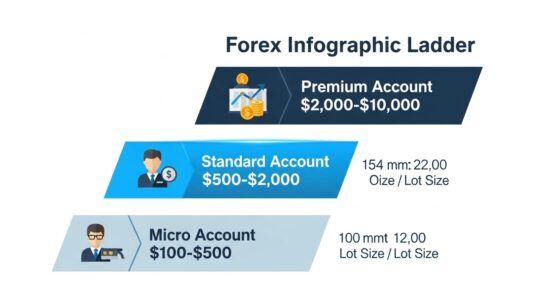
Micro Account Brokers: $10-$100 minimum
Target beginning traders and those with limited capital
Offer micro lot trading (1,000 units)
Often offshore or less regulated brokers
May have wider spreads or limited features
For complete details on micro accounts, including position sizing calculations, broker selection criteria, effective trading strategies, and when to upgrade to standard accounts, see our Forex Micro Accounts: Complete Guide.
Standard Retail Brokers: $100-$500 minimum
Mainstream retail forex brokers
Offer multiple account types
Regulated by major authorities
Competitive spreads and full platform access
For complete details on standard accounts, including position sizing strategies, broker selection criteria, risk management rules, and when to upgrade to premium accounts, see our Standard Forex Accounts: Complete Guide.
Premium Brokers: $1,000-$10,000 minimum
Professional-grade platforms and execution
Tighter spreads and premium service
Advanced tools and analysis
Direct market access (DMA) or ECN routing
For complete details on premium accounts, including ECN/DMA execution models, institutional spreads, dedicated account managers, and when to graduate to institutional accounts, see our Premium Forex Accounts: Complete Guide.
The Commodity Futures Trading Commission regulates forex brokers in the United States and requires them to maintain minimum net capital requirements to protect client funds, though they don’t mandate specific minimum deposits for clients.
Just Because You Can Doesn’t Mean You Should
A $50 minimum deposit doesn’t mean $50 is a realistic amount to start forex trading successfully. These low minimums serve marketing purposes—getting traders in the door—rather than representing adequate capitalization for sustainable trading.
How Much Money to Start Forex Trading?The Realistic Minimum: $500-$1,000
While you can open accounts with less, $500-$1,000 represents a more realistic minimum for several important reasons.
Why $500-$1,000 is the Practical Minimum
Risk Management Becomes Possible
With $500, you can risk 1-2% per trade ($5-$10) while using proper stop losses. This allows 10-20 consecutive losing trades before your account faces serious damage, giving your edge time to play out.
With only $50, risking 2% means $1 per trade. While technically possible, this creates scenarios where a single broker spread or commission consumes a significant percentage of your capital.
Psychological Comfort
A $500 account feels substantial enough to take seriously without being so large that losses cause panic. This psychological sweet spot helps traders follow their plans rather than making emotional decisions.
Access to Better Execution
Most reputable, well-regulated brokers require $100-$500 minimums. Starting with $500 ensures access to brokers with competitive spreads, reliable execution, and strong regulatory oversight.
Room for Strategy Testing
You can test different position sizes and strategies with $500-$1,000 without the constraints of trading only the absolute minimum lot sizes.
Growth Potential
Starting with $500-$1,000 and targeting 5-10% monthly returns (aggressive but achievable) creates meaningful dollar profits that compound over time. A $50 account growing 10% monthly adds $5—too small to feel meaningful.
Example: $500 Account Management
Account: $500 Risk per trade: 2% = $10 Stop loss: 20 pips Position size calculation: $10 ÷ 20 pips = $0.50 per pip = 5 micro lots
This provides:
Meaningful exposure to market movements
Proper risk management (2% per trade)
Realistic stop loss distances (20 pips)
Room for 50 consecutive losses before account depletion
Potential for $25-$50 monthly profits with consistent 5-10% returns
While $500-$1,000 works for learning, $2,000-$5,000 provides significantly more flexibility and reduces capital constraints.
Advantages of Starting with $2,000-$5,000
Multiple Position Management
With $2,000+, you can maintain 2-3 positions simultaneously while keeping total risk under 5% of your account. This diversification reduces the impact of any single losing trade.
Better Position Sizing Options
Access to mini lots (10,000 units) and fractional lot trading gives you precise control over position sizes without being limited to micro lots only.
Absorption of Costs
Spread costs and commissions represent a smaller percentage of your capital and potential profits, improving your overall return on investment.
Psychological Benefits
A $2,000+ account eliminates the feeling of being undercapitalized. You can focus on trading well rather than worrying about growing a tiny account.
Sustainable Income Potential
A $5,000 account growing 5% monthly generates $250—not life-changing but meaningful supplemental income. This creates positive reinforcement that encourages continued learning and improvement.
Example: $3,000 Account Management
Account: $3,000 Risk per trade: 1.5% = $45 Average stop loss: 30 pips Position size: $45 ÷ 30 pips = $1.50 per pip = 1.5 mini lots
This provides:
Ability to trade mini lots comfortably
Conservative 1.5% risk per trade
Room for 66+ consecutive losses
Potential for $150+ monthly income at 5% returns
Multiple position capability
Understanding what is a lot in forex helps you optimize position sizing for your account size.
The Professional Minimum: $10,000+
For traders seeking to generate primary income from forex trading, $10,000+ represents the realistic minimum account size.
Why $10,000+ for Serious Income Generation
Standard Lot Trading Access
With $10,000, you can trade standard lots (100,000 units) with proper risk management, accessing $10 per pip movements that create meaningful dollar profits.
Sustainable Income Potential
A $10,000 account generating 5% monthly returns produces $500 in profit—a meaningful income contribution. At 10% (very aggressive but possible for skilled traders), that’s $1,000 monthly.
Multiple Strategy Implementation
Sufficient capital allows running different strategies simultaneously—swing trades, day trades, longer-term positions—without capital constraints forcing you into a single approach.
Reduced Pressure
Starting with adequate capital removes the psychological pressure to make quick money, allowing you to trade patiently and wait for high-probability setups.
Professional Trading Infrastructure
A $10,000+ account justifies investing in premium tools, data feeds, and educational resources that improve trading performance.
Career Development Pathway
$10,000 provides a realistic foundation for developing trading into a primary income source over 2-3 years of consistent performance and regular capital additions.
Example: $10,000 Account Management
Account: $10,000 Risk per trade: 1% = $100 Average stop loss: 40 pips Position size: $100 ÷ 40 pips = $2.50 per pip = 2.5 mini lots or 0.25 standard lots
This provides:
Access to standard lot trading
Conservative 1% risk per trade
Room for 100 consecutive losses
Potential for $500-$1,000 monthly income at 5-10% returns
Multiple simultaneous positions across strategies
How Your Starting Capital Affects Your Trading
Different account sizes impose different constraints and create different psychological dynamics.
$100-$500 Accounts: The Learning Phase
Advantages:
Low financial risk during the learning curve
Real market experience without substantial capital exposure
Builds discipline and tests strategies with real money
Spread costs represent significant percentage of profits
Small absolute returns can feel unrewarding
May need to use higher risk percentages for meaningful engagement
Very limited ability to recover from drawdowns
Best Approach: Treat these accounts as paid education. Focus on learning, developing consistency, and proving you can follow a trading plan rather than expecting meaningful profits. Plan to add capital as skills develop.
$500-$2,000 Accounts: The Development Phase
Advantages:
Can implement proper risk management (1-2% per trade)
Access to micro and mini lots for better position sizing
Large enough for meaningful psychological engagement
Room to test multiple strategies
Sufficient buffer to survive normal losing streaks
Limitations:
Still limited to smaller lot sizes
One or two large losses can significantly impact account
Best Approach: Focus on consistency and developing a proven track record. Document everything, refine your edge, and add capital quarterly as you demonstrate consistent profitable trading.
$2,000-$10,000 Accounts: The Transition Phase
Advantages:
Can trade mini lots comfortably and begin using standard lots
Multiple position management becomes practical
Monthly income becomes meaningful ($100-$500+)
Psychologically feels like “real” trading
Adequate capital for most retail strategies
Limitations:
Not yet sufficient for full-time income replacement
Still vulnerable to significant drawdowns
May be tempted to overtrade to accelerate growth
Best Approach: Maintain conservative risk management (1-2% per trade), continue adding capital from outside income, and focus on proving consistency over 6-12 months before considering increasing lot sizes or risk.
$10,000+ Accounts: The Professional Phase
Advantages:
Standard lot trading with proper risk management
Income potential begins approaching full-time replacement levels
Larger absolute losses possible (though same percentages)
May feel pressure to perform to justify larger capital commitment
Requires continued discipline to avoid scaling risk too aggressively
Best Approach: Maintain the same risk management that got you to this level. Don’t increase risk percentages just because the account is larger. Focus on consistency and let compound growth build the account naturally.
The National Futures Association emphasizes that adequate capitalization relative to trading strategy and risk management approach is critical for retail forex trader success.
Starting Capital by Trading Style
How much money to start forex trading also depends heavily on which trading style you plan to use.
Different trading styles have different capital requirements due to varying time commitments, position holding periods, and profit targets.
Scalping (Highest Capital Efficiency)
Minimum recommended: $500-$1,000
Scalpers target 5-15 pips per trade, often executing 10-30 trades daily. This high frequency means small pip targets accumulate to meaningful profits even with micro and mini lots.
With $1,000:
Trade 1-3 micro lots per position
Risk $10-$20 per trade (1-2%)
Target 50-100 pips daily across multiple trades
Potential: $50-$100 daily with consistent execution
Scalping requires:
Tight spreads (micro accounts often have wider spreads)
Fast execution
Significant screen time (4-8 hours daily)
Intense focus and quick decision-making
Capital efficiency: High (many trades, small targets, quick turnover)
Day Trading (Moderate Capital Efficiency)
Minimum recommended: $1,000-$2,000
Day traders hold positions for minutes to hours, targeting 20-50 pips per trade with 3-10 trades daily. This moderate frequency requires slightly more capital than scalping for proper position sizing.
With $2,000:
Trade 1-5 mini lots per position
Risk $20-$40 per trade (1-2%)
Target 100-200 pips daily across all trades
Potential: $100-$200 daily with solid execution
Day trading requires:
Availability during peak trading hours
Ability to monitor positions throughout trading day
Strong technical analysis skills
Decisive trade execution
Capital efficiency: Moderate (several trades daily, moderate targets)
Swing Trading (Lower Capital Efficiency)
Minimum recommended: $2,000-$5,000
Swing traders hold positions for days to weeks, targeting 100-300 pips per trade with 2-5 trades weekly. Longer holding periods require more capital since positions remain open longer.
With $5,000:
Trade 1-3 standard lots or equivalent mini lots
Risk $50-$100 per trade (1-2%)
Target 500-1,000 pips monthly across all trades
Potential: $500-$1,000 monthly with consistent execution
Swing trading requires:
Patience to hold through normal pullbacks
Fundamental and technical analysis skills
Ability to ignore short-term noise
Discipline to wait for high-probability setups
Capital efficiency: Lower (fewer trades, larger targets, longer holding)
Position Trading (Lowest Capital Efficiency)
Minimum recommended: $5,000-$10,000
Position traders hold for weeks to months, targeting 500-1,000+ pips per trade with 1-3 trades monthly. Very long holding periods require significant capital and patience.
With $10,000:
Trade 1-5 standard lots per position
Risk $100-$200 per trade (1-2%)
Target 1,000-3,000 pips monthly
Potential: $1,000-$3,000 monthly with successful positions
Position trading requires:
Strong fundamental analysis skills
Ability to ignore short-term volatility
Patience to wait weeks for setups
Sufficient capital to weather extended drawdowns
Capital efficiency: Lowest (very few trades, very large targets)
How Leverage Affects Starting Capital Requirements
Leverage allows controlling larger positions with less capital, significantly affecting how much money you need to start trading.
Understanding Leverage and Margin
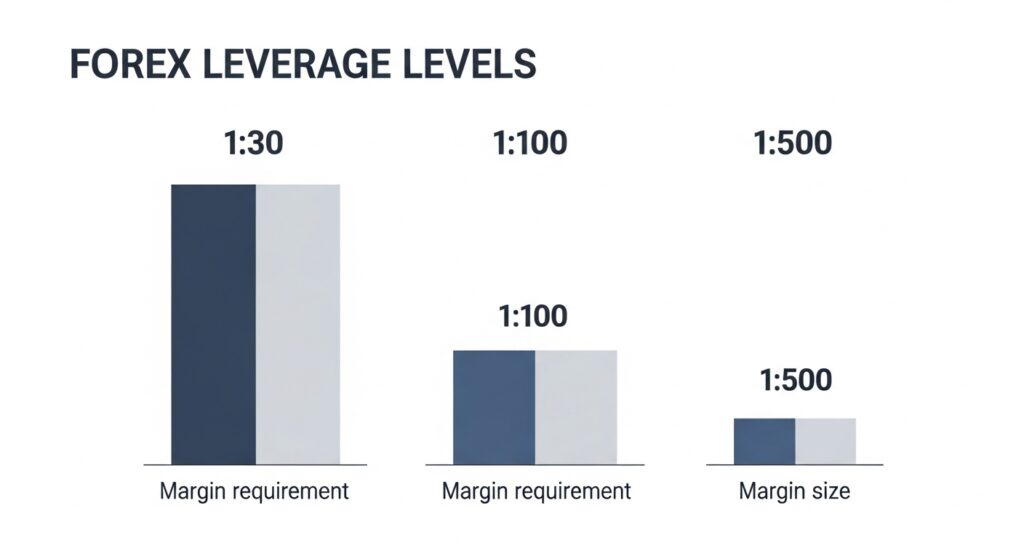
Leverage is expressed as a ratio (1:30, 1:50, 1:100, 1:500) showing how much market exposure you can control relative to your capital.
Example: $1,000 Account
1:30 leverage: Can control up to $30,000 in positions
1:100 leverage: Can control up to $100,000 in positions
1:500 leverage: Can control up to $500,000 in positions
Leverage Doesn’t Change Your Risk
This is critical: Higher leverage doesn’t inherently increase risk if you maintain proper position sizing. A $1,000 account trading 1 mini lot faces the same $1 per pip exposure whether using 1:30 or 1:500 leverage—the difference is only in margin requirements.
Higher leverage allows trading the same position sizes with less capital:
Trading 1 Standard Lot EUR/USD (100,000 units at 1.0850 = $108,500 position):
With 1:30 Leverage:
Required margin: $3,617
Minimum suggested account: $5,000-$10,000
With 1:100 Leverage:
Required margin: $1,085
Minimum suggested account: $2,000-$5,000
With 1:500 Leverage:
Required margin: $217
Minimum suggested account: $500-$1,000
Higher leverage makes standard lot trading accessible with smaller account balances, but this doesn’t mean you should use maximum leverage.
The Leverage Trap
The danger is that high leverage enables position sizes that can destroy accounts quickly:
$500 Account with 1:500 Leverage:
Maximum position: 2.5 standard lots (250,000 units)
Pip value: $25 per pip
A 20-pip loss = $500 = Entire account gone
Just because leverage permits this doesn’t mean it’s wise. Proper risk management limits positions based on your risk percentage (1-2%), not maximum leverage available.
Optimal Leverage by Account Size
Small Accounts ($100-$1,000): Use 1:100 to 1:500 leverage to access meaningful position sizes while maintaining proper risk management. Higher leverage is necessary here not for taking larger risks but for meeting margin requirements on appropriately sized positions.
Medium Accounts ($1,000-$10,000): Use 1:50 to 1:100 leverage. Sufficient capital reduces reliance on extreme leverage while still providing flexibility for multiple positions.
Large Accounts ($10,000+): Use 1:30 to 1:50 leverage. Adequate capital means leverage serves only to free up capital for multiple positions rather than enabling overleveraged trading.
Growing a Small Account: Realistic Strategies
Many successful traders began with small accounts and grew them over time. Here’s how to approach small account growth realistically.
Strategy 1: Conservative Growth with Capital Additions
The most reliable approach combines modest trading returns with regular capital additions from outside income.
After one year: $500 has grown to $4,000 through modest trading returns and consistent additions. This demonstrates more than doubling your trading capital annually while keeping risk manageable.
Strategy 2: Aggressive Compounding (Higher Risk)
Some traders attempt rapid account growth through aggressive risk-taking and full profit compounding. This approach carries significantly higher risk of total loss.
Reality: Most traders attempting this approach experience account destruction within 3-6 months. The few who succeed often had previous experience and are effectively rebuilding skills proven elsewhere.
Strategy 3: Hybrid Approach (Recommended)
Combine moderate trading returns with regular capital additions while gradually increasing risk as account grows:
This balances growth ambition with risk management, giving you multiple paths to success rather than relying solely on trading returns.
When NOT to Start Trading (No Matter How Much Money You Have)
Sometimes the answer isn’t about how much money—it’s about whether you should start at all right now.
Don’t Start Real Trading If:
You Haven’t Completed Demo Training
If you can’t demonstrate consistent profitability over 100+ demo trades, you’re not ready for real money regardless of your capital. Demo trading lets you prove your strategy works without financial risk.
Never trade with money you can’t afford to lose. If losing your entire trading account would create financial hardship, you’re not adequately capitalized regardless of the dollar amount.
You’re Emotionally Unstable
Trading during major life stress (divorce, job loss, illness) often leads to emotional decision-making and poor results. Wait until your personal life stabilizes.
You Don’t Understand Risk Management
If you can’t explain position sizing, stop loss placement, and risk-reward ratios, you need more education before risking real capital.
Traders starting because they “need” to make money quickly almost always fail. Desperation leads to overleveraging, poor decisions, and account destruction.
You Haven’t Researched Brokers
Opening an account with the first broker you found without comparing spreads, regulation, and execution quality often results in higher costs and potential problems.
Starting Capital for Different Goals
How much money to start forex trading changes significantly depending on whether your goal is learning, part-time income, or full-time trading.
Your required starting capital depends heavily on what you’re trying to achieve with forex trading.
Goal: Learn Forex Trading
Recommended capital: $100-$500
Purpose: Gain real trading experience with minimal financial risk. Focus on education and skill development rather than profits.
Approach:
Use micro lots only
Risk 1-2% per trade maximum
Track all trades in a journal
Focus on process over results
Plan to graduate to larger account once consistent
Goal: Generate Supplemental Income
Recommended capital: $2,000-$5,000
Purpose: Create meaningful additional income ($100-$500 monthly) without relying on trading as primary income.
Approach:
Use mini lots primarily
Risk 1-2% per trade
Target 5-10% monthly returns (aggressive but achievable)
Add capital quarterly from outside income
Maintain conservative risk management
Goal: Replace Part-Time Job Income
Recommended capital: $10,000-$25,000
Purpose: Generate $1,000-$2,500 monthly to replace part-time work income.
Approach:
Use standard lots with proper risk management
Risk 1-2% per trade
Target 5-10% monthly returns
Continue part-time work initially while proving consistency
Transition gradually as trading income proves reliable
Goal: Full-Time Trading Income
Recommended capital: $50,000-$100,000+
Purpose: Replace full-time job income ($3,000-$8,000+ monthly).
Approach:
Prove consistent profitability over 12-24 months first
Maintain 6-12 months living expenses separate from trading capital
Risk 1% per trade (more conservative as stakes are higher)
Target 5-10% monthly returns
Treat trading as a business with proper infrastructure
The Financial Conduct Authority requires regulated brokers to provide risk warnings emphasizing that forex trading should not be undertaken with funds you cannot afford to lose.
Hidden Costs That Affect Starting Capital
Your starting capital isn’t just your trading account—consider these additional expenses.
Education Costs
Trading courses: $0-$5,000
Books and resources: $100-$500
Premium indicators or tools: $0-$300
Mentorship or coaching: $500-$5,000+
Budget: $500-$2,000 for quality education before or during your first year
Commissions: $3-$10 per round turn (if applicable)
Swap/rollover fees: Variable for overnight positions
Withdrawal fees: $0-$30 per withdrawal
Budget: Built into each trade’s profit/loss calculation
Total Additional Investment
First Year: $2,000-$10,000+ beyond trading capital Ongoing: $200-$600 monthly
These costs mean a $500 trading account should really be viewed as requiring $2,500-$5,000 total commitment for the first year including education and infrastructure.
Frequently Asked Questions
The most common question new traders ask is how much money to start forex trading — and the honest answer depends on several individual factors.
Can I really start forex trading with $100?
Technically yes, but practically it’s inadequate for sustainable trading. $100 limits you to micro lots only, provides very limited room for drawdowns, and makes proper risk management challenging. Use $100 for initial learning only, with plans to add capital as skills develop.
How long until I can make a living from forex?
Most successful full-time traders required 2-5 years of part-time trading while maintaining other income before transitioning to full-time trading. This timeline allows building capital, proving consistency, and developing the psychological skills needed for trading as primary income.
Should I start with a small account or save up for a larger one?
Both approaches work. Starting small ($500-$1,000) lets you begin learning immediately with real money while saving for larger capital additions. Waiting to save $5,000-$10,000 means starting with adequate capital but delays your learning curve. Consider starting with $500-$1,000 while continuing to save, adding capital quarterly as you prove consistency.
What if I lose my starting capital?
View your initial capital as tuition—the cost of learning a valuable skill. If you lose it, analyze what went wrong, continue demo trading to address weaknesses, and start again with fresh capital when ready. Most successful traders lost accounts early in their careers before finding consistency.
Is more money always better?
Not necessarily. More capital creates more psychological pressure that can interfere with good decision-making. Start with an amount that feels meaningful but not overwhelming—enough that you take trading seriously, but not so much that losses cause panic.
The question “How much money do I need to start forex trading?” has multiple answers depending on your goals. The technical minimum is as low as $10-$100, but realistic minimums range from $500 for learning to $10,000+ for income generation.
For most beginners, starting with $500-$1,000 provides adequate capital for learning proper risk management while limiting financial exposure during the inevitable learning curve. This amount allows trading micro and mini lots, implementing 1-2% risk per trade, and surviving normal losing streaks while developing skills.
As you progress and prove consistency, gradually increase your trading capital through both profits and additions from outside income. Most successful traders didn’t start with large accounts—they built them over time through disciplined trading and regular capital additions.
Remember that having adequate capital is only one piece of the puzzle. Proper education, risk management, psychological discipline, and a proven trading strategy matter more than account size. A skilled trader with $1,000 will outperform an unskilled trader with $10,000 every time.
Focus first on developing real trading skill through demo trading and education. When you transition to real money, start with capital you can genuinely afford to lose while learning. As you prove consistency, let your account grow naturally through both trading profits and regular additions from other income sources.
The traders who succeed aren’t necessarily those who started with the most money—they’re those who started with adequate capital for their skill level, proper risk management, and the discipline to let their edge play out over hundreds of trades.