Learn How to Make Fast Money by Learning diffrent Strategies in Forex Trading and Different Investment Options
What is Spread in Forex Trading: Complete Beginner’s Guide
what is spread in forex trading? Spread represents the difference between the price you can buy a currency pair and the price you can sell it. This difference is your broker’s primary compensation for executing your trades and constitutes one of the most important costs every forex trader must understand and manage.
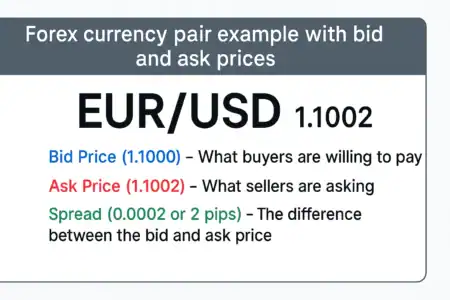
When you open a forex trading platform, you’ll see two prices for every currency pair: the bid price and the ask price. EUR/USD might show 1.0850 / 1.0852, where 1.0850 is the bid (the price you can sell at) and 1.0852 is the ask (the price you can buy at). The 2-pip difference between these prices is the spread, and it represents an immediate cost to your trade.
Understanding spread is fundamental to successful forex trading. The spread affects every trade you make, determines your break-even point, impacts strategy viability, and significantly influences your overall profitability. A trader who ignores spread costs will struggle to achieve consistent profits, even with an otherwise sound trading strategy.
This comprehensive guide explains everything you need to know about forex spreads: how they work, how to calculate spread costs, what factors influence spreads, and most importantly, how to minimize spread expenses to maximize your trading profits.
Before diving into spreads specifically, you must understand the bid-ask structure that creates spreads.
The Bid Price
The bid price is the highest price a buyer in the market is willing to pay for a currency pair at any given moment. When you want to sell a currency pair, you sell at the bid price. The bid represents what you can receive for your position.
Think of the bid as what a buyer offers you. If EUR/USD shows a bid of 1.0850, that means if you want to sell EUR/USD right now, you’ll receive 1.0850 per unit.
The Ask Price
The ask price (also called the offer price) is the lowest price a seller in the market is willing to accept for a currency pair. When you want to buy a currency pair, you buy at the ask price. The ask represents what you must pay to enter a position.
The ask is what a seller demands from you. If EUR/USD shows an ask of 1.0852, you must pay 1.0852 per unit to buy EUR/USD immediately.
The Spread Defined
The spread is simply the difference between the ask price and the bid price:
Spread = Ask Price – Bid Price
Using our EUR/USD example:
Ask: 1.0852
Bid: 1.0850
Spread: 1.0852 – 1.0850 = 0.0002 = 2 pips
This 2-pip spread means that as soon as you buy EUR/USD at 1.0852, you’re immediately down 2 pips because you could only sell it at 1.0850. Your position must move 2 pips in your favor just to break even.
The Commodity Futures Trading Commission requires forex brokers to clearly disclose their spreads and execution quality, as these directly impact trader costs and outcomes.
What is Spread in Forex and How Spread Works as a Trading Cost
The spread represents a built-in transaction cost for every trade. Unlike commissions which some brokers charge separately, the spread is embedded directly in the prices you trade.
Immediate Impact on Your Position
The moment you enter a trade, you’re immediately at a loss equal to the spread. This happens because:
When you buy at the ask price (1.0852), the market’s bid price (where you can sell) sits at 1.0850. You’re automatically 2 pips underwater before the market moves at all.
For this trade to be profitable, the market must move more than the spread amount in your favor. If the spread is 2 pips, the price must move at least 3 pips in your direction for you to achieve a 1-pip profit.
Example: EUR/USD Trade with 2-Pip Spread
Initial Prices:
Bid: 1.0850
Ask: 1.0852
Spread: 2 pips
You buy 1 standard lot (100,000 units) at 1.0852.
Immediately after entering:
Your entry: 1.0852
Current bid (where you can exit): 1.0850
Current loss: 2 pips = $20 (for 1 standard lot, where each pip = $10)
For profit scenarios:
Price moves to 1.0855 bid / 1.0857 ask
You exit at bid: 1.0855
Entry: 1.0852, Exit: 1.0855
Gross profit: 3 pips
Spread cost: 2 pips (paid at entry)
Net profit: 1 pip = $10
Round-Trip Cost
Some traders mistakenly count the spread twice, thinking it costs them at both entry and exit. This is incorrect. The spread cost is incurred once per trade, at entry. When you exit, you’re simply accepting the current bid price (if long) or ask price (if short), which already reflects the spread at that moment.
However, if you enter AND exit at similar price levels in a ranging market, you effectively pay the spread twice: once to enter and once to enter the opposite position later. This is why scalpers and range traders are particularly sensitive to spread costs.
Measuring Spread in Pips
Forex spreads are measured in pips, the standard unit of price movement in forex. Understanding pip measurement is essential for calculating spread costs.
Standard Currency Pairs (4 Decimal Places)
For most currency pairs quoted to four decimal places (EUR/USD, GBP/USD, AUD/USD, USD/CHF), one pip equals 0.0001, the fourth decimal place.
Spread Examples:
EUR/USD: 1.0850 / 1.0852 = 2-pip spread (0.0002)
GBP/USD: 1.2645 / 1.2648 = 3-pip spread (0.0003)
AUD/USD: 0.6580 / 0.6585 = 5-pip spread (0.0005)
Japanese Yen Pairs (2 Decimal Places)
Currency pairs involving the Japanese yen (USD/JPY, EUR/JPY, GBP/JPY) quote to two decimal places, where one pip equals 0.01, the second decimal place.
Spread Examples:
USD/JPY: 149.50 / 149.52 = 2-pip spread (0.02)
EUR/JPY: 162.25 / 162.30 = 5-pip spread (0.05)
GBP/JPY: 188.70 / 188.80 = 10-pip spread (0.10)
Fractional Pips (Pipettes)
Many brokers now display prices with an additional decimal place called a pipette or fractional pip. Standard pairs show five decimals, and yen pairs show three decimals.
This example shows why spread costs must be factored into your trading strategy and why high-frequency traders require extremely tight spreads to remain profitable.
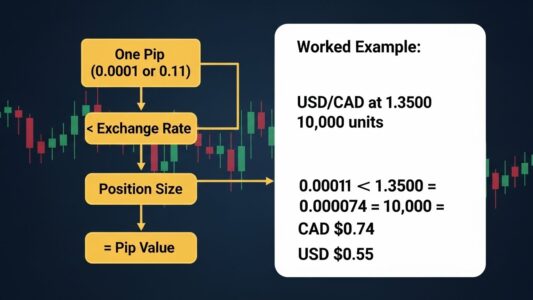
Understanding pip value helps you calculate exact spread costs for your position sizes.
Fixed vs Variable Spreads
Brokers offer two main spread models: fixed spreads and variable spreads. Each has advantages and disadvantages depending on your trading style.
Fixed Spreads
Fixed spreads remain constant regardless of market conditions. If a broker offers a fixed 3-pip spread on EUR/USD, you’ll always pay 3 pips whether markets are calm or volatile, liquid or thin.
Advantages of Fixed Spreads:
Predictable costs make strategy testing and risk management easier
Spreads don’t widen during news releases or volatile periods
Easier to calculate profit targets and stop-loss levels
Transparency in costs
Disadvantages of Fixed Spreads:
Often wider than average variable spreads during normal conditions
Broker may requote prices during extreme volatility
Less competitive pricing during high-liquidity periods
May include higher commissions to compensate broker
Fixed spreads suit traders who value predictability and trade during news events or volatile periods when variable spreads might widen significantly.
Variable Spreads
Variable spreads (also called floating spreads) fluctuate based on market conditions, liquidity, and volatility. During normal trading hours with high liquidity, variable spreads might be 1-2 pips for EUR/USD. During news releases or Asian session low liquidity, the same pair might widen to 5-10 pips.
Advantages of Variable Spreads:
Tighter spreads during normal market conditions
More competitive pricing during liquid trading sessions
Reflects true market conditions and liquidity
Often combined with low or zero commission models
Disadvantages of Variable Spreads:
Unpredictable costs make precise profit/loss calculations difficult
Spreads widen during news, volatile periods, or low liquidity
Can widen dramatically during crisis events
Slippage more common when spreads are widening
Variable spreads suit traders who trade during liquid market hours, avoid major news releases, and want the tightest possible spreads under normal conditions.
Which Should You Choose?
Your trading style determines the better option:
Choose Fixed Spreads If:
You trade during news releases or volatile events
You value predictable costs above all else
You’re a beginner who wants simplicity
You trade exotic or less liquid pairs
Choose Variable Spreads If:
You trade major pairs during liquid hours (London/NY sessions)
You avoid major news releases
You’re experienced and can adapt to changing conditions
You want the tightest possible spreads most of the time
The National Futures Association requires brokers to clearly disclose their spread types and typical spread ranges to help traders make informed decisions.
Factors That Affect Spread Width
Multiple factors influence how wide or tight spreads are at any given moment. Understanding these helps you choose optimal trading times and conditions.
Market Liquidity
Liquidity—the ease of buying or selling without affecting price—is the primary factor affecting spreads. High liquidity creates tight spreads because many buyers and sellers are active, creating competition. Low liquidity widens spreads because fewer participants mean less competition and higher risk for market makers.
Major currency pairs (EUR/USD, GBP/USD, USD/JPY) maintain tight spreads due to enormous trading volume. Exotic pairs (USD/TRY, EUR/ZAR) carry wider spreads because of lower liquidity.
Trading Session and Time of Day
Spreads vary significantly across trading sessions:
London-New York Overlap (8 AM – 12 PM EST): Tightest spreads due to maximum liquidity with both European and American markets active. EUR/USD might trade with 1-2 pip spreads.
Tokyo Session (7 PM – 4 AM EST): Wider spreads for European and American pairs due to lower participation. EUR/USD might widen to 3-5 pips during quiet Asian hours.
Weekend and Holiday Periods: Spreads widen significantly when major financial centers are closed. Friday evenings and Sunday evenings see reduced liquidity and wider spreads.
High volatility increases uncertainty and risk for brokers and liquidity providers, causing spreads to widen to compensate for this risk.
Normal Conditions: EUR/USD might maintain 1-2 pip spreads during calm markets.
News Releases: During major economic announcements (Non-Farm Payrolls, FOMC decisions, GDP releases), spreads can widen to 10-20 pips or more as liquidity providers pull back to avoid adverse selection risk.
Market Crises: During extreme events (COVID-19 pandemic onset, Brexit referendum results), spreads can explode to 50+ pips as liquidity evaporates.
News traders must account for spread widening in their strategies. A trade that looks profitable with a 2-pip spread might fail with a 15-pip spread during the news release execution.
Currency Pair Characteristics
Different currency pairs carry naturally different spread ranges:
Major Pairs (Tightest Spreads):
EUR/USD: 0.5-2 pips typically
GBP/USD: 1-3 pips typically
USD/JPY: 0.5-2 pips typically
Minor Pairs (Medium Spreads):
EUR/GBP: 2-4 pips typically
EUR/JPY: 2-5 pips typically
GBP/JPY: 3-6 pips typically
Exotic Pairs (Widest Spreads):
USD/TRY: 20-50+ pips typically
EUR/ZAR: 50-150+ pips typically
USD/RUB: 100-300+ pips typically
Trading exotic pairs requires strategies with larger profit targets to overcome the substantial spread costs.
Broker Type and Business Model
Your broker’s business model significantly affects spreads:
Market Makers: Often offer fixed spreads, wider than variable spread competitors during liquid conditions but more predictable during volatility. They profit from spread widening and may trade against clients.
ECN/STP Brokers: Typically offer variable spreads that reflect actual interbank market conditions. Spreads are tighter during liquid periods but widen during volatility. These brokers route orders to liquidity providers and charge commissions.
Understanding normal spread ranges helps you identify when you’re getting competitive pricing and when spreads are unreasonably wide.
Major Currency Pairs
EUR/USD (Euro / US Dollar):
Best conditions: 0.5-1.0 pips
Normal conditions: 1.0-2.0 pips
News/low liquidity: 3-10+ pips
GBP/USD (British Pound / US Dollar):
Best conditions: 1.0-1.5 pips
Normal conditions: 1.5-3.0 pips
News/low liquidity: 5-15+ pips
USD/JPY (US Dollar / Japanese Yen):
Best conditions: 0.5-1.0 pips
Normal conditions: 1.0-2.0 pips
News/low liquidity: 3-10+ pips
USD/CHF (US Dollar / Swiss Franc):
Best conditions: 1.5-2.0 pips
Normal conditions: 2.0-3.0 pips
News/low liquidity: 5-12+ pips
Minor Currency Pairs
EUR/GBP (Euro / British Pound):
Best conditions: 1.5-2.5 pips
Normal conditions: 2.5-4.0 pips
News/low liquidity: 6-15+ pips
AUD/JPY (Australian Dollar / Japanese Yen):
Best conditions: 2.0-3.0 pips
Normal conditions: 3.0-5.0 pips
News/low liquidity: 8-20+ pips
EUR/CAD (Euro / Canadian Dollar):
Best conditions: 3.0-4.0 pips
Normal conditions: 4.0-6.0 pips
News/low liquidity: 10-25+ pips
Exotic Currency Pairs
USD/TRY (US Dollar / Turkish Lira):
Best conditions: 20-30 pips
Normal conditions: 30-80 pips
News/low liquidity: 100-300+ pips
EUR/TRY (Euro / Turkish Lira):
Best conditions: 30-50 pips
Normal conditions: 50-100 pips
News/low liquidity: 150-400+ pips
USD/ZAR (US Dollar / South African Rand):
Best conditions: 30-60 pips
Normal conditions: 60-120 pips
News/low liquidity: 150-300+ pips
If your broker’s spreads consistently fall outside these ranges (especially on the high end), consider shopping for a more competitive broker.
Spread vs Commission: Understanding Total Trading Costs
Some brokers charge commission in addition to or instead of spreads. Understanding total cost requires comparing both elements.
Spread-Only Models
Traditional retail forex brokers make money through the spread alone, charging no separate commission. You simply pay the bid-ask spread on each trade.
Example: EUR/USD with 2-pip spread
Entry: 1.0852 (ask)
Exit: 1.0850 (bid)
Spread cost: 2 pips = $20 per standard lot
Commission: $0
Total cost: $20 per round-turn trade
Commission-Based Models
ECN and STP brokers often offer very tight spreads but charge separate commissions per trade. Commission might be quoted per lot, per side, or per round-turn.
Example: EUR/USD with 0.5-pip spread + $7 commission per round-turn
Spread cost: 0.5 pips = $5 per standard lot
Commission: $7 per round-turn (both entry and exit)
Total cost: $5 + $7 = $12 per round-turn trade
Comparing Total Costs
To accurately compare brokers, convert everything to pips:
Commission in Pips = Commission $ ÷ Pip Value
Example comparison for 1 standard lot EUR/USD:
Broker A (Spread-Only):
Spread: 2.0 pips = $20
Commission: $0
Total: $20 = 2.0 pips
Broker B (Commission Model):
Spread: 0.5 pips = $5
Commission: $7 per round-turn = 0.7 pips
Total: $12 = 1.2 pips
Broker B offers better total cost despite charging commission.
Which Model Costs Less?
Generally, commission-based models with tight spreads offer lower total costs for active traders trading major pairs during liquid hours. Spread-only models may be simpler for beginners and can be more competitive for exotic pairs or during volatile conditions.
Calculate your total cost per trade including both spread and commission before choosing a broker.
Strategies to Minimize Spread Costs
Since spreads represent unavoidable costs, minimizing them directly improves profitability. Here are proven strategies to reduce spread expenses:
Trade During Liquid Market Hours
Execute trades during the London-New York overlap (8 AM – 12 PM EST) when liquidity peaks and spreads tighten. Avoid trading during the Asian session or late New York afternoon when liquidity thins and spreads widen.
Major pairs like EUR/USD might offer 1-pip spreads during the overlap but widen to 3-5 pips during Asian hours. Simply timing your trades better can reduce spread costs by 60-80%.
Choose Major Currency Pairs
Focus on highly liquid major pairs (EUR/USD, GBP/USD, USD/JPY) that maintain tight spreads. Avoid exotic pairs with 20-100+ pip spreads unless your strategy specifically targets them and can overcome the higher costs.
A strategy that needs 50-pip profit targets might work well with 2-pip spreads on EUR/USD (4% of target) but fails with 40-pip spreads on exotic pairs (80% of target consumed by spread).
Select the Right Broker
Compare total trading costs (spread + commission) across multiple brokers. Even small differences compound significantly over hundreds of trades.
Example: 0.5-pip difference over 1,000 trades at 1 standard lot = 500 pips = $5,000 saved or wasted depending on broker selection.
Look for brokers regulated by the Financial Conduct Authority, CFTC, or other major regulators who maintain competitive spreads.
Limit orders to enter positions at specific prices sometimes receive better execution than market orders. While you still pay the spread, you control your entry price and avoid slippage that compounds spread costs.
Market orders during volatile periods can experience slippage that effectively widens the spread by several pips beyond the quoted spread.
Reduce Trading Frequency
Every trade incurs spread costs. Reducing unnecessary trades directly reduces total spread expenses. A trader executing 50 trades per month instead of 200 pays 75% less in spread costs while potentially improving win rate through increased selectivity.
Develop trading strategies with higher win rates and larger average profits per trade rather than high-frequency approaches that multiply spread costs.
Avoid Trading During News Releases
Unless you’re specifically a news trader, avoid executing trades during major economic releases when spreads widen dramatically. The 1-2 pip spread you expect might become 10-20 pips during the release, significantly increasing your costs.
Wait 15-30 minutes after major news for spreads to normalize before entering positions, or use news releases to identify direction but enter after volatility settles.
Scale Position Sizes Appropriately
Larger position sizes multiply spread costs proportionally. A 2-pip spread costs $2 on a micro lot but $200 on 10 standard lots. Ensure your position sizes make sense for your account and that the potential profit justifies the spread cost.
A scalping strategy targeting 5-10 pips per trade needs tight spreads to succeed. The same strategy with 5-pip spreads becomes unprofitable immediately.
Spread impact varies dramatically based on your trading approach and timeframe.
Scalping (Very Sensitive to Spread)
Scalpers target small profits of 5-15 pips per trade, often holding positions for seconds to minutes. Spread costs represent a huge percentage of profit targets.
Example:
Target profit: 10 pips
Spread: 2 pips
Net profit: 8 pips
Spread as % of target: 20%
With a 50% win rate, the trader needs to overcome the spread on every trade, making tight spreads absolutely critical. A 3-pip spread instead of 2 pips reduces net profit by 12.5% on every winning trade.
Scalpers must use brokers with the tightest possible spreads, trade only during peak liquidity hours, and focus exclusively on major pairs. Even then, spread costs make scalping one of the most challenging trading styles.
Day Trading (Moderate Sensitivity)
Day traders hold positions for several minutes to hours, targeting 20-50 pip profits. Spread costs represent a moderate percentage of targets but still significantly impact overall profitability.
Example:
Target profit: 40 pips
Spread: 2 pips
Net profit: 38 pips
Spread as % of target: 5%
Day traders benefit from tight spreads but can tolerate slightly wider spreads than scalpers. They should still trade during liquid hours and focus on major pairs to minimize costs.
Swing traders hold positions for several days to weeks, targeting 100-300+ pip profits. Spread costs represent a small percentage of profit targets but still matter over many trades.
Example:
Target profit: 200 pips
Spread: 3 pips
Net profit: 197 pips
Spread as % of target: 1.5%
Swing traders can trade minor pairs with wider spreads and aren’t as affected by session timing. However, consistently tight spreads still provide an edge over hundreds of trades.
Position Trading (Minimal Sensitivity)
Position traders hold for weeks to months, targeting 500-1000+ pip profits. Spread costs become almost negligible relative to profit targets.
Example:
Target profit: 800 pips
Spread: 5 pips
Net profit: 795 pips
Spread as % of target: 0.6%
Position traders focus more on swap/rollover costs for holding positions long-term than on spread costs for entry.
Common Spread-Related Mistakes
Avoid these errors that increase your spread costs or create unrealistic expectations:
Many traders backtest strategies without accounting for spread costs, creating unrealistic performance expectations. A strategy showing 1,000 pips profit over 100 trades might show only 600 pips after subtracting 2-pip spreads on each trade—a 40% difference.
Always include spread costs in backtesting and forward testing. Most platforms allow you to specify spread assumptions when testing.
Mistake 2: Trading High-Spread Pairs Without Adjusting Strategy
Using a strategy designed for tight-spread major pairs on exotic pairs with 50+ pip spreads leads to failure. The spread costs overwhelm profit targets designed for different cost structures.
Either avoid high-spread exotic pairs or significantly adjust profit targets and trade frequency to account for higher costs.
Executing trades without checking current spread leads to surprise costs. A 2-pip spread that suddenly widened to 10 pips during your order can destroy an otherwise profitable trade.
Always check current spread before executing, especially during or near news events. Most platforms display current spread for each pair.
Mistake 4: Assuming All Brokers Offer Similar Spreads
Spread differences between brokers can be substantial. Some brokers offer 0.5-1.0 pip EUR/USD spreads while others charge 2-3 pips—a 200-300% difference that dramatically affects profitability.
Compare spreads across multiple brokers during your typical trading hours before opening an account.
Mistake 5: Using Market Orders During News
Market orders during news releases often execute at massively widened spreads plus slippage, potentially costing 20-50 pips or more instead of the normal 2-pip spread.
Either avoid news trading or use limit orders with acceptance criteria that prevent execution at unreasonable spread widths.
Conclusion
The spread in forex trading represents the difference between the bid and ask price, constituting your primary transaction cost for every trade. Understanding spread mechanics, calculating spread costs accurately, and implementing strategies to minimize spread expenses directly impacts your bottom-line trading profitability.
Major currency pairs offer the tightest spreads (1-3 pips typically) while exotic pairs carry much wider spreads (20-100+ pips). Trading during peak liquidity hours (London-New York overlap) provides the best spread conditions, while news events and low-liquidity periods cause spreads to widen significantly.
Choose between fixed spreads for predictability or variable spreads for potentially lower costs during normal conditions. Compare total trading costs including both spreads and commissions when evaluating brokers. Even small spread differences compound over hundreds of trades, making broker selection crucial for long-term success.
Your trading style determines spread sensitivity. Scalpers require the tightest possible spreads since spread costs consume a large percentage of small profit targets. Position traders can tolerate wider spreads since their large profit targets minimize spread impact.
Minimize spread costs by trading liquid major pairs during peak hours, reducing unnecessary trade frequency, avoiding news volatility, and selecting competitive brokers. Always account for spread costs in strategy testing and trade planning to maintain realistic expectations.
Remember that spread is just one component of total trading costs. Also consider commissions, swap/rollover fees, and slippage when calculating the true cost of your trading activity. Mastering spread management provides a significant edge that compounds into substantial profit differences over your trading career.