Advanced forex trading strategies separate professionals from novices, combining technical precision, risk management discipline, and market psychology understanding. These sophisticated approaches—including price action trading, harmonic patterns, order flow analysis, and multi-timeframe frameworks—require deeper market knowledge but deliver superior risk-adjusted returns when properly executed.
Price Action Trading Strategies
Price action trading analyzes raw price movement without relying heavily on indicators. This approach focuses on candlestick patterns, support and resistance levels, and market structure to identify high-probability trade setups.
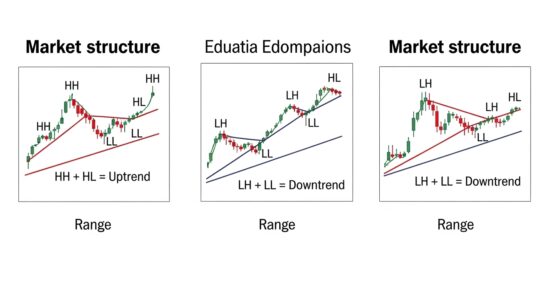
Understanding Market Structure: Professional price action traders identify market structure through swing highs and swing lows. An uptrend creates higher highs and higher lows. A downtrend produces lower highs and lower lows. Recognizing when structure breaks signals potential trend changes before lagging indicators respond.
Structure breaks occur when price violates the most recent swing high in a downtrend or swing low in an uptrend. These violations suggest momentum shifts and often precede sustained directional moves. Waiting for structure confirmation reduces false signals that occur during temporary volatility spikes.
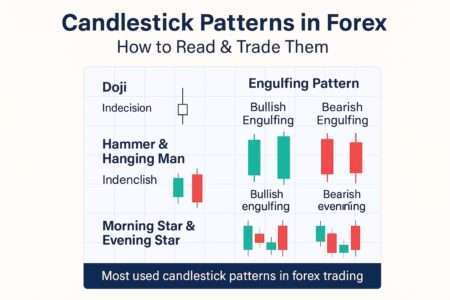
Pin Bar Reversals: Pin bars—candlesticks with small bodies and long wicks—indicate rejection of price levels and potential reversals. A bullish pin bar at support with a long lower wick shows buyers rejected lower prices aggressively. A bearish pin bar at resistance with a long upper wick demonstrates sellers defending the level.
Pin bar reliability increases dramatically when they form at significant support or resistance levels, particularly when confluence exists with Fibonacci retracements, round numbers, or previous market structure points. Isolated pin bars in the middle of ranges offer less predictive value.
Entry for pin bar trades typically occurs on a break of the pin bar high (for bullish setups) or low (for bearish setups), confirming the rejection. Stops place beyond the pin bar wick, while targets aim for the next significant support or resistance level.
Inside Bar Breakouts: Inside bars—candles completely contained within the range of the previous candle—represent consolidation and potential energy buildup. These patterns often precede breakouts in the direction of the prevailing trend.
The most reliable inside bar setups occur after strong trending moves and before trend continuation. Multiple inside bars stacking together (inside bar within an inside bar) increase breakout potential. Entry occurs on a decisive break above or below the inside bar range with stops on the opposite side.
Engulfing Patterns at Key Levels: Bullish engulfing patterns (larger bullish candle completely engulfing previous bearish candle) and bearish engulfing patterns (larger bearish candle engulfing previous bullish candle) signal momentum shifts. These patterns carry greater significance at support, resistance, or after extended trends.
An engulfing pattern after a 200+ pip trend suggests exhaustion and potential reversal. The larger the engulfing candle relative to recent price action, the stronger the reversal signal. Volume confirmation—higher volume on the engulfing candle—adds reliability.
The Commodity Futures Trading Commission requires forex dealers to disclose that technical analysis and pattern trading carry no guarantee of success and that past patterns don’t predict future results.
Harmonic Pattern Trading
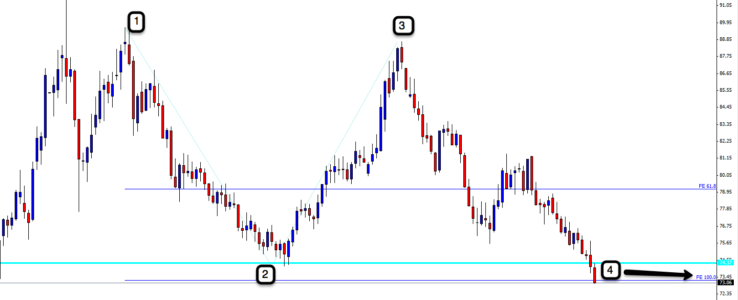
Harmonic patterns use Fibonacci-derived ratios to identify potential reversal points with mathematical precision. These patterns—including Gartley, Bat, Butterfly, and Crab—offer specific entry, stop, and target levels based on Fibonacci relationships.
Understanding Harmonic Pattern Structure: Harmonic patterns consist of specific Fibonacci retracements and extensions between designated swing points labeled X, A, B, C, and D. The D point represents the potential reversal zone (PRZ) where traders enter positions.
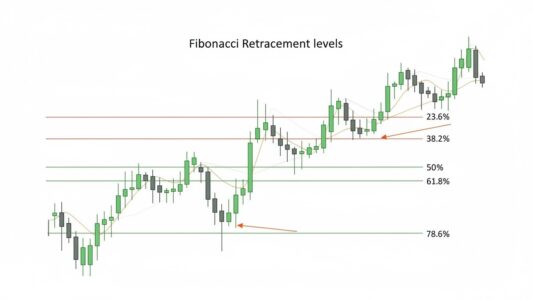
Each pattern has precise ratio requirements. A Gartley pattern requires the B point to retrace 0.618 of XA, the C point to retrace 0.382-0.886 of AB, and the D point to complete at 0.786 retracement of XA with 1.27-1.618 extension of BC. These mathematical relationships define the pattern’s validity.
The Gartley Pattern: The Gartley, one of the most common harmonic patterns, identifies potential reversals after corrective moves within larger trends. The pattern maintains specific Fibonacci relationships across all legs, creating high-probability reversal zones.
Bullish Gartley patterns form in downtrends and signal potential upside reversals. Bearish Gartleys form in uptrends and indicate possible downside reversals. Entry occurs at the D point completion with stops beyond the X point and targets at the 0.618 retracement of AD.
The Bat Pattern: Bat patterns differ from Gartleys primarily in their deeper B point retracement (0.382-0.500 of XA) and shallower D point completion (0.886 of XA). These patterns often provide tighter stop losses relative to profit potential compared to Gartleys.
The Bat’s precise 0.886 retracement for the D point creates a specific entry zone rather than a range. This precision requires exact Fibonacci tool application but rewards accuracy with clearly defined risk parameters.
The Butterfly Pattern: Butterfly patterns extend beyond the initial X point, with D completing at 1.27-1.618 extension of XA. These patterns signal potential reversals after extended moves and often form at major support or resistance levels.
Butterfly patterns require patience as price extends significantly before reaching the completion point. However, the extended moves often coincide with market exhaustion, increasing reversal probability at the D point.
The Crab Pattern: The Crab represents the most extreme harmonic pattern, with D completing at a 1.618 extension of XA. These patterns form less frequently but offer excellent risk-reward ratios when they develop at significant market extremes.
The deep extension to 1.618 often corresponds with round numbers, major Fibonacci levels from larger timeframe analysis, or significant historical support/resistance. This confluence increases trade reliability.
Harmonic pattern trading requires disciplined adherence to Fibonacci ratios. Patterns that don’t meet precise requirements should be disregarded, as approximate ratios significantly reduce reliability. Professional harmonic traders use automated pattern recognition software to ensure accuracy.
Order Flow and Market Depth Analysis
Order flow analysis examines actual trading activity—buy and sell orders, volume distribution, and liquidity—to anticipate price movements before they occur. This approach provides insight into institutional activity and smart money positioning.
Understanding the Order Book: The order book displays pending buy and sell orders at various price levels. Large order clusters indicate potential support (buy orders) or resistance (sell orders). However, the order book shows only limit orders, not market orders, and orders can be canceled before execution.
Significant order imbalances—many more buy orders than sell orders or vice versa—suggest potential directional bias. However, sophisticated traders place and cancel large orders to create false impressions, making order book analysis most reliable when combined with actual traded volume.
Volume Profile Analysis: Volume profile displays how much volume traded at each price level over specific periods. High volume areas represent price acceptance—levels where substantial trading occurred and future support or resistance likely exists. Low volume areas indicate price rejection—levels that price moved through quickly with minimal trading interest.
When price returns to high volume areas, these levels often provide support or resistance as traders who previously transacted there defend their positions. Breaks through high volume areas with strong momentum suggest significant sentiment shifts.
Point of Control (POC)—the price level with the highest traded volume—acts as a magnet for price. Price often returns to test the POC before trending away. Monitoring where current POC sits relative to price helps anticipate mean reversion opportunities.
Footprint Charts: Footprint charts display buy and sell volume at each price level within individual candles, revealing intrabar order flow. Green numbers show volume traded on the ask (aggressive buying), while red numbers show volume on the bid (aggressive selling).
Identifying absorption—where large volume trades at a level without significant price movement—signals strong support or resistance. If price approaches support and large buy volume appears without price declining further, absorption indicates buyers defending the level aggressively.
Imbalances—significant differences between buy and sell volume at specific price levels—often precede directional moves. If sell volume overwhelms buy volume near resistance, a breakdown becomes more probable.
The National Futures Association regulates forex dealers offering volume-based analysis tools and requires them to disclose that order flow data may be delayed or represent only a portion of total market activity.
Multi-Timeframe Analysis Strategies
Professional traders analyze multiple timeframes simultaneously to align short-term entries with longer-term trends. This approach provides context for individual trades and significantly improves win rates.
The Three-Timeframe Approach: Select three timeframes with approximately 4-6x relationships—for example, daily, 4-hour, and 1-hour charts. The longest timeframe determines overall trend direction. The middle timeframe identifies pullbacks within that trend. The shortest timeframe provides precise entry timing.
Example: Daily chart shows EUR/USD in uptrend. Four-hour chart reveals a pullback to support. One-hour chart shows a bullish pin bar at that support level. This alignment creates a high-probability long entry—trading with the daily trend, entering on a pullback identified on the 4-hour chart, with specific entry signal on the 1-hour chart.
Trend Identification on Higher Timeframes: The highest timeframe in your analysis determines trend direction. Use moving averages, market structure (higher highs and higher lows), or trendlines to define trend. Never trade against this higher timeframe trend unless explicitly trading reversals.
If the daily chart shows a downtrend, focus exclusively on short positions from lower timeframes. Counter-trend long positions fight the prevailing momentum and face lower probability of success.
Entry Timing on Lower Timeframes: Once higher timeframes establish trend direction, use lower timeframes for precise entries during pullbacks or breakouts. A daily uptrend might pull back for several 4-hour candles before resuming. The 1-hour chart shows exactly when that pullback completes.
Watch for reversal patterns, support tests, or momentum divergences on the entry timeframe. These signals time entries within the larger trend structure, providing tight stops and favorable risk-reward ratios.
Stop Loss and Profit Target Placement: Base stop losses on structure from the entry timeframe while basing profit targets on the higher timeframe. If entering on a 1-hour pin bar, place stops beyond the pin bar wick. Target the next significant resistance level visible on the 4-hour or daily chart.
This approach creates asymmetric risk-reward—risking 30-50 pips based on 1-hour structure while targeting 100-200 pips based on daily structure. Multiple winning trades with 3:1 or 4:1 reward-risk overcome inevitable losses.
Breakout Trading Strategies
Breakout strategies capitalize on price movements beyond established ranges, channels, or patterns. Successful breakout trading requires distinguishing genuine breakouts from false signals.
Consolidation Breakout Strategy: Identify clear consolidation ranges after trending moves. The longer the consolidation, the more significant the eventual breakout. Measure the consolidation range width and project this distance from the breakout point for profit targets.
Enter on decisive breaks beyond consolidation boundaries with increased volume confirming the move. Avoid entering on small range breaks or during low-volume periods when false breakouts occur more frequently.
Place stops inside the consolidation range. If price breaks out but then retreats back into the range, the breakout failed and the position should be stopped out. Failed breakouts often precede moves in the opposite direction.
Triangle Pattern Breakouts: Ascending triangles (flat top, rising bottom), descending triangles (falling top, flat bottom), and symmetrical triangles (converging trendlines) all create breakout opportunities as price coils tighter within narrowing ranges.
Ascending and descending triangles suggest directional bias—ascending triangles typically break upward, descending triangles break downward. Symmetrical triangles offer less directional certainty but often produce explosive moves once resolved.
Enter triangle breakouts when price closes beyond the pattern boundary with volume confirmation. Measure from the widest part of the triangle and project this distance from the breakout point for targets. Stop losses sit just inside the triangle on the opposite side.
Range Expansion Breakouts: After periods of low volatility and narrow ranges, markets often expand explosively. Monitor Average True Range (ATR) to identify contracted volatility. When ATR reaches multi-week lows, anticipate range expansion.
Position for range expansion by waiting for the initial breakout direction to establish, then entering on the first pullback. This approach avoids entering during the volatile initial expansion while capturing the sustained move.
False Breakout Avoidance: False breakouts plague traders who enter too aggressively. Requiring a close beyond the breakout level (not just an intrabar spike) filters many false signals. Volume confirmation—breakouts on higher than average volume—adds reliability.
Multiple timeframe confirmation helps distinguish real breakouts from false moves. A 1-hour chart breakout confirmed by the 4-hour chart moving in the same direction carries more conviction than an isolated 1-hour move.
The Financial Conduct Authority requires UK forex brokers to disclose that breakout strategies involve substantial risk, particularly during low liquidity periods when false breakouts occur frequently.
Carry Trade Strategies
Carry trades profit from interest rate differentials between currencies while potentially gaining from favorable exchange rate movements. These positions can be held for weeks or months, generating both interest income and capital appreciation.
Understanding Interest Rate Differentials: When you buy a currency with higher interest rates and sell one with lower rates, you earn the rate differential daily. For example, if Australian rates are 4.00% and Japanese rates are -0.10%, a long AUD/JPY position earns approximately 4.10% annually, paid daily as rollover interest.
Positive carry (earning interest) makes positions cheaper to hold long-term. Negative carry (paying interest) adds cost to positions, making extended holds less attractive. Always verify current rollover rates with your broker as they change with central bank policy shifts.
Identifying Carry Trade Opportunities: Select currency pairs with large interest rate differentials where the higher-yielding currency shows economic strength. AUD/JPY, NZD/JPY, and historically USD/TRY represent popular carry trades due to significant rate gaps.
Evaluate whether the higher-yielding currency is likely to appreciate or at least remain stable against the lower-yielding currency. Carry trades work best when interest income combines with favorable exchange rate movements or stable rates.
Risk Management in Carry Trades: Carry trades can reverse violently during risk-off events. The 2008 financial crisis saw carry trades collapse as investors fled to safe-haven currencies like the yen, causing sharp reversals in pairs like AUD/JPY.
Use wider stops than typical swing trades since carry positions aim to capture both interest and longer-term appreciation. However, maintain disciplined risk management—don’t allow interest income to justify holding losing positions indefinitely.
Monitor central bank policy closely. When rate differentials narrow due to rate cuts in the higher-yielding currency or rate hikes in the lower-yielding currency, carry trade attractiveness diminishes and positions should be reconsidered.
Carry Trade Entry and Exit: Enter carry trades during risk-on environments when investors favor higher-yielding currencies. Technical support levels provide specific entry points that combine favorable carry with defined risk.
Exit carry trades when technical structure breaks, rate differential expectations change, or risk sentiment shifts dramatically. Don’t rely on carry interest to offset capital losses—the exchange rate component typically overwhelms interest income during reversals.
Mean Reversion Strategies
Mean reversion strategies profit from prices returning to average levels after extended deviations. These approaches work best in range-bound markets and during temporary overextensions within trends.
Bollinger Band Mean Reversion: Bollinger Bands create dynamic support and resistance based on standard deviations from a moving average. Prices touching the lower band suggest oversold conditions potentially due for reversion to the middle band. Upper band touches indicate overbought conditions.
Trade mean reversion by entering when price reaches the outer bands and exiting at the middle band. This approach works best in ranging markets where price oscillates between bands without trending persistently.
Confirm band touches with additional indicators like RSI showing oversold (below 30) or overbought (above 70) readings. This confluence improves entry timing and reduces false signals during strong trends.
Relative Strength Index (RSI) Divergence: RSI divergence—price making new highs while RSI fails to confirm or price making new lows while RSI doesn’t—signals momentum exhaustion and potential mean reversion.
Bullish divergence occurs when price makes lower lows but RSI makes higher lows, suggesting downward momentum weakening. Bearish divergence happens when price makes higher highs but RSI makes lower highs, indicating upward momentum fading.
Enter mean reversion trades when divergence completes and price shows reversal confirmation through candlestick patterns or structure breaks. Divergence alone doesn’t guarantee reversals—confirmation prevents premature entries.
Support and Resistance Mean Reversion: Identify clear support and resistance levels from recent market structure. When price reaches these levels, enter positions expecting reversion to the range midpoint or opposite boundary.
This strategy requires clear ranges—avoid attempting mean reversion during trending markets where support and resistance levels consistently break. Wait for established ranges with multiple touches confirming level validity.
Mean Reversion vs. Trend Following: Mean reversion and trend following represent opposite philosophies. Mean reversion assumes prices return to averages. Trend following assumes momentum persists. Successful traders recognize which approach suits current market conditions.
Ranging markets favor mean reversion—prices oscillate between defined levels. Trending markets favor trend following—prices continue in the established direction. Identify market regime before applying either approach.
Advanced Risk Management Techniques
Advanced strategies require sophisticated risk management beyond simple stop losses:
Position Scaling: Rather than entering full position size immediately, scale into positions as they prove correct. Enter one-third position initially, add another third if price moves favorably, and add the final third after further confirmation.
Scaling provides flexibility—if price immediately moves against you, only partial position is at risk. If price moves favorably, average entry improves compared to full initial entry.
Correlation-Adjusted Position Sizing: When trading multiple pairs, adjust individual position sizes based on correlations. If trading three positively correlated pairs, reduce each position size to maintain total risk consistent with a single position.
Calculate effective exposure across correlated positions. Three 1-lot positions in pairs with +0.80 correlation create approximately 2.6 lots of effective exposure, not 3 lots, requiring position size adjustments.
Time-Based Stops: Beyond price-based stops, implement time-based exits. If a trade hasn’t moved as expected within a defined timeframe (e.g., 3 days), exit regardless of profit or loss. Time stops prevent capital from remaining trapped in stagnant positions.
Advanced traders recognize that opportunity cost—capital unable to deploy in better opportunities—represents real cost even without realized losses.
Volatility-Adjusted Position Sizing: Adjust position sizes based on current market volatility. During high volatility periods (high ATR), reduce position sizes to maintain consistent dollar risk. During low volatility, increase sizes appropriately.
This approach maintains consistent risk regardless of market conditions. A 50-pip stop during high volatility represents more dollar risk than a 50-pip stop during low volatility if position sizes remain constant.
Combining Advanced Forex Trading Strategies
Professional traders often combine elements from multiple strategies to create robust approaches:
A comprehensive setup might require: (1) Daily chart uptrend confirmed, (2) 4-hour chart pullback to support, (3) Bullish harmonic pattern completing at support, (4) Order flow showing absorption of sell orders, (5) 1-hour chart pin bar forming. This multi-layered confirmation significantly improves trade quality.
Combining strategies provides redundancy—if one element fails, others may still support the trade. However, avoid over-optimizing with so many requirements that trades rarely qualify. Balance between selectivity and opportunity.
Conclusion
Advanced forex strategies separate casual traders from professionals through mathematical precision, market psychology understanding, and disciplined execution. Price action trading reads raw market behavior. Harmonic patterns apply Fibonacci mathematics to identify reversal zones. Order flow analysis reveals institutional activity before price fully reflects it. Multi-timeframe approaches align short-term entries with longer-term trends.
Master one strategy completely before attempting others. A trader expert in pin bar price action will outperform someone superficially applying five different approaches. Depth of understanding matters more than breadth of techniques.
As you develop your trading, focus on finding high-probability setups where multiple factors align—technical structure, order flow, harmonic patterns, and multi-timeframe analysis all confirming the same direction. These rare but powerful opportunities offer the risk-reward ratios that build trading careers.
Advanced strategies require practice, patience, and realistic expectations. Even professionals win only 50-60% of trades—their edge comes from superior risk-reward ratios, consistent execution, and comprehensive risk management.
Apply these advanced techniques systematically, manage risk disciplinarily, and view trading as a long-term statistical edge rather than individual trade outcomes.
Before you attempt these advanced strategies, make sure to execute these ratios precisely and check our guide on How to Calculate Pips to ensure your risk management is precise