Learn How to Make Fast Money by Learning diffrent Strategies in Forex Trading and Different Investment Options
Currency Correlation Trading: How to Use Forex Pair Relationships
Currency pairs don’t move in isolation. Understanding how different forex pairs relate to each other—their correlations—provides critical insights for risk management, trade confirmation, and portfolio diversification. Currency correlation analysis reveals hidden connections between seemingly unrelated pairs and helps traders avoid unintentional overexposure to single currencies or economic factors.
Currency correlation is one of the most important and most overlooked concepts in forex risk management.
Currency correlation measures how two currency pairs move in relation to each other. When pairs move in the same direction, they exhibit positive correlation. When they move in opposite directions, they show negative correlation. These relationships arise from shared currencies, economic connections, and commodity linkages between nations.
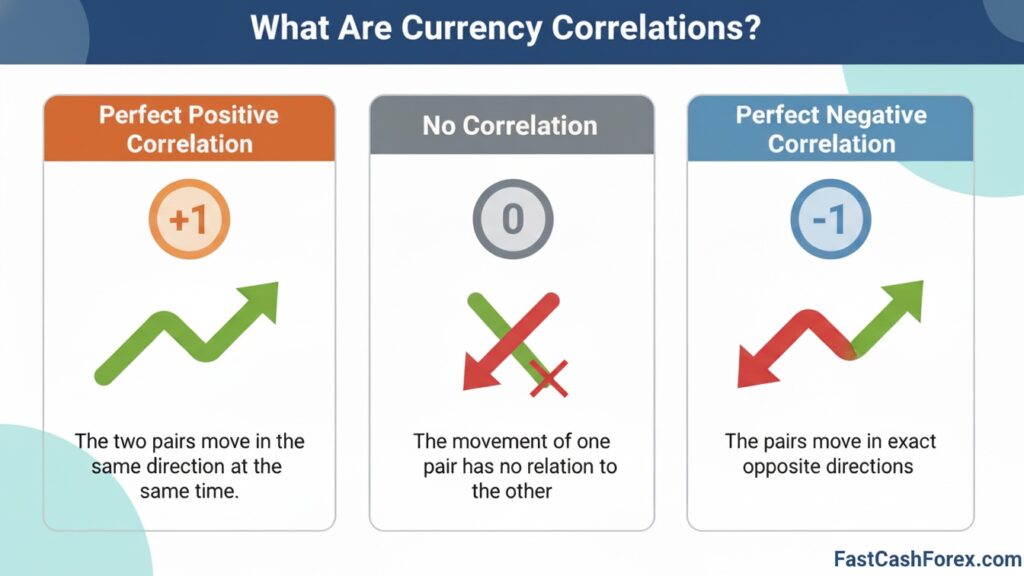
The currency correlation coefficient quantifies this relationship on a scale from -1.00 to +1.00. A correlation of +1.00 means two pairs move perfectly in sync. A correlation of -1.00 indicates they move in exactly opposite directions. A correlation near 0.00 suggests no meaningful relationship.
The Commodity Futures Trading Commission requires forex dealers to disclose trading risks, including how correlated positions can amplify exposure beyond what individual positions suggest. Understanding correlation is fundamental to proper risk assessment.
Understanding Correlation Coefficients
Perfect Positive Correlation (+1.00): Two pairs with perfect positive correlation move in lockstep. If EUR/USD rises 50 pips, a perfectly correlated pair rises by a proportional amount simultaneously. In practice, perfect correlation rarely exists except in mathematically related pairs (like EUR/USD and USD/EUR, which are inversions).
Strong Positive Correlation (+0.70 to +0.99): Strongly correlated pairs move in the same direction most of the time. EUR/USD and GBP/USD typically show strong positive correlation because both pairs measure dollar strength against European currencies. When the dollar weakens, both pairs generally rise together.
Moderate Positive Correlation (+0.40 to +0.69): Moderately correlated pairs often move together but with regular divergences. The relationship exists but isn’t strong enough to rely on for all trading decisions. These currency correlations require verification before assuming paired movement.
Weak or No Correlation (-0.39 to +0.39): Pairs in this range show little consistent relationship. They may move together briefly, then diverge completely. These pairs offer genuine diversification benefits when building portfolios with multiple positions.
Moderate Negative Correlation (-0.40 to -0.69): Pairs that often move in opposite directions but with regular exceptions. USD/CHF and EUR/USD typically show moderate negative correlation—when EUR/USD rises (dollar weakness), USD/CHF often falls (dollar weakness against the franc).
Strong Negative Correlation (-0.70 to -0.99): Pairs that almost always move in opposite directions. This relationship can be used for hedging strategies or confirming directional bias across different pairs.
Perfect Negative Correlation (-1.00): Pairs moving in exactly opposite directions. Like perfect positive currency correlation, this rarely occurs except in inverted pairs (EUR/USD and USD/EUR move in perfect negative correlation by mathematical necessity).
Common Currency Pair Correlations
Understanding typical correlations between major pairs helps anticipate how positions interact:
EUR/USD and GBP/USD (Strong Positive): Both pairs measure dollar strength against European currencies. UK and Eurozone economies maintain close trade relationships, creating economic linkages. When the dollar weakens broadly, both pairs typically rise together. Divergences often signal unique factors affecting either the euro or pound specifically.
EUR/USD and USD/CHF (Strong Negative): Switzerland’s economic ties to the Eurozone create inverse movement patterns. When EUR/USD rises (euro strengthening and dollar weakening), USD/CHF typically falls (dollar weakening and franc strengthening). This relationship has weakened slightly since the Swiss National Bank abandoned its EUR/CHF peg, but remains substantial.
AUD/USD and NZD/USD (Strong Positive): Australian and New Zealand economies share geographic proximity, commodity export focus, and Asian trade relationships. These similarities create highly correlated currency movements. Both currencies also serve as risk sentiment indicators, rising together when global risk appetite increases.
USD/CAD and Crude Oil Prices (Strong Negative): Canada’s position as a major oil exporter creates a strong inverse relationship between oil prices and USD/CAD. Rising oil prices benefit the Canadian economy, strengthening CAD and causing USD/CAD to fall. Falling oil prices create the opposite effect.
Gold Prices and AUD/USD (Moderate Positive): Australia’s significant gold mining industry creates correlation between gold prices and the Australian dollar. Rising gold prices often support AUD/USD, though other factors like iron ore prices and Chinese demand also influence the pair significantly.
EUR/USD and EUR/JPY (Perfect Mathematical Relationship): EUR/JPY equals EUR/USD multiplied by USD/JPY. This mathematical relationship means EUR/JPY movements reflect combined movements in both component pairs. Understanding this connection helps identify which pair drives EUR/JPY action at any given time.
Why Correlations Change Over Time
Currency correlation is not a fixed measurement — it shifts constantly as economic conditions, central bank policies, and market sentiment evolve
currency correlations aren’t static. They strengthen, weaken, and sometimes reverse based on evolving economic conditions:
Central Bank Policy Divergence: When the Federal Reserve and European Central Bank pursue different monetary policies—one tightening while the other eases—typical correlations can break down. EUR/USD and GBP/USD might diverge if the Bank of England pursues notably different policy than the ECB.
Economic Crises and Safe Haven Flows: During financial crises, normal currency correlations often fail as safe-haven demand dominates. The Swiss franc and Japanese yen may strengthen against all other currencies simultaneously, breaking typical correlation patterns.
Commodity Price Shocks: Sudden commodity price movements can temporarily override normal correlations. A dramatic oil price collapse might cause USD/CAD to move independently of other dollar pairs as Canadian dollar weakness dominates.
Brexit and Political Events: Major political developments can isolate specific currencies from their normal correlations. GBP/USD often diverged from EUR/USD during Brexit negotiations as pound-specific concerns overwhelmed general dollar movements.
The Financial Conduct Authority requires UK forex brokers to warn clients that historical correlations may not persist, particularly during stressed market conditions. Regular currency correlation monitoring is essential for risk management.
Calculating and Monitoring Correlations
Most trading platforms provide currency correlation matrices showing current relationships between major pairs. These tools typically calculate correlation coefficients over various timeframes—1 week, 1 month, 3 months, 6 months, and 1 year.
Short-Term Correlations (1-4 weeks): Recent correlations reflect current market dynamics and immediate factors driving currencies. These short-term measures help with active position management and near-term trading decisions.
Medium-Term Correlations (1-3 months): Medium-term correlations smooth out brief anomalies while capturing prevailing market themes. These timeframes suit swing traders and position traders managing exposure over several weeks.
Long-Term Correlations (6-12 months): Long-term correlations reveal fundamental relationships less affected by temporary market noise. These measures inform strategic portfolio construction and identify stable diversification opportunities.
Comparing correlations across multiple timeframes reveals whether current relationships are typical or anomalous. A pair showing +0.85 correlation over six months but only +0.45 over one week suggests recent divergence that may or may not persist.
Using Correlation for Risk Management
Understanding correlation transforms how you assess portfolio risk. Two long EUR/USD positions clearly double your euro exposure, but what about long EUR/USD and long GBP/USD? With +0.85 correlation, these positions provide far less diversification than separate exposures to uncorrelated currencies.
Avoiding Overconcentration: Traders often unknowingly create concentrated positions through correlated pairs. Three positions—long EUR/USD, long GBP/USD, and short USD/CHF—might seem diversified but actually create triple exposure to dollar weakness. All three positions profit from a weaker dollar and lose from a stronger dollar.
Calculate total directional exposure by summing position sizes adjusted for correlation. If you’re long 1 standard lot EUR/USD (+10 per pip dollar exposure) and long 0.5 standard lots GBP/USD (+5 per pip dollar exposure) with +0.85 correlation, your effective dollar exposure approximates 1.42 lots, not 1.5 lots.
Diversification Through Low Correlation: Genuine diversification requires combining positions in pairs with weak or negative correlation. Long EUR/USD and long AUD/JPY provide better diversification than long EUR/USD and long GBP/USD, assuming similar position sizes.
Pairs with correlations between -0.30 and +0.30 offer the best diversification benefits. These pairs respond to different economic drivers and provide uncorrelated return streams, reducing portfolio volatility while maintaining directional exposure.
Hedging with Negative Correlation: Strongly negatively correlated pairs can provide hedging opportunities. Long EUR/USD and long USD/CHF partially offset each other since these pairs typically move in opposite directions. This hedging reduces overall portfolio volatility but also limits profit potential.
The National Futures Association requires members to disclose how hedging strategies affect potential profits and losses. Hedged positions may seem safer but can trap capital in offsetting positions that generate minimal net returns.
Correlation Confirmation Strategies
Using currency correlation for trade confirmation is one of the most practical applications of correlation analysis for active traders.
Correlation analysis improves trade entry by providing confirmation from related pairs:
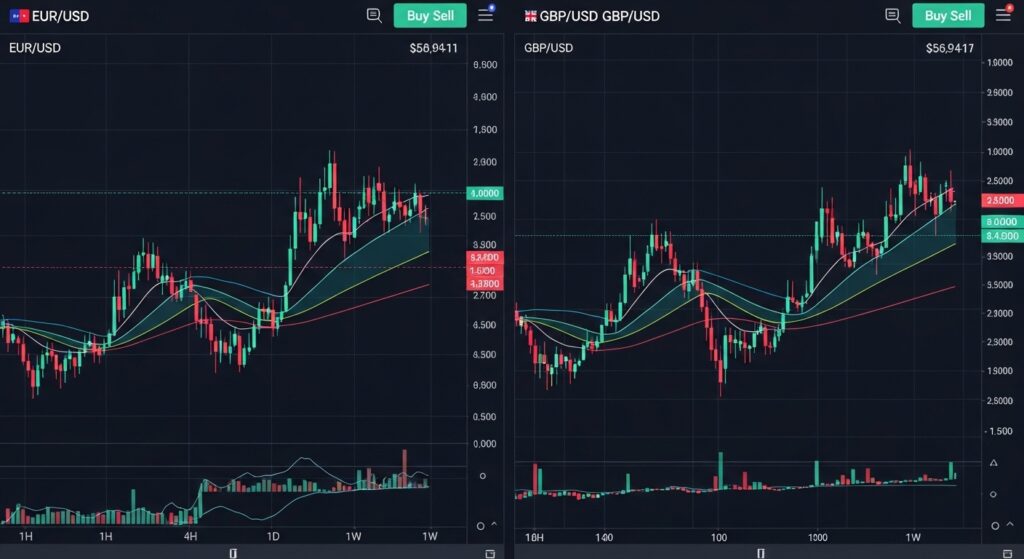
Confirming Breakouts: When EUR/USD breaks above resistance, check whether GBP/USD confirms by also showing strength. If EUR/USD breaks higher but GBP/USD remains weak, the breakout may be EUR-specific rather than broad dollar weakness. Confirmed breakouts across correlated pairs suggest more reliable moves.
A EUR/USD upside breakout confirmed by GBP/USD, AUD/USD, and NZD/USD all showing dollar weakness indicates broad-based dollar selling—more reliable than isolated EUR strength. Divergences where one pair breaks while correlated pairs don’t may signal false breakouts.
Identifying Relative Strength: Compare two positively correlated pairs to identify which currency shows greater strength or weakness. If EUR/USD rises 50 pips while GBP/USD rises 75 pips, the pound is outperforming the euro despite both strengthening against the dollar.
Trading the stronger currency often provides better risk-reward. In the example above, initiating or adding to GBP/USD long positions might offer better profit potential than EUR/USD, assuming similar stop-loss placement.
Divergence Trading: When historically correlated pairs diverge significantly, a reversion trade opportunity may exist. If EUR/USD and GBP/USD typically correlate at +0.85 but EUR/USD has risen 200 pips while GBP/USD remained flat, this divergence might correct through GBP/USD catching up, EUR/USD pulling back, or both.
Divergence trades carry risk since correlations can break down during structural changes. Verify that no fundamental reason explains the divergence before assuming reversion. Brexit, for example, created extended EUR/USD and GBP/USD divergences that didn’t mean-revert on typical timeframes.
Commodity Correlations in Forex
Several currency pairs show strong correlations with commodity prices, creating additional trading opportunities:
USD/CAD and Crude Oil: The inverse relationship between USD/CAD and crude oil prices is among the market’s most reliable correlations. Rising oil strengthens the Canadian economy and CAD, pushing USD/CAD lower. Falling oil creates the opposite effect.
Traders can use oil price movements to anticipate USD/CAD direction. A strong rally in crude oil often precedes USD/CAD declines. Conversely, oil price collapses frequently signal USD/CAD strength before the currency pair fully adjusts.
AUD/USD and Iron Ore/Gold: Australia’s economy depends heavily on iron ore exports to China. Iron ore price strength typically supports AUD/USD, while weakness pressures the pair lower. Australia’s gold production also creates correlation between gold prices and AUD/USD, though weaker than the iron ore connection.
Monitoring Chinese economic data and iron ore prices provides insight into potential AUD/USD movements. Strong Chinese manufacturing data often precedes AUD strength as demand expectations support commodity prices.
NZD/USD and Dairy Prices: New Zealand’s dairy industry represents a significant portion of exports. Rising dairy prices benefit the New Zealand economy and typically support NZD/USD. The GlobalDairyTrade index provides specific insight into dairy price trends affecting the kiwi.
NOK/SEK and Oil Prices: Norway’s substantial oil production creates correlation between crude oil prices and the Norwegian krone. Rising oil prices typically strengthen NOK against EUR, USD, and other currencies. Sweden’s less commodity-dependent economy means SEK shows weaker commodity correlation.
Cross Currency Analysis
Analyzing currency crosses—pairs not involving USD—reveals relationships between non-dollar currencies:
EUR/GBP Correlation Insights: When EUR/USD and GBP/USD both rise but EUR/GBP falls, the pound is strengthening faster than the euro. This cross pair isolates relative euro/pound strength independent of dollar movements.
Traders can use EUR/GBP to determine whether to focus long positions on EUR/USD or GBP/USD when anticipating dollar weakness. A falling EUR/GBP suggests emphasizing GBP/USD long positions over EUR/USD.
AUD/JPY as Risk Sentiment Indicator: The Australian dollar represents risk-on currency while the yen serves as risk-off safe haven. AUD/JPY rises when risk appetite increases and falls during risk aversion. This cross pair often leads equity market movements.
Strong AUD/JPY rallies typically accompany rising stock markets and risk-on sentiment across other currency pairs. AUD/JPY declines often precede or confirm broader risk-off moves affecting multiple carry trade pairs.
EUR/JPY Combining EUR/USD and USD/JPY: Since EUR/JPY mathematically equals EUR/USD × USD/JPY, analyzing this cross pair requires understanding both components. A EUR/JPY rally might result from euro strength (EUR/USD rising), yen weakness (USD/JPY rising), or both.
Decomposing EUR/JPY moves into EUR/USD and USD/JPY components clarifies which currency drives the cross. If EUR/JPY rallies while EUR/USD remains flat, the move reflects pure USD/JPY strength (yen weakness).
Correlation Trading Strategies
Several specific trading approaches are built entirely around exploiting currency correlation relationships when they diverge or converge.
Several specific strategies exploit currency correlations:
Pairs Trading: Simultaneously trade two correlated pairs in opposite directions when they diverge beyond normal levels. If EUR/USD and GBP/USD historically correlate at +0.85 but suddenly diverge with EUR/USD much stronger, a pairs trade might involve buying GBP/USD and selling EUR/USD, expecting the correlation to reassert.
Pairs trading profits from convergence regardless of overall direction. The strategy bets on relationship normalization rather than absolute price movements, providing market-neutral exposure.
Basket Trading: Combine multiple currency pairs to create synthetic exposure to single currencies. To isolate pure euro exposure independent of dollar movements, trade a basket of EUR/USD long, EUR/JPY long, EUR/GBP long, and EUR/CHF long. This basket profits from euro strength against all major currencies simultaneously.
Basket trading reduces single-pair volatility by spreading exposure across multiple relationships. The approach suits traders with strong currency views but uncertainty about which specific pair offers the best expression.
Correlation Confirmation: Use correlated pairs to confirm trade signals before entry. Before entering long EUR/USD on a breakout, confirm that GBP/USD, AUD/USD, and other risk currencies also show dollar weakness. Multiple confirmation reduces false signal probability.
This approach may cause occasional missed trades when one pair breaks while others lag, but significantly improves overall win rate by filtering false breakouts.
Common Correlation Mistakes
Misunderstanding currency correlation is one of the most common and costly errors traders make when managing multiple open positions.
Assuming Correlations Remain Constant: Historical correlations can break down suddenly due to policy changes, economic divergence, or market crises. Always monitor current correlations rather than assuming past relationships persist. Brexit shattered typical EUR/USD and GBP/USD correlation for extended periods.
Overtly Relying on Mathematical RelationshipsHow to Calculate Pips in Forex Trading: Complete Guide with Examples: While EUR/JPY equals EUR/USD × USD/JPY mathematically, real-time price movements don’t always align perfectly due to liquidity differences and timing lags across pairs. Small discrepancies in these relationships rarely create risk-free arbitrage opportunities for retail traders.
Ignoring Transaction Costs: Correlation strategies involving multiple simultaneous positions multiply trading costs. Spreads, commissions, and financing charges accumulate across all positions. Ensure expected profits from correlation strategies exceed these cumulative costs.
Doubling Risk Through Correlation: New traders sometimes add positions in correlated pairs believing they’re diversifying when they’re actually multiplying risk. Three long positions in EUR/USD, GBP/USD, and AUD/USD with +0.80+ correlations create nearly triple exposure to dollar weakness, not diversified risk.
Tools and Resources for Correlation Analysis
Modern trading platforms provide various correlation analysis tools:
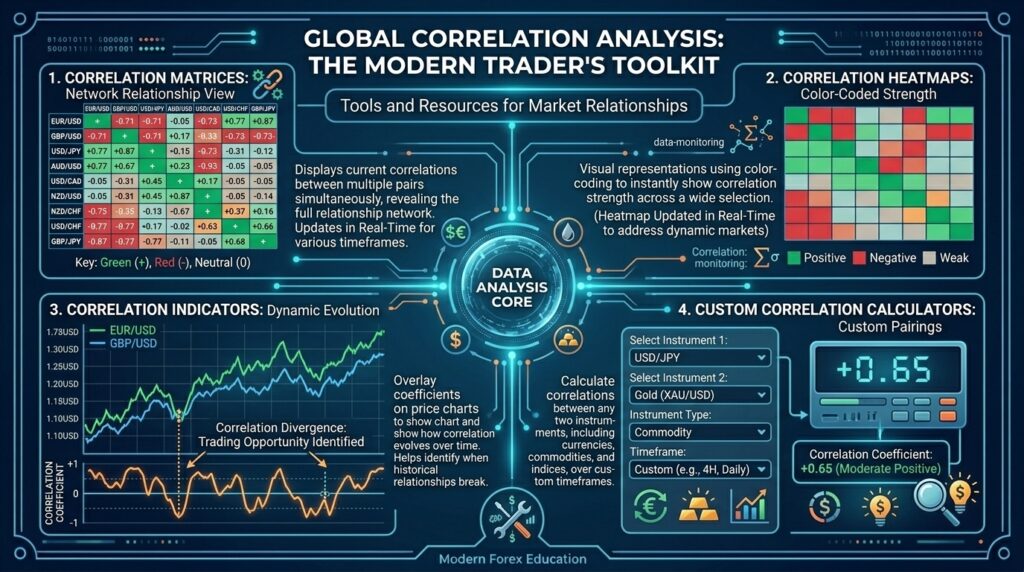
Correlation Matrices: Display current correlations between multiple pairs simultaneously, showing the full relationship network. These matrices typically update in real-time and can be customized for different timeframes.
Correlation Indicators: Overlay correlation coefficients directly on price charts, showing how correlation evolves over time. These indicators help identify when historically correlated pairs diverge, potentially creating trading opportunities.
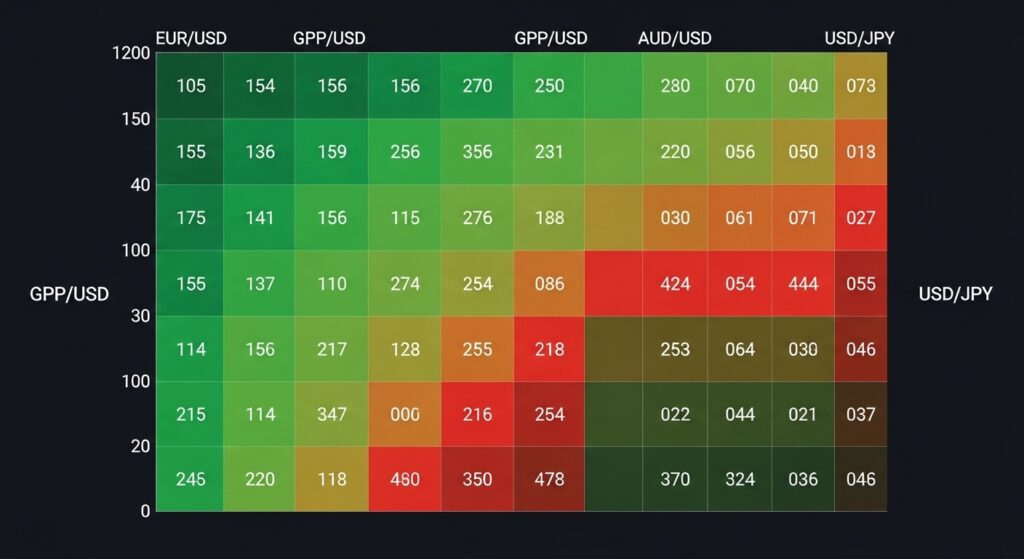
Correlation Heatmaps: Visual representations using color coding to show correlation strength across multiple pairs. Strong positive correlations appear in one color (often green), strong negative correlations in another (often red), and weak correlations in neutral tones.
Custom Correlation Calculators: Some platforms allow calculating correlations between any two instruments—including currencies, commodities, and indices—over custom timeframes. This flexibility helps identify non-standard correlations that most traders overlook.
Rolling Correlations: Rather than calculating single correlation coefficients over fixed periods, rolling correlations show how relationships evolve continuously. A 30-day rolling correlation calculated daily reveals when relationships strengthen, weaken, or reverse.
Rolling correlation analysis identifies regime changes in currency relationships, helping traders adapt strategies to current market dynamics rather than relying on outdated correlation assumptions.
Multi-Factor Correlation Models: Advanced approaches analyze correlations between currency pairs and multiple factors simultaneously—commodity prices, equity indices, bond yields, and volatility measures. These models provide richer understanding of what drives specific currency movements.
Correlation-Adjusted Position Sizing: Sophisticated risk management adjusts position sizes based on correlation levels. When trading highly correlated pairs, reduce individual position sizes to maintain constant portfolio risk. When trading uncorrelated pairs, standard position sizing applies.
Conclusion
Currency correlation analysis transforms forex trading from evaluating individual pairs in isolation to understanding the full interconnected network of currency relationships.
Currency correlation analysis transforms forex trading from evaluating individual pairs in isolation to understanding the interconnected network of currency relationships. Successful correlation trading recognizes that currency movements reflect complex interactions between economies, commodity markets, and global capital flows.
Master the basics—understanding correlation coefficients, recognizing common pair relationships, and monitoring how correlations change over time. Use correlation for risk management by avoiding overconcentrated positions and achieving genuine diversification through uncorrelated exposures.
Apply correlation for trade confirmation, using related pairs to verify signals and identify false breakouts. Recognize commodity correlations that link currencies to oil, gold, and agricultural prices. Consider cross-currency analysis to isolate relative strength independent of dollar movements.
As you develop your trading strategy, incorporate correlation awareness into every position. Ask whether new trades add diversified exposure or merely multiply existing risk. Verify signals through correlated pairs before committing capital. Monitor correlation changes that might transform your portfolio risk profile without any trade activity.
Understanding correlation separates traders who truly manage portfolio risk from those who accidentally concentrate exposure through seemingly diversified positions. The mathematics provides precision, but practical application—knowing when correlations matter and when they break down—develops only through experience and continuous market observation.