Learn How to Make Fast Money by Learning diffrent Strategies in Forex Trading and Different Investment Options
NZD/USD Trading Guide: The Kiwi
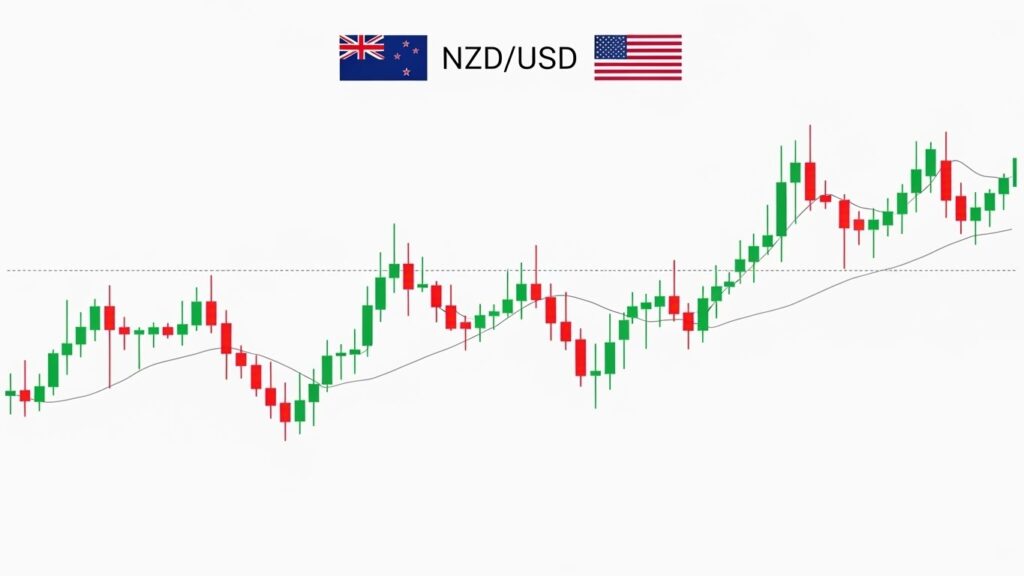
Welcome to our comprehensive NZD/USD trading guide. The NZD/USD currency pair, known as “The Kiwi” after New Zealand’s national bird, represents the exchange rate between the New Zealand dollar and the US dollar. As a commodity currency with unique characteristics, it offers trading opportunities driven by dairy prices, interest rate differentials, and risk sentiment
NZD/USD ranks among the top ten most traded currency pairs, accounting for approximately 2% of daily forex volume according to the Bank for International Settlements (https://www.bis.org). While less liquid than major pairs like EUR/USD or GBP/USD, it maintains sufficient trading volume for reliable price execution and reasonable spreads.
New Zealand’s small, export-oriented economy makes the Kiwi particularly sensitive to global trade conditions and commodity prices. The country’s primary exports include dairy products, meat, wood, and fruit, with dairy representing approximately 25% of total exports. This agricultural focus differentiates NZD from other commodity currencies focused on energy or metals.
The Reserve Bank of New Zealand (RBNZ) (https://www.rbnz.govt.nz) manages monetary policy with a flexible inflation targeting approach, maintaining inflation between 1-3% over the medium term. The Federal Reserve (https://www.federalreserve.gov) controls US policy, and interest rate differentials between these central banks significantly influence NZD/USD trends, as explained in our Fundamental Analysis Guide.
China represents New Zealand’s largest export market, purchasing roughly 25-30% of exports. This economic relationship means Chinese growth directly impacts New Zealand’s economy and the Kiwi’s strength. Strong Chinese data typically supports NZD, while weak Chinese figures pressure the currency lower.
Key Drivers of NZD/USD Movement
Dairy prices represent a unique driver for the Kiwi. New Zealand produces approximately 3% of global milk supply but accounts for roughly 30% of international dairy trade. The Global Dairy Trade (GDT) auction, held twice monthly, provides real-time dairy pricing that often moves NZD/USD immediately upon release.
Rising dairy prices indicate strong demand for New Zealand’s primary export, supporting the NZD. Declining prices suggest weak demand or oversupply, typically pressuring the currency lower. Monitor GDT auction results through the Global Dairy Trade (https://www.globaldairytrade.info) official website.
Interest rate differentials between the RBNZ and Federal Reserve drive medium to long-term trends. New Zealand historically maintained relatively high interest rates compared to other developed economies, making the Kiwi popular for carry trades. When RBNZ rates exceed Fed rates significantly, carry trade demand typically supports NZD/USD. Conversely, narrowing differentials or Fed rate premiums pressure the pair lower.
Risk sentiment profoundly affects NZD/USD. The Kiwi functions as a classic “risk-on” currency—it strengthens during periods of global economic optimism and weakens during risk-averse periods. Stock market rallies often coincide with NZD strength, while equity selloffs typically pressure the pair lower. This characteristic makes NZD/USD sensitive to global economic data and geopolitical developments.
Chinese economic health impacts NZD through trade channels. Strong Chinese manufacturing PMI, industrial production, and GDP figures typically support the Kiwi. Weak Chinese data or signs of economic slowdown pressure NZD lower. The National Bureau of Statistics of China (https://www.stats.gov.cn/english) releases crucial data affecting the Kiwi.
Trading Sessions and Timing
NZD/USD demonstrates distinct behavioral patterns across trading sessions. The Wellington market opens at 10 PM GMT (5 PM EST), initiating the global forex trading week. Early Asian session trading often establishes the day’s initial direction as traders react to weekend developments and position for upcoming events.
The Sydney-Tokyo overlap from 11 PM to 8 AM GMT generates moderate liquidity suitable for range trading strategies covered in our Range Trading Strategies guide. During this period, NZD/USD often consolidates or makes modest moves based on Asian economic data.
The Asian-European session overlap from 7 AM to 9 AM GMT increases volatility as European traders enter markets. This transition period frequently produces breakouts from Asian ranges, creating opportunities for momentum traders using techniques from our Breakout Trading Strategies guide.
The European session from 7 AM to 4 PM GMT brings higher volatility, particularly during major European economic releases. While European data doesn’t directly affect New Zealand, it influences global risk sentiment and US dollar strength, both impacting NZD/USD.
The New York session opening at 1 PM GMT typically dominates price action. Major US economic releases and Federal Reserve communications often override New Zealand factors. Strong US data generally pressures NZD/USD lower through USD strength, while weak US figures can lift the pair.
Technical Analysis for NZD/USD
NZD/USD responds well to technical analysis despite occasionally experiencing overnight gaps between Friday’s close and Sunday’s Wellington open. The pair respects major support and resistance levels, particularly psychological round numbers like 0.6000, 0.6500, and 0.7000. These levels provide reference points for entries and exits, as detailed in our Support and Resistance Trading guide.
Moving averages work effectively across multiple timeframes. The 50-day and 200-day simple moving averages on daily charts often act as dynamic support and resistance. The 20-period exponential moving average on 4-hour charts helps identify short-term trend direction and provides entry opportunities when price approaches during pullbacks.
The Relative Strength Index (RSI) provides valuable momentum signals. Readings above 70 suggest overbought conditions where pullbacks may occur, while readings below 30 indicate oversold conditions where bounces become likely. Divergences between price and RSI often precede significant reversals, particularly when they occur at major support or resistance levels.
Candlestick Patterns at key technical levels offer high-probability setups. Pin bars, engulfing patterns, and doji formations become particularly reliable when they form at confluent technical zones—areas where multiple support/resistance factors converge. The pair’s liquidity ensures these patterns complete properly most of the time.
Fibonacci retracements identify potential reversal points during trend corrections. After significant moves, NZD/USD frequently retraces to the 38.2%, 50%, or 61.8% Fibonacci levels before resuming the primary trend. Combining Fibonacci levels with other technical factors increases setup reliability. Our Forex Indicators Guide covers these technical tools in detail.
Fundamental Trading Strategies
RBNZ monetary policy decisions provide major trading opportunities. The central bank meets eight times annually, typically releasing decisions at 9 PM GMT (4 PM EST). Rate decisions, monetary policy statements, and Governor speeches can move NZD/USD 100+ pips. The RBNZ often provides detailed forward guidance, making policy trajectory relatively predictable.
New Zealand employment data releases quarterly from Statistics New Zealand (https://www.stats.govt.nz), unlike the monthly releases in most major economies. This quarterly frequency means each release carries significant weight. Strong employment growth and declining unemployment typically support NZD strength, while weak figures pressure the currency lower.
Inflation data, particularly the Consumer Price Index (CPI), directly influences RBNZ policy expectations. Above-target inflation increases the probability of RBNZ rate hikes, typically lifting NZD/USD. Below-target inflation suggests potential easing, pressuring the pair lower. New Zealand CPI releases quarterly, making each release highly impactful.
GDT dairy auction results provide unique trading opportunities twice monthly. Significant price increases often spark immediate NZD rallies, while sharp declines trigger selloffs. These moves typically occur during Asian trading hours when NZD/USD liquidity may be thinner, potentially amplifying price swings.
Chinese economic data offers indirect but powerful trading signals. Chinese manufacturing PMI on the first business day of each month often moves NZD/USD significantly. Strong Chinese data suggests sustained demand for New Zealand exports, supporting the Kiwi. Weak data raises concerns about New Zealand’s export outlook, pressuring the currency lower.
Common Trading Approaches
Range Trading works well during Asian session consolidations when NZD/USD establishes clear boundaries. The pair often trades in defined ranges overnight that persist into European morning hours, providing opportunities for buying near support and selling near resistance.
Trend Following suits traders preferring longer holding periods. NZD/USD develops extended trends lasting weeks or months, driven by interest rate differential changes or sustained shifts in risk sentiment. Using indicators like moving averages and ADX helps identify and ride these moves, as covered in our Trend Trading Strategies guide.
Breakout Trading capitalizes on momentum when NZD/USD breaks significant technical levels. Major support or resistance breaks, particularly when confirmed by fundamental developments or dairy price moves, often lead to sustained trends. Position yourself ahead of known events like RBNZ decisions or immediately after confirmed breakouts.
Carry Trading historically worked well with NZD/USD given New Zealand’s relatively high interest rates. When the RBNZ maintains rates significantly above the Federal Reserve, positive carry accumulates daily on long NZD/USD positions. However, carry trades work best during stable or bullish market conditions—risk-off periods can quickly erase months of carry gains through rapid NZD declines.
Risk Management for NZD/USD
Position sizing must account for NZD/USD’s average daily range of 60-80 pips, though this can spike to 100+ pips during major events. Using principles from our Risk Management guide, risk no more than 1-2% of account equity on any single trade. A 50-pip stop loss on a $10,000 account with 2% risk allows for approximately 4,000 units (0.04 lots).
Volatility increases significantly during RBNZ decisions and major US economic releases. Consider reducing position size by 50% when trading these high-impact events to manage increased risk. Pre-define your maximum position size for event trading and stick to it regardless of setup quality perceptions.
Gap risk exists with NZD/USD more than most major pairs due to New Zealand’s position as the first major market opening each week. Weekend news—geopolitical developments, commodity price crashes, or surprise central bank actions—can cause substantial gaps between Friday’s close and Sunday’s Wellington open. Avoid holding large positions through weekends unless you can tolerate potential gap risk.
Correlation awareness prevents overexposure. NZD/USD maintains strong positive correlation with AUD/USD (often 0.85+) since both are commodity currencies with similar characteristics. Holding simultaneous long positions in both pairs concentrates risk in similar factors. Review currency pair relationships in our Understanding Currency Pairs guide.
Economic Calendar Events
Track these regular releases significantly impacting NZD/USD:
RBNZ Official Cash Rate Decisions occur eight times annually on predetermined dates. Rate changes typically move NZD/USD 100+ pips immediately. The monetary policy statement and Governor’s press conference often matter more than the rate decision itself, providing insights into future policy direction.
New Zealand Employment Change releases quarterly, making each report highly significant. Strong employment growth supports RBNZ tightening expectations, typically lifting NZD/USD. Weak employment figures raise easing possibilities, pressuring the pair lower.
New Zealand CPI publishes quarterly, directly influencing RBNZ policy expectations. Above-consensus inflation supports NZD strength through potential tightening, while weak inflation pressures the currency lower.
GDT Price Index releases twice monthly, providing real-time dairy pricing. Significant moves (5%+) often trigger immediate NZD/USD reactions. These releases typically occur during Asian trading hours.
US Non-Farm Payrolls on the first Friday of each month dominates trading regardless of New Zealand factors. Strong US employment typically pressures NZD/USD lower through USD strength. Weak employment can spark NZD rallies. The Bureau of Labor Statistics (https://www.bls.gov) publishes this influential report.
Chinese Manufacturing PMI on the first business day of each month affects NZD through trade linkages. Readings above 50 suggest expansion and typically support the Kiwi. Readings below 50 indicate contraction, often pressuring NZD lower.
Seasonal Patterns and Considerations
NZD/USD exhibits seasonal tendencies worth monitoring. The pair sometimes weakens during New Zealand’s summer months (December-February) when agricultural production slows and holiday periods thin market participation. This pattern isn’t guaranteed but occurs frequently enough to warrant awareness.
March-April often brings increased volatility as dairy production peaks and GDT auctions become more significant. Strong auction results during this period can establish bullish NZD trends extending into mid-year.
Year-end effects impact NZD/USD like most currency pairs. Portfolio rebalancing, profit-taking, and reduced institutional participation create choppier price action and potential for exaggerated moves on thin liquidity. Consider reducing position sizes during late December and early January.
Advanced Trading Techniques
Correlation trading with AUD/USD provides context for NZD/USD moves. When both pairs move together, it confirms broad commodity currency trends or USD directional moves. Divergences between the pairs—where one strengthens while the other weakens—often signal pair-specific factors worth investigating.
Equity market correlation creates trading opportunities. NZD/USD typically correlates positively with global stock indices. S&P 500 rallies often coincide with NZD strength, while equity selloffs pressure the Kiwi lower. Monitor major indices for confirmation of NZD/USD directional bias.
Interest rate differential tracking provides medium-term direction signals. Monitor the spread between New Zealand and US 10-year government bond yields. Widening spreads favoring New Zealand typically support NZD/USD gains, while spreads favoring US yields pressure the pair lower. The Treasury.gov (https://www.treasury.gov) publishes US yield data.
Multi-timeframe analysis improves trade timing as detailed in trading strategy guides. Analyze daily charts for overall trend direction, 4-hour charts for swing trade entries, and 1-hour charts for precise entry points. This ensures trades align with multiple timeframe confluences.
Trading Psychology and Common Mistakes
The Kiwi’s status as a risk-sensitive currency can create emotional trading challenges. During risk-off periods, NZD/USD can decline rapidly and persistently, testing trader patience and discipline. Pre-define your risk parameters and stick to them rather than averaging down into falling markets.
Overtrading during thin liquidity represents a common mistake. Asian session trading sometimes offers insufficient liquidity for larger positions, leading to wider spreads and slippage. Adjust position sizes for the session you’re trading, reducing size during low-volume periods.
Ignoring overnight gap risk costs traders regularly. The Sunday Wellington open can gap significantly from Friday’s close. Use appropriate position sizing that accounts for this risk, or close positions before weekends if you’re uncomfortable with gap exposure.
Maintain a Trading Journal tracking NZD/USD trades specifically. Note the dominant driver for each trade—dairy prices, interest rates, risk sentiment, or US dollar factors. This analysis reveals which scenarios you handle most profitably. Our Common Forex Trading Mistakes guide covers additional pitfalls to avoid.
Building Your NZD/USD Trading Plan
Develop clear entry criteria incorporating technical setups, fundamental factors, and risk sentiment assessment. Require multiple confirming signals before entering trades—perhaps a technical breakout aligned with positive GDT results and improving risk sentiment. Our Creating a Forex Trading Plan guide provides comprehensive frameworks.
Define specific exit rules including profit targets and stop losses. Many successful NZD/USD traders use 1:2 or 1:3 risk-reward ratios, targeting 80-120 pips of profit while risking 40-60 pips. Adjust these parameters based on current volatility and trading timeframe.
Establish position sizing rules accounting for varying liquidity across sessions. Trade standard size during London-New York overlap but reduce to 50-75% size during thin Asian hours. Further reduce size when trading major events like RBNZ decisions or US Non-Farm Payrolls.
Create pre-trade checklists ensuring comprehensive analysis: recent GDT auction results, current RBNZ policy stance, upcoming economic events, technical setup quality, risk sentiment indicators, and Chinese economic trends. This systematic approach prevents impulsive trades based on incomplete analysis.
Broker Considerations for NZD/USD
Select brokers offering competitive NZD/USD spreads, typically 1.5 to 3.0 pips with quality brokers. Spreads vary significantly by broker and often widen during Asian hours and news events. Test your broker’s spread behavior across different sessions using a demo account. Our How to Choose a Forex Broker guide covers selection criteria.
Execution quality matters particularly during thin Asian session trading and news events. Verify your broker provides reliable execution during Wellington and Sydney hours without excessive slippage or requotes.
Confirm your broker offers access to New Zealand economic calendars and GDT auction schedules. Some platforms provide alerts for these events, helping you prepare for potential volatility.
NZD/USD vs Other Major Currency Pairs
NZD/USD vs EUR/USD
The structural differences between NZD/USD and EUR/USD extend beyond mere liquidity metrics. EUR/USD represents the deepest market in foreign exchange with institutional flow dominating price discovery. The pair’s $1.5 trillion daily volume ensures minimal market impact even for large orders, while NZD/USD’s $200 billion daily volume requires careful execution strategy for institutional-sized positions.
Market microstructure analysis reveals EUR/USD’s superior price efficiency—bid-ask spreads compress to 0.1-0.3 pips during peak liquidity, whereas NZD/USD maintains 0.8-1.5 pip spreads even during optimal conditions. This spread differential compounds significantly across high-frequency strategies, often rendering NZD/USD unsuitable for sub-minute trading methodologies that perform well on EUR/USD.
From a macro perspective, EUR/USD serves as the primary vehicle for expressing views on transatlantic monetary policy divergence and global risk sentiment. NZD/USD functions as a higher-beta expression of the same themes, amplifying movements through its sensitivity to commodity cycles and Asian growth dynamics. Portfolio managers seeking leveraged exposure to USD weakness often allocate to NZD/USD while hedging with EUR/USD to isolate the commodity and carry components.
NZD/USD vs GBP/USD
GBP/USD and NZD/USD occupy similar positions on the volatility spectrum, though their volatility drivers differ fundamentally. Cable’s elevated volatility stems from UK political uncertainty, Brexit-related structural shifts, and the Bank of England’s reactive policy stance. The Kiwi’s volatility derives from its small economy’s vulnerability to external shocks, particularly shifts in Chinese demand and global dairy prices.
Order flow analysis suggests distinct institutional participation patterns. GBP/USD attracts significant algorithmic trading flow and options hedging activity from London-based institutions, creating intraday volatility spikes during European morning hours. NZD/USD flow concentrates during Wellington/Sydney sessions with positioning driven by Asian real-money accounts and commodity trading advisors responding to agricultural market developments.
Both pairs demonstrate trending characteristics suitable for momentum strategies, yet their trend persistence differs. GBP/USD trends often reverse sharply following political events or central bank surprises, creating challenging drawdown management scenarios. NZD/USD trends tied to multi-quarter commodity cycles exhibit smoother price action with fewer violent reversals, though the smaller market size means individual large orders can temporarily disrupt established trends.
NZD/USD vs USD/JPY
The relationship between NZD/USD and USD/JPY illuminates key aspects of risk architecture in currency markets. Both pairs serve as liquid instruments for implementing risk-on/risk-off positioning, though USD/JPY’s role as a funding currency for carry trades creates additional complexity. When leveraged accounts unwind yen-funded positions, USD/JPY can fall sharply even as NZD/USD maintains stability if the deleveraging doesn’t extend to high-yielding currencies.
Cross-market correlation analysis reveals these pairs typically maintain 0.60-0.75 positive correlation during normal market regimes, rising toward 0.80-0.85 during crisis periods when risk factors dominate individual currency dynamics. This correlation instability requires dynamic hedging approaches rather than static ratio-based strategies when managing multi-pair exposure.
From a positioning standpoint, NZD/USD attracts discretionary macro funds seeking commodity exposure and carry returns, while USD/JPY draws systematic trend followers and Tokyo-based institutional flow. This participant mix creates different liquidity profiles—USD/JPY maintains consistent two-way flow across all sessions, whereas NZD/USD liquidity concentrates heavily in Asian hours with markedly wider spreads during European and American sessions.
NZD/USD vs USD/CHF
The NZD/USD and USD/CHF pairing represents extremes of the risk spectrum in developed market currencies. Swiss franc appreciation during risk-off events reflects safe-haven demand and repatriation flows, while New Zealand dollar depreciation during identical conditions reflects unwinding of carry positions and commodity price weakness. This structural opposition creates near-perfect negative correlation during stress periods, though correlation weakens considerably during calm market regimes.
Central bank policy divergence amplifies this relationship. The Swiss National Bank’s willingness to intervene aggressively to cap CHF strength contrasts sharply with the Reserve Bank of New Zealand’s general tolerance for market-determined exchange rates. This intervention asymmetry creates tail risk in USD/CHF (sudden SNB action) absent in NZD/USD, affecting options pricing and risk management approaches.
Institutional applications differ markedly between these pairs. USD/CHF serves primarily as a hedging vehicle and safe-haven positioning tool for European-based accounts. NZD/USD functions as a carry trade vehicle and commodity proxy for Asian and Australasian institutions. The participant base divergence means these pairs respond to different order flow patterns despite their theoretical risk-on/risk-off relationship.
NZD/USD vs USD/CAD
Both NZD/USD and USD/CAD exhibit commodity currency characteristics, yet their commodity linkages operate through distinct transmission mechanisms. CAD correlation with WTI crude oil exceeds -0.80 (negative due to USD/CAD quote convention), creating a direct, mechanistic relationship exploitable through statistical arbitrage. NZD correlation with global dairy prices operates through longer lag periods and demonstrates lower consistency, as dairy markets lack crude oil’s liquidity and price discovery efficiency.
Market structure analysis reveals USD/CAD’s superior liquidity during North American hours stems from energy sector hedging flows and algorithmic market-making centered in Toronto and New York. NZD/USD liquidity peaks during Asian hours but never achieves USD/CAD’s depth, requiring larger institutions to execute NZD positions through multiple sessions to minimize market impact.
Portfolio construction considerations favor combining these pairs due to their commodity diversification—exposure to energy markets via CAD and agricultural markets via NZD. Correlation between the pairs fluctuates between 0.50-0.70 depending on relative commodity price movements, providing genuine diversification benefits unavailable when combining more tightly correlated pairs like EUR/USD and GBP/USD.
NZD/USD vs AUD/USD
The NZD/USD and AUD/USD relationship represents the highest correlation coefficient among major currency pairs, typically ranging 0.85-0.95. This extreme correlation reflects shared geographical proximity, similar economic structures dependent on commodity exports to Asia, and nearly identical monetary policy cycles from the Reserve Bank of New Zealand and Reserve Bank of Australia.
Despite high correlation, institutional traders identify exploitable divergences driven by differing commodity exposures. AUD tracks industrial commodities (iron ore, coal, copper) tied to Chinese infrastructure investment, while NZD follows agricultural commodities (dairy, meat) tied to Chinese consumption patterns. Chinese economic rebalancing from investment toward consumption creates temporary decoupling opportunities, though these divergences typically revert within quarterly timeframes.
Liquidity differential constitutes the primary practical distinction—AUD/USD trades approximately three times NZD/USD’s volume, translating into tighter spreads and superior execution quality. This liquidity advantage makes AUD/USD the preferred vehicle for most institutional applications, with NZD/USD reserved for specific strategies requiring its higher volatility or different correlation characteristics during particular market regimes. Risk managers often treat positions in both pairs as compound exposure requiring combined risk limits rather than independent allocations.
NZD/USD offers unique trading opportunities driven by dairy prices, interest rate differentials, Chinese economic health, and global risk sentiment. Its characteristics as a commodity currency and risk barometer create diverse trading opportunities across various timeframes and strategies.
Success with the Kiwi requires understanding its distinctive drivers. Monitor dairy prices through GDT auctions, track RBNZ policy carefully, stay informed about Chinese economic developments, and recognize the pair’s role as a risk sentiment indicator. Combine this fundamental awareness with technical analysis using tools from our Chart Patterns in Forex guide and disciplined risk management.
Whether you’re trading short-term moves around GDT auctions, swinging multi-day positions based on RBNZ policy shifts, or holding longer-term carry trade positions aligned with interest differentials, NZD/USD provides opportunities for prepared traders. Develop expertise in this pair’s unique characteristics, maintain discipline through its occasional volatility, and continuously refine your approach through careful analysis and journaling.