USD/JPY, nicknamed “The Gopher,” is the second most traded currency pair after EUR/USD, representing approximately 13% of daily forex volume. Known for its unique safe-haven dynamics, strong technical respect, and close correlation with U.S. Treasury yields, USD/JPY trading offers distinctive trading opportunities for those who understand its characteristics.
This comprehensive USD/JPY Trading Guide covers everything needed to trade USD/JPY successfully: its special features, best strategies, optimal trading times, safe-haven behavior, key drivers, and how it differs from EUR/USD and GBP/USD.

Why Trade USD/JPY?
The Technical Trader’s Favorite
USD/JPY has earned a reputation as one of the most technically “clean” pairs in forex—respecting support/resistance levels, trend lines, and chart patterns with remarkable consistency.
Key Advantages
1. Excellent Technical Respect
USD/JPY trading adheres to technical analysis better than most pairs:
- Respects support/resistance levels precisely
- Trend lines work exceptionally well
- Chart patterns play out cleanly
- Moving averages act as dynamic support/resistance
2. Moderate Volatility
- Average daily range: 70-110 pips
- Less than GBP/USD (100-150 pips)
- Similar to EUR/USD (60-100 pips)
- Manageable for all experience levels
3. Tight Spreads
- ECN brokers: 0.3-0.7 pips
- Standard accounts: 0.8-1.5 pips
- Competitive costs support frequent trading
4. Safe-Haven Dynamics
JPY is a safe-haven currency—understanding this creates unique profit opportunities during market turmoil.
5. U.S. Treasury Yield Correlation
USD/JPY trading is strongly correlates with 10-year U.S. Treasury yields—a powerful fundamental indicator.
6. Clear USD/JPY Trading Sessions
Strong movements during both Asian session (Tokyo open) and U.S. session.
Who Should Trade USD/JPY?
Ideal For:
- Technical traders (patterns work well)
- Trend followers (respects trends)
- Carry traders (interest rate differential)
- Risk sentiment traders (safe-haven plays)
- All experience levels
Consider Carefully:
- Pure fundamental traders (technical aspects matter greatly)
- Traders unfamiliar with safe-haven dynamics
USD/JPY Characteristics
The Safe-Haven Factor
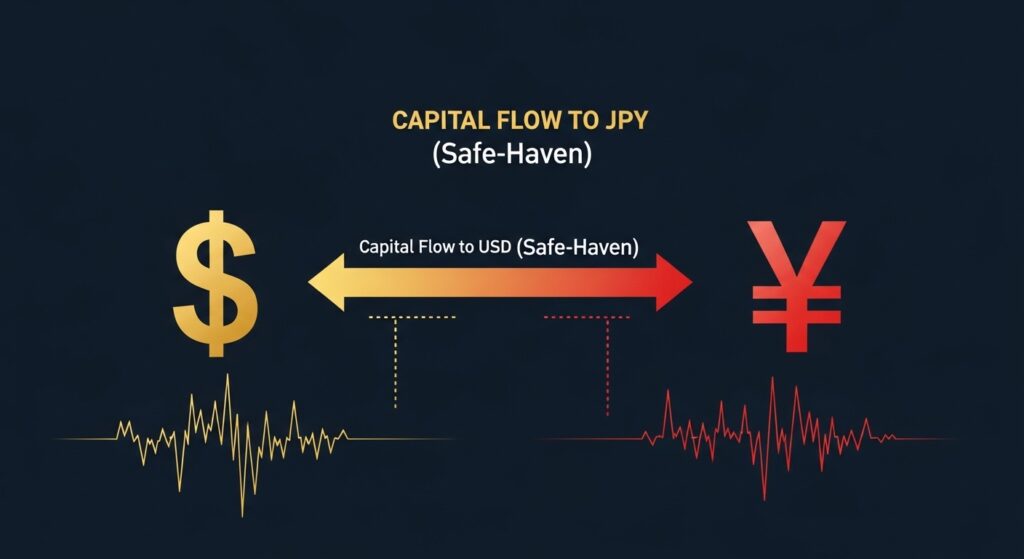
JPY as Safe Haven: When global markets panic, investors flee to safety—JPY and USD both benefit, but JPY typically gains more strength, causing USD/JPY to fall.
Risk Sentiment Impact:
Risk-On (market optimism, stocks rallying):
- USD/JPY tends to RISE
- Investors leave safe JPY for higher-yielding assets
- Carry trade activity increases
Risk-Off (market fear, stocks falling):
- USD/JPY tends to FALL
- Investors buy JPY as safe haven
- Carry trades unwound rapidly
Examples:
- COVID-19 panic (Feb-Mar 2020): USD/JPY crashed from 112 to 101
- Stock market rallies (2021-2022): USD/JPY climbed from 102 to 151
Correlation with U.S. Treasury Yields
Strongest Correlation in Forex: USD/JPY and 10-year U.S. Treasury yields move together closely (0.70-0.85 correlation).
Why:
- Higher U.S. yields = More attractive to hold USD
- Interest rate differential favors USD over JPY
- Investors buy USD to capture higher yields
USD/JPY Trading Implication: Monitor U.S. 10-year yields—rising yields predict USD/JPY strength; falling yields predict USD/JPY trading weakness.
Correlation with Stock Markets
S&P 500 Correlation: USD/JPY correlates positively with U.S. stocks (0.60-0.75).
Why: Both represent risk sentiment
- Stocks rallying = risk-on = USD/JPY rises
- Stocks falling = risk-off = USD/JPY falls
Trading Implication: Watch S&P 500 futures overnight for clues about next-day USD/JPY direction.
Volatility Profile
Average Daily Range:
- Quiet days: 60-80 pips
- Normal days: 70-100 pips
- Active days (news/risk events): 110-150 pips
- Extreme crisis: 200-400+ pips (rare)
Comparison:
- EUR/USD: 60-100 pips
- USD/JPY: Similar to EUR/USD
- GBP/USD: 100-150 pips (more volatile)
Implication: USD/JPY offers manageable volatility—not too quiet, not too wild.
Trending Behavior
USD/JPY trends strongly when conditions align:
- 40-45% of time in trends
- 35-40% ranging
- 20-25% choppy
Notable: When USD/JPY trends, it can run for months (examples: 2012-2015 massive uptrend from 75 to 125).
Best Times to Trade USD/JPY
Session Breakdown
Asian Session (7 PM – 4 AM ET):
- Range: 40-70 pips
- Liquidity: Moderate (better than EUR/USD’s Asian session)
- Good For: USD/JPY actually viable during Asian hours
- Peak: Tokyo open (7 PM – 1 AM ET)
- Japanese economic data releases
European/London Session (3 AM – 12 PM ET):
- Range: 50-80 pips
- Liquidity: Moderate
- Acceptable: Less active than EUR/GBP, more than USD/CAD
New York Session (8 AM – 5 PM ET):
- Range: 60-90 pips
- Liquidity: High
- Excellent: U.S. data drives movement
- Peak: 8:00-10:00 AM ET (U.S. open + data)
Tokyo-London Overlap (3 AM – 4 AM ET):
- Brief but can see increased activity
London-NY Overlap (8 AM – 12 PM ET):
- Range: 40-70 pips
- Liquidity: Good
- Strong: Combined European and U.S. activity
Optimal Trading Schedule
Scalpers/Day Traders:
- Primary: 8 AM – 12 PM ET (NY session)
- Secondary: 7 PM – 1 AM ET (Tokyo session)
Swing Traders: Session timing less critical—enter when technical setups present
News Traders:
- Japanese data: Usually 7:30-9:00 PM ET
- U.S. data: 8:30 AM ET, 10:00 AM ET, 2:00 PM ET (Fed)
USD/JPY Trading Strategies
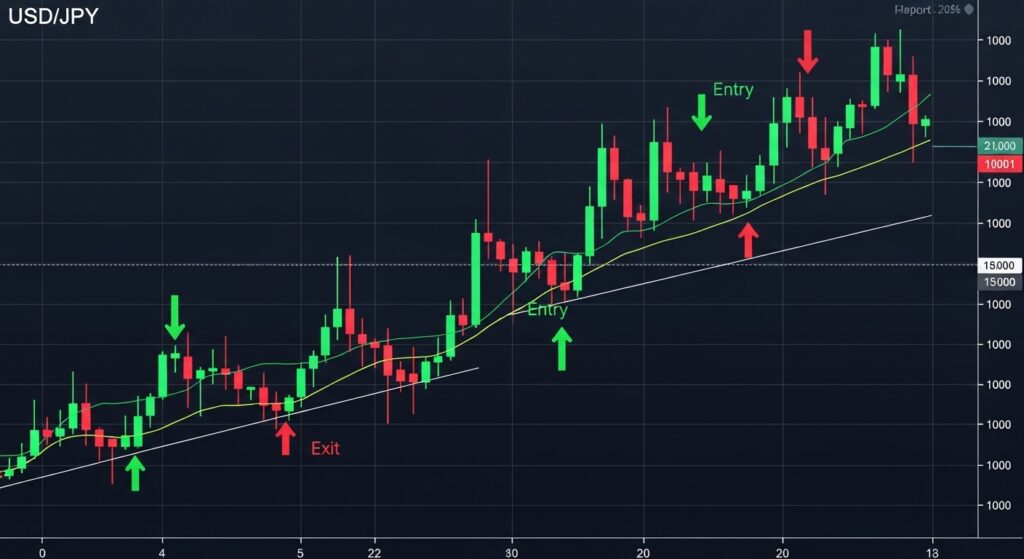
Strategy 1: Trend Following with Yield Correlation
Why It Works: USD/JPY trends align with U.S. Treasury yield trends
Setup:
- Monitor 10-year U.S. Treasury yield direction
- Identify USD/JPY trend using 50 EMA, 200 EMA
- Rising yields + USD/JPY uptrend = alignment
- Falling yields + USD/JPY downtrend = alignment
Entry:
- Wait for pullback to 50 EMA in established trend
- Bullish/bearish candle confirmation
- Yields confirming direction
Stop Loss: 40-60 pips beyond entry
Take Profit: 80-150 pips, trail with 50 EMA for major trends
Best Conditions: Clear yield trend, strong directional bias
Strategy 2: Safe-Haven Flow USD/JPY Trading
Why It Works: Predictable behavior during risk-on/risk-off shifts
Risk-Off Setup (USD/JPY Falls):
- VIX spiking (fear increasing)
- S&P 500 falling sharply
- Geopolitical crisis emerging
- Action: Short USD/JPY
Risk-On Setup (USD/JPY Rises):
- VIX falling (fear decreasing)
- S&P 500 rallying
- Economic optimism increasing
- Action: Long USD/JPY
Entry:
- Confirm risk sentiment shift
- Enter on technical signal (support/resistance break)
Stop Loss: 50-70 pips
Take Profit: Depends on crisis severity—can be 100-300+ pips
Strategy 3: Support/Resistance Bounce Trading
Why It Works: USD/JPY respects levels exceptionally well
Setup:
- Identify clear S/R levels with multiple historical touches
- Wait for price approach to level
- Look for rejection (pin bar, engulfing)
Entry:
- Long: Bullish rejection at support
- Short: Bearish rejection at resistance
Stop Loss: 20-30 pips beyond support/resistance
Take Profit: Next S/R level or 60-100 pips
Best Conditions: Ranging or consolidating USD/JPY
Strategy 4: Breakout Trading (Major Levels)
Why It Works: USD/JPY breakouts often lead to sustained moves
Setup:
- Major psychological level (105.00, 110.00, 115.00, etc.)
- Consolidation at level for extended period
- Decreasing volatility (squeeze)
Entry:
- Clean break of level with momentum
- Retest of broken level preferred
Stop Loss: Back inside broken level
Take Profit: Next major level (500-pip targets possible on major breakouts)
Best Conditions: After prolonged consolidation
Strategy 5: Carry Trade
Why It Works: Interest rate differential favors USD over JPY (when Fed rates higher than BoJ)
Setup:
- U.S. interest rates significantly higher than Japanese rates
- Stable or rising USD/JPY trend
- Low market volatility (VIX < 20)
Execution:
- Buy and hold USD/JPY
- Collect positive swap/rollover daily
- Hold for weeks/months
Profit Sources:
- Daily interest (swap)
- USD/JPY appreciation
Risk: Sudden risk-off event can cause rapid USD/JPY decline, erasing weeks of interest in hours.
Best Conditions: Fed hiking cycle, BoJ maintaining ultra-low rates, stable risk environment
Technical Analysis for USD/JPY
Key Psychological Levels
Major Levels (incredibly important for USD/JPY):
- 160.00: Historical high, major resistance
- 150.00: Psychological resistance
- 140.00: Key pivot level
- 130.00: Major support/resistance
- 120.00: Key pivot
- 110.00: Critical level
- 100.00: Major psychological support
Note: USD/JPY respects round numbers (100.00, 105.00, 110.00) better than almost any pair.
Best Indicators
For Trending:
- 20 EMA, 50 EMA, 200 EMA (work excellently)
- ADX (trend strength confirmation)
- Ichimoku Cloud (popular for USD/JPY specifically)
For Momentum:
- RSI (14)—divergences work very well
- MACD (12,26,9)
For Volatility:
- Bollinger Bands (20,2)
- ATR (Average True Range)
Unique to USD/JPY: Ichimoku Kinko Hyo (Japanese indicator, very popular for this pair)
Chart Patterns
Work Exceptionally Well:
- Head and shoulders (reversals)
- Triangles (consolidation before breakout)
- Flags and pennants (continuation)
- Double tops/bottoms
USD/JPY Characteristic: Patterns tend to complete with precise measurements—target projections accurate.
Fundamental Analysis for USD/JPY
U.S. Economic Indicators
(Same as EUR/USD and GBP/USD)
Highest Impact:
- Fed Interest Rate Decisions
- NFP
- CPI
- GDP
Strong U.S. data → USD/JPY rises (typically) Weak U.S. data → USD/JPY falls (typically)
Japanese Economic Indicators
Highest Impact:
- Bank of Japan (BoJ) Policy Decisions: 8x per year
- BoJ Press Conference: After decisions
- Japan CPI (Inflation): Monthly
- Japan GDP: Quarterly
Moderate Impact:
- Tankan Survey (business sentiment)
- Trade Balance
- Industrial Production
Important Note: Japanese data has LESS impact on USD/JPY than U.S. data—USD side drives more.
Bank of Japan (BoJ) Policy
USD/JPY is heavily influenced by Bank of Japan (BoJ) policy decisions. US forex trading is regulated by the CFTC and NFA, while UK brokers are overseen by the FCA
BoJ Unique Characteristic: Ultra-loose monetary policy for decades (near-zero or negative rates).
Policy Shifts:
- Hawkish BoJ (hints at ending ultra-loose policy) → JPY strength → USD/JPY falls
- Dovish BoJ (maintaining ultra-loose policy) → JPY weakness → USD/JPY rises
Recent Context: BoJ was last major central bank to maintain ultra-loose policy while Fed hiked aggressively 2022-2023, causing USD/JPY to surge to 40-year highs near 152.
U.S. Treasury Yields (CRITICAL)
10-Year Yield Direction Predicts USD/JPY:
- Yields rising → USD/JPY rising (strong correlation)
- Yields falling → USD/JPY falling
Where to Monitor: Bloomberg, TradingView, CNBC (ticker: US10Y)
Risk Sentiment Indicators
VIX (S&P 500 volatility index):
- VIX rising → Fear increasing → USD/JPY falls
- VIX falling → Fear decreasing → USD/JPY rises
S&P 500:
- Rallying → Risk-on → USD/JPY rises
- Falling → Risk-off → USD/JPY falls
Gold:
- Gold rallying → Fear → USD/JPY falls
- Gold falling → Risk-on → USD/JPY rises
Common USD/JPY Trading Mistakes
Mistake 1: Ignoring Risk Sentiment
USD/JPY Trading without monitoring VIX, stocks, or risk events leads to surprises.
Solution: Check VIX and S&P 500 daily before trading USD/JPY.
Mistake 2: Fading Safe-Haven Flows
Shorting USD/JPY during risk-off can work briefly but often leads to large losses as flight-to-safety accelerates.
Solution: Trade WITH safe-haven flows, not against them.
Mistake 3: Underestimating BOJ Intervention
Historically, BoJ has intervened to weaken JPY when USD/JPY rises too fast.
Solution: Be aware of potential intervention at extreme levels (historically above 145-150), use appropriate stops.
Mistake 4: Overleveraging Carry Trades
Carry trades seem “safe” (collect interest daily) until sudden risk-off event causes 300-pip overnight gap.
Solution: Use conservative leverage on carry trades, always use stop losses, reduce positions during elevated VIX.
Mistake 5: Trading Asian Session Carelessly
While USD/JPY is more active during Asian session than EUR/USD, liquidity still lower—wider spreads, potential choppy action.
Solution: Prefer NY session if possible, or wait for Tokyo open (7-10 PM ET) if trading Asian hours.
USD/JPY Trading Plan Template
Strategy: [Trend-following / Safe-haven flows / Support-Resistance / Carry trade]
Timeframe: [4-hour / Daily]
Additional Monitoring:
- U.S. 10-year Treasury yield
- VIX index
- S&P 500 direction
Risk Per Trade: 1-2% maximum
Position Sizing: Calculate based on 40-60 pip stops
Trading Sessions:
- Primary: 8 AM – 12 PM ET (NY)
- Secondary: 7 PM – 1 AM ET (Tokyo)
Stop Loss: 40-60 pips typical
Take Profit: Minimum 80 pips, trail for larger trends
Entry Checklist:
- [ ] Setup matches strategy
- [ ] Technical setup confirmed
- [ ] Risk sentiment assessed (VIX, S&P 500)
- [ ] U.S. yields confirming direction (for trends)
- [ ] No major BOJ or Fed events in next 24 hours
- [ ] Stop loss and targets identified
- [ ] Position size calculated
- [ ] Risk-reward minimum 1:2
Unique Trading Opportunities
BOJ Policy Announcement Days
BoJ meetings can cause 100-200 pip moves if policy changes hinted.
Approach:
- Identify scheduled BoJ meeting dates
- Trade the outcome based on hawkish/dovish shift
- Hawkish surprise = USD/JPY falls
- Dovish confirmation = USD/JPY rises
U.S. Treasury Auctions
Large U.S. Treasury auctions can move yields and thus USD/JPY.
Monitor: Check Treasury auction schedule, watch for demand/yield results.
Seasonal Patterns
Japanese Fiscal Year End (March 31):
- Japanese companies repatriate funds
- Can cause JPY strength (USD/JPY falls) late March
- Tendency, not guaranteed
USD/JPY – More Technical/Analytical Style:
How USD/JPY Compares to Other Major Pairs
USD/JPY Trading vs EUR/USD Trading
The relationship between USD/JPY and EUR/USD is complex and changes based on market conditions. Unlike pairs with consistent correlation, these two can move together or inversely depending on which currency is driving movement.
During broad USD strength (Fed rate hikes, strong US data), both pairs move in opposing directions—EUR/USD falls while USD/JPY rises. This inverse correlation can reach -0.70 in such environments. However, when risk sentiment dominates, both pairs may fall simultaneously if investors flee to JPY as a safe haven while also buying USD.
Technical traders often prefer EUR/USD for its cleaner chart patterns and more predictable behavior around support/resistance. USD/JPY tends to respect round numbers (100.00, 105.00, 110.00) more rigidly but can make explosive moves during Japanese intervention or when crossing major psychological levels.
USD/JPY vs GBP/USD
GBP/USD and USD/JPY represent opposite ends of the volatility spectrum among major pairs. While GBP/USD whipsaws through 100+ pip ranges regularly, USD/JPY tends toward steadier, more methodical trends punctuated by occasional violent moves during intervention or crisis events.
Both pairs benefit from excellent liquidity, but their optimal trading windows differ significantly. USD/JPY offers consistent action through Asian, European, and US sessions due to Japanese market activity, whereas GBP/USD goes dormant during Asian hours. Spread traders sometimes use the GBP/JPY cross pair to capture the volatility differential between these two majors.
USD/JPY vs USD/CHF
USD/JPY Trading alongside USD/CHF creates an interesting dynamic since both pairs feature safe haven currencies but respond to different triggers. During pure USD strength/weakness, both move in the same direction—if USD rallies, both USD/JPY and USD/CHF rise together.
The divergence appears during risk-off events. When global markets panic, JPY strengthens more aggressively than CHF, causing USD/JPY to fall sharply while USD/CHF may fall only moderately or even hold steady. Experienced traders monitor both pairs simultaneously to gauge whether market moves are USD-driven or safe-haven-driven.
USD/JPY vs AUD/USD
AUD/USD and USD/JPY serve as reliable barometers of risk appetite, often moving in the same direction during clear risk-on or risk-off environments. When markets embrace risk, both pairs typically rise (AUD strength + JPY weakness). When fear dominates, both fall (AUD weakness + JPY strength).
The carry trade historically linked these pairs—investors would borrow in low-yielding JPY to buy high-yielding AUD. Large unwinding of such positions during crisis periods creates dramatic simultaneous moves. AUD/USD responds more to commodity prices and Chinese data, while USD/JPY is more sensitive to US treasury yields and Japanese economic policy.
USD/JPY vs USD/CAD
While both USD/JPY and USD/CAD share USD as the base currency, their price drivers differ substantially. USD/CAD dances to the rhythm of oil prices—when crude rallies, CAD strengthens and USD/CAD falls. USD/JPY cares little about commodities, instead tracking US-Japan interest rate differentials and risk sentiment.
Correlation between these pairs fluctuates widely depending on whether USD strength or commodity/risk factors dominate. During periods of stable oil prices, they move together based on USD. When oil becomes volatile, USD/CAD breaks away to follow crude while USD/JPY maintains its focus on rates and safe haven flows.
USD/JPY vs NZD/USD
The connection between USD/JPY and NZD/USD centers on risk appetite and carry trade dynamics. NZD historically offered high interest rates making it a favorite funding target using borrowed JPY. When this carry trade flourishes (risk-on), USD/JPY and NZD/USD both rise. When it unwinds (risk-off), both plummet.
NZD/USD exhibits far greater volatility with regular 100-150 pip daily swings versus USD/JPY’s typical 60-80 pip range. USD/JPY provides more trading opportunities during Asian hours due to Japanese market activity, while NZD/USD becomes most active during the Sydney/Wellington session. Professional traders often monitor both to confirm risk sentiment signals.
USD/JPY offers unique trading opportunities driven by safe-haven dynamics, U.S. Treasury yield correlation, and exceptional technical reliability. Success requires understanding the risk-on/risk-off framework, monitoring U.S. yields, and respecting the pair’s precise adherence to technical levels.
Whether trend-following during Fed hiking cycles, trading safe-haven flows during market turmoil, or capturing multi-month carry trade returns, USD/JPY provides the liquidity, movement, and predictability needed for consistent profitability.
The pair rewards traders who integrate fundamental awareness (yields, risk sentiment) with technical precision (support/resistance, patterns). Study the unique characteristics, respect the safe-haven dynamics, and USD/JPY can become a reliable profit generator in your forex portfolio.
Expand Your Currency Trading Knowledge
Explore other major currency pairs:
- EUR/USD Trading Guide – Master the world’s most traded pair
- GBP/USD Trading Guide – Master the volatile Cable pair
- USD/CHF Trading Guide – Understand the Swissie
- USD/CAD Trading Guide – Trade the oil-correlated Loonie
- AUD/USD Trading Guide – Master the risk-on Aussie
- NZD/USD Trading Guide – Trade the high-yield Kiwi
For a complete overview of all major currency pairs and how to choose which pairs to trade, see our Major Currency Pairs: Complete Trading Guide.