Understanding pip value is fundamental to successful forex trading. While knowing how many pips you’ve gained or lost is important, translating those pips into actual monetary value determines your real profit, loss, and risk exposure. This comprehensive guide explains how to calculate pip value across different currency pairs and account currencies.
What Is Pip Value?
Pip value represents the monetary worth of a one-pip movement in a currency pair for a specific position size. It’s the dollar amount (or your account currency) you gain or lose when the exchange rate moves by one pip.
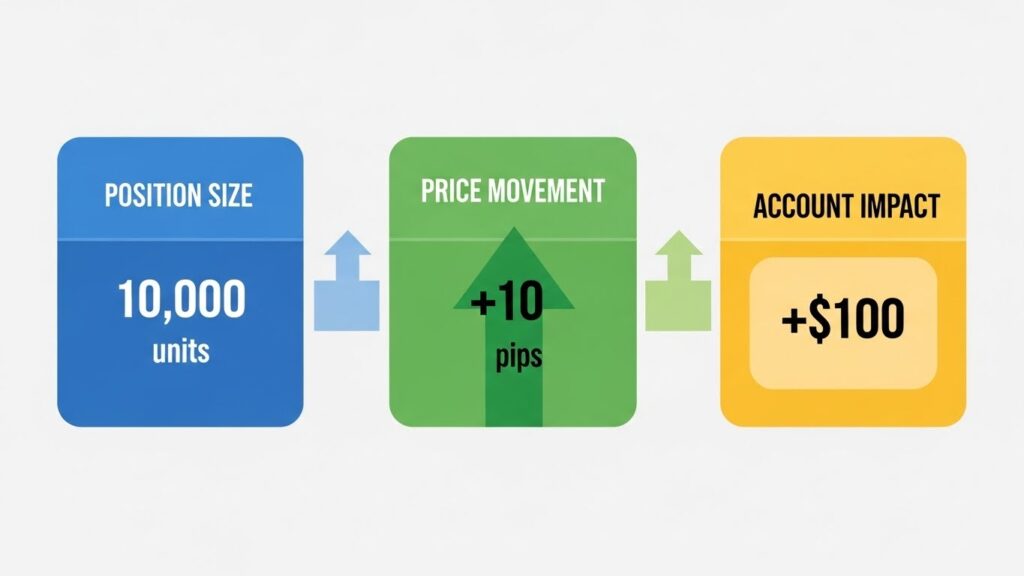
For example, if you’re trading one standard lot of EUR/USD and the price moves 10 pips in your favor, you need to know the pip value to calculate that this movement equals $100 in profit. Without understanding pip value, you cannot accurately assess risk or properly size your positions.
Pip value varies based on three key factors: the currency pair being traded, your position size, and your account currency. The National Futures Association requires forex dealers to provide clear risk disclosures, including how pip movements translate to monetary risk.
Standard Pip Values for Major Pairs
For USD-based accounts trading standard lots (100,000 units), certain currency pairs have consistent pip values:
For pairs where USD is the quote currency (EUR/USD, GBP/USD, AUD/USD, NZD/USD):
- Standard lot: $10 per pip
- Mini lot: $1 per pip
- Micro lot: $0.10 per pip
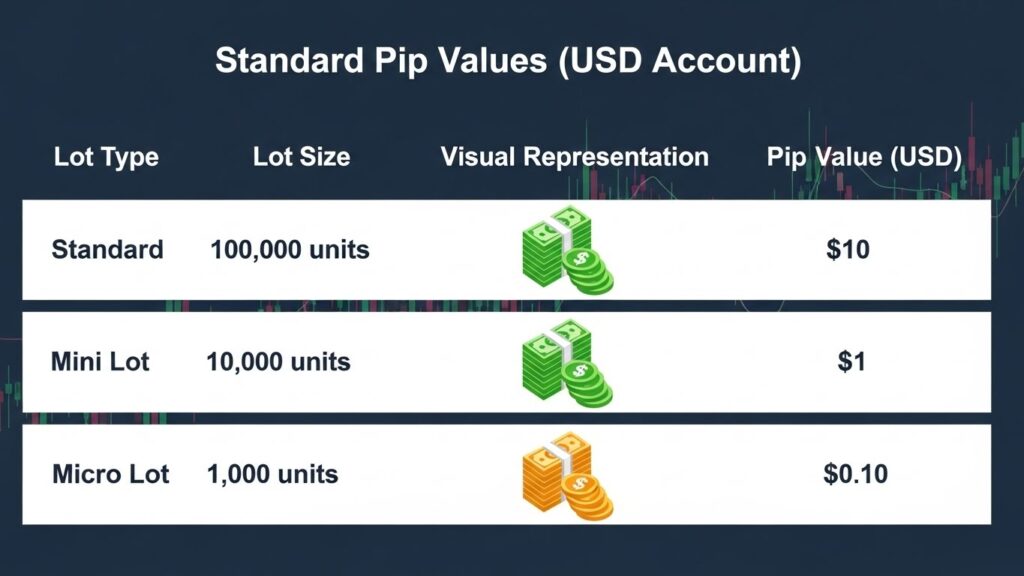
These consistent values make position sizing straightforward for these popular pairs. If you risk 50 pips on a mini lot EUR/USD trade, you’re risking exactly $50. This predictability helps traders quickly calculate risk without complex formulas.
For pairs where USD is the base currency (USD/JPY, USD/CHF, USD/CAD), pip values fluctuate based on the current exchange rate. As these rates change, so does your pip value, requiring recalculation.
The Pip Value Formula
For pairs where your account currency is not the quote currency, calculate pip value using this formula:
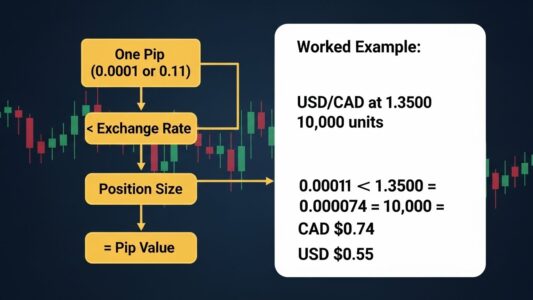
Pip Value = (One Pip / Exchange Rate) × Position Size
Let’s break this down step by step:
Step 1: Determine “One Pip”
- For most pairs: 0.0001
- For JPY pairs: 0.01
Step 2: Identify the relevant exchange rate
- Use the current rate for the pair you’re trading
Step 3: Apply your position size
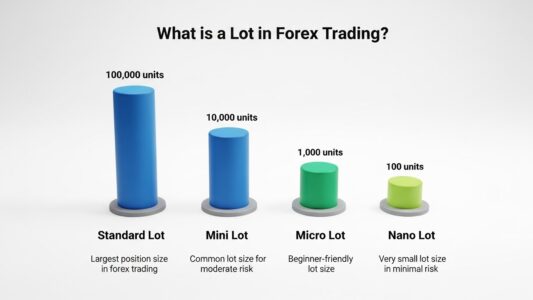
- Standard lot: 100,000 units
- Mini lot: 10,000 units
- Micro lot: 1,000 units
Example: USD/CAD at 1.3500 for a mini lot (10,000 units)
- One Pip: 0.0001
- Exchange Rate: 1.3500
- Position Size: 10,000 units
- Calculation: (0.0001 / 1.3500) × 10,000 = 0.74 CAD
- If your account is in USD, convert: 0.74 / 1.3500 = $0.55 per pip
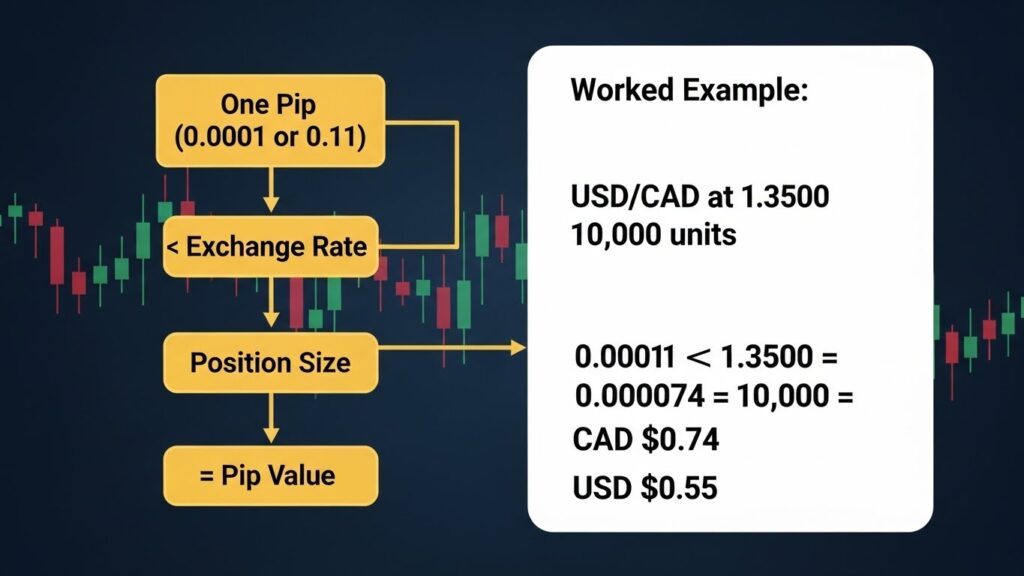
This formula works for any currency pair and position size. The Commodity Futures Trading Commission emphasizes understanding these calculations as part of proper risk management in leveraged forex trading.
Calculating Cross Currency Pip Values
Cross currency pairs (pairs not involving USD) require additional conversion steps. For a GBP/JPY trade with a USD account, you must first calculate the pip value in JPY, then convert that to USD.
Example: GBP/JPY at 188.50 for a standard lot (100,000 units)
- One Pip for JPY pairs: 0.01
- Position Size: 100,000 units
- Calculation: 0.01 × 100,000 = 1,000 JPY per pip
- Convert to USD: 1,000 / 188.50 = $5.31 per pip
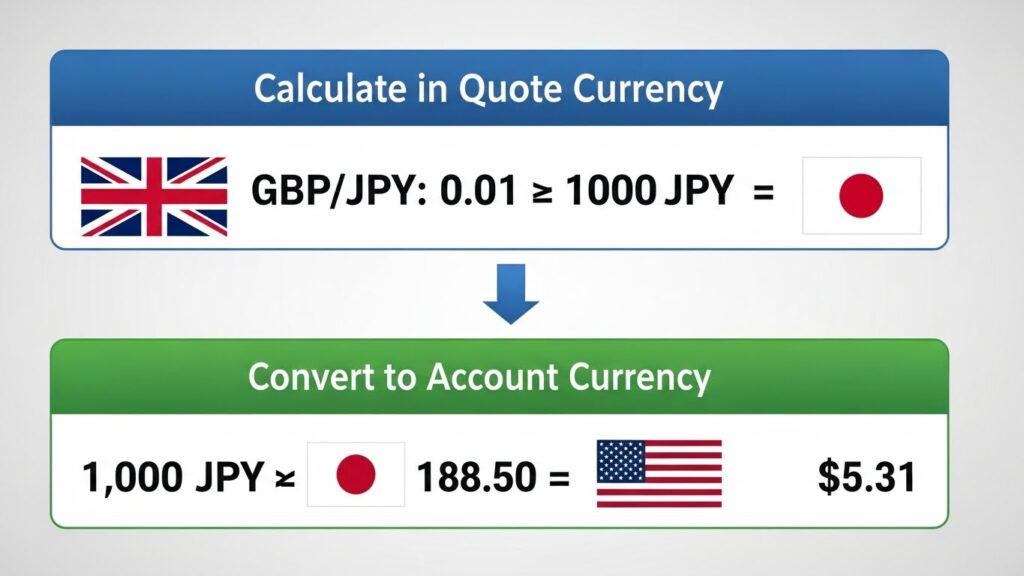
For EUR/GBP with a USD account, calculate the pip value in GBP first, then convert using the GBP/USD rate. This two-step process ensures accurate risk assessment when trading exotic or cross pairs.
Some brokers regulated by the Financial Conduct Authority provide pip value calculators, but understanding the underlying mathematics helps you verify accuracy and trade with confidence.
Position Sizing Using Pip Value
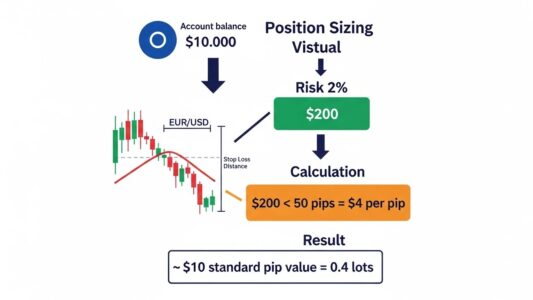
Pip value is essential for proper position sizing. To determine appropriate position size based on your risk tolerance:
Step 1: Decide your dollar risk per trade (e.g., $100)
Step 2: Determine your stop loss in pips (e.g., 50 pips)
Step 3: Calculate required pip value: $100 / 50 pips = $2 per pip
Step 4: Select position size that matches this pip value
- For EUR/USD: 2 mini lots = $2 per pip
- For USD/JPY at 149.50: ~3 mini lots
- For GBP/JPY at 188.50: ~4 mini lots
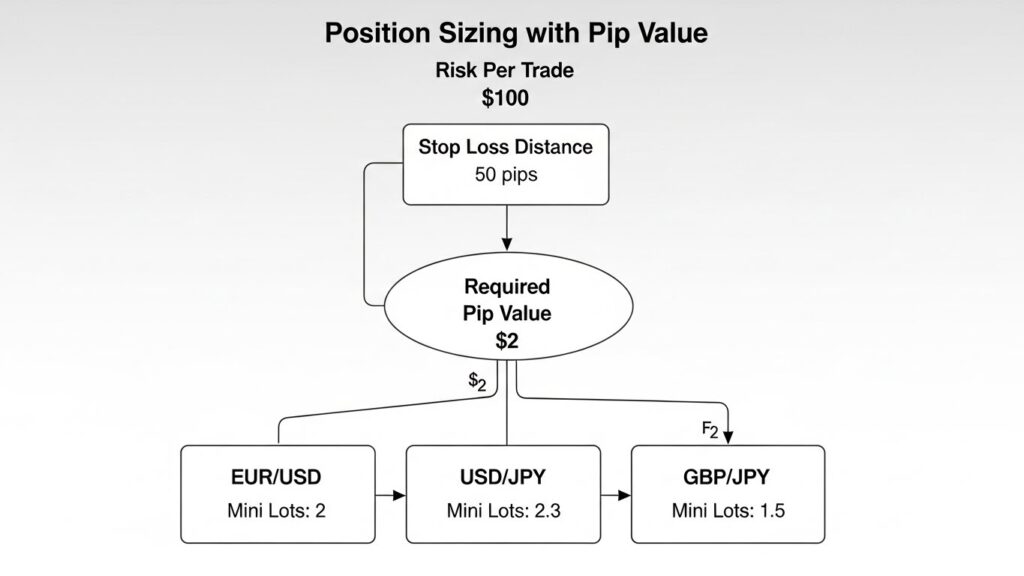
Without proper pip value calculation, traders often over-leverage certain pairs while under-utilizing others. A 50-pip stop loss represents different dollar risks depending on the pair and lot size—pip value makes these differences clear.
Pip Value Changes with Account Currency
Your account currency significantly affects pip value calculations. A trader with a EUR account sees different pip values than a USD account holder trading the same pairs.
For EUR account trading EUR/USD: The pair quote is already in your account currency, simplifying calculations. One standard lot always equals approximately 10 EUR per pip, regardless of the current exchange rate.
For GBP account trading EUR/USD: You must convert USD pip values to GBP using the current GBP/USD rate. As this rate fluctuates, your actual profit in GBP changes even if the EUR/USD pip movement remains constant.
For JPY account trading any pair: All pip values must be converted to JPY, often resulting in larger numerical values (though equivalent purchasing power) compared to USD or EUR accounts.
Understanding these differences prevents confusion when comparing trading results with others or when switching between accounts denominated in different currencies.
Variable Pip Values in JPY Pairs
Pairs involving Japanese yen present unique considerations because their pip values fluctuate with the exchange rate more noticeably than other major pairs.
Example: USD/JPY pip value changes
- At 140.00: One standard lot = $7.14 per pip
- At 150.00: One standard lot = $6.67 per pip
- At 160.00: One standard lot = $6.25 per pip
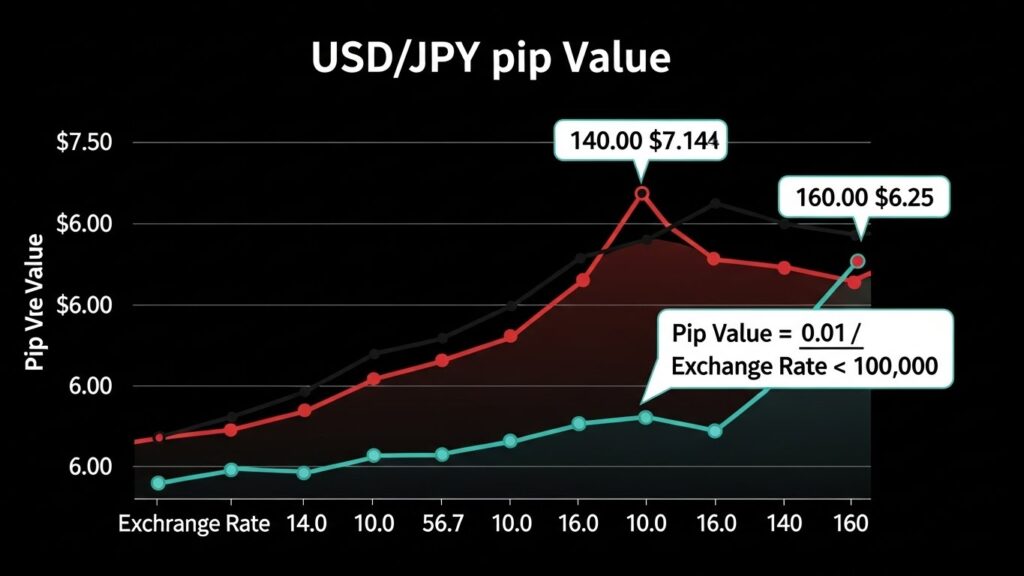
As USD/JPY rises, the pip value in dollars decreases. This inverse relationship means your actual dollar risk and profit potential change as the rate moves, even with constant position sizing.
For active traders, this variability requires recalculating pip value periodically, especially during significant price movements. A position sized appropriately when USD/JPY traded at 140.00 may represent different dollar risk if the rate moves to 155.00.
Pip Value in Practical Risk Management
Professional traders use pip value as the foundation of their risk management systems. Here’s how to implement pip value in your trading strategy:
Pre-Trade Planning: Before entering any position, calculate the pip value for your intended position size. Multiply this by your planned stop loss distance to know your exact dollar risk. If this exceeds your risk tolerance, reduce position size or widen the stop loss.
Profit Targets: Convert profit targets from pips to dollars using pip value. A 100-pip target sounds impressive, but with a micro lot it represents only $10 in profit. Understanding real dollar values helps set realistic expectations.
Comparing Opportunities: Pip value allows fair comparison between different setups. A 50-pip opportunity on GBP/JPY might represent more profit potential than a 75-pip setup on EUR/USD, depending on position sizes and pip values.
Scaling Positions: When building or reducing positions, maintain consistent risk by adjusting lot sizes based on pip value. Adding one standard lot to EUR/USD increases risk by $10 per pip, while adding the same to USD/JPY at 150.00 increases risk by approximately $6.67 per pip.
Regular pip value calculations prevent the common mistake of inconsistent position sizing, where traders unknowingly risk different dollar amounts on different trades.
Common Pip Value Mistakes
Understanding what not to do helps avoid costly errors:
Assuming all pairs have equal pip values: A standard lot doesn’t always equal $10 per pip. This assumption works for EUR/USD but fails for USD/JPY, USD/CHF, and all cross pairs, potentially doubling your intended risk without realizing it.
Forgetting to account for account currency: Calculator results showing pip values in USD don’t apply directly if your account is denominated in EUR, GBP, or other currencies. Always convert to your actual account currency.
Using outdated pip values: For pairs where pip value changes with the exchange rate, using yesterday’s calculation for today’s trade introduces errors. Recalculate when rates move significantly.
Ignoring pip value when comparing strategies: Measuring strategy performance solely in pips without considering pip value creates misleading comparisons. A strategy averaging 50 pips per trade on micro lots underperforms one averaging 25 pips on standard lots.
Overleveraging due to misunderstanding: New traders sometimes see that a micro lot “only” moves by $0.10 per pip and take excessive positions, not realizing that 100 micro lots equal 10 standard lots—$100 per pip of exposure.
Advanced Pip Value Considerations
Experienced traders optimize their approach with these advanced techniques:
Dynamic Position Sizing: Adjust position sizes based on current pip values to maintain consistent dollar risk. As exchange rates change, recalculate pip values and modify lot sizes accordingly to keep risk constant.
Partial Position Management: When closing partial positions, understand the pip value of your remaining exposure. Closing half a position doesn’t always halve your pip value if you’re trading multiple pairs with different pip values.
Correlation-Adjusted Risk: When trading correlated pairs simultaneously, sum the pip values to understand total exposure. Two standard lots of EUR/USD and two of GBP/USD represent approximately $40 per pip of correlated risk, not $20 per pip of independent risk.
Account Currency Hedging: Traders with non-USD accounts can use pip value differences to naturally hedge currency exposure. A EUR account holder trading EUR/USD has different risk dynamics than trading USD/JPY, affecting overall portfolio currency exposure.
Conclusion
Mastering pip value calculation transforms pips from abstract movements into concrete monetary reality. Whether you’re risking $50 or $500 per trade, pip value ensures you know exactly what each price movement means for your account.
Calculate pip value before every trade, adjust position sizes to maintain consistent risk, and verify your broker’s pip value displays against your own calculations. This fundamental skill separates traders who manage risk effectively from those who discover their true exposure only after losses mount.
As you develop your trading strategy, make pip value calculation automatic. Understanding that your 50-pip stop loss represents $50, $500, or $5 in real risk makes the difference between disciplined trading and gambling. The mathematics is straightforward—the discipline to apply it consistently is what builds long-term success in forex trading.