Pips vs Points vs Pipettes: Complete Beginner’s Guide

Forex trading has confusing terminology, and nowhere is this more apparent than the confusion between pips, points, and pipettes. Pips vs Points vs Pipettes, New traders hear these terms used interchangeably and struggle to understand what each one means, how they differ, and which term to use in different contexts.

You might read that EUR/USD moved “50 pips” in one article and “500 points” in another, describing the same price movement. A broker might quote prices showing five decimal places, leaving you wondering if you’re looking at pips or pipettes. Without clarity on these terms, you can’t accurately calculate position sizes, understand profit/loss, or communicate clearly with other traders.

This comprehensive guide eliminates the confusion. You’ll learn the precise definitions of pips, points, and pipettes, understand how each term is used in different markets, see visual examples of each measurement, and master when to use which term. By the end, you’ll confidently navigate forex terminology and accurately measure price movements.

What Is a Pip

A pip (percentage in point or price interest point) is the standard unit of measurement for price changes in forex trading.

Standard Definition

For most currency pairs, one pip equals 0.0001 (movement in the fourth decimal place).

Examples:

EUR/USD moves from 1.1000 to 1.1001 = 1 pip move

GBP/USD moves from 1.2500 to 1.2550 = 50 pip move

AUD/USD moves from 0.6500 to 0.6485 = 15 pip move (downward)

JPY Pairs Exception

For currency pairs involving Japanese Yen, one pip equals 0.01 (movement in the second decimal place).

Examples:

USD/JPY moves from 145.00 to 145.50 = 50 pip move

EUR/JPY moves from 160.00 to 160.25 = 25 pip move

GBP/JPY moves from 185.50 to 185.00 = 50 pip move (downward)

Why JPY is Different:

The Japanese Yen has much lower value compared to other major currencies (approximately 140-150 yen per dollar vs. 1.10 euros per dollar). Using two decimal places instead of four keeps pip values comparable in dollar terms across all pairs.

According to the National Futures Association, understanding basic forex terminology including pips is essential for new traders

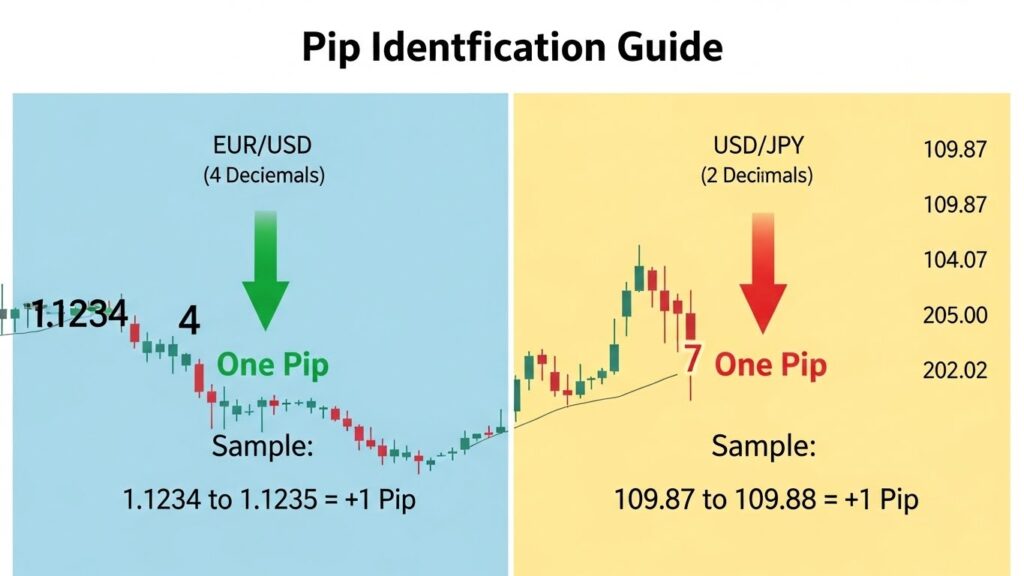
Pip Identification Guide Two side-by-side examples showing EUR/USD (4 decimals) and USD/JPY (2 decimals) with large arrows and labels clearly marking which decimal place represents one pip. Include sample calculations showing pip movements.

What Is a Point

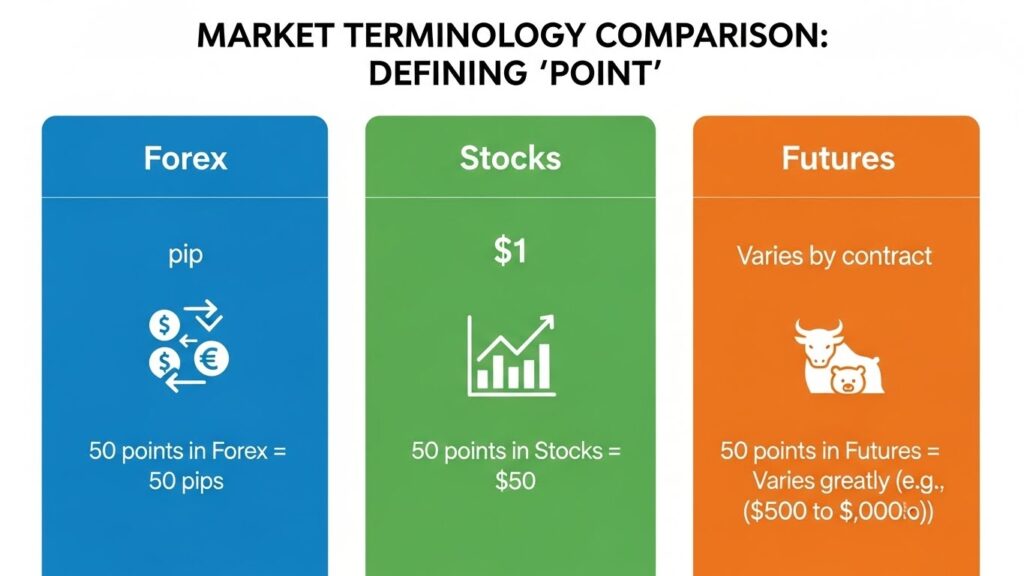
A “point” has different meanings depending on which market you’re discussing. This creates significant confusion.

Points in Forex

In forex trading, one point typically equals one pip. The terms are used interchangeably.

When forex traders say “EUR/USD moved 50 points,” they mean 50 pips (0.0050 movement).

Usage: “Point” and “pip” mean the same thing in forex contexts. Most forex traders prefer saying “pip” to avoid confusion with other markets.

Points in Stock Markets

In stock trading, one point equals one dollar of price movement.

Apple stock moving from $150.00 to $151.00 = 1 point move = $1.00 change

This creates confusion when traders discuss both stocks and forex, as “point” means completely different measurements in each market.

Points in Futures Markets

Futures markets define points differently for each contract. One point might equal $50 in one contract and $10 in another.

E-mini S&P 500 futures: 1 point = $50 Crude oil futures: 1 point = $1,000

The Problem:

Because “point” means different things in different markets, forex traders increasingly use “pip” exclusively to avoid ambiguity.

The Commodity Futures Trading Commission notes that understanding contract specifications including point values is important for futures traders.

Recommendation for Forex Traders

Use “pip” not “point” when discussing forex. This eliminates confusion and aligns with standard forex terminology used globally.

chart showing how "point" is defined differently across Forex (=pip), Stocks (=$1), and Futures (varies by contract). Use icons for each market type. Shows example of "50 points" meaning different things in each market.

What Is a Pipette

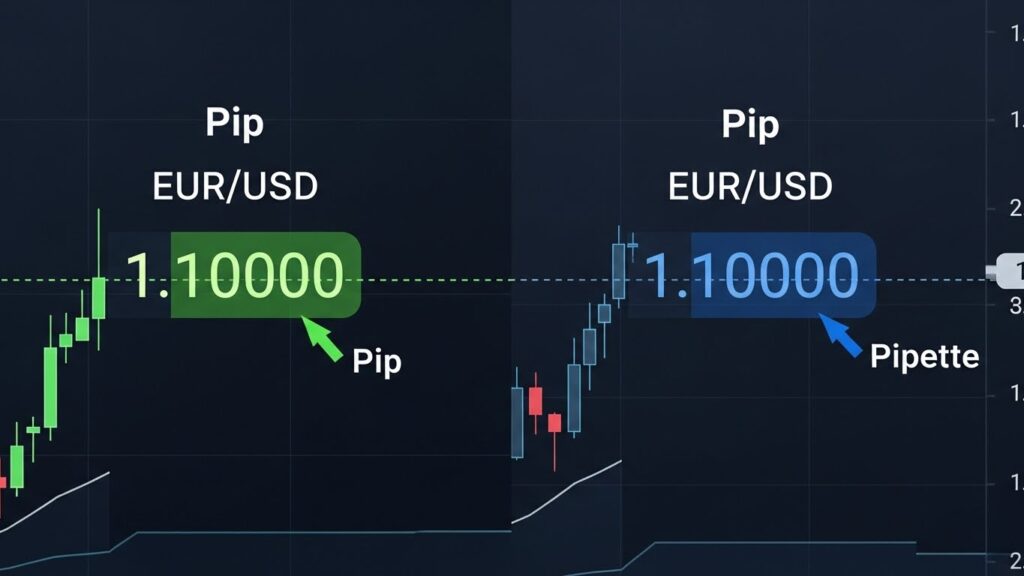
A pipette (also called a fractional pip or micro pip) is one-tenth of a pip.

Technical Definition

Standard Pairs: Movement in the fifth decimal place (0.00001)

EUR/USD: 1.10000 to 1.10001 = 1 pipette = 0.1 pips

JPY Pairs: Movement in the third decimal place (0.001)

USD/JPY: 145.000 to 145.001 = 1 pipette = 0.1 pips

Why Pipettes Exist

Brokers introduced fractional pip pricing to offer:

Tighter spreads: Instead of 2-pip spread, offer 1.5-pip (15-pipette) spread

More precise pricing: Five decimal places provide finer price granularity

Better execution: Slight price improvements possible with fractional pricing

Competitive advantage: Brokers can advertise “lower spreads” by measuring in pipettes

Pipettes in Practice

Example 1: Spread Comparison

Broker A spread: 2 pips (0.0002) Broker B spread: 1.8 pips (0.00018) = 18 pipettes

Broker B can advertise “20% tighter spreads” using fractional pips.

Example 2: Price Quote

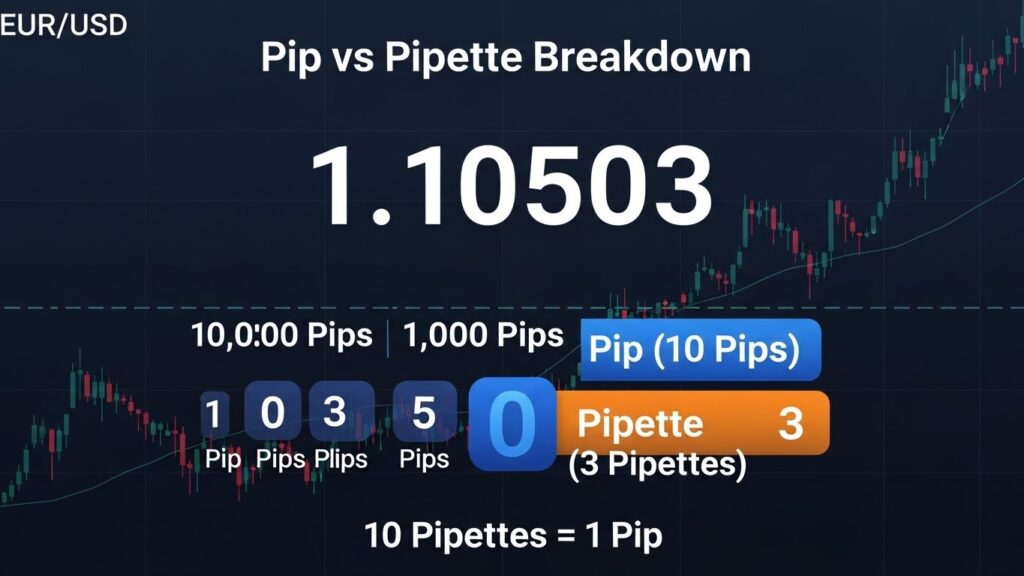
Old format (4 decimals): EUR/USD = 1.1050 New format (5 decimals): EUR/USD = 1.10503

The “3” in the fifth decimal place represents 3 pipettes (0.3 pips).

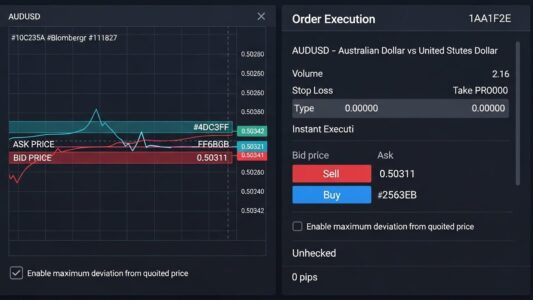
Pips vs Points vs Pipettes. EUR/USD price display showing 1.10503 with detailed breakdown. Show each decimal place labeled, with pip (4th decimal) and pipette (5th decimal) highlighted in different colors. Include conversion showing 10 pipettes = 1 pip.

Converting Between Pips, Points, and Pipettes

Understanding conversions helps you interpret different price quotations accurately.

Basic Conversions

Pipettes to Pips: 10 pipettes = 1 pip

50 pipettes = 5 pips 100 pipettes = 10 pips

Pips to Pipettes: 1 pip = 10 pipettes

5 pips = 50 pipettes 10 pips = 100 pipettes

Pips to Points (Forex): 1 pip = 1 point

50 pips = 50 points 100 pips = 100 points

Conversion Examples

Example 1: Understanding Broker Spread

Broker advertises: “EUR/USD spread from 0.8 pips”

In pipettes: 0.8 pips = 8 pipettes In price terms: 0.00008 movement

Example 2: Converting Pipettes to Pips

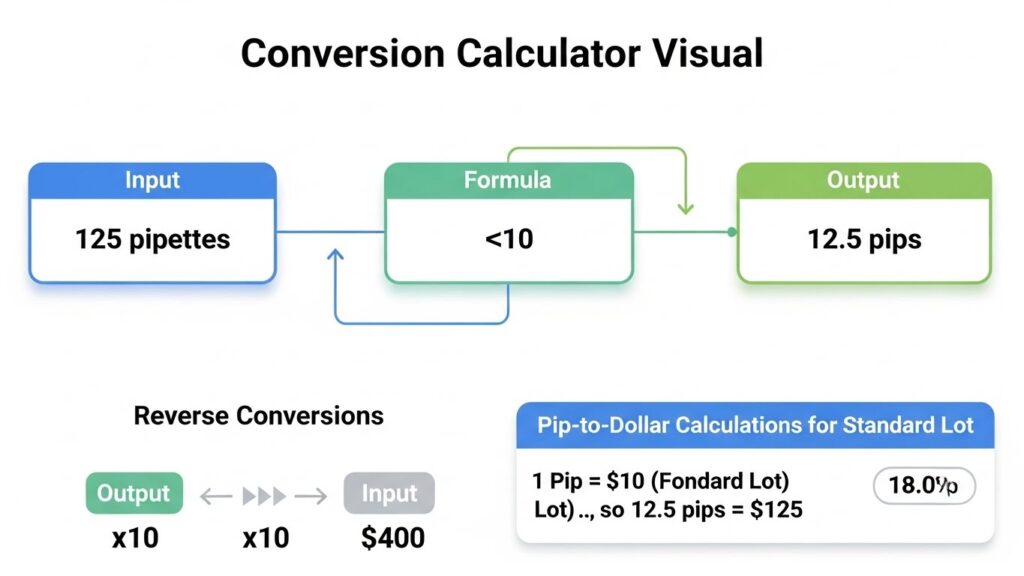
EUR/USD moves from 1.10000 to 1.10125

Movement: 0.00125 = 125 pipettes = 12.5 pips

Example 3: Profit Calculation

Position gains 75 pipettes

In pips: 75 ÷ 10 = 7.5 pips On 1 standard lot EUR/USD: 7.5 pips × $10 = $75 profit

The Financial Conduct Authority emphasizes that retail traders should understand how profits and losses are calculated in leveraged products.

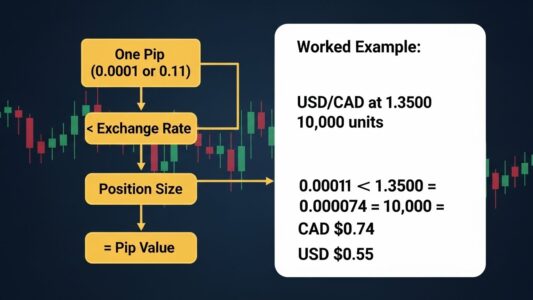
calculator graphic showing conversion formulas. Three boxes showing: Input (125 pipettes) → Formula (÷10) → Output (12.5 pips). Include reverse conversions and pip-to-dollar calculations for standard lot.

Which Term Should You Use

Choosing the right terminology improves clarity and prevents misunderstandings.

When to Use “Pip”

Use “pip” when:

  • Discussing forex trading specifically
  • Calculating position sizes
  • Setting stop-losses and take-profits
  • Talking with other forex traders
  • Reading forex educational content

Examples: “My stop-loss is 50 pips below entry” “EUR/USD moved 80 pips today” “I risk 2% per trade, which equals 40 pips on this setup”

When to Use “Pipette”

Use “pipette” when:

  • Comparing broker spreads
  • Discussing fractional pip pricing
  • Analyzing five-decimal-place quotes
  • Evaluating execution quality

Examples: “This broker’s spread is 15 pipettes tighter” “Price improved by 3 pipettes on my entry”

Note: Most trading conversations use pips, not pipettes. Pipettes matter mainly for spread comparisons and precise order execution analysis.

When to Use “Point”

Avoid “point” in forex to prevent confusion with stock and futures markets.

If you must use it, clarify: “50 points (pips)” to ensure understanding.

Use “point” when:

  • Trading stocks (where 1 point = $1)
  • Trading futures (where point value varies by contract)

Industry Standard

Forex traders worldwide primarily use “pip.” This creates universal understanding regardless of the trader’s country or native language.

When in doubt, use “pip”—it’s the clearest, most widely accepted forex terminology.

Practical Applications

Understanding pips, points, and pipettes has direct impact on your trading decisions.

Setting Stop-Losses

Pip-Based Stops:

“I’ll place my stop-loss 50 pips below my entry” provides clear, specific risk definition.

Entry: EUR/USD 1.1000 Stop: 50 pips below = 1.0950

Pipette Precision:

Some traders use pipettes for very tight stops: “Stop at 1.09503” (50.3 pips below 1.1000) instead of round 50 pips

This precision rarely matters unless scalping with very tight stops.

Calculating Profit Targets

Risk-Reward in Pips:

Risk: 50 pips Reward target: 100 pips (1:2 risk-reward)

Entry: 1.1000 Stop: 1.0950 (-50 pips) Target: 1.1100 (+100 pips)

Why Pips Work Better Than Price:

Saying “I want 1:2 risk-reward” translates directly to “100-pip target for 50-pip stop.”

This consistency across different currency pairs and account sizes makes risk management simpler.

Spread Comparison

Understanding Broker Costs:

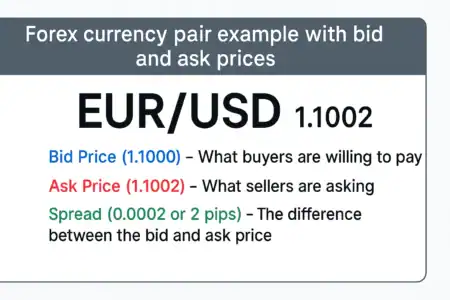
Broker A: 2-pip spread (0.0002) Broker B: 1.8-pip spread (0.00018 or 18 pipettes)

Cost Difference:

0.2 pips = 2 pipettes difference

On 1 standard lot: 0.2 pips × $10 = $2 per trade 100 trades: $200 savings with Broker B

Understanding pipette-level differences helps evaluate true trading costs.

Real Trading Scenarios: Three practical examples showing: 1) Stop-loss placement with pip measurements, 2) Risk-reward calculation using pips, 3) Spread comparison in pips vs pipettes with dollar cost breakdown. Use real EUR/USD price examples.

Common Mistakes and Misconceptions

Avoid these errors that create confusion about pips, points, and pipettes.

Mistake 1: Confusing Stock Points with Forex Pips

The Error: Thinking “50 points” in forex means $50 movement like in stocks.

Why It’s Wrong: In forex, 50 points = 50 pips = 0.0050 movement. On 1 standard lot, this equals $50 only coincidentally for pairs where pip value is $10.

The Solution: Use “pip” not “point” in forex contexts to avoid this confusion.

Mistake 2: Miscounting Decimals

The Error: Counting EUR/USD movement from 1.1000 to 1.1500 as 500 pips instead of 5,000 pips.

Why It’s Wrong: Each 0.0001 = 1 pip. Movement of 0.0500 = 500 pips.

The Solution: Remember the pip is the fourth decimal place. Count decimal places carefully: 0.0001 = 1 pip 0.0010 = 10 pips 0.0100 = 100 pips 0.1000 = 1,000 pips

Mistake 3: Ignoring Pipettes Entirely

The Error: Seeing price quote 1.10503 and thinking it’s just 1.1050, ignoring the fifth decimal.

Why It’s Wrong: The “3” in the fifth decimal matters for spread calculations and precise entries. Ignoring it can cost money over many trades.

The Solution: Pay attention to all decimal places shown. If broker shows five decimals, use them for precise entry prices.

Mistake 4: Treating JPY Pairs Like Standard Pairs

The Error: Calculating USD/JPY movement from 145.00 to 145.50 as 500 pips instead of 50 pips.

Why It’s Wrong: JPY pairs use two decimals, not four. Movement of 0.50 = 50 pips, not 500.

The Solution: Remember: Standard pairs = 4 decimals, JPY pairs = 2 decimals.

Mistake 5: Overthinking Pipettes

The Error: Obsessing over 2-3 pipette differences in entry prices when trading with 50-pip stops.

Why It’s Wrong: A 3-pipette (0.3 pip) entry difference is meaningless noise with a 50-pip stop. You’re adding complexity without meaningful benefit.

The Solution: Focus on pips for strategy and risk management. Only worry about pipettes when comparing broker spreads or analyzing scalping execution.

Pips, Points, and Pipettes Across Different Pairs

Understanding how these measurements apply to different currency pairs prevents calculation errors.

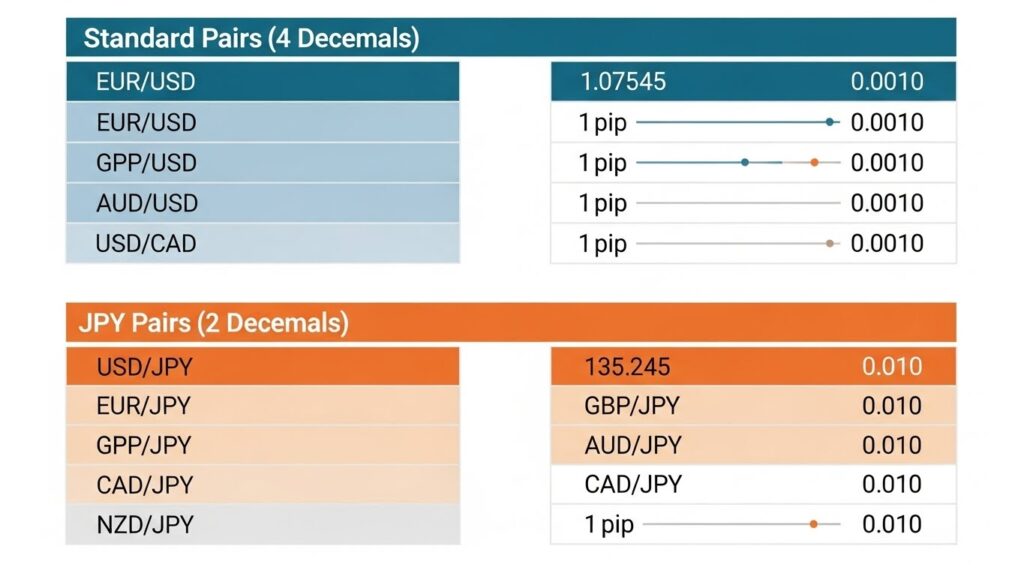
Major Pairs (4 Decimal Places)

Standard pip measurement (0.0001):

  • EUR/USD
  • GBP/USD
  • AUD/USD
  • NZD/USD

Example: EUR/USD moves from 1.1000 to 1.1075 = 75 pips

JPY Pairs (2 Decimal Places)

Modified pip measurement (0.01):

  • USD/JPY
  • EUR/JPY
  • GBP/JPY
  • AUD/JPY

Example: USD/JPY moves from 145.00 to 145.75 = 75 pips

Note: Same “75 pips” but different decimal places.

Exotic Pairs

Most exotic pairs follow standard 4-decimal pip measurement:

  • USD/TRY (Turkish Lira)
  • USD/MXN (Mexican Peso)
  • USD/ZAR (South African Rand)

Exception: Some may show additional decimals for precision, but pip calculation remains at fourth decimal place.

Currency Pair Pip Reference Chart, reference table showing 10 major currency pairs divided into two groups: Standard (4 decimals) and JPY pairs (2 decimals). For each pair, show sample price and what 1 pip movement looks like. Color-code the two groups differently.

Quick Reference Guide

Use this section for fast lookups when you need to verify terminology.

Definitions Summary

Pip: Standard unit measuring forex price changes

  • Standard pairs: 0.0001 (fourth decimal)
  • JPY pairs: 0.01 (second decimal)

Point: In forex, typically equals one pip (avoid to prevent confusion with other markets)

Pipette: One-tenth of a pip

  • Standard pairs: 0.00001 (fifth decimal)
  • JPY pairs: 0.001 (third decimal)

Conversion Chart

PipettesPipsPoints (Forex)10.10.110115055100101050050501000100100

Quick Identification

EUR/USD Price: 1.10503

  • 1 = dollars
  • .10 = cents
  • 5 = pips
  • 0 = tenths of pips
  • 3 = pipettes

USD/JPY Price: 145.503

  • 145 = yen
  • .50 = pips
  • 3 = pipettes

Conclusion

Understanding the difference between pips, points, and pipettes eliminates confusion and enables precise forex trading. A pip is the standard unit for measuring price changes—0.0001 for most pairs, 0.01 for JPY pairs. Points and pips are interchangeable in forex (though “pip” is preferred). Pipettes represent one-tenth of a pip, providing fractional precision.

Use “pip” for all forex discussions to maintain clarity. Use “pipette” only when comparing broker spreads or discussing fractional pricing. Avoid “point” in forex contexts to prevent confusion with stocks and futures markets where it has different meanings.

Master these basics and you’ll accurately calculate position sizes, set appropriate stop-losses, understand broker costs, and communicate clearly with other traders. These fundamental measurements form the foundation of forex trading math—get them right and everything else becomes simpler.
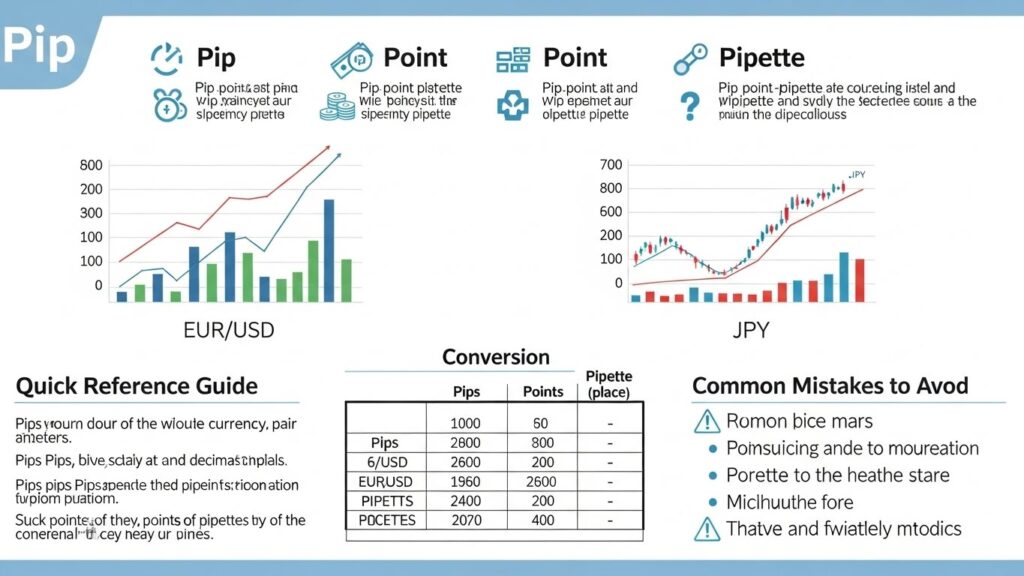
definitions of pip/point/pipette, visual examples for standard and JPY pairs, conversion table, common mistakes to avoid, and quick reference guide. Designed as a printable/saveable reference sheet.

Related Resources

.