Calculating pips correctly is fundamental to forex trading success. Whether you’re determining profit and loss, setting stop losses, or sizing positions, accurate pip calculations ensure you understand exactly what each price movement means for your trading account. This comprehensive guide explains how to calculate pips across different currency pair types with practical examples you can apply immediately.
The first step in calculating pips is knowing where to count them based on currency pair type. Most currency pairs quote to four decimal places, while Japanese yen pairs quote to two decimal places.
Standard Currency Pairs (Four Decimal Places): For pairs like EUR/USD, GBP/USD, AUD/USD, and USD/CHF, one pip equals 0.0001—the fourth decimal place. If EUR/USD moves from 1.0850 to 1.0851, that’s a one-pip move. From 1.0850 to 1.0900 represents 50 pips.
When you see a price like 1.08503, the “3” represents a pipette (fractional pip), not a full pip. Many brokers display five decimal places for standard pairs, but the pip calculation focuses on the fourth decimal place.
Japanese Yen Pairs (Two Decimal Places): Pairs involving the Japanese yen—USD/JPY, EUR/JPY, GBP/JPY, and AUD/JPY—quote to two decimal places. One pip equals 0.01—the second decimal place. If USD/JPY moves from 149.50 to 149.51, that’s a one-pip move. From 149.50 to 150.00 represents 50 pips.
Three decimal place displays for yen pairs (like 149.503) show pipettes in the third position, but pip calculations use the second decimal place.
Wait—negative 70 pips seems like a loss, but this is a short position
For short positions, your profit comes from price declining. Recalculate: (Entry – Exit) / Pip Size = (1.2650 – 1.2580) / 0.0001 = 70-pip profit.
Shortcut for Short Positions: For short positions, reverse the formula: (Opening Price – Closing Price) / Pip Size
Calculating Pips for Standard Pairs
Standard currency pairs—those not involving the Japanese yen—follow consistent pip calculation rules using the fourth decimal place.
EUR/USD Example: EUR/USD quotes at 1.0850 (entry) and moves to 1.0895 (exit).
Difference: 1.0895 – 1.0850 = 0.0045
Pip Calculation: 0.0045 / 0.0001 = 45 pips
Alternative Method (Faster): Simply count the movement in the fourth decimal place:
1.0850 to 1.0895
From 50 to 95 = 45 pips
This mental math approach works when you recognize that each 0.0001 movement equals one pip. The fourth decimal place moving from 50 to 95 means 45 pips of movement.
GBP/USD Example: GBP/USD at 1.2700 moves to 1.2755.
Fourth decimal place: 00 to 55 = 55 pips
AUD/USD Example: AUD/USD at 0.6580 moves to 0.6520.
Fourth decimal place: 80 to 20 (downward movement)
Calculation: 80 – 20 = 60 pips downward
For a short position: 60-pip profit
For a long position: 60-pip loss
USD/CHF Example: USD/CHF at 0.8950 moves to 0.9015.
Fourth decimal place: 50 to 15 (crosses 0.9000)
From 50 to 00 = 50 pips
From 00 to 15 = 15 pips
Total: 65 pips
When price crosses a round number (like from 0.89XX to 0.90XX), break the calculation into segments or use the subtraction formula: 0.9015 – 0.8950 = 0.0065 / 0.0001 = 65 pips.
Calculating Pips for Japanese Yen Pairs
Yen pairs use the second decimal place for to calculate pips, which can confuse traders accustomed to standard pairs.
USD/JPY Example: USD/JPY at 149.50 moves to 150.00.
Difference: 150.00 – 149.50 = 0.50
Pip Calculation: 0.50 / 0.01 = 50 pips
Mental Math for Yen Pairs: Count movement in the second decimal place:
149.50 to 150.00
From .50 to .00 (but crossing 150)
149.50 to 150.00 = 50 pips
EUR/JPY Example: EUR/JPY at 162.25 moves to 163.50.
Difference: 163.50 – 162.25 = 1.25
Pip Calculation: 1.25 / 0.01 = 125 pips
GBP/JPY Example: GBP/JPY at 188.75 moves to 187.20.
Notice that yen pairs often generate larger pip numbers for equivalent price movements compared to standard pairs. A 1.00 move in USD/JPY (from 149.00 to 150.00) equals 100 pips, while a 0.0100 move in EUR/USD (from 1.0900 to 1.1000) equals 100 pips—but the yen move is numerically larger in absolute terms.
Calculating Pips for Exotic Pairs
Exotic pairs—those involving emerging market currencies—may quote to varying decimal places. Always verify decimal place conventions for less common pairs.
USD/TRY (Turkish Lira): USD/TRY typically quotes to four decimal places despite involving a non-major currency.
Some exotic pairs may use different pip conventions. Always verify with your broker how specific exotic pairs calculate pips, particularly for currencies like the Hungarian forint (HUF) or Japanese yen crosses with emerging markets.
The National Futures Association requires member firms to provide clear pricing information including pip calculations for all currency pairs offered.
Calculating Pips Across Price Levels
Pip calculations remain consistent regardless of whether price moves within a level or crosses significant numbers.
Movement Within Same Level: EUR/USD from 1.0850 to 1.0895 (both in 1.08XX range)
Simple subtraction: 95 – 50 = 45 pips
Movement Crossing Round Numbers: EUR/USD from 1.0975 to 1.1025 (crosses 1.1000)
Formula method: (1.1025 – 1.0975) / 0.0001 = 50 pips
Segment method: 1.0975 to 1.1000 = 25 pips, 1.1000 to 1.1025 = 25 pips, total 50 pips
For larger price movements, the formula method ensures accuracy by accounting for all crossed levels mathematically.
Common Pip Calculation Mistakes
Understanding what not to do helps avoid costly errors:
Mistake 1: Wrong Decimal Place Calculating GBP/USD pips using the third decimal instead of fourth.
Incorrect: 1.2650 to 1.2750 = “10 pips” (actually 100 pips)
Correct: Count fourth decimal movement = 100 pips
Mistake 2: Forgetting Yen Pair Differences Applying four-decimal logic to yen pairs.
Incorrect: USD/JPY 149.50 to 149.75 = “25 pips” (actually 25 pips is correct, but reasoning is wrong)
Correct: Use second decimal for yen pairs: 0.25 / 0.01 = 25 pips
Mistake 3: Short Position Sign Confusion Assuming negative pip calculations always mean losses.
For short positions, price declining generates profit
Always consider position direction when interpreting pip calculations
Mistake 4: Including Pipettes in Calculations Counting the fifth decimal (pipette) as a full pip.
Price: 1.08503 to 1.08556
Incorrect: 53 pips
Correct: Focus on fourth decimal: 1.0850 to 1.0855 = 5 pips (plus some pipettes)
Mistake 5: Assuming All Pairs Use Same Decimals Applying standard pair logic to all currencies.
Always verify decimal conventions for exotic and less common pairs
When in doubt, check your broker’s contract specifications
Practical Applications of Pip Calculations
Accurate pip calculations enable several critical trading functions:
Setting Stop Losses: If your risk management allows 50 pips of risk per trade, calculating exactly where to place your stop requires knowing how to count pips. For EUR/USD at 1.0900, a 50-pip stop loss for a long position sits at 1.0850 (1.0900 – 0.0050).
Determining Profit Targets: Targeting 100-pip profits from EUR/USD entry at 1.0850 means your target sits at 1.0950 (1.0850 + 0.0100) for a long position.
Calculating Risk-Reward Ratios: With entry at 1.0900, stop at 1.0850 (50 pips risk), and target at 1.1000 (100 pips profit), your risk-reward ratio is 1:2—risking 50 pips to make 100 pips.
Position Sizing: Knowing you’ll risk 50 pips with a $500 maximum loss means you need pip value of $10 per pip ($500 / 50 pips). This calculation requires accurate pip counting as the foundation.
Trade Analysis: Recording that your EUR/USD trade gained 75 pips allows performance tracking across different currency pairs. You can compare a 75-pip EUR/USD gain to a 150-pip USD/JPY gain by converting both to dollar values using pip values.
Using Trading Platforms for Pip Calculations
Most modern trading platforms automatically calculate pips for open positions:
MetaTrader 4/5: The “Profit” column shows current pip profit or loss for open positions. The “Trade” tab displays entry price, current price, and pip difference automatically.
cTrader: Displays pip profit/loss in real-time for all positions. The position summary shows both pip movement and dollar value.
Proprietary Broker Platforms: Most broker platforms calculate pips automatically, though presentation varies. Familiarize yourself with where your platform displays pip calculations.
Despite automation, understanding manual pip calculation remains critical. Platform errors occur, and verifying pip counts manually ensures accuracy. Additionally, manual skills allow calculation before entry—determining exact stop and target distances in pips before position execution.
Advanced Pip Calculation Scenarios
Experienced traders encounter more complex pip calculation situations:
Partial Position Closes: If you enter EUR/USD at 1.0850 with 2 lots and close 1 lot at 1.0900, calculate pips for the closed portion:
Closed: 1.0850 to 1.0900 = 50 pips on 1 lot
Remaining: 1 lot still open from 1.0850
Track both closed pip profits and remaining open position pips separately for accurate accounting.
Multiple Entries (Averaging): First entry: EUR/USD at 1.0850 Second entry: EUR/USD at 1.0900 Average entry: (1.0850 + 1.0900) / 2 = 1.0875
If both positions close at 1.0950:
From average entry 1.0875: (1.0950 – 1.0875) / 0.0001 = 75 pips
Alternatively, calculate each entry separately and sum pip results.
Rollover/Swap Adjustments: Some platforms show pip profit/loss separately from rollover interest. Ensure you understand whether displayed pips include or exclude financing charges. Generally, pip calculations refer purely to price movement, with financing shown separately.
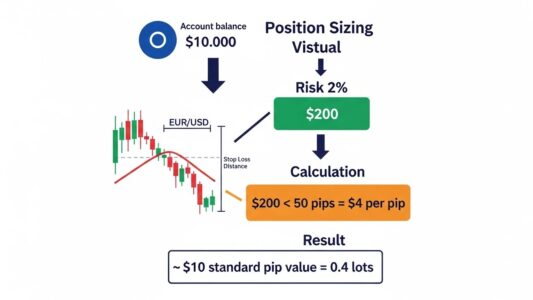
Percent Risk Position Sizing: Account size: $10,000 Risk per trade: 2% = $200 Planned stop loss: 50 pips Required pip value: $200 / 50 pips = $4 per pip
For EUR/USD where standard lot = $10/pip, you need 0.4 lots (40,000 units). Calculating the 50-pip stop loss accurately ensures this position sizing works correctly.
Trailing Stop Pip Distances: If using a 30-pip trailing stop on USD/JPY, calculating exactly where it sits requires knowing that from 150.00, your stop trails at 149.70 (30 pips below). As price rises to 150.50, the stop moves to 150.20.
Break-Even Pip Calculations: After EUR/USD moves 40 pips in your favor from 1.0900 to 1.0940, calculating break-even means moving your stop from initial placement (perhaps 1.0850) to entry at 1.0900. This requires knowing the exact pip distance between levels.
Conclusion
Mastering pip calculations transforms abstract price movements into concrete measures of profit, loss, and risk. Whether calculating pips for standard EUR/USD trades, adjusting for yen pair decimal differences, or determining stops and targets, accurate pip math underpins all trading decisions.
Practice pip calculations until they become automatic. Start with simple examples using major pairs, then progress to yen crosses and exotic currencies. Verify your platform’s automatic calculations manually until confidence builds. The few seconds spent confirming pip counts prevents costly errors in position sizing, risk management, and trade execution.
Remember that pip calculations represent the foundation for translating your trading strategy into specific entry, stop, and target levels. Combined with pip value calculations (converting pips to dollars), pip math gives you complete control over position sizing and risk management. As you develop your trading skills, these fundamental calculations become second nature, allowing focus on market analysis and strategy execution rather than basic math.