Learn How to Make Fast Money by Learning diffrent Strategies in Forex Trading and Different Investment Options
How to Calculate Position Size in Forex
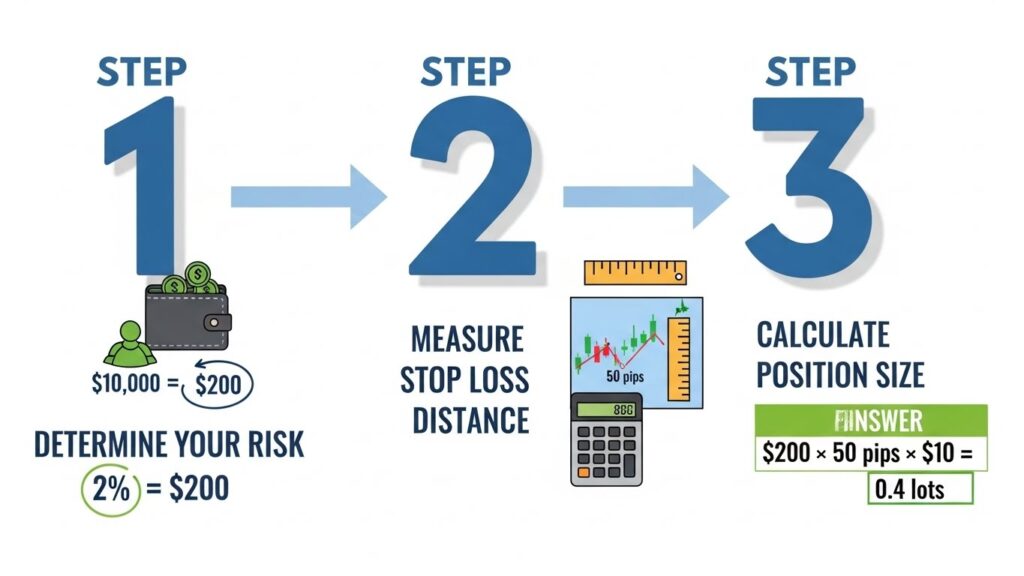
Position sizing is the process of determining how many lots (units of currency) to trade based on your account balance, risk tolerance, and stop loss distance. Proper position sizing ensures you risk the same percentage of your account on every trade regardless of how wide or tight your stop loss is, which is the cornerstone of sustainable risk management.
Most traders focus on finding good entry points and forget that how much they trade matters just as much as when they trade. You can have the best trading strategy in the world, but if your position sizes are too large, a normal losing streak will destroy your account. Conversely, if your positions are too small, even a great win rate won’t generate meaningful profits.
How to Calculate Position Size in Forex? Professional traders use a systematic position sizing formula that adjusts their trade size based on their stop loss distance. A trade with a 30-pip stop requires a different position size than a trade with a 100-pip stop if you want to risk the same dollar amount on both. This dynamic adjustment—rather than always trading the same lot size—is what separates professionals from amateurs.
This comprehensive guide explains the position sizing formula, walks through detailed calculations for different scenarios, shows how to adjust for various account sizes and currencies, and provides strategies for optimal position sizing across different trading styles.
How to Calculate Position Size in Forex?Position Sizing Matters
Before diving into calculations, understand why position sizing is critical to trading success.
Ensures Consistent Risk
Without proper position sizing, your risk per trade varies wildly. You might risk $50 on one trade and $500 on the next, creating unpredictable swings in your account balance.
Example Without Position Sizing:
Trade 1: 1 standard lot, 30-pip stop = $300 risk
Trade 2: 1 standard lot, 100-pip stop = $1,000 risk
Same lot size, but 3.3× more risk on trade 2
Example With Position Sizing:
Trade 1: 0.33 standard lots, 30-pip stop = $100 risk
Trade 2: 0.10 standard lots, 100-pip stop = $100 risk
Different lot sizes, but consistent $100 risk
Consistent risk means you can predict your maximum drawdown, understand your exposure, and maintain psychological equilibrium regardless of which trades you take.
Prevents Account Destruction
Overleveraging—trading position sizes too large for your account—is the number one cause of account blow-ups. Even winning strategies fail when position sizes exceed what your account can sustain through normal losing streaks.
Overleveraged Example:
Account: $5,000
Position: 2 standard lots ($20 per pip)
Stop: 50 pips
Risk: $1,000 = 20% of account
Five losing trades = Account destroyed
Properly Sized Example:
Account: $5,000
Risk: 2% = $100
Stop: 50 pips
Position: 0.1 standard lots ($10 per pip × 0.1 = $1 per pip)
Actual risk: $1 × 50 pips = $50 (1% of account)
Can survive 50+ consecutive losses
The Commodity Futures Trading Commission requires forex dealers to provide risk disclosures emphasizing that proper position sizing relative to account size is essential for retail trader success.
Optimizes Capital Efficiency
Correct position sizing ensures you’re neither underleveraged (missing profit opportunities) nor overleveraged (facing excessive risk). Your capital works optimally when each trade risks an appropriate percentage.
Enables Strategy Testing
You can’t accurately backtest or forward test a strategy without consistent position sizing. Historical performance with random lot sizes tells you nothing useful. Only with systematic position sizing can you evaluate whether a strategy actually works.
The standard position sizing formula in our How to Calculate Position Size in Forex guide shows the following formula: calculates how many lots to trade based on your risk parameters.
The Formula:
Position Size (in lots) = (Account Balance × Risk %) ÷ (Stop Loss in Pips × Pip Value)
Let’s break down each component:
Account Balance: Your current account equity in dollars (or your account currency)
Risk %: The percentage of your account you’re willing to risk on this trade (typically 1-2%)
Stop Loss in Pips: The distance in pips from your entry to your stop loss
Pip Value: The dollar value of one pip for one standard lot in the currency pair you’re trading
Position Size = $94.88 ÷ (40 × $10) = $94.88 ÷ $400 = 0.237 standard lots (round to 0.24)
JPY Account Trading Any Pair
For JPY accounts, convert your risk to the counter currency of your trading pair, calculate position size, then verify the pip value makes sense for your JPY account.
This gets complex—most brokers handle the conversion automatically in their position size calculators.
Quick Position Sizing Shortcuts
For faster calculations during trading, use these mental shortcuts once you understand the underlying math.
The “Risk Per Pip” Method
Calculate how much you want to risk per pip, then find the lot size that matches.
Steps:
Dollar risk ÷ Stop distance in pips = Required risk per pip
Find lot size that produces this pip value
Example:
Risk: $100
Stop: 50 pips
Required risk per pip: $100 ÷ 50 = $2 per pip
For EUR/USD: $2 per pip = 0.2 standard lots (2 mini lots)
The “Percentage of Account Balance” Quick Check
Your position’s notional value should generally not exceed 10-20× your account balance with proper position sizing.
Example:
Account: $10,000
Maximum notional: $100,000-$200,000
1 standard lot EUR/USD at 1.0850 = $108,500 notional
This is within acceptable range for a $10,000 account with 1% risk
If your notional value exceeds 50× your account balance, you’re likely overleveraged.
The “Standard Lot Equivalent” Method
Calculate position size in standard lot equivalents, then convert to mini/micro lots.
Example:
Calculated size: 0.35 standard lots
Convert: 3.5 mini lots or 35 micro lots
Trade whichever your broker offers
Position Sizing by Trading Style
Different trading approaches require adjusted position sizing considerations.
Scalping (Short-Term, Small Stops)
Scalpers use very tight stops (5-15 pips) and frequent trades.
Position Sizing Approach:
Use standard risk percentage (1-2%)
Tight stops naturally result in larger position sizes
Be cautious of transaction costs consuming profits
Example:
Account: $5,000
Risk: 1% = $50
Stop: 10 pips
Position: $50 ÷ (10 × $10) = 0.5 standard lots
Note: 0.5 standard lots on a $5,000 account is aggressive but acceptable with 10-pip stops due to the small dollar risk.
Day Trading (Intraday, Moderate Stops)
Day traders hold positions for minutes to hours with 20-50 pip stops.
Position Sizing Approach:
Standard 1-2% risk per trade
Multiple positions possible throughout day
Account for cumulative daily risk across all trades
Example:
Account: $10,000
Risk per trade: 1.5% = $150
Stop: 30 pips
Position: $150 ÷ (30 × $10) = 0.5 standard lots
Swing Trading (Multi-Day, Wider Stops)
Swing traders hold days to weeks with 50-150 pip stops.
Position Sizing Approach:
Conservative 1-2% risk per trade
May hold multiple positions simultaneously
Calculate total portfolio risk across all open positions
Example:
Account: $25,000
Risk per trade: 1% = $250
Stop: 100 pips
Position: $250 ÷ (100 × $10) = 0.25 standard lots
Position Trading (Long-Term, Very Wide Stops)
Position traders hold weeks to months with 150-500+ pip stops.
Position Sizing Approach:
Very conservative 0.5-1% risk per trade
Very wide stops require smaller lot sizes
Focus on long-term gains with minimal risk
Example:
Account: $50,000
Risk per trade: 0.75% = $375
Stop: 300 pips
Position: $375 ÷ (300 × $10) = 0.125 standard lots
How Leverage Affects Position Sizing
Leverage allows you to control larger positions with less margin, but it doesn’t change your position sizing calculations.
Understanding the Relationship
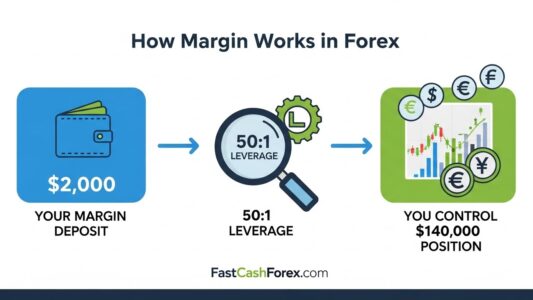
Many traders confuse leverage with position sizing. Leverage determines your margin requirement, while position sizing determines your risk.
Example: Trading 1 Standard Lot EUR/USD (€100,000 or ~$108,500)
With 1:50 Leverage:
Required margin: $108,500 ÷ 50 = $2,170
Risk with 50-pip stop: $500
Risk remains $500 regardless of leverage
With 1:500 Leverage:
Required margin: $108,500 ÷ 500 = $217
Risk with 50-pip stop: $500
Risk remains $500 regardless of leverage
Higher leverage reduces margin requirements but doesn’t reduce risk. Your position sizing formula accounts for risk directly, making leverage selection less critical than most believe.
High leverage enables position sizes that can destroy accounts:
$1,000 Account with 1:500 Leverage:
Maximum position: 5 standard lots (500,000 units)
Pip value: $50 per pip
20-pip adverse move = $1,000 loss = Account destroyed
Proper position sizing protects you from overleveraging. Calculate position size based on risk percentage and stop distance—ignore maximum leverage available.
The National Futures Association emphasizes that proper position sizing based on account risk tolerance, not maximum leverage, is critical for long-term success.
Advanced Position Sizing Techniques
Experienced traders employ sophisticated position sizing approaches.
Volatility-Adjusted Position Sizing
Adjust position sizes based on market volatility, taking larger positions during calm periods and smaller positions during volatile periods.
Method:
Calculate Average True Range (ATR)
When ATR is low (calm markets): Use standard position size or slightly larger
When ATR is high (volatile markets): Reduce position size by 25-50%
Example:
Normal ATR: 40 pips → Standard position size (0.5 lots)
High ATR: 80 pips → Reduced size (0.25 lots)
Maintains similar dollar risk despite changing volatility
Fixed Fractional Position Sizing
Rather than risking a fixed percentage per trade, risk a fixed fraction and adjust based on recent performance.
Method:
Start with 2% risk
After winning trades: Increase to 2.5%
After losing trades: Decrease to 1.5%
Automatically adjust risk based on recent success
Kelly Criterion Position Sizing
Advanced mathematical approach calculating optimal position size based on your win rate and risk-reward ratio.
This suggests risking 50% per trade, which is far too aggressive. Most traders use “Half Kelly” (25%) or “Quarter Kelly” (12.5%) for more conservative approaches.
Portfolio-Based Position Sizing
When trading multiple pairs simultaneously, consider correlation and total portfolio exposure.
Calculated position: 0.37 lots, but you round up to 0.50 lots “to make it even.”
Why It’s Wrong:
You’re now risking 35% more than planned
Multiple trades with aggressive rounding creates overleveraging
Solution: Always round down or trade exact calculated amounts if your broker allows fractional lots.
Mistake 4: Not Adjusting for Account Changes
Continuing to use old position sizes as your account grows or shrinks.
Example:
Started with $10,000, calculated position sizes for 2% risk
Account grows to $15,000
Still using old position sizes = now risking only 1.33%
Missing profit opportunities through under-leverage
Solution: Recalculate position sizes weekly or monthly based on current account balance.
Mistake 5: Overleveraging After Wins
After winning trades, dramatically increasing position sizes to “maximize momentum.”
Example:
Normal position: 0.2 lots
After 3 winning trades: Increase to 1.0 lots
One losing trade gives back all profits
Solution: Maintain consistent risk percentage. Let position sizes grow naturally as account balance increases, not based on recent performance.
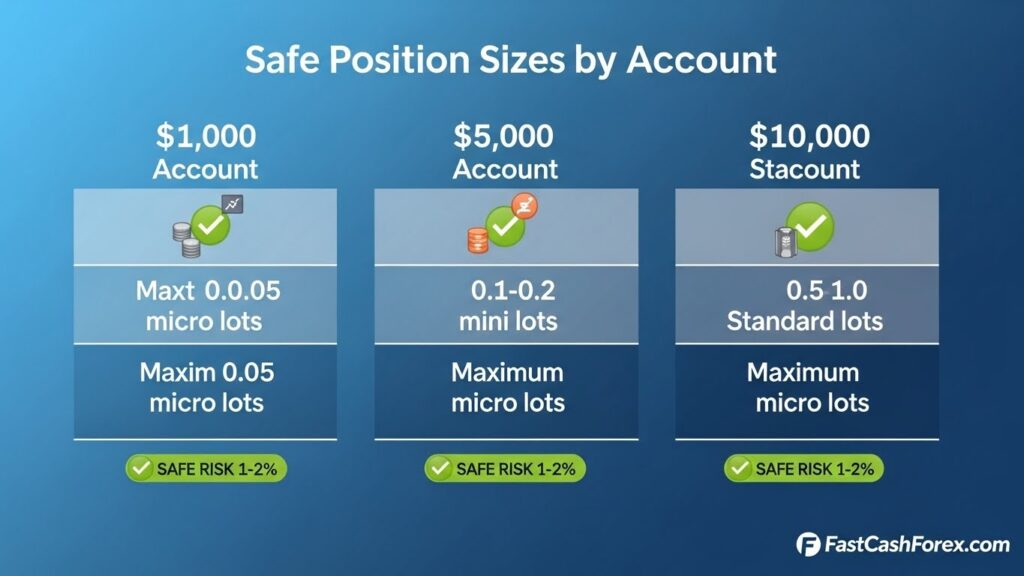
Position Sizing for Different Account Sizes
Optimal approaches vary by account size.
Micro Accounts ($100-$500)
Challenges:
Very limited position sizes
Transaction costs significant relative to account
Must use micro lots exclusively
Approach:
Risk 2% per trade ($2-$10)
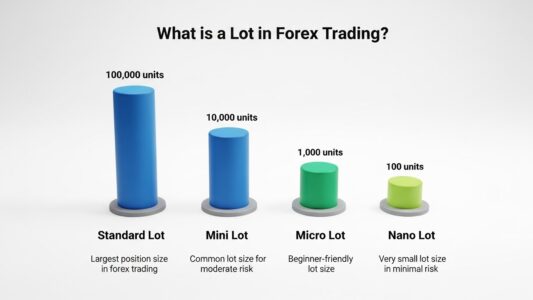
Use micro lots only (1,000 units)
Wider stops require fractional micro lots
Focus on learning, not income
Example:
Account: $500
Risk: 2% = $10
Stop: 50 pips
Position: $10 ÷ (50 × $0.10) = 2 micro lots
Small Accounts ($500-$2,000)
Challenges:
Limited to micro and mini lots
Must balance learning with growth
Approach:
Risk 1.5-2% per trade ($7.50-$40)
Primarily mini lots with micro lots for fine-tuning
Add capital regularly from outside income
Example:
Account: $1,500
Risk: 2% = $30
Stop: 30 pips
Position: $30 ÷ (30 × $1) = 1 mini lot
Medium Accounts ($2,000-$10,000)
Approach:
Risk 1-2% per trade ($20-$200)
Use mini lots and begin incorporating standard lots
Multiple positions possible
Example:
Account: $5,000
Risk: 2% = $100
Stop: 50 pips
Position: $100 ÷ (50 × $10) = 0.2 standard lots (2 mini lots)
Large Accounts ($10,000+)
Approach:
Risk 0.5-1.5% per trade (more conservative as amounts grow)
Primarily standard lots
Multiple strategies and pairs
Example:
Account: $25,000
Risk: 1% = $250
Stop: 40 pips
Position: $250 ÷ (40 × $10) = 0.625 standard lots
The Financial Conduct Authority notes that position sizing relative to account size is among the most critical factors determining trader success or failure.
Position Sizing Calculators and Tools
Most platforms provide calculators, but understanding the math ensures accurate results.
Built-In Platform Calculators
MetaTrader 4/5:
Built-in position size calculator in “New Order” window
Enter risk amount, stop distance, automatically calculates lots
cTrader:
Position size calculator in order panel
Shows risk amount in real-time as you adjust lot size
TradingView:
Shows position size recommendations based on risk percentage
Use this checklist for every trade to ensure proper position sizing:
☐ Determine dollar risk (Account balance × Risk %)
☐ Measure stop loss distance in pips
☐ Identify pip value for the pair and standard lot
☐ Calculate position size using formula
☐ Verify: Position size × Pip value × Stop distance = Dollar risk
☐ Round to available lot increments (round down if needed)
☐ Double-check margin requirements are met
☐ Confirm total portfolio risk remains acceptable
☐ Place order with calculated position size
☐ Document position size in trading journal.
Following this checklist prevents position sizing errors that create unintended risk.
Conclusion
Proper position sizing is the foundation of effective risk management in forex trading. The position sizing formula—(Account Balance × Risk %) ÷ (Stop Loss Pips × Pip Value)—ensures you risk a consistent percentage on every trade regardless of stop loss width or currency pair traded.
Calculate your position size fresh for each trade based on your specific stop loss distance. A 30-pip stop requires a different position size than a 100-pip stop if you want to maintain consistent 1-2% risk. This dynamic adjustment protects you from both overleveraging (positions too large) and underleveraging (positions too small).
Professional traders consistently risk 1-2% per trade using systematic position sizing. This discipline allows them to survive inevitable losing streaks while participating fully in winning periods. Even a 50% win rate becomes profitable when combined with appropriate risk-reward ratios and consistent position sizing.
Start by mastering the basic formula, then progress to adjustments for different account currencies, trading styles, and market conditions. Practice your calculations on a demo account until they become second nature. Proper position sizing transforms trading from gambling into a systematic business with quantifiable and manageable risk.
Remember that no trading strategy, no matter how good, can overcome improper position sizing. You can find the best entries in the world, but if your position sizes are too large, normal market volatility will destroy your account. Master position sizing, and you’ve conquered one of the three pillars of trading success alongside strategy and psychology.