Learn How to Make Fast Money by Learning diffrent Strategies in Forex Trading and Different Investment Options
Margin Trading in Forex: Complete Beginner’s Guide
What is Margin Trading?
Margin Trading is the foundation of forex trading, allowing you to control large positions with relatively small capital. When combined with understanding leverage, margin becomes a powerful tool that can amplify both profits and losses. This comprehensive guide explains everything you need to know about margin trading in forex.
What is Margin in Forex Trading
Margin is the amount of money required in your trading account to open and maintain a leveraged position. Think of margin as a good faith deposit or collateral that your broker holds while you have open trades.
Unlike a loan payment, margin is not a fee or transaction cost. It is simply a portion of your account equity set aside and allocated as margin deposit. When you close your position, the margin is released back to your account and becomes available for new trades.
While margin and leverage are related concepts, they represent different sides of the same coin:
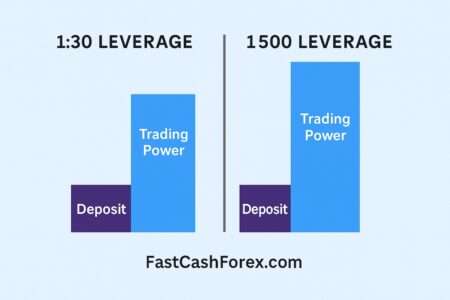
Leverage is the ratio that determines how much market exposure you can gain. If your broker offers 50:1 leverage, you can control $50,000 in currency with $1,000 in margin.
Margin is the actual deposit required to maintain that leveraged position. With 50:1 leverage, your margin requirement is 2% of the position size.
The relationship is simple: Margin requirement percentage = 1 / Leverage ratio
For 50:1 leverage: 1 / 50 = 0.02 or 2% margin requirement For 100:1 leverage: 1 / 100 = 0.01 or 1% margin requirement For 30:1 leverage: 1 / 30 = 0.0333 or 3.33% margin requirement
Types of Margin in Forex
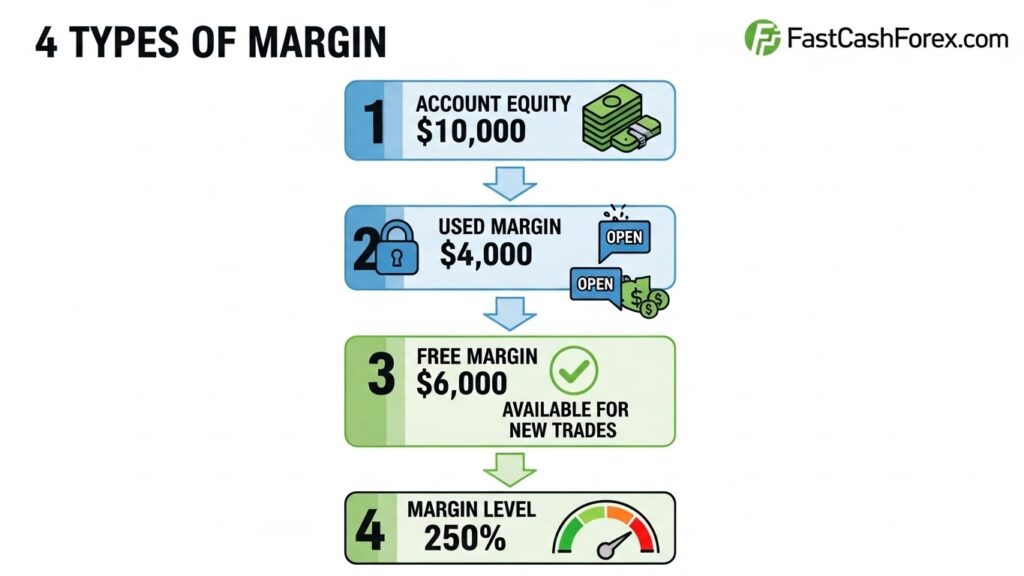
Understanding the different types of margin trading is crucial for managing your trading account effectively.
Required Margin
Required margin (also called initial margin) is the amount needed to open a new position. This is calculated based on the position size and your broker’s margin requirement.
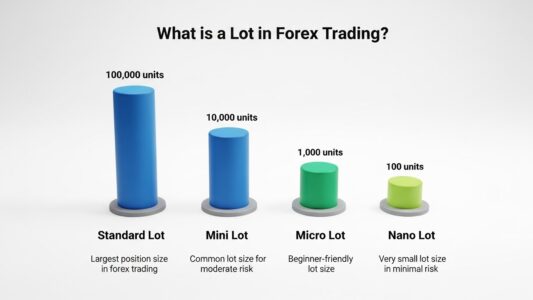
If you want to buy one standard lot of EUR/USD (100,000 units) with 2% margin requirement, your required margin is $2,000.
Used Margin
Used margin is the total amount of margin currently tied up in all your open positions. If you have three open trades requiring $2,000, $1,500, and $1,000 respectively, your used margin is $4,500.
Free Margin
Free margin is the amount available in your account to open new positions. It is calculated as:
Free Margin = Equity – Used Margin
If your account equity is $10,000 and you have $4,500 in used margin, your free margin is $5,500. This is the amount available for opening additional trades.
Margin Level
Margin level is expressed as a percentage and shows the health of your trading account:
Margin Level = (Equity / Used Margin) × 100
A margin level of 200% means your equity is twice your used margin, indicating a healthy account. As positions move against you and equity decreases, your margin level falls.
How Margin Trading Requirements Work
Margin requirements vary based on several factors that traders must understand to calculate position size correctly.
Standard Margin Trading Requirements
Most forex brokers offer margin requirements between 1% and 5% for major currency pairs:
Major Pairs (EUR/USD, GBP/USD, USD/JPY): Typically 1-2% margin (50:1 to 100:1 leverage)
Minor Pairs (EUR/GBP, AUD/NZD, EUR/CHF): Typically 2-3% margin (33:1 to 50:1 leverage)
Exotic Pairs (USD/TRY, EUR/ZAR, USD/MXN): Typically 5-10% margin (10:1 to 20:1 leverage)
The higher margin requirements for exotic pairs reflect their increased volatility and risk.
Weekend and Holiday Margin
Many brokers increase margin requirements before weekends and major holidays when markets are closed and gap risk is higher. Your broker might increase margin requirements from 2% to 5% on Friday afternoon, meaning you can only maintain positions worth 20 times your margin instead of 50 times.
Margin for Different Account Types
Margin requirements often depend on account type and regulatory jurisdiction:
Retail accounts in the United States face maximum leverage of 50:1 for major pairs (2% margin) and 20:1 for minor pairs (5% margin) under CFTC regulations.
Professional accounts in Europe may access higher leverage after meeting specific criteria and acknowledging additional risk.
Islamic accounts have the same margin requirements but are structured to comply with Sharia law regarding overnight interest.
Calculating Margin Requirements
Learning to calculate margin requirements helps you plan trades and manage risk effectively. The calculation depends on which currency is your account base currency.
Basic Margin Calculation
For a standard lot (100,000 units) with 2% margin requirement:
Required Margin = Position Size × Margin Requirement Percentage
Required Margin = 100,000 × 0.02 = $2,000
For a mini lot (10,000 units) with the same 2% requirement:
When your account currency differs from the base currency of the pair you are trading, an additional conversion step is required.
Example 1: USD account trading EUR/USD
Position: 1 standard lot (100,000 EUR) Margin requirement: 2% EUR/USD rate: 1.1000
Required Margin in EUR = 100,000 × 0.02 = 2,000 EUR Convert to USD: 2,000 × 1.1000 = $2,200
Example 2: USD account trading GBP/JPY
Position: 1 standard lot (100,000 GBP) Margin requirement: 3% GBP/USD rate: 1.3000
Required Margin in GBP = 100,000 × 0.03 = 3,000 GBP Convert to USD: 3,000 × 1.3000 = $3,900
Most trading platforms calculate these conversions automatically, but understanding the process helps you verify the numbers and plan your trades.
Margin and Profit/Loss
Your margin requirement stays constant while your equity fluctuates with profit and loss. Understanding this relationship is critical for risk management.
How Floating P/L Affects Margin
When you open a position, the required margin is deducted from your available balance. As the trade moves in your favor or against you, your equity changes but the margin requirement stays the same.
Scenario: You have $10,000 account balance, open a trade requiring $2,000 margin:
Used Margin: $2,000 (stays constant)
Free Margin: $8,000 (at trade entry)
If the trade gains $500 in unrealized profit:
Equity: $10,500
Used Margin: $2,000 (unchanged)
Free Margin: $8,500
If the trade loses $500:
Equity: $9,500
Used Margin: $2,000 (unchanged)
Free Margin: $7,500
The margin requirement does not change, but your ability to open new positions decreases as losses accumulate. Learning to calculate pips helps you track these profit and loss movements.
Multiple Positions and Margin
When trading multiple positions simultaneously, each trade requires its own margin deposit. Your total used margin is the sum of all individual margin requirements.
If your account equity is $12,000, your free margin is $7,000, available for additional trades or to absorb losses on existing positions.
Margin Call Explained
A margin call is a critical alert that occurs when your account equity falls too low to support your open positions. Understanding margin calls and how to avoid them is essential for every trader.
When Margin Calls Occur
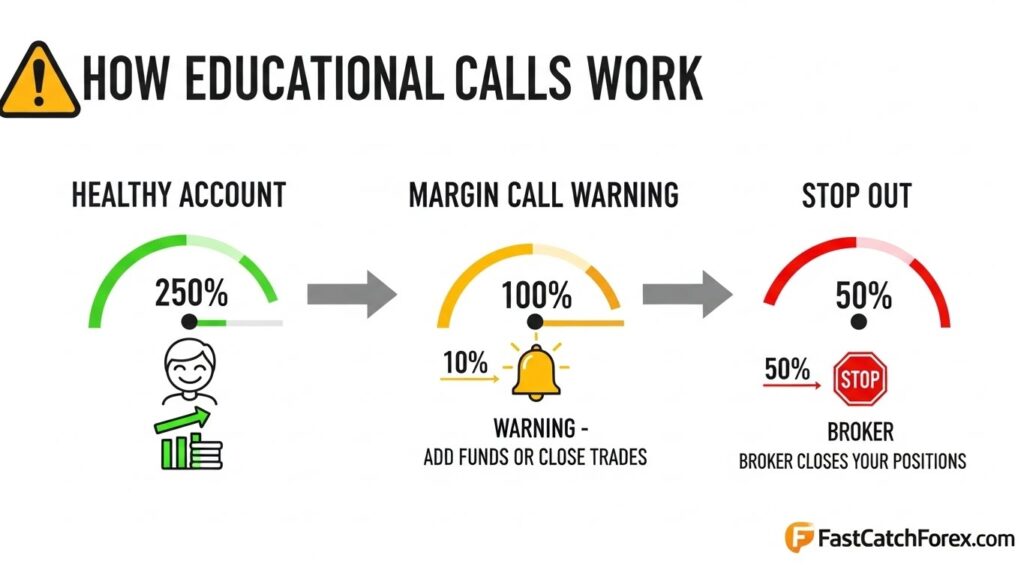
Brokers set specific margin level thresholds that trigger warnings and automatic actions. Common thresholds include:
Margin Call Warning: Triggered at 100-120% margin level. This is a warning that your account is approaching dangerous territory. You receive a notification but positions remain open.
Stop Out Level: Triggered at 50-100% margin level. At this point, the broker begins automatically closing your positions, starting with the largest losing trade, until your margin level rises above the stop out threshold.
Starting account: $10,000 Open position: 2 standard lots EUR/USD Required margin: $4,000 (assuming 2% margin) Margin level at entry: ($10,000 / $4,000) × 100 = 250%
As EUR/USD moves against you:
Loss of $2,000:
Equity: $8,000
Margin Level: ($8,000 / $4,000) × 100 = 200%
Status: Still healthy
Loss of $4,000:
Equity: $6,000
Margin Level: ($6,000 / $4,000) × 100 = 150%
Status: Getting concerning
Loss of $5,500:
Equity: $4,500
Margin Level: ($4,500 / $4,000) × 100 = 112.5%
Status: Margin call warning issued
Loss of $6,500:
Equity: $3,500
Margin Level: ($3,500 / $4,000) × 100 = 87.5%
Status: Below stop out level, broker begins closing positions
How to Respond to Margin Calls
If you receive a margin call warning, you have several options:
Deposit Additional Funds: Adding money to your account increases equity and margin level. This is the safest option if you believe your positions will recover.
Close Losing Positions: Manually closing one or more positions reduces your used margin and increases your margin level. Close the worst performers or positions you have least confidence in.
Reduce Position Sizes: If you have multiple positions, reducing the size of some trades decreases required margin without fully exiting.
Do Nothing: If you cannot or choose not to act, the broker will automatically close positions when you hit the stop out level. This is the worst option as you lose control over which trades are closed and at what prices.
Managing Margin Risk
Effective margin management protects your capital and ensures longevity in forex trading. These strategies help you avoid margin calls and trade sustainably.
Never Use Maximum Leverage
Just because your broker offers 100:1 leverage does not mean you should use it. Conservative traders typically use only a fraction of available leverage.
Recommended approach:
Small accounts ($1,000-$5,000): Use no more than 10:1 effective leverage Medium accounts ($5,000-$25,000): Use no more than 5:1 effective leverage Large accounts ($25,000+): Use no more than 3:1 effective leverage
This means if you have a $10,000 account, keep your total position sizes under $50,000 even if your broker allows $1,000,000 in positions.
Maintain Adequate Free Margin
Always keep significant free margin available to weather drawdowns. A good rule is to never let used margin exceed 30-40% of your account equity.
If you have $10,000 account equity, keep used margin under $3,000-$4,000. This provides a substantial buffer before margin calls become a concern.
Use Protective Stops
Every position should have a stop loss order that limits potential losses. Proper stop loss and take profit placement protects your margin by preventing any single trade from causing catastrophic damage.
Calculate your stop loss distance before entering trades and ensure the potential loss fits within your risk management rules.
Monitor Margin Level Daily
Check your margin level at least once per day when holding positions. If your margin level falls below 200%, consider whether you need to reduce exposure or adjust positions.
Most trading platforms display margin level prominently on the account summary screen.
Margin Requirements by Account Size
Your starting capital determines what positions you can safely trade while maintaining proper margin management.
Small Accounts ($500-$2,000)
With limited capital, you must trade micro lots and maintain very conservative position sizing.
$1,000 account example:
Maximum used margin: $300 (30% of equity)
With 2% margin requirement: Maximum position size $15,000
This equals 0.15 standard lots or 15 micro lots
Trading one or two micro lots at a time allows for proper risk management without margin call danger.
Medium Accounts ($2,000-$10,000)
Medium accounts provide more flexibility while still requiring discipline.
$5,000 account example:
Maximum used margin: $1,500 (30% of equity)
With 2% margin requirement: Maximum position size $75,000
This equals 0.75 standard lots or 75 micro lots
You can comfortably trade mini lots (0.1 standard lots) while maintaining safety margins.
Large Accounts ($10,000+)
Larger accounts can trade standard lots while maintaining conservative leverage.
$20,000 account example:
Maximum used margin: $6,000 (30% of equity)
With 2% margin requirement: Maximum position size $300,000
This equals 3 standard lots
With proper risk management, you can run multiple positions in standard lot sizes without excessive margin pressure.
Regulatory Requirements
Forex margin requirements are regulated differently around the world to protect retail traders from excessive risk.
United States Regulations
The CFTC and NFA limit retail forex leverage to:
50:1 for major currency pairs (2% margin)
20:1 for minor pairs (5% margin)
These restrictions apply to all U.S. retail forex brokers. Professional and institutional accounts may have different rules.
Traders can apply for professional status to access higher leverage after meeting experience and capital requirements.
Other Jurisdictions
Australia (ASIC): 30:1 maximum leverage for retail clients Japan (FSA): 25:1 maximum leverage Switzerland (FINMA): No maximum leverage for retail clients Offshore brokers: Often offer 200:1 to 500:1 leverage (not recommended for retail traders)
Always verify your broker’s regulatory status and understand the protections afforded in your jurisdiction.
Best Practices for Margin Trading
Following these proven practices helps you use margin safely and effectively.
Risk a Fixed Percentage Per Trade
Never risk more than 1-2% of your account equity on any single trade. This rule protects you from margin calls even during losing streaks.
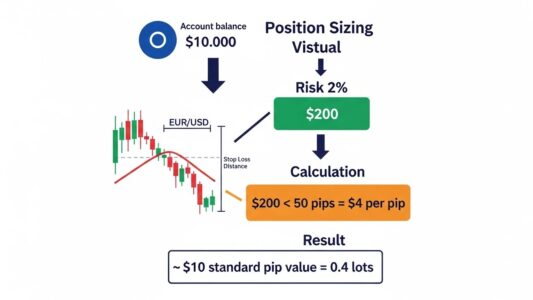
With a $10,000 account risking 2% per trade, your maximum loss per trade is $200. Combined with proper position sizing and stops, this prevents margin problems.
Complete forex risk management involves calculating position size based on stop loss distance and account risk tolerance.
Understand Currency Exposure
When trading multiple pairs, be aware of correlated positions that multiply your margin risk. Trading EUR/USD long and GBP/USD long simultaneously creates significant USD exposure.
If the dollar strengthens, both positions move against you simultaneously, potentially creating margin pressure faster than you expect.
Avoid Trading During High Impact News
Major economic announcements can cause rapid price movements that quickly erode margin. If you hold positions through high-impact news, ensure you have substantial free margin to weather volatility.
Many experienced traders close or reduce positions before major announcements like Non-Farm Payrolls or Central Bank decisions.
Keep Detailed Records
Maintain a record of your margin usage, margin level, and how close you come to margin calls. This data reveals patterns in your trading that may need adjustment.
If you frequently see your margin level drop below 200%, you are likely overtrading or using position sizes too large for your account.
Common Margin Mistakes
Avoid these frequent errors that lead to margin calls and account blowouts.
Overtrading the Account
The most common margin mistake is opening too many positions or using position sizes too large for the account. Just because you can open a trade does not mean you should.
If your platform allows you to open a 5-lot position with your $3,000 account, it is almost certainly too large for safe trading.
Ignoring Margin Requirements
Some traders fail to check margin requirements before trading, especially when switching between currency pairs. Exotic pairs often require significantly more margin than major pairs.
Always verify the margin requirement before opening any position.
Averaging Down Without Margin Buffer
Adding to losing positions without considering margin impact is dangerous. Each additional position requires more margin, and if the trade continues moving against you, a margin call becomes inevitable.
Never add to losing positions unless you have calculated the additional margin requirement and confirmed adequate free margin remains.
Trading Without Stops
Entering positions without stop loss orders exposes you to unlimited loss potential and margin call risk. A sudden market move can wipe out your account if positions lack stops.
Always use stop loss orders that limit losses to predefined levels.
The psychological aspects of margin trading significantly impact success rates. Understanding your emotional responses to margin pressure helps you trade more effectively.
Fear of Margin Calls
Fear of hitting a margin call can cause premature position closure, cutting winners short before they reach profit targets. While respecting margin is important, excessive fear leads to overreaction.
Proper position sizing and stop loss placement eliminate the need for fear-based decisions.
Overconfidence with High Leverage
The availability of high leverage creates false confidence, leading traders to believe they can quickly grow small accounts. This mindset encourages oversized positions and excessive risk.
Sustainable trading focuses on consistent small gains, not home run trades enabled by maximum leverage.
Revenge Trading After Margin Calls
Experiencing a margin call often triggers emotional responses, leading traders to immediately open new large positions trying to recover losses. This revenge trading typically results in additional margin calls and deeper losses.
After any margin call, step back, review what went wrong, and adjust your approach before resuming trading.
Developing strong trading psychology helps you maintain discipline during margin pressure.
Conclusion
Margin trading is a powerful tool that enables forex trading with modest capital, but it demands respect and proper management. Understanding margin requirements, calculations, and risk management strategies separates successful traders from those who blow out accounts.
The key to safe margin trading is conservative leverage use, maintaining adequate free margin, using protective stops on every trade, and never risking more than you can afford to lose. Treat margin as a tool to access markets efficiently, not as a way to gamble with excessive leverage.
Start with small position sizes, monitor your margin level daily, and gradually increase exposure only as your skills and account grow. With disciplined margin management, you can trade forex safely while protecting your capital for long-term success.