Learn How to Make Fast Money by Learning diffrent Strategies in Forex Trading and Different Investment Options
Candlestick Patterns in Forex: How to Read & Trade Them
Candlestick patterns are one of the most popular ways forex traders analyze price charts. These patterns show the battle between buyers and sellers and can signal potential reversals or continuations. Understanding these patterns is crucial for making informed trading decisions, especially for those new to the market. As part of the foundation of forex trading basics explained, traders learn to interpret these signals to identify optimal entry and exit points. By mastering candlestick patterns, traders can enhance their strategies and improve their chances of success in the dynamic forex market. In addition to recognizing candlestick patterns, understanding currency pairs is essential for effective trading. Each currency pair behaves differently based on economic indicators and geopolitical events, which can impact market movements. By combining candlestick analysis with a solid grasp of currency pairs, traders can make more strategic decisions and navigate the complexities of the forex market with greater confidence.
Candlestick patterns are a fundamental component of technical analysis forex trading, working alongside indicators, support/resistance levels, and trend analysis to create comprehensive trading strategies
A candlestick shows four values: open, high, low, and close. Patterns form when one or more candlesticks combine into recognizable shapes that traders interpret for signals. Traders often analyze these patterns to make informed decisions about buying and selling assets. Understanding the relationship between candlestick patterns and market movements can also lead to insights about concepts like what are pips in forex, which measure the smallest price movement in a currency pair. By combining candlestick analysis with knowledge of pips, traders can refine their strategies and improve their chances of success in the forex market. Additionally, mastering candlestick patterns can enhance a trader’s risk management strategies. By incorporating understanding leverage in forex into their analysis, traders can better grasp how to amplify their potential gains while mitigating risks. This comprehensive approach allows for a more nuanced trading experience, ultimately contributing to long-term success in the highly volatile forex market.
Why Use Candlestick Patterns in Forex?
Provide visual cues of market sentiment
Work across multiple timeframes
Easy to combine with support/resistance and indicators
Common Candlestick Patterns
1. Doji
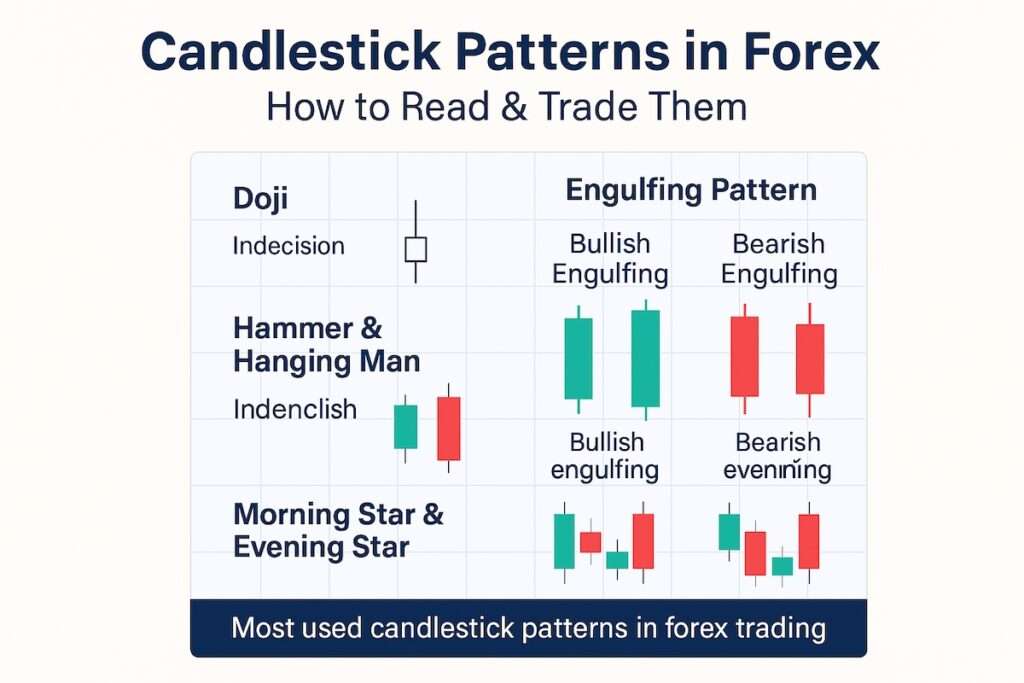
Shows indecision. Price opens and closes at nearly the same level. Can signal reversal when at key support/resistance.
2. Hammer & Hanging Man
Hammer (bullish reversal) appears after a downtrend with a small body and long lower wick. Hanging Man (bearish) is the opposite in an uptrend.
3. Engulfing Pattern
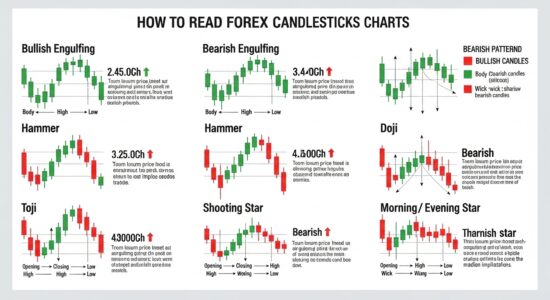
Bullish engulfing: a large green candle fully engulfs the prior red candle. Bearish engulfing: large red candle covers prior green candle.
4. Morning Star & Evening Star
3-candle patterns signaling reversals. Morning Star is bullish, Evening Star is bearish.
How to Trade Candlestick Patterns
Always confirm with trend or support/resistance.
Don’t rely on patterns alone—combine with risk management.
Set stop-loss below/above pattern structure.
Examples on Forex Charts
On EUR/USD daily chart, a bullish engulfing at support often marks reversal upward. On USD/JPY, evening stars at resistance may signal a top.