If you’ve spent any time looking at forex charts, you’ve probably seen those curved bands that wrap around price action like a channel. Those are Bollinger Bands, and they’re one of the most versatile indicators you can use in forex trading.
Created by John Bollinger in the 1980s, these bands do something simple but powerful: they show you when the market is quiet and when it’s about to explode with movement. More importantly, they help you spot potential entry and exit points based on how price interacts with volatility.
In this guide, I’ll walk you through everything you need to know about trading with Bollinger Bands, from basic concepts to advanced strategies that actually work in live markets.
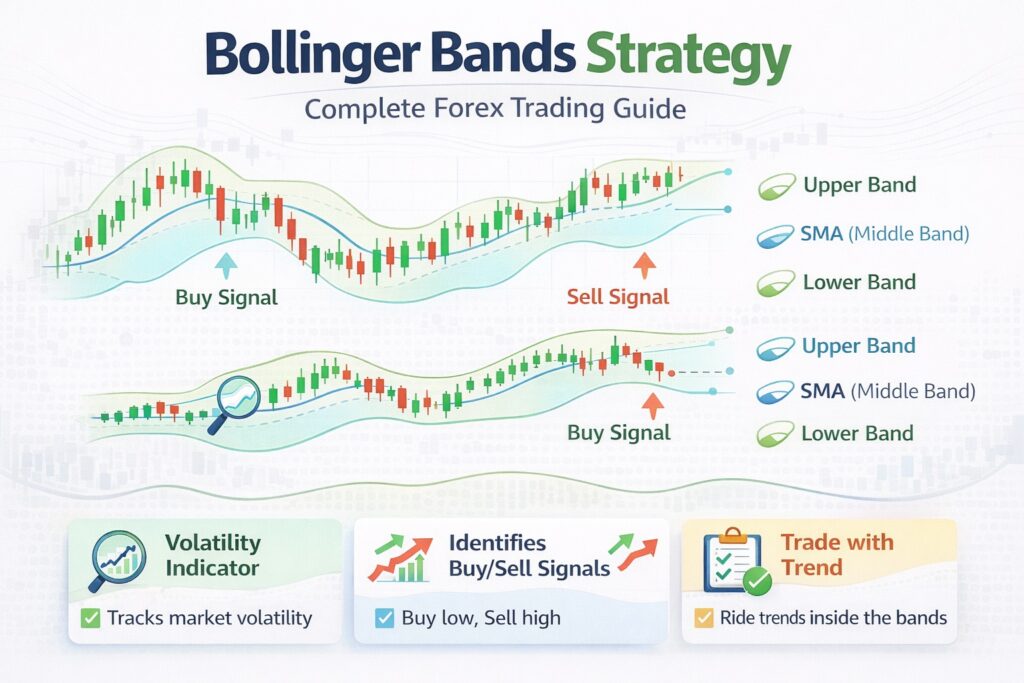
Bollinger Bands consist of three lines plotted on your price chart. Think of them as a dynamic channel that expands and contracts based on market volatility.
The Middle Band is a simple moving average, typically set to 20 periods. This acts as the baseline and represents the average price over your chosen timeframe.
The Upper Band sits two standard deviations above the middle band. When price approaches or touches this band, it suggests the market might be overbought or experiencing strong upward momentum.
The Lower Band sits two standard deviations below the middle band. Price touching this band often signals oversold conditions or strong downward momentum.
The key insight here is the distance between the bands. When the bands are wide, volatility is high and the market is moving aggressively. When the bands squeeze together, volatility is low and the market is consolidating. This squeeze often precedes a significant price move.
How Bollinger Bands Respond to Volatility
Understanding how the bands behave during different market conditions is crucial for effective trading.
During trending markets, the bands widen as volatility increases. You’ll often see price riding along the upper band during strong uptrends or hugging the lower band during downtrends. This is called “walking the bands” and it’s actually a sign of strength, not necessarily an overbought or oversold condition.
During ranging markets, the bands contract as volatility decreases. Price bounces between the upper and lower bands like a ball in a narrow corridor. These are the conditions where band-touch trades work best.
The transition from narrow bands to wide bands is where the real opportunities emerge. A prolonged squeeze followed by a breakout often signals the start of a new trend. Traders who catch these breakouts early can ride substantial moves.
The Bollinger Band Squeeze Strategy
This is arguably the most popular Bollinger Bands strategy, and for good reason. The squeeze identifies periods of extremely low volatility that typically precede explosive moves.
Here’s how to spot a squeeze: Watch for the bands to compress until they’re unusually narrow. The tighter the squeeze, the more powerful the eventual breakout tends to be. You’ll often see multiple candles fitting entirely within the bands during a squeeze.
The challenge is knowing which direction price will break. The bands themselves don’t tell you this. You need to combine the squeeze with other analysis.
Some traders wait for a decisive candle close outside the bands to confirm direction. Others look at the middle band: if price breaks above it during a squeeze, they anticipate an upside breakout. If price breaks below, they prepare for downside.
Volume can also provide clues. Increasing volume during a squeeze often precedes the breakout direction.
Once the breakout occurs, the bands will rapidly expand. This expansion confirms that volatility has returned and a new trend may be developing. Set your stop loss on the opposite side of the middle band to protect against false breakouts.
Trading Band Bounces in Ranging Markets
When forex pairs trade sideways, Bollinger Bands create a clear framework for range trading. The strategy is straightforward: buy near the lower band and sell near the upper band.
This works because in ranging conditions, price tends to revert to the mean (the middle band). When price stretches to the lower band, it’s extended below average and likely to bounce back. The same applies in reverse at the upper band.
However, you need confirmation before entering these trades. Don’t just buy because price touched the lower band. Look for rejection signals like bullish candlestick patterns, support from previous price action, or oversold readings on momentum indicators.
The middle band serves as your primary target. In most range-bound conditions, price will bounce from one band back to at least the middle band. Taking profits at the middle band ensures you capture the core of the move without getting greedy.
For exits, watch for price to stall at the middle band or for momentum to fade. If price pushes through the middle band with conviction, your range might be breaking down and turning into a trend.
The Middle Band as Dynamic Support and Resistance
The 20-period moving average that forms the middle band is more than just a center line. It acts as dynamic support during uptrends and dynamic resistance during downtrends.
In uptrends, price will often pull back to the middle band and bounce. These pullbacks offer lower-risk entry opportunities to join the trend. The middle band essentially becomes a moving support level that travels with price.
The same pattern works in reverse during downtrends. Rallies back to the middle band often fail, with price resuming its downward path. Short sellers use these rallies as entry points.
When the trend is strong, price barely touches the middle band before resuming the trend. When price starts spending more time around the middle band, or cutting through it frequently, the trend is losing strength.
Combining Bollinger Bands with RSI
This combination addresses a key weakness of Bollinger Bands used alone: they don’t tell you if price is truly overbought or oversold, only if it’s extended from the average.
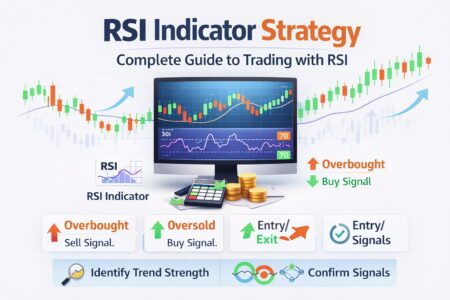
The RSI adds momentum context. When price touches the lower Bollinger Band AND the RSI shows oversold conditions (below 30), you have a stronger buy signal. Both indicators agree that price is stretched to the downside.
Conversely, when price reaches the upper band AND RSI shows overbought conditions (above 70), you have confirmation for potential short trades.
The real power comes during divergences. Imagine price making a new low and touching the lower Bollinger Band, but RSI makes a higher low. This bullish divergence suggests momentum is shifting even though price appears weak. These setups often produce strong reversals.
The standard settings are 20 periods for the middle band and 2 standard deviations for the outer bands. These work well for most forex trading and were John Bollinger’s recommended defaults.
However, you can adjust these settings based on your trading style and market conditions.
For Scalping and Day Trading: Consider tightening the bands to 10 periods with 1.5 standard deviations. This makes the bands more responsive to short-term price swings. The bands will generate more signals, but also more false signals, so use additional confirmation.
For Swing Trading: The standard 20-period, 2-standard-deviation settings work perfectly. They balance responsiveness with reliability and filter out much of the short-term noise.
For Position Trading: Expand the settings to 50 periods with 2.5 standard deviations. This smooths the bands and helps you focus on larger trends while ignoring minor fluctuations.
For Highly Volatile Pairs: Consider increasing the standard deviations to 2.5 or even 3. This prevents the bands from being touched too frequently, which would generate excessive signals.
The key is testing your chosen settings on historical data before using them in live trading. What works for EUR/USD might not work for exotic pairs with different volatility characteristics.
Common Bollinger Band Mistakes
Many traders misuse Bollinger Bands, leading to unnecessary losses. Here are the mistakes to avoid.
Mistake 1: Assuming Band Touches Always Mean Reversals
Just because price touches the upper band doesn’t mean you should immediately short. In strong trends, price can walk along the band for extended periods. Always check the overall trend before fading band touches.
A squeeze looks the same in trending and ranging markets on the chart, but it behaves very differently. In a strong trend, squeezes often lead to continuation moves. In ranging markets, breakouts frequently fail. Always consider the bigger picture.
Mistake 4: Entering Too Early
Wait for confirmation before entering trades. A candle touching the lower band isn’t enough. Wait for a bullish rejection candle, a support level, or a momentum indicator confirmation.
Mistake 5: Using Fixed Profit Targets
Bollinger Bands are dynamic, so your targets should be too. Rather than using a fixed pip target, take profits when price reaches the middle band or when the bands start to contract after expansion.
Bollinger Bands and Candlestick Patterns
Combining Bollinger Bands with candlestick patterns creates a powerful confirmation system.
When price touches the lower band and forms a bullish engulfing pattern or hammer, you have visual confirmation that buyers are stepping in. The band shows price is extended, and the candlestick shows rejection of lower prices.
Similarly, bearish engulfing patterns or shooting stars at the upper band signal potential reversals with strong visual confirmation.
Doji candles at the bands are particularly interesting. They show indecision at extreme prices, often preceding reversals. A doji at the lower band after a downtrend suggests sellers are losing conviction.
Let’s walk through a complete trade setup using Bollinger Bands.
You’re watching EUR/USD on the 4-hour chart. The pair has been ranging between 1.0800 and 1.0900 for several days. The Bollinger Bands have squeezed tight, with price bouncing between the bands in a narrow corridor.
Suddenly, you notice a strong bullish candle that closes above the upper band with increased volume. The bands immediately start to widen, signaling increasing volatility. This looks like a breakout from the range.
You enter a long position at 1.0920, just above the breakout candle. Your stop loss goes below the middle band at 1.0880, about 40 pips away. This protects you if the breakout fails and price reverses back into the range.
As the trade develops, price continues higher and starts walking along the upper band. The bands remain wide, confirming the trend is intact. You trail your stop loss along the middle band, which is now acting as dynamic support.
Eventually, price pulls back sharply to the middle band and the bands start to contract. This signals decreasing momentum. You exit the trade at 1.1020, capturing 100 pips of the move.
The trade worked because you waited for a clear breakout signal, used multiple confirmations, placed a logical stop loss, and exited when the bands showed the trend was losing steam.
Position Sizing with Bollinger Bands
The width of the Bollinger Bands should influence your position size. When bands are wide, volatility is high and price can move dramatically against you before your stop loss is hit. Consider using smaller position sizes during these periods.
When bands are narrow, volatility is low and your stop loss can be tighter. You can potentially use larger position sizes because the risk per trade is lower in absolute pip terms.
Bollinger Bands excel in ranging markets where price oscillates between clearly defined levels. The bands provide objective entry and exit points for mean-reversion trades.
They’re also valuable during the early stages of trends, particularly when a squeeze precedes a breakout. The expansion of the bands confirms the new trend is developing with conviction.
Where Bollinger Bands struggle is during choppy, directionless markets with frequent whipsaws. In these conditions, price crosses the bands repeatedly without establishing a clear pattern, generating many false signals.
Understanding market structure helps you know when to trust Bollinger Band signals and when to stand aside. For identifying support and resistance levels that complement band analysis, see our support and resistance trading guide
Final Thoughts on Bollinger Bands
Bollinger Bands are one of the most versatile technical indicators available to forex traders. They adapt to changing market volatility, provide clear visual signals, and work across all timeframes and currency pairs.
The key to successful Bollinger Band trading is understanding what the bands actually measure: volatility and price deviation from the mean. They don’t predict direction; they show you when price is extended and when volatility is changing.
Use Bollinger Bands as part of a complete trading system, not as a standalone indicator. Combine them with trend analysis, momentum indicators, candlestick patterns, and solid risk management.
Start by mastering the squeeze strategy and band bounces in ranging markets. These are the foundation of Bollinger Band trading. Once you’re comfortable with these approaches, experiment with more advanced techniques like divergence trading and dynamic support/resistance.
Most importantly, backtest your strategies and practice on a demo account before risking real money. Bollinger Bands are powerful tools, but like any indicator, they require practice and experience to use effectively.