Range Trading Strategies: Complete Guide

Range Trading Strategies also called range-bound trading or sideways trading, involves buying near support and selling near resistance when price moves within defined boundaries. Markets range 60-70% of the time, making range trading a valuable skill.

This guide covers everything you need to profit from ranging markets.


What is Range Trading?

Range trading means identifying when price is moving sideways between clear support and resistance levels, then trading the bounces between these boundaries.

Key characteristics of ranges:

  • Horizontal price movement
  • Clear support level (price floor)
  • Clear resistance level (price ceiling)
  • Price oscillates between boundaries
  • No clear trend direction

Why Markets Range

Common reasons:

  • Equilibrium: Buyers and sellers equally matched
  • Consolidation: After strong moves, market rests
  • Uncertainty: Awaiting major news or data
  • Accumulation/Distribution: Large players building positions
  • Lack of catalyst: No fundamental reason to trend

💡 KEY INSIGHT: Markets range 60-70% of the time. Most traders lose money in ranges because they try to trade trends in ranging markets.


Identifying Trading Ranges

esRange Characteristics

Valid trading range must have:

1. Clear Boundaries

  • Obvious horizontal support
  • Obvious horizontal resistance
  • Multiple touches at both levels (minimum 2 each)
  • Boundaries roughly parallel

2. Sufficient Width

  • Minimum 100 pips between support and resistance
  • Wider ranges better (more profit potential)
  • Narrow ranges too risky (stop-outs from noise)

3. Multiple Tests

  • Support tested 2+ times
  • Resistance tested 2+ times
  • Price oscillates between levels
  • Both levels holding

4. Time Duration

  • Range exists for minimum 1-2 weeks
  • Longer ranges more reliable
  • Fresh ranges less trustworthy

Range vs Trend

How to distinguish:

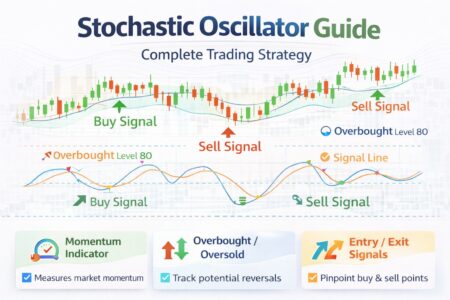
Range MarketTrending Market
Horizontal movementDiagonal movement
Equal highs and lowsHigher/lower highs and lows
ConsolidationDirectional movement
Support/resistance holdSupport/resistance break
Low ADR (Average Daily Range)High ADR
Sideways moving averagesSloping moving averages

Visual test:

  • Draw horizontal lines at recent highs and lows
  • If price respects both levels: Range
  • If price breaks one direction: Trend

[IMAGE 1 – INSERT HERE]

Best Timeframes for Range Trading

Optimal timeframes:

TimeframeRange DurationReliabilityBest For
DailyWeeks-monthsHighestPosition traders
H4Days-weeksHighSwing traders
H1Hours-daysModerateDay traders
M15Minutes-hoursLowScalpers only

Recommendation: Use H4 or Daily for clearest, most reliable ranges.


Range Trading Strategies

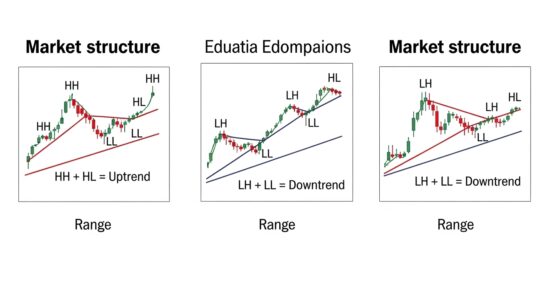
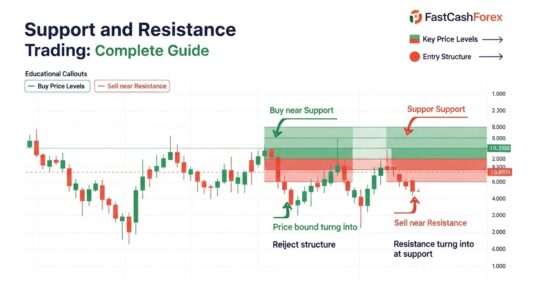
Strategy 1: Support and Resistance Bounce

The fundamental range trading strategy.

Setup requirements:

  • Clear horizontal support and resistance
  • Minimum 100 pips between levels
  • Both levels tested 2+ times
  • Currently ranging (not trending)

Buy setup (at support):

  1. Price approaches support level
  2. Wait for bullish reversal signal
  3. Candlestick patterns: Hammer, bullish engulfing, pin bar
  4. Enter at close of reversal candle
  5. Stop-loss: 20-30 pips below support
  6. Take-profit: Near resistance (leave 10-20 pips buffer)

Sell setup (at resistance):

  1. Price approaches resistance level
  2. Wait for bearish reversal signal
  3. Candlestick patterns: Shooting star, bearish engulfing, pin bar
  4. Enter at close of reversal candle
  5. Stop-loss: 20-30 pips above resistance
  6. Take-profit: Near support (leave 10-20 pips buffer)

Entry refinement:

  • Don’t enter exactly at level
  • Wait for confirmation candle
  • Enter slightly inside range (safer)
  • Account for spread

Exit strategy:

  • Take profit before opposite boundary
  • Don’t wait for exact level (may not reach)
  • Exit if price action weakens mid-range
  • Exit immediately if boundary breaks

Advantages:

  • High win rate (65-75%)
  • Clear entry and exit points
  • Defined risk
  • Multiple opportunities

Disadvantages:

  • Requires patience (wait for boundaries)
  • Risk of breakout losses
  • Smaller profit targets than trends
  • Boring (less excitement)

[IMAGE 2 – INSERT HERE]

Strategy 2: Fade the Extremes

Trade reversals when price reaches range extremes with additional confirmation.

The concept:

  • Price at extremes often “overextends”
  • Oscillators show overbought/oversold
  • High-probability reversal area

Setup (at resistance):

  1. Price reaches resistance
  2. RSI above 70 (overbought)
  3. Stochastic above 80
  4. Bearish divergence (optional, stronger signal)
  5. Bearish reversal candle
  6. Enter short
  7. Stop: Above resistance + 20 pips
  8. Target: Support or middle of range

Setup (at support):

  1. Price reaches support
  2. RSI below 30 (oversold)
  3. Stochastic below 20
  4. Bullish divergence (optional)
  5. Bullish reversal candle
  6. Enter long
  7. Stop: Below support + 20 pips
  8. Target: Resistance or middle of range

Why this works:

  • Combines multiple confirmations
  • Lower risk of failed reversal
  • Higher win rate than S/R alone
  • Oscillators filter best setups

When to skip:

  • Divergence absent and momentum still strong
  • No reversal candle pattern
  • Breakout attempt (strong momentum candle)
  • Range showing signs of breaking

Strategy 3: Mid-Range Trading

Trade within the range when price reaches middle area.

Two approaches:

Approach A: Buy Low, Sell High (Full Range)

  • Buy at support, sell position at resistance
  • Reverse: Sell at resistance, buy position at support
  • Trade both directions
  • Full range profit

Approach B: Middle Fade (Half Range)

  • Range middle = value area
  • Price above middle = expensive, consider shorts
  • Price below middle = cheap, consider longs
  • More conservative, lower risk

Middle fade setup:

  1. Identify range middle (support + resistance ÷ 2)
  2. Price moves significantly above middle (to resistance)
  3. Shows rejection at resistance
  4. Short with target at middle
  5. Stop: Above resistance
  6. Or vice versa for longs from support to middle

Advantages:

  • Lower risk (earlier entries)
  • Better R:R ratio
  • Exit before boundaries
  • More conservative

Disadvantages:

  • Miss full range profit
  • May reverse at middle
  • Requires patience

Strategy 4: Breakout Trading (Range Exit)

Trade when range finally breaks.

Setup for breakout:

  1. Identify established range
  2. Range tested multiple times (4-5+)
  3. Price breaks support or resistance
  4. Enter on break or retest
  5. Stop: Inside broken range
  6. Target: Range height projected beyond break

Entry methods:

Method A: Aggressive (Enter on Break)

  • Enter when candle closes beyond boundary
  • Immediate entry
  • Risk: False breakouts

Method B: Conservative (Enter on Retest)

  • Wait for price to return and test broken level
  • Old support becomes resistance (or vice versa)
  • Enter at retest
  • Lower risk, miss some breakouts

Confirmation filters:

  • Strong momentum candle on break
  • Increased volume (if available)
  • Gap beyond level
  • No immediate return to range
  • Trend indicators confirm (MACD, MA slope)

False breakout protection:

  • Wait for H4 or Daily candle close beyond level
  • Require minimum 20-30 pip break
  • Watch for quick return (sign of false break)
  • Use smaller position size on breakouts

[IMAGE 3 – INSERT HERE]


Range Trading Indicators

Enhance range trading with supporting indicators.

Best Indicators for Ranges

1. RSI (Relative Strength Index)

  • Overbought: Above 70 (near resistance)
  • Oversold: Below 30 (near support)
  • Divergence: Strongest signal for reversals

How to use:

  • Buy when RSI below 30 AND price at support
  • Sell when RSI above 70 AND price at resistance
  • Exit when RSI crosses 50 (mid-range)

2. Stochastic Oscillator

  • Overbought: Above 80
  • Oversold: Below 20
  • Crossover: %K crosses %D for entries

Best settings: 14, 3, 3 (default)

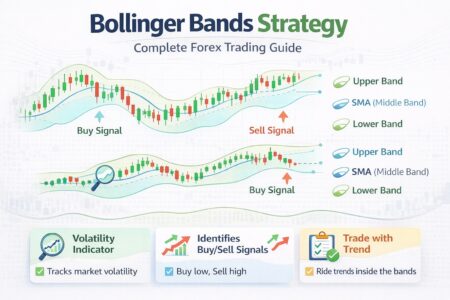
3. Bollinger Bands

  • Price at lower band = oversold (buy)
  • Price at upper band = overbought (sell)
  • Squeeze indicates low volatility (breakout coming)

Range trading with Bollinger Bands:

  • Buy near lower band
  • Sell near upper band
  • Exit at middle band
  • Watch for squeeze (range ending)

4. Volume (If Available)

  • Decreasing volume = range continuing
  • Increasing volume = potential breakout
  • Spike at boundaries = likely reversal
  • Spike on break = real breakout

5. ADX (Average Directional Index)

  • Below 25 = ranging market
  • Below 20 = strong range
  • Rising above 25 = trend developing (exit ranges)

Use ADX as filter:

  • Only range trade when ADX < 25
  • Exit all range positions if ADX > 30
  • Prevents trading ranges as they become trends

[IMAGE 4 – INSERT HERE]


Range Trading Risk Management

Position Sizing

Conservative approach:

  • Risk 1% per trade
  • Maximum 2 positions in same range
  • Total exposure maximum 2% per range

Aggressive approach:

  • Risk 1.5% per trade
  • Can trade both boundaries simultaneously (hedged)
  • Long at support + Short at resistance
  • Close winning side, keep losing side with tight stop

Stop-Loss Placement

Standard stop-loss rules:

At support (Long):

  • 20-30 pips below support
  • Below recent swing low
  • Account for spread and slippage

At resistance (Short):

  • 20-30 pips above resistance
  • Above recent swing high
  • Account for spread and slippage

Never:

  • Place stop exactly at boundary (will get hit)
  • Use stops wider than 50 pips in ranges
  • Move stops away from entry (accept loss if wrong)

Profit Targets

Conservative targets:

  • Exit 10-20 pips before opposite boundary
  • Don’t expect price to reach exact level
  • Take profit at 70-80% of range

Aggressive targets:

  • Exit at opposite boundary
  • Use limit orders
  • Risk: May not fill, price reverses

Partial profits:

  • Take 50% at range middle
  • Trail remaining 50% to opposite boundary
  • Locks in profit, participates in full move

Range Trading Mistakes to Avoid

Common Errors

1. Trading Narrow Ranges

  • Error: Trading 30-50 pip ranges
  • Risk: Stop-loss wider than target
  • Fix: Minimum 100 pip range

2. No Confirmation

  • Error: Buying/selling exactly at boundary
  • Risk: Premature entry, false signals
  • Fix: Wait for reversal candle

3. Holding Through Breakouts

  • Error: “Range will hold” mindset
  • Risk: Large losses when range breaks
  • Fix: Accept loss, exit on break

4. Fighting Breakouts

  • Error: Fading breakouts hoping for return
  • Risk: Trend develops, large losses
  • Fix: Respect breakouts, trade with them

5. Trading New Ranges

  • Error: Trading range after 2-3 days
  • Risk: Not yet established, false range
  • Fix: Wait 1-2 weeks minimum

6. Overtrading

  • Error: Trading every touch of boundaries
  • Risk: Death by a thousand cuts
  • Fix: Wait for quality setups with confirmation

7. Ignoring Bigger Picture

  • Error: Range trading against HTF trend
  • Risk: Range breaks in trend direction
  • Fix: Check daily/weekly context

When to Stop Range Trading

Exit all range positions when:

  • Range breaks decisively
  • ADX rises above 30
  • Fundamental catalyst emerges
  • Volatility increases significantly
  • Major news event approaching
  • Range tested 5-6+ times (likely to break soon)

⚠️ CRITICAL: Ranges eventually break. Never marry a range. Accept breakouts quickly and move on.


Best Currency Pairs for Range Trading

Range-Friendly Pairs

Stable pairs (range often):

  • EUR/CHF: Swiss National Bank intervention creates ranges
  • AUD/NZD: Similar economies, tends to range
  • EUR/GBP: Often sideways, good for range trading
  • USD/CHF: Stable, clear ranges

Avoid for range trading:

  • GBP/JPY: Too volatile, whippy
  • GBP/USD: Trend-heavy, breaks ranges quickly
  • Exotic pairs: Unpredictable, wide spreads

Best Trading Sessions

Range trading sessions:

SessionCharacteristicsBest For
AsianLow volatility, rangingRange trading
London OpenHigh volatility, breakoutsBreakout trading
NY OpenDirectional, trendsTrend trading
London CloseRanges returnRange trading

Optimal: Trade ranges during Asian and late NY sessions when volatility is lower.


Complete Range Trading System Example

Simple Range System

Setup:

  • Timeframe: H4
  • Indicators: Bollinger Bands (20, 2), RSI (14)
  • Risk per trade: 1%

Range identification:

  1. Find clear horizontal S/R on H4
  2. Minimum 100 pips between levels
  3. Both tested 3+ times
  4. Range exists 1+ week

Entry rules (Long at support):

  1. Price touches lower Bollinger Band
  2. Price at horizontal support level
  3. RSI below 30 (oversold)
  4. Bullish hammer or engulfing candle
  5. Enter at close of reversal candle
  6. Stop-loss: 30 pips below support

Exit rules:

  1. Take 50% profit at range middle
  2. Trail remaining 50% to upper boundary
  3. Exit all if support breaks
  4. Exit if RSI crosses above 70

Position management:

  • Maximum 2 positions per range
  • If long from support hits middle, consider short from resistance
  • Never add to losing position

Expected performance:

  • Win rate: 65-70%
  • Average R:R: 1:2 (full range)
  • Consistent small profits

Range Trading Checklist

Before every range trade:

Range Validation

  • [ ] Clear horizontal support and resistance
  • [ ] Minimum 100 pips between levels
  • [ ] Each level tested 2+ times
  • [ ] Range exists 1+ week
  • [ ] Not in strong HTF trend

Entry Confirmation

  • [ ] Price at boundary (support or resistance)
  • [ ] Reversal candlestick pattern present
  • [ ] Oscillator confirmation (RSI, Stochastic)
  • [ ] No breakout signals
  • [ ] Risk-reward minimum 1:2

Risk Management

  • [ ] Stop-loss 20-30 pips beyond boundary
  • [ ] Position size calculated (1% risk)
  • [ ] Profit target defined (opposite boundary or middle)
  • [ ] Breakout exit plan in place
  • [ ] Not overexposed (max 2 positions)

Advanced Range Trading Concepts

Range Maturity

Ranges weaken over time and tests:

Range lifecycle:

  1. Young range (1-2 weeks): Strong boundaries, high win rate
  2. Mature range (3-4 weeks): Still reliable, starting to weaken
  3. Old range (5+ weeks): Weakening, breakout imminent
  4. Breaking range: Exit all positions

Trading by maturity:

  • Young: Full range trades, aggressive
  • Mature: More selective, reduce size
  • Old: Watch for breakouts, consider exit
  • Breaking: Stop range trading, trade breakout

Multiple Timeframe Ranges

Approach:

  • Daily range: Overall structure
  • H4 range: Trading range
  • H1: Entry timing

Example:

  • Daily: Range 1.1000-1.1200
  • H4: Currently at 1.1000 support
  • H1: Bullish hammer forms
  • Action: Enter long, target 1.1200

False Breakout Trading

When ranges fake breakout then reverse:

Setup:

  1. Price breaks support or resistance
  2. Extends 20-30 pips beyond
  3. Quickly reverses back inside range
  4. Enter opposite direction
  5. Target: Opposite boundary
  6. Stop: Beyond false break

Why it works:

  • Traps breakout traders
  • Stop-losses triggered
  • Creates momentum back into range
  • Often leads to strong move to opposite side

Conclusion: Master the Range

Range trading is the overlooked goldmine of forex. While everyone focuses on trending markets, ranges offer:

Key advantages:

  • High win rates (65-75%)
  • Clear risk and reward
  • Multiple opportunities
  • Lower stress than trend trading
  • Markets range 60-70% of time

Success principles:

  1. Patience: Wait for clear ranges and confirmations
  2. Discipline: Exit on breakouts, don’t fight them
  3. Consistency: Small, steady profits compound
  4. Risk management: Tight stops, clear targets
  5. Flexibility: Switch to breakout mode when range breaks

Reality:

  • Range trading is boring but profitable
  • Requires discipline to wait for boundaries
  • Must accept losses when ranges break
  • Not as exciting as trend trading
  • But more consistent profits

The range trader’s creed:

  • Buy support, sell resistance
  • Wait for confirmation
  • Take profits before opposite boundary
  • Exit immediately on breaks
  • Repeat

Master range trading and you’ll profit when 70% of traders are losing in sideways markets.