The Stochastic Oscillator is one of those indicators that looks deceptively simple but packs serious punch when you understand how to use it properly. Developed by George Lane in the late 1950s, it measures momentum by comparing a currency pair’s closing price to its price range over a specific period.
What makes the Stochastic different from other momentum indicators like RSI is its focus on where price closes relative to recent highs and lows, rather than just measuring price change velocity. This subtle difference gives you unique insights into potential reversals and trend strength.
If you’ve been looking for an indicator that excels at catching turning points in ranging markets while still being useful in trends, the Stochastic Oscillator deserves a spot in your trading toolkit.
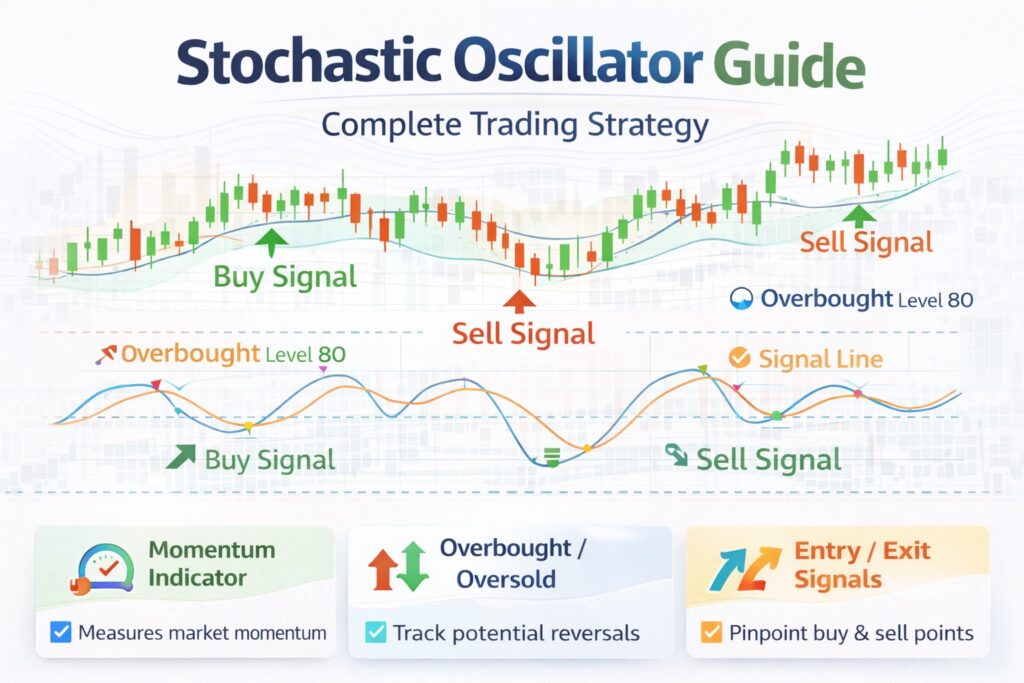
The Stochastic Oscillator consists of two lines that oscillate between 0 and 100, measuring where the current price sits within its recent range.
The %K Line is the main line, sometimes called the “fast” line. It shows the current closing price’s position relative to the high-low range over your chosen lookback period. When %K is at 80, it means the current close is near the top 20% of the recent range. When it’s at 20, price is near the bottom 20% of the range.
The %D Line is a moving average of %K, typically using a 3-period simple moving average. This is the “slow” line and it smooths out %K’s movement, making signals clearer and reducing false triggers.
The interaction between these two lines, combined with their absolute levels, creates the trading signals that make the Stochastic so valuable.
Unlike price-based indicators that can drift to extreme levels during strong trends, the Stochastic is bounded between 0 and 100. This makes it easier to spot overbought and oversold conditions at a glance.
Understanding Overbought and Oversold Levels
The most basic way traders use the Stochastic is to identify overbought and oversold conditions. But here’s where most beginners go wrong: they think overbought automatically means “sell” and oversold means “buy.” That’s a recipe for getting run over by strong trends.
Readings above 80 indicate overbought conditions. This means price has been closing near the top of its recent range, suggesting buyers have been in control. In ranging markets, this often signals an upcoming reversal. In trending markets, it just confirms the trend’s strength.
Readings below 20 indicate oversold conditions. Price has been closing near the bottom of its recent range, showing seller dominance. Again, this might signal a bounce in ranging markets but simply confirms downtrend strength in trending conditions.
The key insight is this: overbought can stay overbought for a long time during uptrends, and oversold can persist during downtrends. The Stochastic reaching extreme levels is just the starting point, not the trading signal itself.
What you’re really waiting for is the Stochastic to reach these extreme levels AND then show signs of reversing. That combination is much more powerful than extreme levels alone.
The Stochastic Crossover Strategy
This is where the two lines (%K and %D) come into play. Crossovers between these lines generate specific buy and sell signals.
A bullish crossover occurs when the fast %K line crosses above the slower %D line. This suggests momentum is shifting upward. When this crossover happens in oversold territory (below 20), it’s considered a strong buy signal. The market was oversold, and now momentum is turning positive.
A bearish crossover happens when %K crosses below %D. This indicates momentum is shifting downward. When this occurs in overbought territory (above 80), it creates a strong sell signal. The market was extended to the upside, and now momentum is reversing.
The best crossovers happen at the extreme levels. A crossover at 50 is much weaker than a crossover at 15 or 85. You want to see the Stochastic reach an extreme AND then cross, confirming both extension and reversal.
One common mistake is acting on every crossover. The Stochastic can whipsaw back and forth in the middle range (between 20 and 80), generating numerous false signals. Focus on crossovers that occur after the indicator has reached overbought or oversold levels.
Stochastic Divergence: The Hidden Gem
Divergence between the Stochastic and price action is one of the most reliable signals the indicator provides. It warns you when momentum is fading even though price appears strong.
Bullish divergence forms when price makes a lower low but the Stochastic makes a higher low. This shows that even though price dropped to new lows, momentum is actually improving. Sellers are losing control. These setups often precede significant reversals to the upside.
Bearish divergence occurs when price makes a higher high but the Stochastic makes a lower high. Price looks strong on the surface, but momentum is weakening. Buyers are losing steam. These patterns frequently lead to reversals to the downside.
The power of divergence lies in its forward-looking nature. While price is still moving in the original direction, divergence tells you the move is running out of gas. It gives you advance warning to prepare for a reversal.
For divergence to be valid, both price and the Stochastic should create clear swing points. Messy, choppy action doesn’t produce reliable divergence signals. You want clean peaks and troughs that are easy to identify.
Combining divergence with other analysis multiplies its effectiveness. If you spot bearish divergence at a key resistance level, or bullish divergence at major support, you’ve stacked multiple factors in your favor.
Optimal Stochastic Settings
The standard Stochastic settings are 14, 3, 3. This means a 14-period lookback for %K, a 3-period moving average for %D, and 3-period smoothing for %K. These settings work well for most forex trading scenarios.
However, you can adjust these parameters based on your trading style and the timeframe you’re using.
For Scalping (1-minute to 5-minute charts), try faster settings like 5, 3, 3. This makes the Stochastic more responsive to short-term price swings. You’ll get more signals, but also more noise, so use additional confirmation from price action or support/resistance levels.
For Day Trading (15-minute to 1-hour charts), the standard 14, 3, 3 settings work perfectly. They balance responsiveness with reliability, filtering out most whipsaws while still catching intraday swings.
For Swing Trading (4-hour to daily charts), consider slower settings like 21, 5, 5. This smooths the indicator and helps you focus on larger market swings while ignoring minor fluctuations. The signals are less frequent but more reliable.
Some traders also adjust the overbought/oversold levels. Instead of 80/20, they might use 75/25 or even 70/30. Tighter levels generate more signals, while wider levels (like 85/15) produce fewer but potentially more reliable signals.
The key is testing different settings on your preferred currency pairs and timeframes. EUR/USD might respond differently than GBP/JPY due to different volatility characteristics.
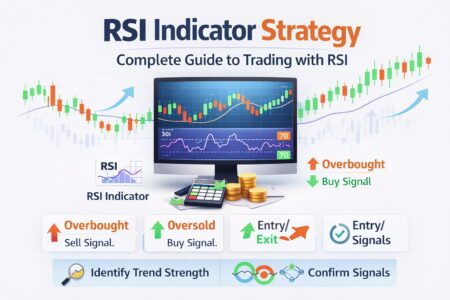
Using the Stochastic alongside RSI creates a powerful momentum confirmation system. While they both measure momentum, they do it differently, so when they agree, the signal is stronger.
When both the Stochastic and RSI show oversold conditions, you have double confirmation that the market is extended to the downside. If both indicators then turn upward together, it’s a strong buy signal.
The same applies in reverse for overbought conditions. When both indicators reach overbought levels and then turn down together, you have compelling evidence for a potential short trade.
Divergence becomes even more powerful when both indicators show it simultaneously. If price makes a new low but both the Stochastic AND RSI make higher lows, the bullish divergence is much more significant than seeing it on just one indicator.
For a complete breakdown of RSI trading strategies and how to combine it with other indicators, see our RSI indicator guide
Stochastic in Trending vs. Ranging Markets
Understanding market context is crucial for using the Stochastic effectively. The indicator behaves very differently in trends versus ranges.
In trending markets, the Stochastic will spend extended periods in overbought or oversold territory. During strong uptrends, it might stay above 80 for days or even weeks. This doesn’t mean you should short; it confirms the trend’s strength.
The smart play during trends is to use the Stochastic for timing entries in the trend’s direction. Wait for minor pullbacks that bring the Stochastic back from extreme levels, then enter when it crosses back in the trend’s direction. For example, in an uptrend, wait for the Stochastic to dip below 80, then buy when it crosses back above 50 or when %K crosses above %D.
Buy when the Stochastic reaches oversold territory and crosses upward near support. Sell when it reaches overbought territory and crosses downward near resistance. The range boundaries provide clear stop loss levels and profit targets.
Even experienced traders make these errors when using the Stochastic. Avoiding them will significantly improve your results.
Mistake 1: Trading Every Overbought/Oversold Signal
Just because the Stochastic hits 80 doesn’t mean you should automatically sell. During strong trends, the indicator can remain overbought for extended periods. Always check the overall trend before fading overbought/oversold readings.
Mistake 2: Ignoring Price Action Confirmation
The Stochastic provides momentum signals, but you still need price action confirmation. A bullish Stochastic crossover means little if price is breaking through major resistance or forming bearish candlestick patterns. Wait for confirmation from actual price behavior before entering trades.
Mistake 3: Using the Same Settings for All Timeframes
Settings that work on the daily chart might generate too much noise on the 5-minute chart. Adjust your parameters based on your trading timeframe and the volatility of the pair you’re trading.
Mistake 4: Forgetting About Divergence
Many traders only use the Stochastic for overbought/oversold signals and completely ignore divergence. This is like owning a car and never using fifth gear. Divergence is one of the Stochastic’s most powerful features.
Mistake 5: Trading Against the Trend
The biggest mistake is using oversold Stochastic readings to buy against a strong downtrend or using overbought readings to short against a strong uptrend. The trend is more powerful than any oscillator. When in doubt, trade with the trend, not against it.
Practical Stochastic Trading Example
Let’s walk through a complete trade using the Stochastic Oscillator on the 4-hour chart of EUR/USD.
The pair has been ranging between 1.0850 and 1.0950 for the past week. You’re watching for reversal opportunities at the range boundaries.
Price drops to 1.0855, just above the range support at 1.0850. The Stochastic dips to 18, entering oversold territory. Both %K and %D are below 20, confirming oversold conditions.
Rather than buying immediately, you wait for the crossover signal. Two candles later, %K crosses above %D while both lines are still below 20. This is your entry signal.
You enter a long position at 1.0865. Your stop loss goes below the recent swing low at 1.0840, about 25 pips away. This protects you if support breaks and the range fails.
Your profit target is the middle of the range at 1.0900, roughly 35 pips away, giving you a 1.4:1 reward-to-risk ratio.
As the trade develops, price rallies back toward the range midpoint. The Stochastic climbs steadily and eventually crosses above 80 into overbought territory. This confirms the momentum shift you anticipated.
Price reaches 1.0905, close to your target. The Stochastic is now at 82, and you see %K starting to flatten out. You exit at 1.0902, capturing 37 pips.
The trade worked because you combined multiple factors: range support, oversold Stochastic reading, crossover confirmation, and clear risk management. You didn’t just blindly trade the oversold reading; you waited for confirmation and had a solid trading plan.
Using Stochastic with Bollinger Bands
Bollinger Bands and the Stochastic complement each other beautifully. The Bands show volatility and price extension, while the Stochastic shows momentum and potential reversal points.
When price touches the lower Bollinger Band AND the Stochastic is oversold, you have confluence suggesting a potential bounce. Both indicators agree that price is extended to the downside.
The power combination occurs when price is at the lower band, the Stochastic is oversold, and then the Stochastic crosses upward while price forms a bullish rejection candle at the band. This triple confirmation creates high-probability long setups.
The same logic applies at the upper Bollinger Band with overbought Stochastic readings for short trades.
The Stochastic Oscillator excels in several specific market conditions.
Ranging markets with clear support and resistance are where the Stochastic truly shines. The oscillating price action produces clear overbought and oversold signals that work reliably.
Lower-volatility pairs and timeframes tend to produce cleaner Stochastic signals. The indicator can get choppy and unreliable during extreme volatility or during major news events.
Swing trading approaches benefit most from the Stochastic. The indicator’s signals are often too slow for scalping but too frequent for long-term position trading. The swing trading timeframes (4-hour to daily) hit the sweet spot.
Where the Stochastic struggles is during strong, sustained trends. It will flash overbought or oversold signals throughout the trend, tempting you to trade reversals that never materialize. During these periods, focus on using the Stochastic for trade timing within the trend rather than trying to pick tops and bottoms.
Risk Management with Stochastic Signals
Even with perfect Stochastic signals, you need solid risk management to succeed. Every overbought or oversold reading won’t result in an immediate reversal, so protecting your capital is essential.
Use support and resistance levels for stop loss placement rather than arbitrary pip amounts. If you’re buying an oversold Stochastic reading, place your stop just below recent support. If support breaks, your signal was wrong and you want to exit quickly.
Position sizing should account for the distance to your stop loss. Calculate your position size based on risking a fixed percentage of your account on each trade, not on how confident you feel about the setup. For detailed position sizing strategies, see our position sizing guide
Consider scaling out of positions as the Stochastic reaches the opposite extreme. If you bought an oversold signal, take partial profits when the Stochastic reaches overbought levels. This locks in gains while letting the remainder run in case the trend continues.
Final Thoughts on the Stochastic Oscillator
The Stochastic Oscillator is a versatile momentum indicator that works across all timeframes and currency pairs. Its bounded nature (0-100) makes signals easy to interpret, and its dual-line structure provides clear entry and exit points.
The key to successful Stochastic trading is understanding that overbought and oversold readings aren’t trading signals by themselves. They’re warnings that price is extended and a reversal might be coming. You need additional confirmation from crossovers, divergence, support/resistance levels, or candlestick patterns.
Start by mastering the basic crossover strategy in ranging markets. Once you’re comfortable identifying and trading these setups, expand to divergence trading and using the Stochastic for timing entries in trending markets.
Remember to adjust your settings based on your trading style and market conditions. The standard 14, 3, 3 parameters work well for most situations, but don’t be afraid to experiment with faster or slower settings to match your approach.
Most importantly, always consider the bigger picture. The Stochastic provides momentum signals, but price action, trend direction, and key levels should guide your final trading decisions. Use the Stochastic as one tool in your complete trading system, not as a standalone solution.