Last Updated: November 2025
Forex scalping is one of the most fast-paced and exciting trading styles in the currency markets. Scalpers aim to profit from tiny price movements by entering and exiting trades within seconds to minutes, often taking dozens or even hundreds of trades per day. While this high-frequency approach can be profitable, it requires specific skills, tools, and strategies that differ significantly from other trading styles.
What is Forex Scalping?
Forex scalping is a trading strategy where traders make multiple trades throughout the day, holding positions for very short periods—typically seconds to a few minutes—to capture small price movements of 5-20 pips per trade.
Key Characteristics of Scalping
Time Horizon
- Seconds to minutes per trade
- Rarely hold positions longer than 5 minutes
- Trade during highest volatility periods
Profit Targets
- 5-20 pips per trade
- Small gains that add up over many trades
- Focus on win rate over individual trade size
Trade Frequency
- 10-100+ trades per day
- Constant market monitoring required
- Quick decision-making essential
Position Sizing
- Often use larger position sizes
- Leverage amplifies small moves
- Tight stop-losses (3-10 pips)
Scalping vs. Other Trading Styles
| Feature | Scalping | Day Trading | Swing Trading |
|---|---|---|---|
| Time per Trade | Seconds–minutes | Minutes–hours | Days–weeks |
| Profit Target | 5–20 pips | 20–80 pips | 100–500 pips |
| Trades per Day | 10–100+ | 2–100 | 2 |
| Leverage Used | High | Moderate | Low |
| Screen Time | Constant | Active hours | Periodic checks |
| Stress Level | Very high | High | Moderate |
Why Traders Choose Scalping
Advantages
No Overnight Risk
- All positions closed by end of session
- No worry about gap openings
- Sleep peacefully without open trades
Many Opportunities
- Dozens of trade setups daily
- Don’t need large market moves
- Can profit in ranging markets
Quick Feedback
- Know if trade works in minutes
- Fast learning curve
- Immediate results
Compound Small Gains
- 10 pips × 50 trades = 500 pips daily (theoretical)
- Small consistent wins add up
- Lower individual trade risk
Disadvantages
- Extremely Demanding: Requires constant attention; high stress and pressure; mental and physical exhaustion
- Transaction Costs: Spreads eat into profits; many trades = higher costs; need very tight spreads
- Requires Fast Execution: Slippage can destroy profits; need reliable broker; technology failures costly
- Not for Beginners: Requires experience and discipline; steep learning curve; easy to lose quickly
- Time Intensive: 4–8 hours daily monitoring; can’t have other commitments during trading; difficult to maintain long-term
Best Currency Pairs for Scalping
Not all currency pairs are suitable for scalping. You need specific characteristics.
Essential Criteria
- Tight Spreads: 0.5–2 pips maximum; spread directly impacts profitability; avoid pairs with 3+ pip spreads
- High Liquidity: Easy entry and exit; minimal slippage; price moves smoothly
- Volatility: Enough movement for profit opportunities but not erratic or unpredictable; consistent price patterns
Top Scalping Pairs
EUR/USD (Best Overall)
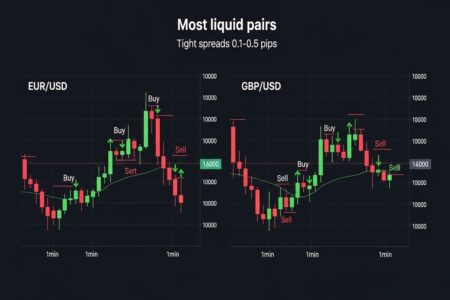
- Tightest spreads (0.5–1 pip)
- Highest liquidity
- Predictable behavior
- Active during European/US sessions
GBP/USD (High Volatility)
- Good movement for profits
- Spreads: 1–2 pips
- More volatile than EUR/USD; requires wider stops
USD/JPY (Asian Session)
- Excellent liquidity
- Spreads: 0.5–1.5 pips
- Good for night traders; smooth price action
USD/CHF
- Tight spreads
- Lower volatility than GBP
- Good for conservative scalpers
AUD/USD
- Active during Asian/Pacific sessions
- Moderate volatility
- Spreads: 1–2 pips
Pairs to AVOID for Scalping
- Exotic Pairs: Wide spreads (5–30 pips), low liquidity, unpredictable movements, high transaction costs
- Minor Pairs During Off-Hours: EUR/GBP outside London hours; AUD/NZD during US session; spread widens significantly
Best Time frames for Scalping
Scalpers use very short timeframes to spot quick opportunities.
Primary Timeframes
- 1-Minute Chart (M1): Most common scalping timeframe; ultra-quick trades (30 seconds–2 minutes); 50–100+ trades per day; requires intense focus
- 5-Minute Chart (M5): Slightly longer holds (2–5 minutes); 20–50 trades per day; less stressful than M1; good for beginners
- 15-Minute Chart (M15): Borderline scalping/day trading; 5–20 trades per day; more reliable signals; less noise than M1/M5
Multiple Timeframe Approach
Use 3 Timeframes:
- Higher Timeframe (H1 or H4): Determine overall trend; identify support/resistance zones; trade direction filter
- Medium Timeframe (M15 or M30): Find trade setup areas; identify key levels; set context for entry
- Entry Timeframe (M1 or M5): Precise entry timing; exit management; quick decision-making
Rule: Only scalp in direction of higher timeframe trend
Top Scalping Strategies
Strategy 1: Price Action Scalping
Concept: Trade based on candlestick patterns and support/resistance.
Setup:
- Mark key support/resistance on M15
- Wait for price to reach these levels
- Look for reversal patterns on M5/M1
Entry Signals:
- Pin bar at support (buy)
- Engulfing pattern at resistance (sell)
- Double top/bottom formations
Example Trade: EUR/USD approaching support at 1.0850 (M15). Pin bar forms on M5 chart at 1.0851. Enter long at 1.0852. Stop-loss: 1.0847 (5 pips). Take-profit: 1.0862 (10 pips). Risk/Reward: 1:2
Strategy 2: Moving Average Crossover
Setup:
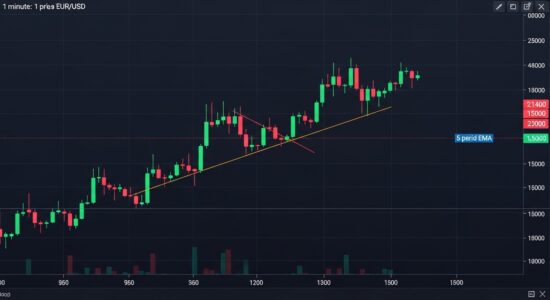
- Apply 5 EMA and 15 EMA on M5 chart
- Apply 50 EMA for trend filter on M15
Buy Signal: 5 EMA crosses above 15 EMA; price above 50 EMA (uptrend); enter on crossover.
Sell Signal: 5 EMA crosses below 15 EMA; price below 50 EMA (downtrend); enter on crossover.
Exit: Take profit: 10–15 pips; Stop loss: Below recent swing low/high (5–8 pips).
Strategy 3: Bollinger Bands + RSI
Setup: Bollinger Bands (20,2) on M5; RSI (14) on M5; Stochastic (5,3,3) for confirmation.
Buy Signal: Price touches lower Bollinger Band; RSI below 30 (oversold); Stochastic crossing up from below 20; enter when candle closes above lower band.
Sell Signal: Price touches upper Bollinger Band; RSI above 70 (overbought); Stochastic crossing down from above 80; enter when candle closes below upper band.
Exit: Take profit: Middle Bollinger Band or 10–15 pips, whichever comes first.
Strategy 4: Breakout Scalping
Setup: Identify consolidation/range on M15; mark support and resistance; wait for breakout.
Entry: Price breaks above resistance (buy) or below support (sell); enter on first candle close outside range.
Confirmation: Increased volume on breakout; strong momentum candle; no immediate rejection.
Exit: Target: Range height (distance between support/resistance). Stop: Inside the range (5–10 pips).
Strategy 5: News Fade Scalping (Advanced)
Concept: Trade against initial news spike when overextended.
Setup: Major news event (NFP, FOMC, CPI); price spikes strongly in one direction; RSI reaches extreme (below 20 or above 80).
Entry: Wait for initial spike to exhaust; look for reversal candle (pin bar, doji); enter against the spike.
Warning: Very risky! Only for experienced scalpers with fast execution.
Essential Scalping Indicators
Core Indicators
- Moving Averages (EMA): Use: Trend direction, entry timing. Settings: 5,15,50 EMA. Signals: Crossovers, price bounces.
- RSI (Relative Strength Index): Use: Overbought/oversold conditions. Settings: RSI(14). Signals: Below 30 (buy), Above 70 (sell).
- Stochastic Oscillator: Use: Momentum confirmation. Settings: 5,3,3 or 14,3,3. Signals: Crosses in extreme zones.
- Bollinger Bands: Use: Volatility, support/resistance. Settings: BB(20,2). Signals: Price at bands, squeeze breakouts.
- MACD: Use: Trend changes, momentum. Settings: MACD(12,26,9). Signals: Crossovers, divergence.
Advanced Indicators
- Volume: Confirms breakouts; shows strength of moves; low volume = weak signal.
- ATR (Average True Range): Measures volatility; helps set stop-loss size; high ATR = wider stops needed.
- Pivot Points: Intraday support/resistance; entry/exit levels; popular among scalpers.
Indicator Setup — Recommended M5 Chart:
5 EMA (use as fast line), 15 EMA (signal), 50 EMA (trend filter), RSI(14) below chart, Bollinger Bands (20,2)
Keep It Simple: Don’t use more than 3–4 indicators. Too many create confusion — focus on price action primarily.
Risk Management for Scalpers
Position Sizing
The 1% Rule: Risk maximum 1% per trade. With 50 trades/day, you can survive 100 consecutive losses. Protects your account.
Example:
Account: $5,000. Risk per trade: 1% = $50. Stop-loss: 5 pips. Pip value needed: $50 ÷ 5 = $10/pip. Position size: 1 standard lot (100,000 units).
Stop-Loss Management
- Tight Stops are Essential: Typical stops: 3–10 pips. Wider stops defeat scalping purpose. Place stops beyond support/resistance.
- Stop Placement Techniques:
- Below/Above Swing Points: Most reliable; gives room for normal volatility
- ATR-Based: Stop = 0.5 × ATR; adjusts to market volatility
- Fixed Pip Stop: Simple but less adaptive; 5–8 pips typical
- Never Move Stop-Loss: Respect your original stop. Moving stops = losses compound. Take the loss and move to next trade.
Take-Profit Targets
- Fixed Targets: 10 pips (conservative), 15 pips (balanced), 20 pips (aggressive)
- Risk/Reward Ratios: Minimum 1:1.5 (risk 5 pips, target 7–8 pips). Ideal 1:2 (risk 5 pips, target 10 pips). Sometimes 1:1 acceptable for high win rate.
- Scaling Out: Take 50% profit at first target; let 50% run to second target — locks in profit while allowing runners.
Choosing a Scalping Broker
Not all brokers are suitable for scalping. You need specific features.
Essential Requirements
- Tight Spreads: EUR/USD: 0.5–1 pip max; GBP/USD: 1–2 pips max; fixed spreads preferred (no widening during news)
- Fast Execution: Order filled in under 1 second; no requotes; minimal slippage
- Scalping-Friendly Policy: Some brokers prohibit scalping — check Terms of Service; ECN/STP brokers usually allow it
- No Minimum Hold Time: Avoid brokers that require positions held 3–5 minutes
- Reliable Platform: Stable during high volatility; mobile app for emergencies
Recommended Broker Types
- ECN Brokers (Best for Scalpers): Direct market access; tight spreads (0.5–1 pip); commission per trade ($3–7 per lot); fast execution
- STP Brokers: Good spreads (1–2 pips); no commission usually; good for smaller accounts
- Avoid Market Makers: Potential conflicts of interest; may widen spreads; possible re-quotes; some prohibit scalping
Platform Recommendations
- MetaTrader 4/5 — industry standard; fast execution; customizable
- cTrader — designed for scalpers; one-click trading; Depth of Market
- Proprietary Platforms — test extensively on demo first
Scalping Psychology
Mental Requirements
- Laser Focus: 100% attention during trading; no distractions; single-tasking only
- Emotional Control: Accept losses immediately; don’t revenge trade; stay mechanical
- Discipline: Follow your rules every trade; no exceptions; system over emotions
- Stress Management: Take breaks every hour; don’t trade when tired; know when to stop
Related Posts:






Powered by Contextual Related Posts