Last Updated: May 2026
Choosing the right forex trading strategy is one of the most important decisions you’ll make as a trader. There’s no single “best” strategy—the optimal approach depends on your schedule, personality, risk tolerance, and financial goals. This comprehensive guide explores every major forex trading strategy, helping you understand the differences and find the style that fits your life.
Understanding Forex Trading Strategies
Forex trading strategies are structured approaches that define when to enter, exit, and manage risk on every trade.
A forex trading strategy is a systematic approach to buying and selling currencies based on specific criteria. Strategies differ by:
Time Horizon:
- How long you hold positions (seconds to months)
- Number of trades per day/week/month
Analysis Method:
- Technical analysis (charts, indicators)
- Fundamental analysis (economic data)
- Combination of both
Risk Profile:
- Position sizing
- Leverage usage
- Stop-loss placement
Market Conditions:
- Trending markets
- Ranging markets
- High/low volatility
The key to success isn’t finding a “perfect” strategy—it’s finding one that matches your lifestyle and consistently executing it with discipline according to your trading plan.
Forex Trading Strategies by Timeframe
Choosing between forex trading strategies often comes down to how much time you can dedicate to monitoring the markets each day.
Overview Comparison
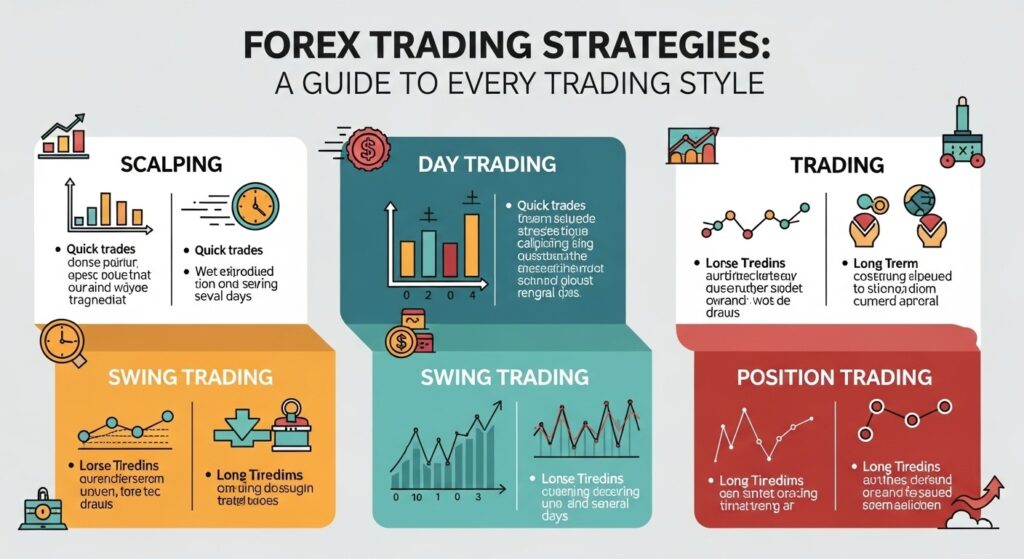
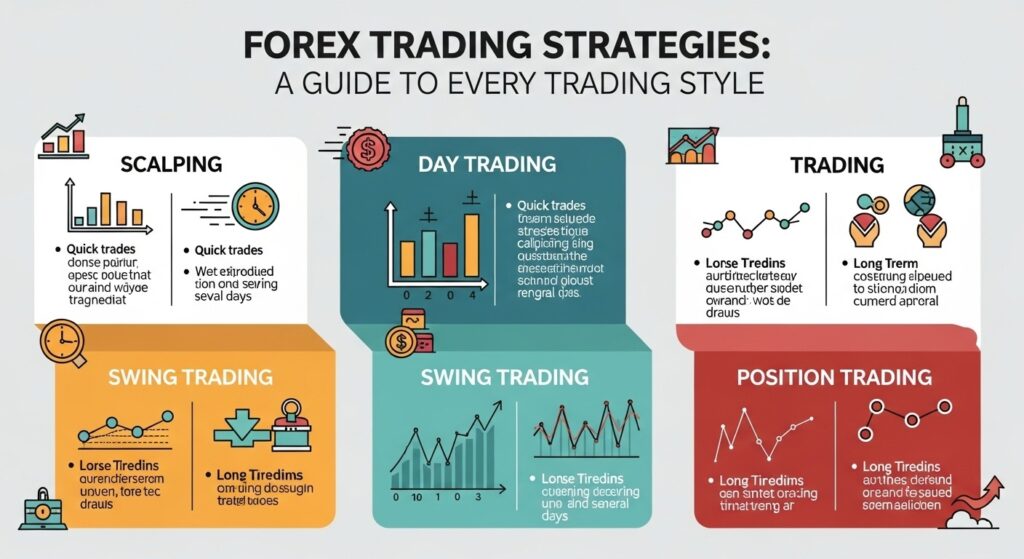
| Strategy | Hold Time | Pips per Trade | Trades | Screen Time | Stress Level | Best For |
|---|---|---|---|---|---|---|
| Scalping | Seconds-Minutes | 5-20 | 20-100/day | Constant | Very High | Full-time traders |
| Day Trading | Minutes-Hours | 20-80 | 2-10/day | 4-8 hours | High | Active traders |
| Swing Trading | Days-Weeks | 100-500 | 2-10/week | 1-2 hours | Moderate | Part-time traders |
| Position Trading | Weeks-Months | 500-5000 | 1-5/month | 30 min/day | Low | Long-term investors |
Strategy 1: Forex Scalping
Time Horizon: Seconds to a few minutes
Target: 5-20 pips per trade
Frequency: 20-100+ trades per day
What is Scalping?
Scalping is the fastest-paced forex trading style. Scalpers aim to profit from tiny price movements by entering and exiting trades within seconds to minutes, accumulating many small wins throughout the day.
Core Characteristics:
Advantages:
- No overnight risk (all positions closed daily)
- Many trading opportunities every day
- Small losses per trade (tight stops)
- Quick feedback on performance
- Can profit in any market condition
Disadvantages:
- Extremely demanding (constant attention required)
- High stress and mental fatigue
- Spread costs add up (many trades)
- Requires fast execution and tight spreads
- Not suitable for beginners
Ideal Profile:
You might be a good scalper if you:
- Can dedicate 4-8 hours daily to trading
- Make quick decisions confidently
- Handle stress well
- Have fast internet and reliable technology
- Thrive in fast-paced environments
- Can accept many small losses without emotional impact
Essential Requirements:
Broker:
- Tight spreads (0.5-1 pip on EUR/USD)
- Fast execution (under 1 second)
- ECN or STP account type
- No minimum hold time restrictions
See our best forex brokers for scalping for a full list of brokers that permit scalping strategies.
Technology:
- Fast computer
- Stable internet (fiber/cable)
- Dual monitors
- Low-latency broker connection
Capital:
- Minimum $1,000 (realistic)
- $2,000-5,000 recommended
Best Currency Pairs:
Major Pairs Only:
- EUR/USD (tightest spreads)
- GBP/USD (high volatility)
- USD/JPY (smooth price action)
- USD/CHF (stable movements)
Recommended Timeframes:
- M1 (1-minute) – Advanced scalpers
- M5 (5-minute) – Most common
- M15 (15-minute) – Conservative scalping
Strategy 2: Day Trading
Time Horizon: Minutes to hours (all closed by end of day)
Target: 20-80 pips per trade
Frequency: 2-10 trades per day
What is Day Trading?
Day traders open and close positions within the same trading day, never holding overnight. This style balances the intensity of scalping with the patience of swing trading.
Core Characteristics:
Advantages:
- No overnight risk or gap exposure
- Multiple opportunities daily
- Moderate screen time (4-8 hours)
- Better risk/reward than scalping
- Less stressful than scalping
Disadvantages:
- Requires daily availability during trading hours
- Can’t have full-time job easily
- Need to monitor positions actively
- Spread costs still significant
- Emotional discipline essential
Ideal Profile:
You might be a good day trader if you:
- Can trade 4-6 hours daily during peak sessions
- Prefer closing all positions before sleep
- Make decisions within minutes
- Handle moderate stress well
- Have some trading experience
- Are comfortable with technical analysis
Essential Requirements:
Broker:
- Competitive spreads (1-2 pips)
- Reliable execution
- Good charting platform — see our best forex trading platforms guide
Schedule:
- Available during London or New York sessions
- Consistent daily availability
- Morning or evening block of 4-6 hours
Capital:
- Minimum $500-1,000
- $2,000+ recommended for flexibility
Best Currency Pairs:
- EUR/USD (most popular)
- GBP/USD (volatility)
- AUD/USD (trending)
- EUR/GBP (range trading)
Recommended Timeframes:
- M15 (15-minute) – Entry timing
- H1 (1-hour) – Trend direction
- H4 (4-hour) – Major support/resistance
Common Day Forex Trading Strategies:
Breakout Trading: Trade range breakouts in the morning session. Enter when price breaks key levels and target the measured move.
Trend Following: Identify the trend on H1, enter on pullbacks to the moving average, and ride the trend throughout the session.
Range Trading: Trade between support and resistance zones. Works well during the Asian session.
Strategy 3: Swing Trading
Time Horizon: Days to weeks
Target: 100-500 pips per trade
Frequency: 2-10 trades per week
What is Swing Trading?
Swing traders hold positions for multiple days or weeks, aiming to capture larger price movements in trending markets. This style combines technical and fundamental analysis.
Core Characteristics:
Advantages:
- Minimal screen time (1-2 hours daily)
- Compatible with a full-time job
- Larger profit potential per trade
- Less stressful than intraday trading
- Better risk/reward ratios (1:3 or higher)
Disadvantages:
- Overnight and weekend risk
- Fewer trading opportunities
- Requires patience
- Gap risk during news events
- Swap/rollover fees accumulate
Ideal Profile:
You might be a good swing trader if you:
- Have a full-time job or business
- Prefer analysis over constant monitoring
- Can handle holding through volatility
- Enjoy both technical and fundamental analysis
Essential Requirements:
Capital:
- Minimum $1,000
- $3,000-5,000 recommended (larger stops needed)
Best Currency Pairs:
- EUR/USD (steady trends)
- GBP/JPY (large swings)
- AUD/NZD (strong trends)
- USD/CAD (commodity correlation)
Recommended Timeframes:
- H4 (4-hour) – Entry timing
- D1 (Daily) – Trend direction
- W1 (Weekly) – Major support/resistance
Risk Management:
Risk 1-2% per trade. Stop-loss: 50-200 pips depending on timeframe. Take-profit: 150-600 pips (minimum 1:3 risk/reward). Use our position size calculator to size every swing trade correctly.
Strategy 4: Position Trading
Time Horizon: Weeks to months
Target: 500-5000 pips per trade
Frequency: 1-5 trades per month
What is Position Trading?
Position traders take long-term views on currencies, holding positions for weeks or months based primarily on fundamental analysis. This is closest to traditional investing.
Core Characteristics:
Advantages:
- Minimal time commitment (30 min/day)
- Lowest stress level
- Largest profit potential
- Very few transactions (low costs)
- Can maintain a full-time career
Disadvantages:
- Significant overnight/weekend risk
- Need large capital (bigger stops)
- Very few opportunities
- Swap fees accumulate significantly
Capital Requirements:
- Minimum $5,000
- $10,000+ recommended
Best Currency Pairs:
- AUD/JPY (carry trade)
- NZD/JPY (carry trade)
- EUR/USD (major trends)
- GBP/USD (macro trends)
Learn about interest rates and central bank policy in our Economic Indicators Guide.
Forex Trading Strategies by Market Approach
Strategy 5: Trend Following
Concept: Trade in the direction of the prevailing trend. Key Principle: “The trend is your friend.” Best Markets: Strongly trending conditions.
Key Tools: Moving averages (50, 200), trendlines, higher highs/higher lows (uptrend), lower highs/lower lows (downtrend).
Strategy 6: Range Trading
Concept: Buy at support, sell at resistance in sideways markets. Best Markets: Low volatility, consolidation periods.
Key Tools: Support/resistance zones, Bollinger Bands, RSI (overbought/oversold), Stochastic.
Strategy 7: Breakout Trading
Concept: Enter when price breaks key levels with momentum. Best Markets: After consolidation, before major news.
Key Tools: Support/resistance, consolidation patterns, volume confirmation, Bollinger Band squeeze.
Strategy 8: News Trading
Concept: Trade volatility around economic announcements. Best Events: Non-Farm Payrolls (NFP), FOMC interest rate decisions, CPI inflation data, GDP releases.
See our Economic Indicators Guide to understand which news moves markets most.
⚠️ Warning: Extremely high risk. Spreads widen dramatically. Only for experienced traders.
Forex Trading Strategies by Analysis Type
Technical Analysis Strategies
Focus: Price action, charts, indicators. Best For: Short-term trading (scalping, day trading).
Key Tools: Candlestick patterns, support/resistance, moving averages, RSI, MACD, Stochastic, chart patterns.
See our Complete Technical Analysis Guide for a full breakdown of every tool.
Fundamental Analysis Strategies
Focus: Economic data, central banks, geopolitics. Best For: Long-term trading (swing, position).
Key Factors: Interest rates, inflation (CPI), GDP growth, employment data, central bank policies.
See our Economic Indicators Guide and Fundamental Analysis Guide for more.
Price Action Trading
Focus: Pure price movement without indicators. Philosophy: Price reflects all available information.
Key Tools: Candlestick patterns, support/resistance, trendlines, chart patterns — no indicators needed.
See our Price Action Trading Guide for a complete walkthrough.
Choosing Your Strategy: Decision Framework
No single set of forex trading strategies works for every trader — your choice depends on personality, schedule, and available capital.
Step 1: Assess Your Available Time
- 1-2 hours per day → Swing Trading or Position Trading
- 4-8 hours per day → Day Trading or Swing Trading
- Full-time (8+ hours) → Scalping or Day Trading
Step 2: Evaluate Your Personality
- Quick Decision Maker, High Energy → Scalping or Day Trading
- Patient, Analytical → Swing Trading or Position Trading
- Emotion-Driven, Impulsive → Position Trading (fewer decisions)
- Disciplined, Methodical → Any style (Day Trading ideal)
Review our Trading Psychology Guide to understand your trader type.
Step 3: Consider Your Capital
- Under $500 → Scalping or Day Trading (smaller stops)
- $500-$2,000 → Day Trading or Swing Trading
- $2,000-$5,000 → Swing Trading or Position Trading
- $5,000+ → Any style (most flexibility)
Step 4: Risk Tolerance
- Low Risk Tolerance → Position Trading
- Moderate Risk → Swing Trading or Day Trading
- High Risk Tolerance → Scalping or Day Trading
Combining Strategies
Example 1: Primary + Secondary
Primary: Swing Trading (70% of capital, 3-5 swing trades active)
Secondary: Day Trading (30% of capital, 1-2 day trades when clear setups appear)
Example 2: Timeframe Diversification
Long-term: Position Trade (1-2 trades, months-long holds)
Medium-term: Swing Trades (3-5 trades, days-weeks holds)
Short-term: Day Trades (occasional, only perfect technical setups)
Strategy Development: 6-Month Plan
Months 1-2: Learn & Demo
Study one strategy deeply, demo trade extensively, track every trade, no live money yet. Goal: Understand your chosen strategy completely.
Months 3-4: Consistency on Demo
Prove consistency — need 2 months profitable on demo, win rate 55%+, positive risk/reward, emotional control. Goal: Consistent results before live trading.
Months 5-6: Small Live Account
Start with $500-1,000, trade micro lots, same strategy as demo, focus on psychology. Goal: Translate demo success to live trading.
Common Strategy Mistakes
Most traders fail not because forex trading strategies don’t work, but because they switch strategies before giving any one approach enough time.
Mistake 1: Strategy Hopping — Switching strategies after a few losses. Solution: Commit to one strategy for 3-6 months minimum.
Mistake 2: Over-Optimization — Constantly tweaking based on recent results. Solution: Follow consistent rules and track long-term results.
Mistake 3: Ignoring Risk Management — Great strategy but poor position sizing. Solution: Risk management is more important than entry signals.
Mistake 4: Wrong Timeframe for Lifestyle — Choosing scalping with a full-time job. Solution: Match strategy to available time.
Mistake 5: No Trading Plan — Random trading without documented rules. Solution: Write a detailed trading plan with clear rules.
Essential Tools for Every Strategy
Traders should review regulatory guidelines from the CFTC and NFA in the US, and the FCA internationally, when evaluating brokers and ensuring their chosen forex trading strategies comply with applicable rules.
Risk Management: Position size calculator, risk/reward calculator, trade journal, economic calendar.
Technical Analysis Platforms: MetaTrader 4/5, TradingView, cTrader. See our Best Trading Platforms Guide.
Broker Selection: Look for regulation (CFTC, FCA, ASIC), tight spreads, fast execution, and no scalping restrictions. See our How to Choose a Forex Broker guide.
Next Steps: Your Action Plan
Today: Identify your available trading time, assess your personality honestly, choose ONE strategy to focus on.
This Week: Study your chosen strategy in depth, open a demo account, start practicing.
This Month: Demo trade daily, keep a detailed trade journal, refine your approach.
Months 2-3: Achieve consistency on demo, prove profitable results, prepare for live trading.
Continue Your Education
Master the fundamentals and specific strategies:
Foundations:
Trading Styles:
- Forex Scalping: Complete Guide
- 2-5 Pip Scalping
- Scalping with $100
- Day Trading Guide
- Swing Trading Guide
Risk Management:
Technical Analysis:
Fundamental Analysis:
Psychology & Planning:
Currency Pairs:
- EUR/USD Trading Guide
- GBP/USD Trading Guide
- USD/JPY Trading Guide
- AUD/USD Trading Guide
- USD/CAD Trading Guide
Final Thoughts
The best forex trading strategies are the ones you can follow consistently with discipline and proper risk management.
There is no “best” forex trading strategy — only the strategy that best fits you. Success comes from choosing a strategy that matches your lifestyle, mastering it through extensive practice, executing with discipline and consistency, managing risk properly, and continuously learning and adapting.
Start with one strategy, practice extensively on demo, prove consistency, then gradually transition to live trading. The traders who succeed are those who find their fit and stick with it long enough to master it.
Ready to start? Create your personalized Trading Plan and begin your journey to forex trading success.