Learn How to Make Fast Money by Learning diffrent Strategies in Forex Trading and Different Investment Options
Price Action Trading: Complete Guide
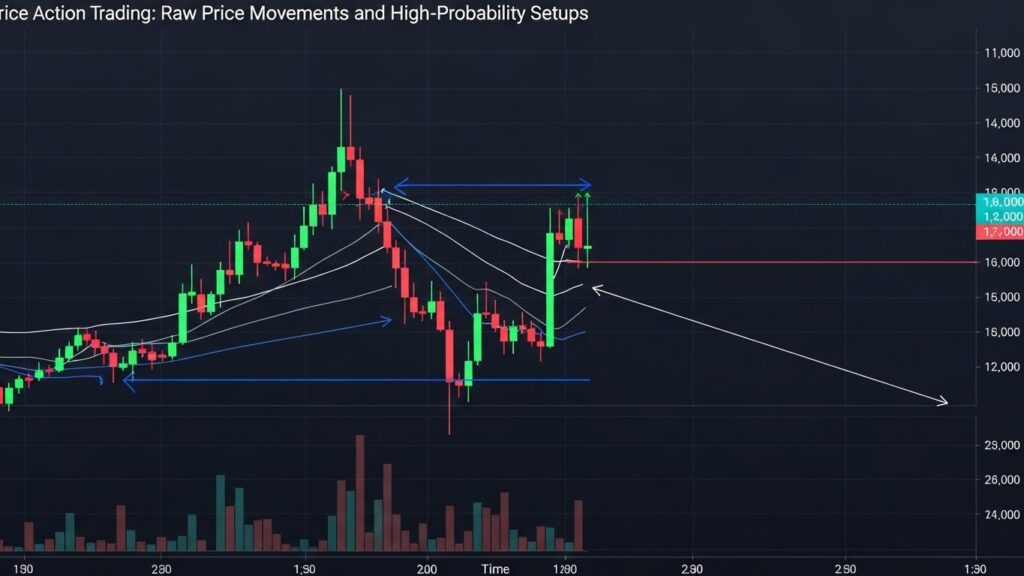
Price action trading is the art of reading and interpreting raw price movements without relying on indicators. It’s how professional traders analyze markets, identifying high-probability setups based purely on candlestick patterns, support/resistance, and market structure.
Price action is the movement of price over time, displayed as candlesticks or bars on a chart. Price action trading means making decisions based solely on this price movement, not indicators.
Core philosophy: Price reflects all available information. Everything you need to know is in the price itself.
Why Price Action Works
The reality:
Price action trading reflects actual buying and selling
Shows real supply and demand
Indicators lag (they’re derived from price)
Price leads, indicators follow
Professional traders use price action
Key advantages:
Works on all timeframes
Works on all instruments
No lagging signals
Clean, simple charts
Universal language of markets
KEY INSIGHT: Every indicator is calculated FROM price. Why not just read price directly and eliminate the lag?
Core Price Action Concepts
Market Structure
Understanding how markets move.
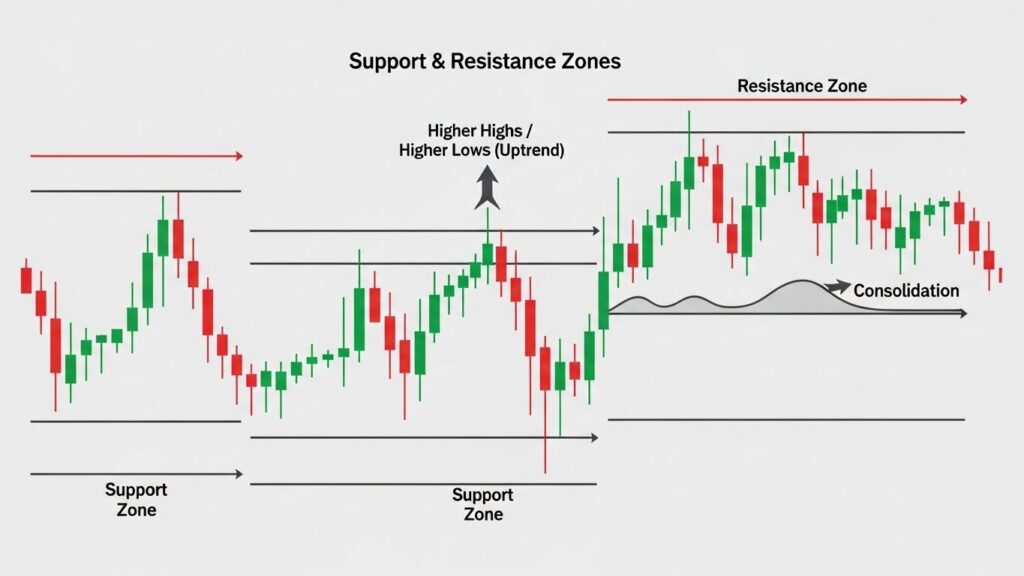
Uptrend structure:
Higher highs (HH)
Higher lows (HL)
Each rally exceeds previous high
Each pullback stops above previous low
Clear staircase pattern upward
Downtrend structure:
Lower highs (LH)
Lower lows (LL)
Each decline exceeds previous low
Each bounce stops below previous high
Clear staircase pattern downward
Range structure:
Equal highs
Equal lows
Horizontal movement
Price oscillates between boundaries
No clear trend
Structure breaks:
Trend ends when structure breaks
Uptrend breaks when lower low forms
Downtrend breaks when higher high forms
Signals potential reversal
Support and Resistance
Price levels where buying or selling pressure concentrates.
Identifying key levels:
Mark obvious swing highs (resistance)
Mark obvious swing lows (support)
Look for multiple touches (confirms level)
Focus on clean, horizontal levels
Ignore minor levels (reduce noise)
Level strength:
2 touches: Potential level
3 touches: Confirmed level
4+ touches: Strong level, likely to break soon
Time: Older levels stronger than fresh ones
Dynamic support/resistance:
Trendlines connecting swing points
Move with price
Provide clear invalidation points
Supply and Demand Zones
Areas where significant buying or selling occurred.
Demand zone (support):
Area where price reversed sharply upward
Strong buying interest
Price returned to origin of move
Often bounces again from same zone
Supply zone (resistance):
Area where price reversed sharply downward
Strong selling interest
Price returned to origin of move
Often gets rejected again
How to mark zones:
Find strong impulsive move
Identify consolidation before move (origin)
Mark rectangular zone at origin
Wait for price to return
Trade the bounce/rejection
Zone rules:
Fresh zones stronger than tested ones
Larger moves create stronger zones
Zones from HTF stronger than LTF
Once broken, zones flip (support becomes resistance)
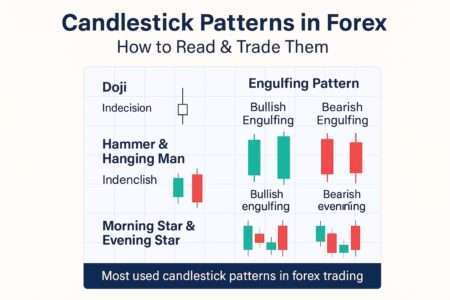
Individual candles and patterns tell stories about sentiment.
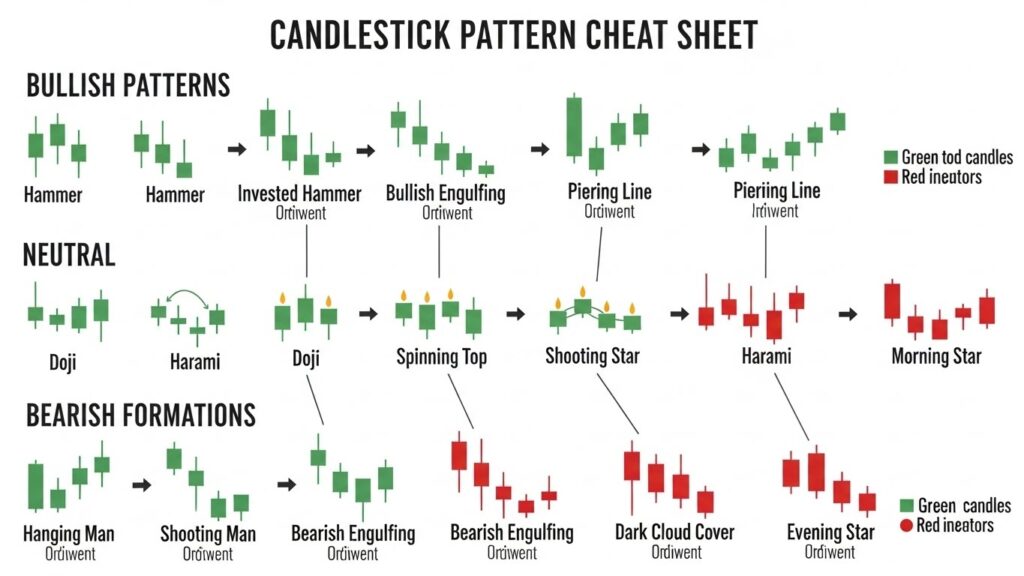
Single Candlestick Patterns
Hammer (Bullish)
Small body at top
Long lower wick (2-3× body length)
Little or no upper wick
Forms at support
Signals: Sellers tried, buyers won
Shooting Star (Bearish)
Small body at bottom
Long upper wick (2-3× body length)
Little or no lower wick
Forms at resistance
Signals: Buyers tried, sellers won
Pin Bar (Reversal)
Long wick in one direction
Small body opposite end
Nose (wick) shows rejection
Strong reversal signal
Best at key levels
Doji (Indecision)
Open equals close (or very close)
Represents indecision
At trend extremes signals potential reversal
Mid-trend often meaningless
Engulfing Candles
Bullish Engulfing:
Previous red candle
Current green candle completely engulfs it
Body of current candle covers previous entirely
Strong bullish signal
Bearish Engulfing:
Previous green candle
Current red candle completely engulfs it
Body covers previous candle
Strong bearish signal
Multi-Candlestick Patterns
Morning Star (Bullish Reversal):
Long red candle (downtrend)
Small-bodied candle (indecision)
Long green candle (reversal)
Forms at support
Signals: Downtrend exhaustion, buyers entering
Evening Star (Bearish Reversal):
Long green candle (uptrend)
Small-bodied candle (indecision)
Long red candle (reversal)
Forms at resistance
Signals: Uptrend exhaustion, sellers entering
Three White Soldiers (Bullish):
Three consecutive green candles
Each closes near its high
Steady progression upward
Shows strong buying pressure
Three Black Crows (Bearish):
Three consecutive red candles
Each closes near its low
Steady progression downward
Shows strong selling pressure
Pattern importance:
Context matters most
Patterns at key levels more reliable
Larger timeframe patterns stronger
Confirm with market structure
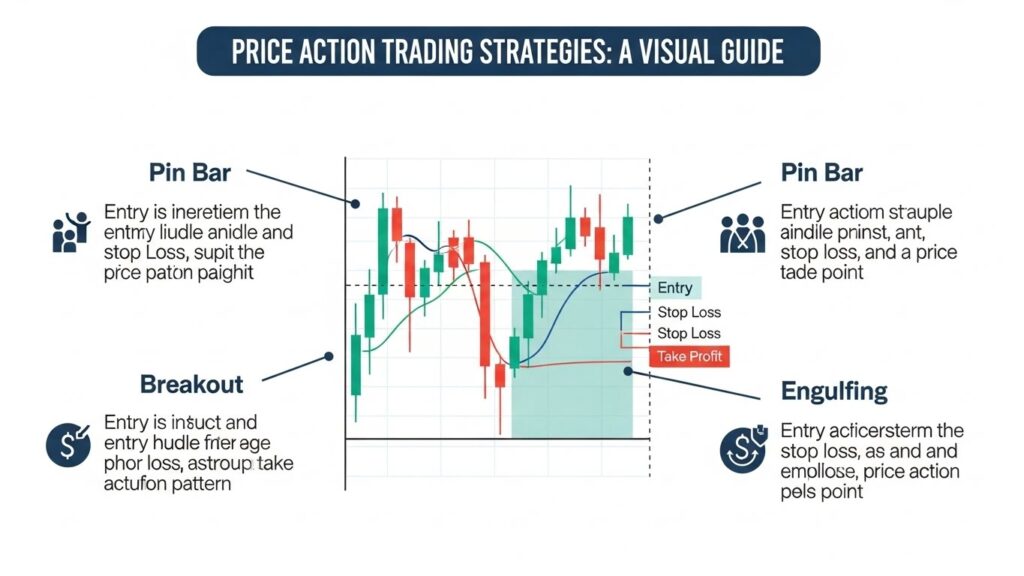
Price Action Trading Strategies
Strategy 1: Pin Bar Reversal
Trade rejection candles at key levels.
Setup requirements:
Clear support or resistance level
Pin bar forms at level
Long wick shows rejection (2-3× body)
Small body at opposite end
Entry rules (Bullish pin bar):
Pin bar forms at support
Long lower wick (rejection of lower prices)
Small body at top of candle
Enter at close of pin bar OR
Enter on break of pin bar high (more conservative)
Stop-loss: Below pin bar low
Target: Next resistance or 2× risk
Entry rules (Bearish pin bar):
Pin bar forms at resistance
Long upper wick (rejection of higher prices)
Small body at bottom
Enter at close OR break of pin bar low
Stop-loss: Above pin bar high
Target: Next support or 2× risk
Best practices:
Trade HTF pin bars (H4, Daily)
Require clear level confluence
Bigger wick = stronger signal
Body should be 1/3 or less of total candle
Win rate: 60-70% at quality levels
Strategy 2: Engulfing Pattern Trading
Trade strong sentiment shifts.
Bullish engulfing setup:
Downtrend or at support
Red candle followed by larger green candle
Green candle body completely covers red body
Shows: Buyers overwhelmed sellers
Enter at close of engulfing candle
Stop: Below engulfing candle low
Target: Previous swing high or 2× risk
Bearish engulfing setup:
Uptrend or at resistance
Green candle followed by larger red candle
Red candle body completely covers green body
Shows: Sellers overwhelmed buyers
Enter at close of engulfing candle
Stop: Above engulfing candle high
Target: Previous swing low or 2× risk
Confirmation factors:
Engulfing candle much larger (1.5-2×)
Forms at key support/resistance
HTF engulfing (H4+) more reliable
Volume increase (if available)
False signals:
Small engulfing candles (weak sentiment)
Mid-trend (no key level)
LTF engulfing (M5, M15 too noisy)
Strategy 3: Support/Resistance Bounce
Trade when price respects key levels.
The concept:
Price approaches support/resistance
Shows respect for level
Bounces with momentum
Clear rejection
Bounce entry process:
Identify strong S/R level (3+ touches)
Price approaches level
Reversal candle forms (pin bar, engulfing, hammer)
Enter at close of reversal candle
Stop: Beyond the level (20-30 pips)
Target: Opposite S/R or measured move
Bounce confirmation:
Don’t enter on level touch alone
Wait for reversal candle
Check for fake-out attempts
Ensure level hasn’t broken
Multiple timeframe approach:
HTF level (Daily)
Wait for approach
LTF reversal pattern (H1, H4)
Enter with tight stop
Strategy 4: Breakout and Retest
Trade role reversal after breakout.
Setup:
Price breaks resistance (bullish)
Extends beyond level
Pulls back to test broken level
Old resistance becomes new support
Rejection candle forms at retest
Enter long at close
Stop: Below retest low
Target: Measured move or next resistance
Why this works:
Level flips role (resistance → support)
Trapped traders want out at breakeven
New traders join at proven level
Creates high-probability setup
Requirements:
Clean initial break
Strong momentum on breakout
Clear rejection at retest
Reversal candle pattern
Success rate: 70-75% when all factors present
Strategy 5: Trend Continuation
Trade pullbacks in established trends.
Trend continuation setup:
Identify clear trend (HH and HL, or LH and LL)
Price pulls back to support (uptrend)
Reversal candle at support
Structure intact (no break)
Enter at close
Stop: Below pullback low
Target: Previous high or trailing stop
Key rules:
Only trade WITH trend direction
Wait for pullback to key level
Require reversal signal
Don’t chase (let price come to you)
Best levels for entries:
Trendline bounces
Previous resistance (now support)
Round numbers
Fibonacci retracements (50%, 61.8%)
Reading Market Context
Trending vs Ranging Markets
Trending market characteristics:
Clear HH and HL (or LH and LL)
Pullbacks shallow (don’t retrace much)
Momentum strong in trend direction
Rejections at counter-trend levels
Strategy: Trade pullbacks WITH trend
Ranging market characteristics:
Equal highs and lows
Deep retracements (full range)
No clear direction
Both boundaries holding
Strategy: Trade bounces at boundaries
Transition periods:
Structure breaking
Indecision candles
Choppy, erratic movement
Strategy: Stay out, wait for clarity
Market Momentum
Strong momentum signals:
Large bodied candles
Small wicks
Series of same-colored candles
Fast price movement
Little hesitation
Weak momentum signals:
Small candles
Large wicks
Doji candles
Slow, grinding movement
Multiple rejections
Trading momentum:
Strong momentum: Trade WITH it
Weak momentum: Expect reversal
Momentum shifts: Major trading signals
Price Action Risk Management
Stop-Loss Placement
Structure-based stops:
Below swing low (long trades)
Above swing high (short trades)
Beyond reversal candle
Outside supply/demand zone
Good stop-loss characteristics:
Logical level (price structure)
Respects volatility (not too tight)
Invalidates thesis if hit
Not arbitrary distance
Bad stop-loss placement:
Random pip distance
Too tight (normal volatility hits it)
Within consolidation zones
At obvious levels (stop hunts)
Position Sizing
Calculate based on structure:
Identify entry point
Identify logical stop (swing low/high)
Measure distance in pips
Calculate position size for 1% risk
Adjust if stop too wide (reduce size)
Example:
Entry: 1.1000
Stop: 1.0950 (50 pips)
Account: $10,000
Risk: 1% = $100
Position: 0.2 lots
Profit Targets
Structure-based targets:
Previous swing high/low
Key S/R levels
Supply/demand zones
Round numbers
Measured moves from patterns
Trailing stops:
Trail behind each swing
Protects profits
Lets winners run
Exit on structure break
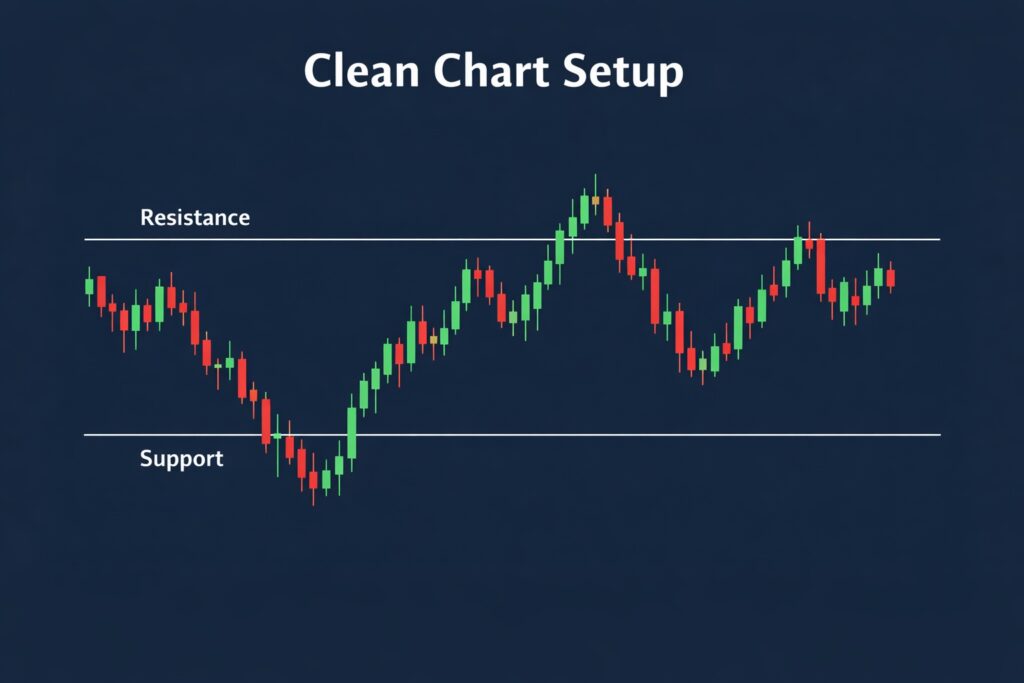
Clean Chart Setup
Price action requires clean, uncluttered charts.
Essential elements only:
Candlesticks (primary focus)
Support/resistance lines (horizontal)
Supply/demand zones (rectangles)
Optional: One MA (50 or 200)
Remove from chart:
Multiple indicators
Oscillators
Extra moving averages
News feeds
Unnecessary clutter
Visual setup:
White or black background
Clear candlestick colors
Thin gridlines or none
Clean, minimalist
Easy to read
TIP: If your chart looks like a Christmas tree with indicators, you’re not doing price action. Keep it simple.
Common Price Action Mistakes
Beginner Errors
1. Ignoring Context
Error: Trading patterns without checking trend
Fix: Always assess market structure first
2. Trading Every Pattern
Error: Every pin bar is a trade
Fix: Only trade patterns at key levels
3. No Confirmation
Error: Entering before candle close
Fix: Wait for candle to close, confirm pattern
4. Wrong Timeframe
Error: Trading M5 pin bars
Fix: Use H4 and Daily for reliability
5. Arbitrary Stops
Error: “I’ll use 50 pip stop”
Fix: Place stops based on structure
6. Overcomplicating
Error: Adding indicators “to help”
Fix: Trust price action, stay simple
7. No Patience
Error: Forcing trades when no setup
Fix: Wait for quality setups at key levels
Advanced Challenges
False patterns:
Not all pin bars work
Not all engulfing candles work
Context is everything
Quality over quantity
Stop hunting:
Market makers hunt obvious stops
Don’t place stops at exact swing points
Give 10-20 pip buffer
Subjectivity:
Support/resistance somewhat subjective
Mark only obvious levels
If questionable, skip it
Price Action Checklist
Pre-Trade Analysis
[ ] Market structure identified (trend/range
[ ] Key S/R levels marked
[ ] Supply/demand zones identified
[ ] Trading WITH structure, not against
[ ] Using H4 or Daily timeframe
Pattern Validation
[ ] Clear reversal pattern formed
[ ] Pattern at key level (S/R, supply/demand)
[ ] Candle closed (pattern complete)
[ ] Pattern quality high (clear rejection)
[ ] Context appropriate (not mid-range)
Trade Execution
[ ] Entry at pattern close or break
[ ] Stop-loss beyond structure
[ ] Risk 1% maximum
[ ] Profit target identified
[ ] Risk-reward minimum 1:2
Trade Management
[ ] Move to breakeven at 1:1
[ ] Trail stop behind swings
[ ] Exit if structure breaks
[ ] Don’t move stop wider
[ ] Trade logged in journal
Developing Price Action Trading Skills
Practice Routine
Daily review (15 minutes):
Mark key S/R levels
Identify market structure
Note supply/demand zones
Mark quality patterns
Review previous trades
Weekly analysis (30 minutes):
Review all trades
What worked? What didn’t?
Were patterns at quality levels?
Did you follow rules?
Adjust approach if needed
Screen time matters:
100+ hours to recognize patterns
500+ hours to trade proficiently
1,000+ hours to master
No shortcuts, just screen time
Resources for Learning
Best practices:
Study historical charts
Mark levels in hindsight
See what worked, what failed
Build pattern library
Screenshot quality setups
Trading journal:
Screenshot every trade
Mark entry, stop, target
Note why you entered
Review monthly
Identify patterns in your trading
Price action trading is widely recognized by leading trading educators including Investopedia and is regulated in the US by the CFTC and NFA, with UK brokers overseen by the FCA
Conclusion: The Purest Form of Trading
Price action trading is how professional traders analyze markets. It’s simple but not easy. Mastery requires:
Key principles:
Context is king: Structure before patterns
Quality over quantity: Wait for perfect setups
Key levels only: Trade obvious S/R, ignore noise
Clean charts: Remove indicators, trust price
Patience essential: Best traders wait for setup
The truth:
Price action trading is simple (not easy)
Requires discipline and patience
Screen time builds skill
No holy grail patterns
Context makes patterns work
Success formula:
Learn to identify structure
Mark only key S/R levels
Wait for price to reach level
Identify reversal pattern
Enter with proper risk management
Manage trade professionally
Why price action trading works:
Universal (works everywhere)
Timeless (always will work)
Clean and simple
No lag (unlike indicators)
Foundation of all trading
Start with clean charts. Master structure. Learn patterns. Wait for quality. Execute with discipline.
Price action trading is the language of the market. Learn to read it fluently.