Learn How to Make Fast Money by Learning diffrent Strategies in Forex Trading and Different Investment Options
News Trading Guide: Trading Economic Events
News trading involves capitalizing on volatility and price movements triggered by scheduled economic data releases and central bank announcements. When done correctly, news trading offers explosive profit potential, but it also carries significant risk.
This guide teaches you how to trade news events safely and profitably.
News trading is a strategy where traders take positions based on expected or actual economic data releases, central bank decisions, and major geopolitical events.
Two main approaches:
Pre-news positioning: Enter before news based on expectations
Post-news trading: React to actual data after release
Why News Moves Markets
Market reality:
Economic data affects currency values
Central banks respond to economic data
Traders anticipate and react to news
Large institutional orders triggered by news
Creates explosive volatility
Volatility characteristics:
Normal day: 50-100 pip range
Major news day: 150-300+ pip moves
In minutes or even seconds
Can exceed daily average range in minutes
💡 KEY INSIGHT: A single major news event can produce more profit (or loss) in 5 minutes than a week of normal trading.
Types of Market-Moving News
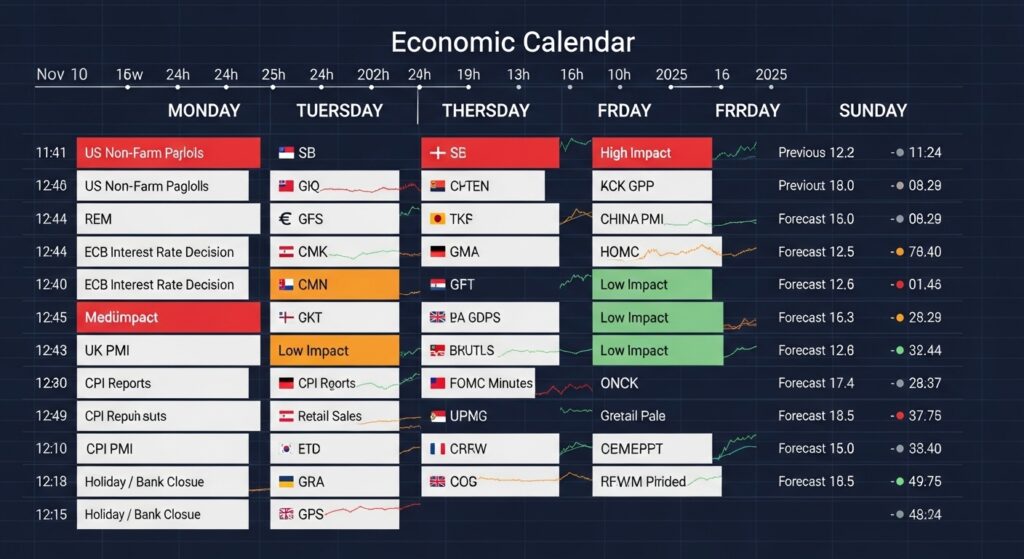
High-Impact Economic Data
Tier 1 Events (Extreme Impact):
United States:
Non-Farm Payrolls (NFP): Monthly employment data
Released: First Friday of month, 8:30 AM ET
Impact: 100-200+ pips typical
Moves: USD pairs violently
Federal Reserve Decisions (FOMC): Interest rate announcements
Released: 8 times per year, 2:00 PM ET
Impact: 150-300+ pips
Moves: All USD pairs
CPI (Consumer Price Index): Inflation data
Released: Monthly, 8:30 AM ET
Impact: 80-150 pips
Moves: USD pairs strongly
Eurozone:
ECB Interest Rate Decisions: European Central Bank
Impact: 100-200 pips on EUR pairs
United Kingdom:
BOE Interest Rate Decisions: Bank of England
Impact: 100-200 pips on GBP pairs
Tier 2 Events (High Impact):
GDP (Gross Domestic Product)
Retail Sales
Unemployment Rate
PMI (Purchasing Managers Index)
Trade Balance
Tier 3 Events (Moderate Impact):
Housing data
Consumer confidence
Manufacturing data
Minor central bank speeches
[IMAGE 1 – INSERT HERE]
Central Bank Announcements
Most impactful events:
Federal Reserve (Fed):
Interest rate decisions
FOMC statements
Press conferences
Meeting minutes
Impacts: All USD pairs
European Central Bank (ECB):
Rate decisions
Policy statements
Impacts: EUR pairs
Bank of England (BOE):
Rate decisions
MPC votes
Impacts: GBP pairs
Bank of Japan (BOJ):
Rate decisions (rare changes)
Policy statements
Impacts: JPY pairs
Geopolitical Events
High-impact events:
Elections (presidential, parliamentary)
Brexit-type referendums
Major policy changes
Trade war announcements
Geopolitical crises
Characteristics:
Often unexpected
Can override technical analysis
Create sustained trends
Difficult to trade (high uncertainty)
News Trading Strategies
Strategy 1: Straddle Strategy (Pending Orders)
Place orders both directions before news, catch the breakout.
Setup process:
30 minutes before news:
Identify current range
Mark recent high and low
Calculate range width
Place pending orders:
Buy stop: 20-30 pips above high
Sell stop: 20-30 pips below low
Equal distance from current price
Set stops on BOTH orders:
Buy stop SL: 30-50 pips below entry
Sell stop SL: 30-50 pips above entry
When news releases:
One order triggers
Other order cancels automatically (OCO)
Let trade run
Management:
Move to breakeven quickly (20-30 pips)
Trail stop aggressively
Take partial profits at 50-100 pips
Advantages:
Catch move regardless of direction
No need to predict outcome
Mechanical, no emotion
Can catch full move
Disadvantages:
Whipsaw risk (both orders hit)
Wide spreads during news
Slippage on entry
Fast-moving market
Best for:
Major news (NFP, FOMC)
Binary outcomes
High volatility events
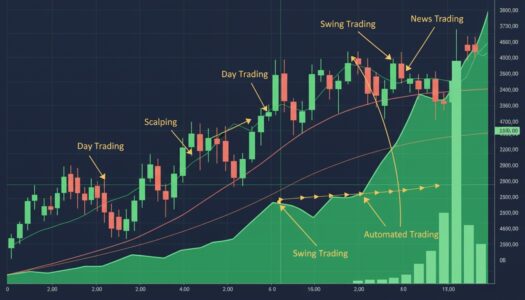
Strategy 2: Fade the Spike
Trade against initial overreaction, expecting reversion.
The concept:
News creates knee-jerk reaction
Price overshoots rational level
Market corrects back
Trade the correction
Entry process:
Wait for news release
Let initial spike complete (2-5 minutes)
Identify extreme:
100+ pip spike in one direction
Extension beyond recent range
Panic candles (long wicks)
Enter opposite direction:
Enter when momentum slows
Look for reversal candle
Enter against the spike
Stop-loss: Beyond spike extreme
Target: 50% retracement of spike
Requirements:
Massive initial spike (100+ pips)
Clear overextension
Signs of exhaustion (long wicks, slowing)
Strong level nearby (S/R)
When to avoid:
Fundamental shift major (rate change)
Strong directional conviction
No clear overextension
Low liquidity
Success rate: 60-70% with proper setup
[IMAGE 2 – INSERT HERE]
Strategy 3: Trade the Trend (Post-News)
Let initial volatility settle, then trade emerging trend.
Approach:
Don’t trade during news (too volatile)
Wait 30-60 minutes after release
Analyze result:
Clear direction emerged?
Trend forming?
Support/resistance respected?
Enter with trend:
Price pulled back from initial spike
Reversal candle at key level
Enter in spike direction
Stop: Beyond pullback
Target: Extension of spike
Why this works:
Avoid initial whipsaw
Let market digest news
Trade with established direction
Better risk-reward
Best practices:
Wait for clear trend formation
Don’t chase (let price come to you)
Use smaller position size
Trail stops aggressively
Strategy 4: Pre-News Positioning (Advanced)
Enter before news based on expectations.
High-risk approach:
Analyze consensus expectations
Position based on likely outcome
Exit immediately after news
Don’t hold through release
Requirements:
Deep fundamental understanding
Clear consensus expectation
Binary outcome expected
Tight risk management
Example:
Inflation expected to rise
Current rate: 2.1%, expected: 2.3%
If hits 2.3%+: Bullish for currency
Position: Long before news
Exit: Immediately on release
Risks:
Unexpected outcomes
Market already priced in
Slippage
Gap risk
Recommendation: Only for experienced traders with deep fundamental knowledge.
Risk Management for News Trading
Position Sizing
Conservative approach:
Risk maximum 0.5-1% per news trade
Half your normal position size
News more unpredictable than technical
Protect capital
Never:
Risk more than 2% on news
Trade with full position size
Hold multiple positions during news
Overtrade news events
Stop-Loss Considerations
Wider stops necessary:
Normal: 30-50 pips
News trading: 50-100 pips
Volatility much higher
Avoid premature stop-outs
Stop placement:
Beyond recent swing
Account for spike potential
Consider ATR (use 3-4× ATR)
Don’t place at obvious levels (hunted)
Managing Spread Widening
The problem:
Normal spread: 1-2 pips
During news: 5-20+ pips
Drastically affects profitability
Can stop you out unfairly
Solutions:
Use limit orders when possible
Avoid market orders during spike
Wait for spread to normalize
Factor spread into R:R calculation
Consider ECN brokers (better spreads)
News Trading Mistakes to Avoid
Common Errors
1. Trading Major News Without Experience
Error: First time trading NFP with live account
Risk: Account blow-up
Fix: Practice on demo first, 10+ news events
2. Using Too Much Leverage
Error: Full position size on news trade
Risk: Margin call
Fix: Half position, 0.5-1% risk maximum
3. No Stop-Loss
Error: “I’ll watch it and exit manually”
Risk: Frozen during volatility, huge loss
Fix: Always set stop before news
4. Holding Through News
Error: “I’ll hold my swing trade through NFP”
Risk: Stop-out, large unexpected loss
Fix: Close positions before major news or use very wide stops
5. Chasing the Spike
Error: Entering as price spikes 100 pips
Risk: Buying top, immediate reversal
Fix: Wait for pullback or fade the extreme
6. Overtrading News
Error: Trading every news event
Risk: Death by a thousand cuts
Fix: Trade only Tier 1 events, 1-2 per week maximum
News trading isn’t necessary for success. Many profitable traders avoid it entirely. If you choose to trade news, respect the volatility and manage risk carefully.
Master normal trading first. News trading is advanced, optional, and extremely risky.