Last Updated: November 2025
Forex swing trading is the perfect forex strategy for traders who have full-time jobs or businesses but still want to profit from currency markets. Unlike scalping or day trading that require constant monitoring, swing trading allows you to capture larger price movements over days or weeks with just 1-2 hours of analysis daily. This guide covers everything you need to master forex swing trading and build consistent profits while maintaining your regular life.
What is Forex Swing Trading?
Swing trading involves holding positions for multiple days to weeks, aiming to capture medium-term price “swings” within larger trends. Swing traders combine technical and fundamental analysis to identify high-probability setups and then patiently wait for trades to develop.
Key Characteristics:
Time Horizon:
- Hold positions: 2 days to 4 weeks typically
- Entry decisions: 1-2 hours daily
- Position monitoring: 2-3 times daily (15 minutes each)
Profit Targets:
- 100-500 pips per trade
- Larger moves than day trading
- Fewer trades but bigger wins
Trading Frequency:
- 2-10 trades per week
- 5-20 trades per month
- Quality over quantity
Analysis Style:
- 60% technical analysis
- 40% fundamental awareness
- Multi-timeframe approach
Why Swing Trading Works for Most People
Compatible with Full-Time Work:
- Analyze markets in the evening (30-60 minutes)
- Check positions on lunch break
- Weekend planning and review
- No need to watch charts all day
Better Risk/Reward:
- Target 1:3 to 1:5 ratios
- Risk 50 pips to gain 200+ pips
- Larger stops allow trades to “breathe”
Lower Stress:
- Not reacting to every price tick
- Make decisions calmly with time
- Less emotional involvement
- Better work-life balance
Fundamental Edge:
- Time to analyze economic factors
- Can hold through short-term noise
- Benefit from major trend developments
Swing Trading vs. Other Styles
| Feature | Scalping | Day Trading | Swing Trading | Position Trading |
|---|---|---|---|---|
| Hold Time | Seconds-Minutes | Minutes-Hours | Days-Weeks | Weeks-Months |
| Pips/Trade | 5-20 | 20-80 | 100-500 | 500-5000 |
| Trades | 20-100/day | 2-10/day | 2-10/week | 1-5/month |
| Screen Time | 4-8 hours | 4-8 hours | 1-2 hours | 30 min/day |
| Stress | Very High | High | Moderate | Low |
| Full-Time Job? | No | Difficult | Yes | Yes |
| Analysis | Technical | Technical | Both | Fundamental |
Advantages of Swing Trading
Time Flexibility
Morning Routine (15 minutes):
- Check overnight price action
- Review open positions
- Adjust stops if needed
- Check economic calendar
Evening Analysis (45-60 minutes):
- Scan charts for new setups
- Analyze potential trades
- Place pending orders
- Update trade journal
Weekend Planning (1-2 hours):
- Review past week’s trades
- Mark key levels for coming week
- Plan potential setups
- Study market fundamentals
Better Risk/Reward Ratios
Typical Day Trade:
- Risk: 30 pips
- Target: 60 pips
- Ratio: 1:2
Typical Swing Trade:
- Risk: 80 pips
- Target: 280 pips
- Ratio: 1:3.5
With better ratios, you can have a lower win rate and still profit.
Less Emotional Trading
Problems with Day Trading:
- Constant price watching creates stress
- Every tick matters
- Quick decisions under pressure
- Overtrading temptation
Forex Swing Trading Benefits:
- Set and forget approach
- Decisions made calmly
- Less temptation to overtrade
- Can walk away from screen
Cost Efficiency
Spread Costs:
- Day trader: 10 trades × 2 pips = 20 pips daily spread cost
- Swing trader: 2 trades × 2 pips = 4 pips weekly spread cost
Lower frequency = lower transaction costs eating into profits.
Disadvantages to Consider
Overnight Risk
Gap Risk:
- Markets can gap over weekends
- News events after hours
- Central bank surprise announcements
Mitigation:
- Check economic calendar
- Reduce size before major events
- Use guaranteed stop-loss (if available)
- Don’t overleverage
Swap Fees
Rollover Costs:
- Charged nightly for holding positions
- Can be positive or negative
- Adds up over weeks
Solution:
- Choose pairs with favorable swaps
- Factor swap into profit calculations
- Consider swap-free Islamic accounts
Fewer Opportunities
Reality:
- 5-10 good setups per week vs. 20+ daily for day trading
- Need patience waiting for quality setups
- Can’t force trades
Mindset:
- Quality over quantity
- Patience is profitable
- Perfect setup > many mediocre ones
Requires Patience
Mental Challenges:
- Watching positions in drawdown for days
- Resisting urge to close early
- Trusting your analysis
- Not checking charts every hour
Solution:
- Set stop-loss and take-profit
- Review once daily maximum
- Focus on process, not outcome
- Build confidence through demo trading
Best Currency Pairs for Swing Trading
Major Pairs (Most Recommended)
EUR/USD:
- Tightest spreads
- Smooth trends
- Predictable behavior
- Best for beginners
GBP/USD:
- Larger swings (volatility)
- Clear trends
- Good risk/reward potential
- Requires slightly wider stops
AUD/USD:
- Commodity-driven
- Strong trends
- Clear technical patterns
- Good fundamentals to follow
USD/CAD:
- Oil price correlation
- Trending behavior
- Clear support/resistance
- Lower volatility than GBP
Minor Pairs (For Experienced Traders)
EUR/GBP:
- Strong range-bound tendencies
- Good for range trading
- Lower volatility
- Predictable swings
AUD/NZD:
- Excellent trends
- Related economies
- Clear technical setups
- Good for trend following
GBP/JPY:
- Large swings (200-500 pips)
- High volatility
- Not for beginners
- Best for experienced swing traders
Pairs to Avoid
Exotic Pairs:
- Wide spreads
- Low liquidity
- Unpredictable movements
- High swap costs
EUR/CHF:
- Low volatility
- Small swings
- SNB intervention risk
- Poor for swing trading
Timeframes for Forex Swing Trading
Multi-Timeframe Analysis
Successful forex swing traders use three timeframes:
Higher Timeframe (Trend Direction):
- Daily (D1): Main trend analysis
- Weekly (W1): Major support/resistance
- Purpose: Determine market direction
Medium Timeframe (Setup Identification):
- 4-Hour (H4): Find trade setups
- Purpose: Identify swing points and patterns
Lower Timeframe (Entry Timing):
- 1-Hour (H1): Precise entry timing
- Purpose: Fine-tune entry, set stops
The Top-Down Approach
Step 1: Weekly Chart
- Identify major trend
- Mark key support/resistance zones
- Note overall market structure
Step 2: Daily Chart
- Confirm trend direction
- Find potential swing levels
- Identify chart patterns
Step 3: 4-Hour Chart
- Wait for price to reach key level
- Look for reversal/continuation patterns
- Identify specific entry setup
Step 4: 1-Hour Chart
- Fine-tune entry point
- Set precise stop-loss
- Determine exact entry trigger
Forex Swing Trading Strategies
Strategy 1: Trend Following
Concept: Trade pullbacks within established trends
Setup:
- Identify trend on Daily chart (price above/below 50 MA)
- Wait for pullback to key level (previous support becomes resistance)
- Enter when price resumes trend direction
- Target swing high/low
Example – Uptrend:
- Daily: EUR/USD above 50 MA (uptrend)
- H4: Price pulls back to 1.0850 (previous resistance)
- H1: Bullish pin bar forms at 1.0850
- Entry: 1.0855 (above pin bar)
- Stop: 1.0820 (35 pips below)
- Target: 1.0950 (95 pips – previous swing high)
- Risk/Reward: 1:2.7
Entry Confirmation:
- Candlestick reversal pattern at pullback level
- RSI oversold (in uptrend) or overbought (in downtrend)
- Momentum showing on H1 chart
Strategy 2: Support and Resistance
Concept: Trade bounces from major S/R zones
Setup:
- Mark major S/R on Weekly/Daily charts
- Wait for price to reach these levels
- Look for rejection (pin bar, engulfing)
- Enter on confirmation
- Target opposite S/R zone
Example:
- Weekly: EUR/USD support at 1.0800
- Daily: Price approaches 1.0800
- H4: Forms bullish engulfing at 1.0805
- Entry: 1.0810
- Stop: 1.0775 (35 pips)
- Target: 1.0950 (resistance zone – 140 pips)
- Risk/Reward: 1:4
Key Points:
- Wait for confirmation (don’t anticipate)
- Support becomes resistance (and vice versa)
- Stronger levels have multiple touches
Strategy 3: Moving Average Crossovers
Concept: Trade MA crosses on Daily chart
Setup:
- Apply 50 EMA and 200 EMA on Daily chart
- Golden Cross (50 above 200) = Buy signal
- Death Cross (50 below 200) = Sell signal
- Enter on crossover
- Hold until opposite crossover
Advantages:
- Simple, objective rules
- Catches major trends
- Less screen time
Disadvantages:
- Lags (late entries)
- Whipsaws in ranging markets
- Works only in trending conditions
Enhancement:
- Use H4 chart for better entries after Daily crossover
- Add RSI filter (avoid overbought/oversold)
- Use with trend strength indicator
Strategy 4: Breakout Trading
Concept: Trade breakouts from consolidation
Setup:
- Identify consolidation on Daily/H4 (range, triangle, flag)
- Mark breakout levels
- Wait for strong breakout candle
- Enter on breakout or retest
- Target measured move
Example – Rectangle Breakout:
- H4: EUR/USD ranges between 1.0850-1.0900 for 2 weeks
- Range height: 50 pips
- Price breaks above 1.0900 with strong bull candle
- Entry: 1.0905 (on close above)
- Stop: 1.0875 (30 pips – back in range)
- Target: 1.0950 (50 pip measured move)
- Risk/Reward: 1:1.5
Confirmation:
- Strong momentum candle
- Increased volume (if available)
- Close clearly outside range
- No immediate reversal
Strategy 5: Fibonacci Retracements
Concept: Trade retracements to Fibonacci levels
Setup:
- Identify strong trend move (swing low to swing high)
- Apply Fibonacci retracement tool
- Wait for pullback to 38.2%, 50%, or 61.8% level
- Enter on reversal confirmation
- Target previous swing extreme or extension levels
Example:
- EUR/USD trends from 1.0750 to 1.0900 (150 pips)
- Pulls back to 61.8% level (1.0807)
- Bullish pin bar forms at 1.0807 (H4)
- Entry: 1.0812
- Stop: 1.0785 (27 pips)
- Target: 1.0900 (88 pips – previous high)
- Risk/Reward: 1:3.3
Most Reliable Levels:
- 50% (psychological midpoint)
- 61.8% (golden ratio)
- 38.2% (shallow retracement in strong trends)
Risk Management for Forex Swing Trading
Position Sizing
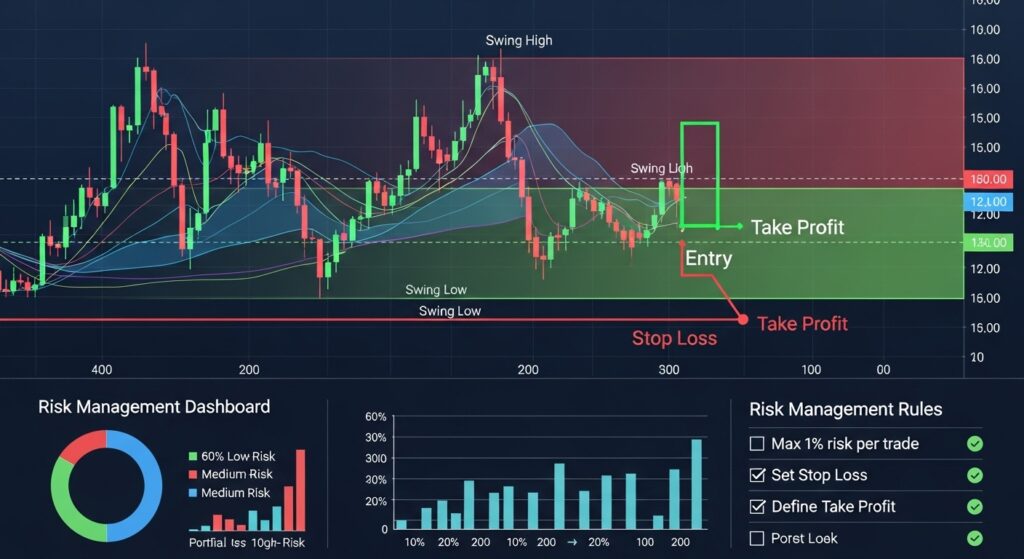
The 1-2% Rule:
- Risk maximum 1-2% of account per trade
- Accounts for larger stop-losses
- Allows multiple losing trades without significant damage
Calculation Example:
- Account: $5,000
- Risk: 2% = $100
- Stop-loss: 80 pips
- Pip value: $100 ÷ 80 = $1.25 per pip
- Position size: 0.125 lots (12,500 units)
Stop-Loss Placement
Methods:
Technical Levels:
- Below support (long) or above resistance (short)
- Most reliable method
- Typical range: 50-150 pips
ATR-Based:
- Stop = 1.5 × ATR (14 period on Daily)
- Adjusts to volatility
- Dynamic approach
Percentage:
- 2-3% from entry
- Simple but less optimal
Never:
- Mental stops (always use hard stops)
- Move stop against position
- Set stop based on dollar amount only
Take-Profit Strategies
Option 1: Fixed Target
- Set R:R ratio (1:3 minimum)
- Place and forget
- Simple, removes emotion
Option 2: Technical Target
- Previous swing high/low
- Major S/R level
- Fibonacci extension
- More sophisticated
Option 3: Trailing Stop
- Lock in profits as trade moves favorably
- Use ATR trailing stop
- Captures extended moves
- May exit prematurely
Option 4: Scale Out
- Close 50% at first target (1:2)
- Move stop to breakeven
- Let 50% run to second target (1:4)
- Balances locked profit with potential
Fundamental Analysis for Swing Traders
Economic Calendar Awareness
High-Impact Events to Monitor:
US Events:
- Non-Farm Payrolls (first Friday each month)
- FOMC interest rate decisions (8 times/year)
- CPI inflation data (monthly)
- GDP releases (quarterly)
Eurozone:
- ECB interest rate decisions
- German manufacturing PMI
- Eurozone CPI
UK:
- Bank of England rate decisions
- UK employment data
- UK GDP
Strategy:
Forex swing traders should monitor economic releases on Forex Factory and use brokers regulated by the CFTC and NFA in the US, or the FCA in the UK
- Check calendar weekly
- Reduce position size before major events
- Don’t enter new trades 24 hours before high-impact news
- Consider closing profits before weekend if major news due Monday
Interest Rate Trends
Hawkish = Bullish for Currency:
- Central bank considering rate hikes
- Strong economic data
- Inflation above target
Dovish = Bearish for Currency:
- Central bank considering rate cuts
- Weak economic data
- Deflation concerns
Application:
- Follow central bank communications
- Trade in direction of rate expectations
- Major trend changes happen on policy shifts
Economic Divergence
Concept: Trade currencies with diverging economic paths
Example:
- US economy strengthening (Fed hawkish)
- Eurozone economy weakening (ECB dovish)
- Trade: Sell EUR/USD (long-term downtrend expected)
This fundamental bias guides which direction you take technical setups.
Technical Indicators for Forex Swing Trading
Essential Indicators
Moving Averages:
- 50 EMA (short-term trend)
- 200 EMA (long-term trend)
- Use: Trend direction, support/resistance
RSI (Relative Strength Index):
- Settings: RSI(14) on Daily
- Use: Overbought (>70), oversold (<30)
- Divergence spotting
MACD:
- Settings: 12, 26, 9
- Use: Trend changes, momentum
- Crossovers for entry/exit
Bollinger Bands:
- Settings: 20, 2 on H4/Daily
- Use: Volatility, overbought/oversold
- Squeeze indicates upcoming move
Advanced Tools
Fibonacci:
- Retracements: 38.2%, 50%, 61.8%
- Extensions: 127.2%, 161.8%
- Use: Pullback entries, profit targets
Pivot Points:
- Calculate daily/weekly pivots
- Use: Support/resistance levels
- Entry/exit targets
ADX (Trend Strength):
- Above 25 = strong trend
- Below 20 = weak trend, ranging
- Use: Filter trades (only trade in trends)
Trading Psychology for Swing Traders
Patience Development
Challenges:
- Waiting days for trades to develop
- Watching drawdowns without panicking
- Not checking charts every hour
- Resisting urge to close winners early
Solutions:
- Set alerts instead of watching
- Review only once daily
- Trust your analysis
- Focus on other activities
Dealing with Overnight Holds
Mental Preparation:
- Accept overnight risk as part of strategy
- Size positions appropriately
- Use guaranteed stops if very risk-averse
- Check positions morning and evening only
Avoid:
- Checking charts before bed (causes poor sleep)
- Obsessing over open positions
- Moving stops due to anxiety
- Closing winners prematurely
Managing Losing Streaks
Reality:
- 3-5 consecutive losses are normal
- Even with 60% win rate, losing streaks occur
- Don’t abandon strategy after few losses
Response:
- Review trades objectively
- Check if you followed rules
- If following rules, continue
- Take break if emotionally affected
- Reduce size temporarily if needed
Forex Swing Trading Routine
Sunday Evening (1-2 hours)
Weekly Preparation:
- Review last week’s trades (journal)
- Check economic calendar for coming week
- Scan Daily charts for potential setups
- Mark key levels on multiple pairs
- Set alerts for important levels
- Plan potential trades for the week
Weekday Evening (30-45 minutes)
Daily Analysis:
- Check open positions (5 min)
- Any stop/target adjustments needed?
- Any breaking news affecting positions?
- Scan charts for new setups (20 min)
- Review 5-7 currency pairs
- Look for entries at key levels
- Place pending orders if applicable (10 min)
- Update trade journal (10 min)
Morning Check (10-15 minutes)
Before Work:
- Check overnight price action
- Review open positions
- Check economic calendar
- Quick news scan
- Adjust stops if needed (move to breakeven if in profit)
Lunch Break (5-10 minutes)
Midday Review:
- Quick position check
- Any alerts triggered?
- Major news developments?
Note: This level of monitoring is optional but recommended for active management.
Tools and Technology
Essential Setup
Trading Platform:
- MetaTrader 4 or 5 (most common)
- TradingView (excellent charting)
- Broker’s proprietary platform
Devices:
- Computer for analysis (evening)
- Smartphone for monitoring (daytime)
- Tablet optional
Internet:
- Regular internet sufficient (no super-fast required)
- Mobile data backup
Helpful Tools
Economic Calendar:
- ForexFactory.com
- Investing.com
- DailyFX.com
Trade Journal:
- Edgewonk (paid)
- MyFXBook (free)
- Excel/Google Sheets (manual)
Alerts:
- Price alerts on platform
- Email/push notifications
- Set at key levels
Analysis:
- TradingView for charting
- Stockcharts.com
- Broker research tools
Demo Trading Practice Plan
Phase 1: Learning (Month 1)
Goals:
- Understand forex swing trading concepts
- Learn technical and fundamental analysis
- Practice chart reading
Activities:
- Study this guide thoroughly
- Watch forex swing trading videos
- Read forex swing trading books
- Paper trade without demo account
Phase 2: Demo Trading (Months 2-3)
Goals:
- Prove strategy works
- Build confidence
- Develop routine
Activities:
- Open demo account
- Trade one strategy only
- Take 2-5 trades per week
- Keep detailed journal
- Review weekly
Success Metrics:
- Win rate: 50%+
- Risk/reward: 1:2 minimum
- Follow rules consistently
- Positive after 20+ trades
Phase 3: Small Live (Month 4)
Goals:
- Transition to real money
- Manage psychology
- Prove demo success transfers
Activities:
- Open live account ($500-$1,000)
- Trade micro/mini lots
- Same strategy as demo
- Focus on psychology
- Continue journaling
Success Criteria:
- Profitable for 2-3 months on live
- Emotional control maintained
- Consistent execution
Phase 4: Scale Up (Months 5-6+)
Goals:
- Gradually increase position size
- Build track record
- Develop long-term approach
Activities:
- Increase capital as profitable
- Maintain same risk % (don’t increase risk)
- Refine strategy
- Consider multiple pairs
Common Forex Swing Trading Mistakes
Mistake 1: Taking Too Many Trades
Problem: Forcing setups that aren’t optimal
Solution: Quality over quantity. Wait for perfect setups matching all criteria.
Mistake 2: Closing Winners Too Early
Problem: Exiting at first sign of profit due to fear
Solution: Set target at entry, let it run. Don’t check intraday progress.
Mistake 3: Ignoring Fundamentals
Problem: Trading against major fundamental trends
Solution: Always be aware of larger economic picture. Don’t fade strong fundamentals.
Mistake 4: Overleveraging
Problem: Using too much leverage, oversized positions
Solution: Risk only 1-2% per trade. Use position size calculator.
Mistake 5: Not Using Stop-Loss
Problem: “It’ll come back” mentality
Solution: Always use hard stops. No exceptions.
Mistake 6: Trading During Major News
Problem: Getting stopped out by volatility spikes
Solution: Avoid entering 24 hours before high-impact news. Consider exiting before NFP/FOMC.
Mistake 7: Checking Charts Constantly
Problem: Overmonitoring creates emotional decisions
Solution: Check once or twice daily maximum. Use alerts.
Success Metrics and Expectations
Realistic Targets
Monthly Returns:
- Beginners: 3-5% of account
- Intermediate: 5-10%
- Advanced: 10-15%
Win Rate:
- Target: 50-60%
- With 1:3 risk/reward, 40% win rate is profitable
- Focus on R:R over win rate
Monthly Activity:
- Trades per month: 10-25
- Quality setups only
- Don’t force trades
Time to Profitability
Realistic Timeline:
- Months 1-3: Learning and demo
- Months 4-6: Small live trading
- Months 7-12: Consistent profits
- Year 2+: Scaling up
Most traders need 12-24 months to become consistently profitable.
Next Steps: Your Action Plan
This Week:
- Open demo trading account
- Set up charts with proper timeframes
- Practice identifying trends on Daily charts
- Mark support/resistance zones
This Month:
- Take 5-10 swing trades on demo
- Keep detailed trade journal
- Review each trade objectively
- Study one setup pattern deeply
Months 2-3:
- Continue demo trading
- Achieve 20+ trades with positive results
- Refine your specific strategy
- Build confidence and consistency
Month 4+:
- Transition to small live account
- Maintain same approach as demo
- Focus on psychology and discipline
- Gradually scale as profits compound
Continue Your Forex Education:
Foundations:
Other Trading Styles:
Risk Management:
Technical Analysis:
Strategy Development:
Psychology:
Forex swing trading offers the perfect balance between profit potential and lifestyle flexibility. By holding positions for days to weeks, you can capture significant price movements without needing to watch charts constantly. Start with demo trading, prove your strategy works, and gradually transition to live trading as your confidence and consistency grow. Remember: patience and discipline are your greatest assets in forex swing trading.
Related Posts:








Powered by Contextual Related Posts