Forex indicators are mathematical calculations based on price, volume, or open interest that help traders identify trading opportunities and make better decisions. This comprehensive guide covers the most effective forex indicators and how to use them.
The most widely used forex indicators are documented by Investopedia. US forex trading is regulated by the CFTC and NFA, while UK brokers are overseen by the FCA
What Are Forex Indicators?
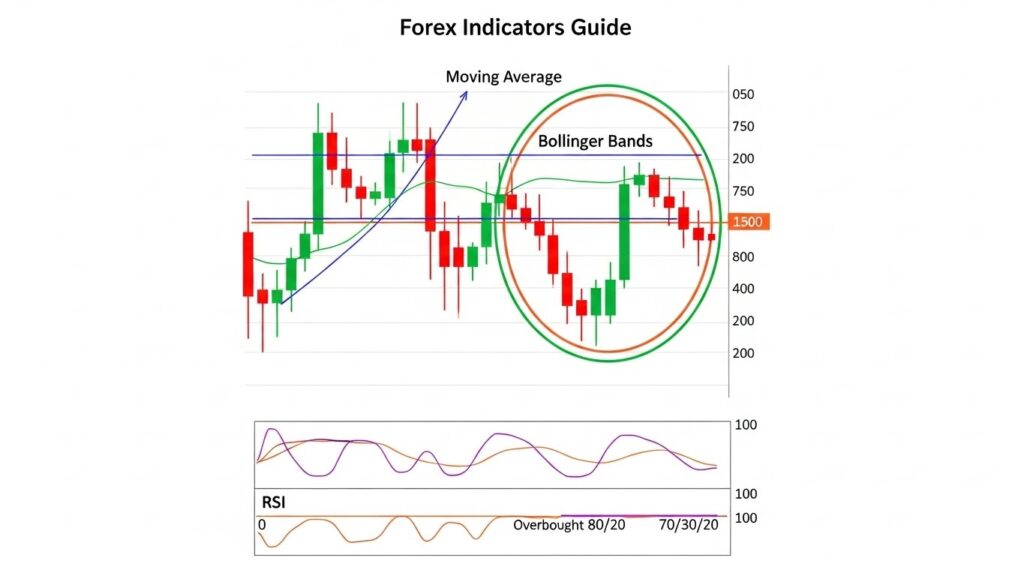
Forex indicators are tools that analyze historical price data to predict future price movements. They fall into four main categories:
1. Trend Indicators – Identify market direction 2. Momentum Indicators – Measure strength of price movements
3. Volatility Indicators – Measure market volatility 4. Volume Indicators – Analyze trading volume patterns
KEY INSIGHT: Forex Indicators are tools, not magic. They work best when combined with price action and proper risk management.
Moving Averages: The Foundation
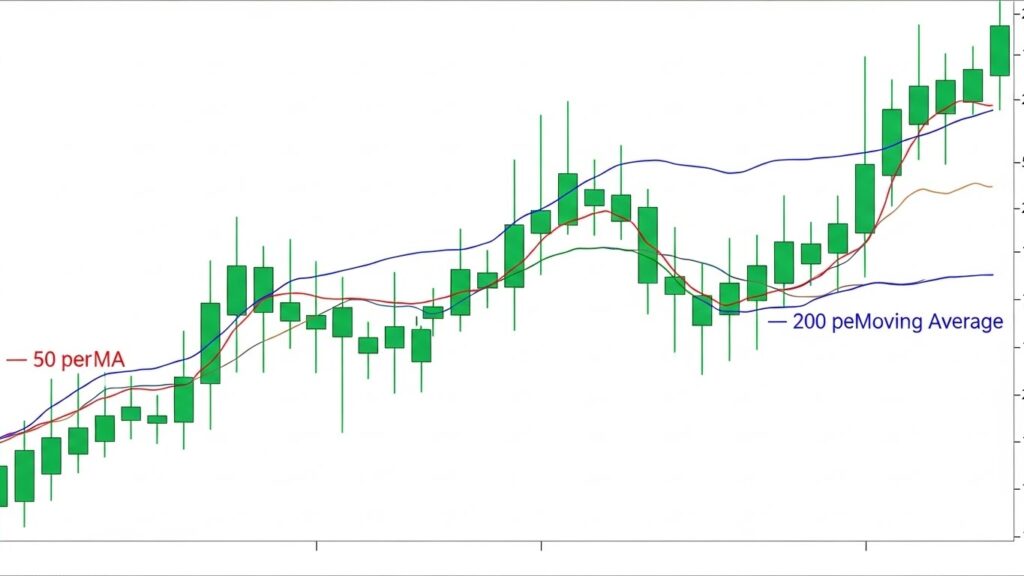
Moving averages smooth price data to identify trends and potential reversal points.
Simple Moving Average (SMA)
Calculates the average price over a specific period.
Formula:
SMA = Sum of Closing Prices ÷ Number of Periods
Example (10-period SMA):
Last 10 closes: 1.1000, 1.1010, 1.1020, 1.1015, 1.1025,
               1.1030, 1.1035, 1.1040, 1.1045, 1.1050
SMA = 11.027 ÷ 10 = 1.10270
Best uses:
- Identifying trend direction
- Support and resistance levels
- Crossover signals
Popular periods:
- 50 SMA: Medium-term trend
- 100 SMA: Intermediate trend
- 200 SMA: Long-term trend (most respected)
Exponential Moving Average (EMA)
Gives more weight to recent prices, making it more responsive than SMA.
Key differences from SMA:
| Feature | SMA | EMA |
|---|---|---|
| Calculation | Equal weight all periods | More weight recent prices |
| Responsiveness | Slower to react | Faster to react |
| Lag | More lag | Less lag |
| Best for | Long-term trends | Short-term trading |
Popular EMA periods:
- 12 EMA & 26 EMA: Used in MACD
- 9 EMA: Fast scalping
- 21 EMA: Day trading
- 50 EMA & 200 EMA: Swing trading
Moving Average Trading Strategies
Strategy 1: MA Crossover
- Signal: Fast MA crosses above slow MA = Buy
- Example: 50 EMA crosses above 200 EMA (Golden Cross)
- Exit: Fast MA crosses below slow MA
Strategy 2: Price and MA
- Buy: Price bounces off MA from above
- Sell: Price rejected by MA from below
- Best with: 50 or 200 period MA
Strategy 3: Multiple MA Ribbon
- Apply 20, 50, 100, 200 MA
- Uptrend: MAs stacked (20 above 50 above 100 above 200)
- Downtrend: MAs stacked reverse order
- Trade: With trend direction when MAs aligned
WARNING: Moving averages lag price action. They work best in trending markets and give false signals in ranging markets.
RSI (Relative Strength Index)
RSI measures momentum by comparing magnitude of recent gains to recent losses. Range: 0-100.
Understanding RSI Levels
Traditional interpretation:
- Above 70: Overbought (potential sell signal)
- Below 30: Oversold (potential buy signal)
- 50: Neutral (trend determination)
Reality: Strong trends stay overbought/oversold for extended periods.
RSI Trading Strategies
Strategy 1: Overbought/Oversold (Range-Bound Markets)
- Wait for RSI above 70
- Enter short when RSI turns down from overbought
- Wait for RSI below 30
- Enter long when RSI turns up from oversold
Strategy 2: RSI Divergence (More Reliable)
Bullish divergence:
- Price makes lower low
- RSI makes higher low
- Signal: Momentum weakening, reversal likely
Bearish divergence:
- Price makes higher high
- RSI makes lower high
- Signal: Upward momentum weakening
Strategy 3: RSI with Trend
- In uptrends: Buy when RSI dips to 40-50 (not 30)
- In downtrends: Sell when RSI rallies to 50-60 (not 70)
- Confirms trend continuation
RSI Settings
Default: 14 periods (balanced) Faster: 9 periods (more signals, more noise) Slower: 21 periods (fewer signals, more reliable)
TIP: RSI works best when combined with trend analysis. Don’t fight a strong trend just because RSI is “overbought.”
MACD (Moving Average Convergence Divergence)
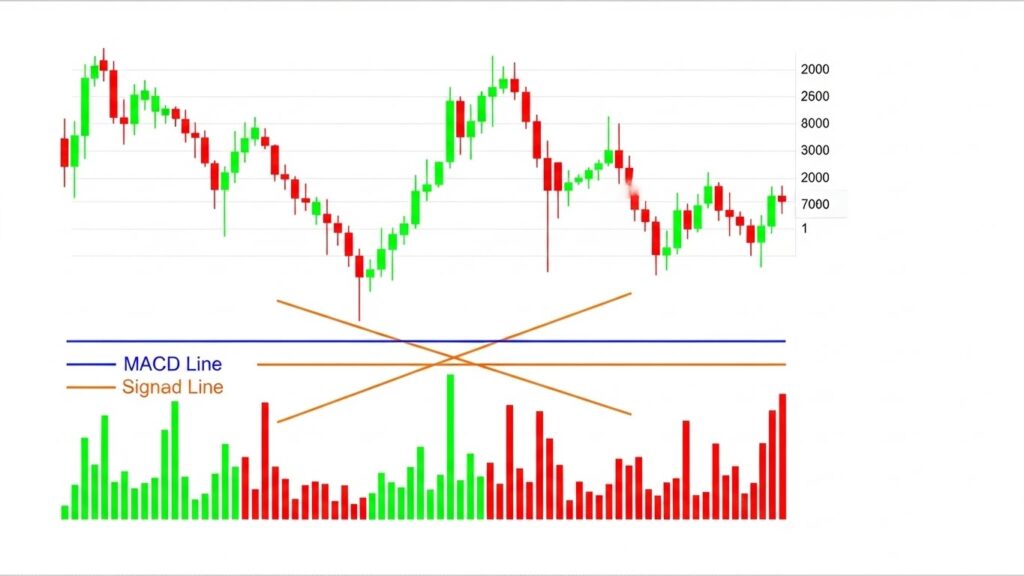
MACD shows relationship between two moving averages and identifies momentum changes.
MACD Components
Three elements:
- MACD line: 12 EMA minus 26 EMA
- Signal line: 9 EMA of MACD line
- Histogram: Difference between MACD and signal line
Visual representation:
- MACD and signal lines cross
- Histogram shows distance between them
- Zero line represents equilibrium
MACD Trading Strategies
Strategy 1: MACD Line Crossover
- Buy: MACD crosses above signal line
- Sell: MACD crosses below signal line
- Strength: Larger histogram = stronger signal
Strategy 2: Zero Line Crossover
- Buy: MACD crosses above zero line (bullish momentum)
- Sell: MACD crosses below zero line (bearish momentum)
- Use: Confirms trend changes
Strategy 3: MACD Divergence
Bullish divergence:
- Price makes lower low
- MACD makes higher low
- Signal: Selling pressure weakening
Bearish divergence:
- Price makes higher high
- MACD makes lower high
- Signal: Buying pressure weakening
MACD Settings
Standard: 12, 26, 9 (works for most timeframes) Faster: 5, 13, 5 (more signals, better for scalping) Slower: 19, 39, 9 (fewezr signals, less noise)
Best timeframes:
- H1 and above for reliable signals
- M15 works but more false signals
- M5 too noisy except with price action confirmation
BEST PRACTICE: Wait for MACD histogram to change color AND price to break structure before entering.
Bollinger Bands: Volatility and Mean Reversion
Bollinger Bands measure volatility and identify overbought/oversold conditions relative to recent price action.
Bollinger Bands Components
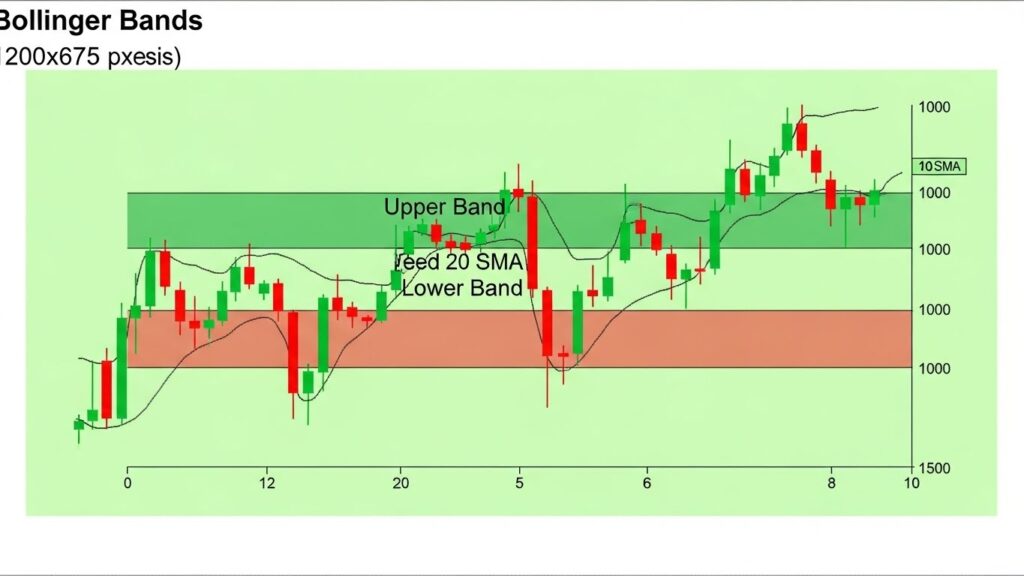
Three bands:
- Middle band: 20-period SMA
- Upper band: Middle + (2 × standard deviation)
- Lower band: Middle – (2 × standard deviation)
Key concepts:
- Price spends 95% of time within bands
- Bands expand during high volatility
- Bands contract during low volatility
- Price tends to return to middle band (mean reversion)
Bollinger Bands Strategies
Strategy 1: Bollinger Bounce (Range Markets)
- Price touches lower band = Buy signal
- Price touches upper band = Sell signal
- Exit at middle band
- Works best: In ranging, low-volatility markets
Strategy 2: Bollinger Squeeze
- Bands contract significantly (low volatility)
- Breakout imminent (high volatility coming)
- Trade: Breakout direction when it happens
- Confirm: With volume increase
Squeeze Forex I
Squeeze Forex Indicators:
- Bands narrowest in 6+ months
- Histogram near zero
- Sideways price action
Strategy 3: Walking the Bands (Trending Markets)
- Strong uptrend: Price “walks” upper band
- Strong downtrend: Price “walks” lower band
- Don’t fade: Price at band in strong trend
- Trade: Pullbacks to middle band
Strategy 4: Bollinger Band M/W Patterns
W-Bottom (Bullish):
- First low below lower band
- Second low stays inside lower band (higher low)
- Confirms: Momentum shift
- Buy: When price breaks above middle band
M-Top (Bearish):
- First high above upper band
- Second high stays inside upper band (lower high)
- Confirms: Weakening momentum
- Sell: When price breaks below middle band
Bollinger Bands Settings
Standard: 20 period, 2 standard deviations Tighter: 20 period, 1.5 SD (more signals) Wider: 20 period, 2.5 SD (fewer signals, stronger)
CRITICAL: Bollinger Bands are NOT buy/sell signals alone. They show relative price extremes. Always confirm with price action or other forex indicators.
Stochastic Oscillator: Momentum and Timing
Stochastic compares closing price to price range over a period, showing where price is relative to recent high-low range.
Understanding Stochastic
Two lines:
- %K line: Fast line (main line)
- %D line: Slow line (3-period SMA of %K)
Range: 0-100
- Above 80: Overbought
- Below 20: Oversold
- 50: Neutral
Formula concept:
%K = (Current Close - Lowest Low) ÷ (Highest High - Lowest Low) × 100
Stochastic Trading Strategies
Strategy 1: Overbought/Oversold
- Buy: Stochastic crosses above 20 (leaving oversold)
- Sell: Stochastic crosses below 80 (leaving overbought)
- Best in: Ranging markets
Strategy 2: Stochastic Crossover
- Buy: %K crosses above %D in oversold zone (<20)
- Sell: %K crosses below %D in overbought zone (>80)
- Confirmation: Both lines exit extreme zone together
Strategy 3: Bull/Bear Setup
Bull setup:
- Price in uptrend
- Stochastic drops to 20-40 zone
- Stochastic turns up = Buy
- Entry: Confirms trend continuation
Bear setup:
- Price in downtrend
- Stochastic rises to 60-80 zone
- Stochastic turns down = Sell
Strategy 4: Stochastic Divergence
- Same as RSI divergence
- Price makes new high/low
- Stochastic fails to confirm
- Signal: Momentum weakening
Stochastic Settings
Fast Stochastic: 5, 3, 3 (very responsive, noisy) Slow Stochastic: 14, 3, 3 (default, balanced) Smoother: 21, 5, 5 (fewer signals, more reliable)
Best timeframes:
- H4 and daily: Most reliable
- H1: Works well
- M15 and lower: Too many false signals
TIP: Stochastic works best when combined with trend indicators. Use for timing entries within established trends.
ATR (Average True Range): Volatility Measurement
ATR measures market volatility by calculating average range between high and low prices.
Understanding ATR
What ATR shows:
- High ATR = High volatility (large price swings)
- Low ATR = Low volatility (small price swings)
- Rising ATR = Increasing volatility
- Falling ATR = Decreasing volatility
Important: ATR does NOT indicate direction, only volatility.
ATR Practical Applications
Application 1: Stop-Loss Placement
Formula:
Stop-Loss Distance = Entry Price ± (ATR × Multiplier)
Example:
- EUR/USD entry: 1.1000
- ATR (14): 0.0050 (50 pips)
- Multiplier: 2×
- Stop-loss: 1.1000 – (50 × 2) = 1.0900 (100 pips)
Benefits:
- Adapts to market conditions
- Wider stops in volatile markets
- Tighter stops in quiet markets
- Reduces premature stop-outs
Application 2: Position Sizing
Adjust position size based on volatility:
- High ATR = Smaller position size
- Low ATR = Larger position size
- Keeps dollar risk consistent
Application 3: Profit Targets
Formula:
Take-Profit = Entry ± (ATR × Multiple)
Example:
- Risk: 1× ATR (50 pips)
- Reward: 2× ATR (100 pips)
- Creates consistent 1:2 risk-reward
Application 4: Breakout Confirmation
Breakout criteria:
- Price breaks support/resistance
- Movement > 0.5× ATR
- Confirms: Meaningful breakout, not noise
ATR Settings
Standard: 14 periods (most common) Shorter: 7-10 periods (more responsive) Longer: 20-25 periods (smoother, less reactive)
Note: ATR value depends on currency pair and timeframe. Always compare ATR to recent values, not absolute numbers.
BEST PRACTICE: Use 1.5-2× ATR for stop-losses in swing trading, 0.5-1× ATR for day trading.
Fibonacci Retracement: Natural Support and Resistance
Fibonacci levels identify potential support and resistance areas based on mathematical ratios found in nature.
Fibonacci Levels
Key retracement levels:
- 23.6%: Minor retracement
- 38.2%: Shallow retracement
- 50.0%: Mid-point (not true Fibonacci, but widely used)
- 61.8%: Golden ratio (most important)
- 78.6%: Deep retracement
How to Use Fibonacci
Drawing Fibonacci:
For uptrends:
- Find significant low (swing low)
- Find significant high (swing high)
- Draw from low to high
- Watch for bounces at levels
For downtrends:
- Find significant high
- Find significant low
- Draw from high to low
- Watch for resistance at levels
Fibonacci Trading Strategies
Strategy 1: Trend Continuation
- Identify strong trend
- Wait for pullback to Fibonacci level
- Entry: 38.2%, 50%, or 61.8% level
- Stop: Below/above next Fibonacci level
- Target: Recent high/low or extension levels
Strategy 2: Fibonacci + Confirmation
Don’t trade Fibonacci alone. Confirm with:
- Candlestick patterns at Fibonacci level
- Support/resistance confluence MA bounce at same level
- RSI divergence
Strategy 3: Fibonacci Extensions
- Used for profit targets
- Levels: 127.2%, 161.8%, 261.8%
- Project: Beyond recent high/low
- Shows where trend likely to extend
Fibonacci Best Practices
Selection criteria:
- Use obvious swing highs/lows
- Larger timeframes more reliable
- H4, Daily, Weekly work best
- M15 and lower = too much noise
Multiple timeframe Fibonacci:
- Draw daily Fibonacci
- Draw H4 Fibonacci
- Best entries: Where multiple Fibonacci levels align
TIP: 61.8% retracement is the “last line of defense.” If price breaks below/above 61.8%, trend may be reversing.
Pivot Points: Intraday Support and Resistance
Pivot points calculate support and resistance levels based on previous day’s high, low, and close.
Pivot Point Calculation
Standard Pivot Points:
Pivot Point (PP) = (High + Low + Close) ÷ 3

Resistance 1 (R1) = (2 × PP) - Low
Resistance 2 (R2) = PP + (High - Low)
Resistance 3 (R3) = High + 2(PP - Low)

Support 1 (S1) = (2 × PP) - High
Support 2 (S2) = PP - (High - Low)
Support 3 (S3) = Low - 2(High - PP)
Pivot Point Trading Strategies
Strategy 1: Pivot Point Bounce
- Price approaches pivot/support/resistance level
- Price bounces from level
- Enter: In bounce direction
- Stop: Beyond the level
Strategy 2: Pivot Point Breakout
- Price consolidates near pivot level
- Decisive break above/below level
- Enter: Break direction
- Target: Next pivot level
Strategy 3: Central Pivot Range
- Trade range between S1 and R1
- Buy: Near S1, target PP or R1
- Sell: Near R1, target PP or S1
- Exit: If breaks S1 or R1 (no longer ranging)
Pivot Point Types
Standard: Equal weight to high, low, close Fibonacci: Uses Fibonacci ratios for levels Camarilla: 8 levels, closer to price Woodie’s: More weight to close price
Most popular: Standard and Camarilla for day trading
Pivot Point Best Practices
Timeframe usage:
- Daily pivots: Most popular (use yesterday’s H/L/C)
- Weekly pivots: For swing traders
- Monthly pivots: For long-term levels
Market behavior:
- Asian session: Often ranges between S1-R1
- London open: Often triggers breakouts
- NY session: May test extremes (S2/R2, R2/R3)
💡 TIP: Pivot points work best in liquid markets and major pairs. Less effective in thin markets or exotic pairs.
Combining Forex Indicators: Multi-Indicator Strategies
Using multiple forex indicators together filters false signals and increases accuracy.
Trend + Momentum Strategy
Combination 1: MA + RSI
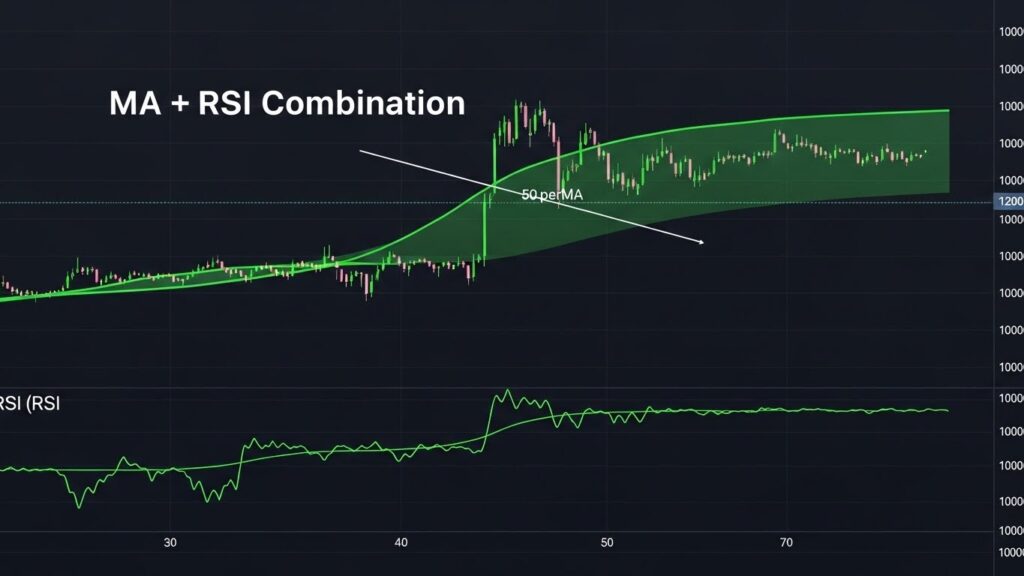
- Trend: 50 EMA (uptrend = price above)
- Momentum: RSI (buy when RSI dips to 40-50)
- Entry: Price bounces off 50 EMA AND RSI confirms
- Result: High-probability trend continuation
Combination 2: MACD + EMA
- Trend: 200 EMA (only trade in trend direction)
- Timing: MACD crossover
- Entry: MACD crosses in trend direction
- Filter: Ignore MACD signals against 200 EMA trend
Triple Confirmation Strategy
Three-indicator setup:
- Trend: Moving average (direction)
- Momentum: RSI or Stochastic (timing)
- Volatility: Bollinger Bands or ATR (context)
Example trade:
- Price above 50 MA (uptrend confirmed)
- RSI dips to 40 and turns up (momentum buy signal)
- Price bounces from lower Bollinger Band (support)
- Enter: All three align = Strong buy signal
Support/Resistance + Indicator Strategy
High-probability entries:
Level identification:
- Horizontal support/resistance
- Fibonacci retracement
- Pivot points
Confirmation indicators:
- RSI divergence at level
- Stochastic turn at level
- MACD histogram decreasing
Entry: Price at key level + indicator confirmation
Common Indicator Combinations
| Primary (Trend) | Secondary (Momentum) | Filter (Context) |
|---|---|---|
| 50/200 EMA | RSI | ATR for stops |
| MA Cross | MACD | Bollinger Bands |
| EMA Ribbon | Stochastic | Volume |
| Price Action | RSI Divergence | Fibonacci |
WARNING: More forex indicators doesn’t mean better results. 2-3 indicators maximum. Too many create analysis paralysis and conflicting signals.
Indicator Mistakes to Avoid
Common Indicator Errors
1. Indicator Obsession
- Error: Adding 10+ indicators to chart
- Result: Confusing signals, delayed entries
- Fix: Use 2-3 indicators maximum
2. Ignoring Price Action
- Error: Trading forex indicators without checking price
- Result: Missing obvious price patterns
- Fix: Price action first, forex indicators confirm
3. Using Wrong Timeframe
- Error: Scalping with daily indicator settings
- Result: Lag, missed opportunities
- Fix: Match indicator settings to timeframe
4. Chasing Perfect Signals
- Error: Waiting for all forex indicators to align perfectly
- Result: Missing most trades
- Fix: Accept that no setup is perfect
5. Ignoring Market Context
- Error: Using range indicators in trends
- Result: Constant stop-outs
- Fix: Use trend indicators in trends, oscillators in ranges
6. Over-Optimization
- Error: Constantly changing indicator settings
- Result: Never master any setup
- Fix: Stick to standard settings, master them
7. No Risk Management
- Error: Perfect indicators, no stop-loss
- Result: One bad trade wipes out account
- Fix: Forex Indicators don’t replace risk management
The Reality of Indicators
What indicators CAN do:
- Identify potential opportunities
- Confirm price action signals
- Filter low-probability setups
- Improve timing of entries
- Provide objective rules
What indicators CANNOT do:
- Predict future with certainty
- Replace trading skills
- Work without risk management
- Eliminate losing trades
- Make you rich alone
TRUTH: Successful traders use simple indicator setups with excellent risk management. Failed traders use complex setups with poor risk management.
Building Your Indicator System
Step-by-Step System Creation
Step 1: Choose Your Trading Style
- Scalping: Fast indicators (5-9 period)
- Day trading: Medium indicators (14-21 period)
- Swing trading: Slow indicators (50-200 period)
Step 2: Select Core Indicators
Minimum viable system:
- One trend indicator: MA or EMA
- One momentum indicator: RSI or Stochastic
- Optional volatility: ATR for stop-loss
Step 3: Define Your Rules
Entry rules example:
LONG ENTRY:
1. Price above 50 EMA
2. RSI crosses above 50
3. MACD histogram turns positive
4. Stop-loss: 2× ATR below entry
5. Take-profit: 1:2 risk-reward
Step 4: Backtest Your System
- Test on 100+ trades
- Calculate win rate
- Measure average R:R
- Adjust if needed
Step 5: Trade Small, Then Scale
- Start with minimum position
- Prove system works
- Gradually increase size
- Never stop following rules
Sample Indicator Systems
System 1: Simple Trend Following
- Indicators: 50 EMA, 200 EMA
- Entry: Price crosses above both EMAs
- Exit: Price crosses below 50 EMA
- Stop: Below recent swing low
- Win rate: 35-45%
- R:R: 1:2 minimum
System 2: RSI + MA
- Indicators: 21 EMA, RSI (14)
- Long: Price above 21 EMA + RSI bounces from 40-50
- Short: Price below 21 EMA + RSI falls from 50-60
- Stop: 1.5× ATR
- Win rate: 45-55%
- R:R: 1:1.5
System 3: Triple Confirmation
- Indicators: 50 MA, MACD, Stochastic
- Entry: All three align (trend + 2 momentum)
- Exit: When MACD or Stochastic reverses
- Stop: Below structure
- Win rate: 50-60%
- R:R: 1:1 to 1:2
Indicator Checklist
Before using any indicator, verify:
Setup checklist:
- [ ] Indicator matches your trading timeframe
- [ ] Settings are appropriate (not over-optimized)
- [ ] Indicator complements price action
- [ ] Clear entry and exit rules defined
- [ ] Tested on 100+ historical trades
- [ ] Risk management rules in place
- [ ] Maximum 2-3 indicators total
Trade checklist:
- [ ] Indicator signal present
- [ ] Price action confirms signal
- [ ] Risk-reward minimum 1:2
- [ ] Stop-loss placed
- [ ] Position size calculated
- [ ] Market condition suitable (trend/range)
Conclusion: Indicators as Tools, Not Magic
Indicators are valuable tools when used correctly, but they’re not holy grails. Success comes from:
Key principles:
- Simplicity beats complexity: 2-3 indicators maximum
- Price action first: Indicators confirm, don’t lead
- Match to market: Trend indicators in trends, oscillators in ranges
- Risk management: No indicator eliminates the need for stops
- Consistency: Master one system before switching
Remember:
- Indicators show what price has done, not what it will do
- No indicator works 100% of the time
- Losing trades are normal and unavoidable
- Risk management is more important than perfect signals
Start simple. Master basics. Add complexity only when necessary.
The best indicator system is the one you understand completely and follow religiously.
For a complete overview of technical analysis and how this indicator fits into a broader trading strategy, see our Technical Analysis Complete Guide.
Related Posts:




Powered by Contextual Related Posts