Forex Risk management is the single most important factor that separates successful forex traders from those who blow up their accounts. You can have the best trading strategy in the world, but without proper risk management, you’re destined to fail.
This comprehensive guide covers everything you need to know about protecting your capital and managing risk in forex trading.
What is Forex Risk Management ?
Forex Risk management is the process of identifying, analyzing, and controlling the potential losses in your trading. It involves setting rules and implementing strategies to protect your trading capital from significant drawdowns.
The fundamental principle: Preserve your capital so you can stay in the game long enough to profit from your trading edge.
Why Forex Risk Management Matters
Consider these statistics:
- 70-80% of retail forex traders lose money
- The average losing trader loses their entire account within 3-6 months
- Successful traders focus on managing losses, not chasing profits
The difference? Proper risk management.
💡 KEY INSIGHT: Professional traders focus on “how much can I lose?” before asking “how much can I make?”
The 1% Rule: Your Foundation
The most important risk management rule in forex trading is simple: Never risk more than 1-2% of your account on a single trade.
How the 1% Rule Works
Example:
- Account size: $10,000
- Risk per trade: 1% = $100
- Even with 10 consecutive losses, you lose only 10%
- Your account: $9,000 (still plenty to recover)
Without the 1% rule:
- Risk 10% per trade
- 3 consecutive losses = 27% account loss
- Requires 37% gain just to break even
- Most traders never recover
Calculating Your Risk Per Trade
Formula:
Risk Amount = Account Size × Risk Percentage
Example calculations:
| Account Size | 1% Risk | 2% Risk |
|---|---|---|
| $1,000 | $10 | $20 |
| $5,000 | $50 | $100 |
| $10,000 | $100 | $200 |
| $50,000 | $500 | $1,000 |
⚠️ WARNING: Never increase your risk percentage hoping to recover losses faster. This is the fastest way to blow up your account.
Position Sizing: How Much to Trade
Position sizing determines how many lots you trade based on your risk tolerance and stop-loss distance.
Position Size Formula
Position Size (lots) = Risk Amount ÷ (Stop Loss in Pips × Pip Value)
Step-by-Step Position Sizing
Example trade setup:
- Account: $10,000
- Risk: 1% = $100
- Stop-loss: 50 pips
- Currency pair: EUR/USD
- Pip value: $10 per standard lot
Calculation:
Position Size = $100 ÷ (50 pips × $10)
Position Size = $100 ÷ $500
Position Size = 0.2 standard lots (or 2 mini lots)
Position Sizing by Account Size
| Account | 1% Risk | 50-Pip Stop | Position Size |
|---|---|---|---|
| $1,000 | $10 | 50 pips | 0.02 lots |
| $5,000 | $50 | 50 pips | 0.10 lots |
| $10,000 | $100 | 50 pips | 0.20 lots |
| $50,000 | $500 | 50 pips | 1.00 lot |
TIP: Use a position size calculator to avoid manual calculation errors. Most trading platforms include one.
Stop-Loss Orders: Your Safety Net
A stop-loss order automatically closes your position when price reaches a specified level, limiting your loss on a trade.
Types of Stop-Loss Strategies
1. Fixed Pip Stop-Loss
- Set stop-loss at fixed distance (e.g., 50 pips)
- Simple and consistent
- Doesn’t account for market volatility
2. Technical Stop-Loss
- Place below support (long trades)
- Place above resistance (short trades)
- Based on market structure
- More effective than arbitrary distances
3. Volatility-Based Stop-Loss
- Use ATR (Average True Range) indicator
- Wider stops in volatile markets
- Tighter stops in quiet markets
- Adapts to market conditions
4. Time-Based Stop-Loss
- Exit after specified time period
- Useful for day traders
- Prevents overnight exposure
Stop-Loss Placement Rules
For Long Trades:
- Below recent swing low
- Below support level
- Below key moving average
- 1.5-2× ATR below entry
For Short Trades:
- Above recent swing high
- Above resistance level
- Above key moving average
- 1.5-2× ATR above entry
CRITICAL: Never move your stop-loss further away from entry to “give the trade more room.” This violates your risk management plan.
Risk-Reward Ratio: Making Risk Work For You
Risk-reward ratio compares potential profit to potential loss on each trade.
Understanding Risk-Reward Ratios
Risk-Reward Ratio = Potential Profit ÷ Potential Loss
Example:
- Risk: 50 pips (stop-loss)
- Reward: 150 pips (take-profit)
- Ratio: 150 ÷ 50 = 3:1 (or 1:3 risk-reward)
Minimum Risk-Reward Requirements
| Win Rate | Minimum R:R | Example |
|---|---|---|
| 30% | 3:1 | Risk $100, Target $300 |
| 40% | 2:1 | Risk $100, Target $200 |
| 50% | 1:1 | Risk $100, Target $100 |
| 60% | 1:1.5 | Risk $100, Target $150 |
The breakeven formula:
Required Win Rate = 1 ÷ (1 + Risk-Reward Ratio)
Why 1:2 Risk-Reward is Ideal
With 1:2 risk-reward (risk $100, target $200):
- Win rate needed: 33.3%
- Win 4 trades, lose 6 trades = Profitable
- Gives room for human error
- Easier to execute psychologically
BEST PRACTICE: Aim for minimum 1:2 risk-reward on every trade. If you can’t find a 1:2 setup, don’t take the trade.
Leverage Management: The Double-Edged Sword
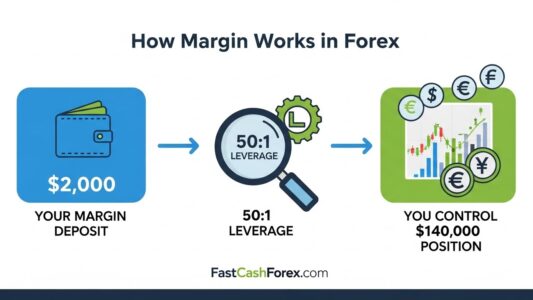
Leverage amplifies both profits AND losses. Improper leverage use is the #1 reason traders blow up accounts.
Safe Leverage Guidelines
Recommended Maximum Leverage:
| Experience Level | Max Leverage | Reason |
|---|---|---|
| Beginner | 5:1 to 10:1 | Learn without danger |
| Intermediate | 10:1 to 20:1 | Some experience |
| Advanced | 20:1 to 30:1 | Proven track record |
Never use maximum leverage offered by brokers (often 500:1 or higher).
Effective Leverage vs. Account Leverage
Account leverage: What broker offers (e.g., 100:1) Effective leverage: What you actually use
Example:
- Account: $10,000
- Account leverage: 100:1
- Position size: $20,000 (0.2 lots EUR/USD)
- Effective leverage: 2:1
Calculation:
Effective Leverage = Total Position Value ÷ Account Equity
⚠️ WARNING: High leverage with large position sizes = margin calls and blown accounts. Control your effective leverage, not just your account leverage.
Drawdown Management: Surviving Losing Streaks
Drawdown is the decline from peak account balance to trough. Managing drawdowns keeps you in the game during inevitable losing periods.
Types of Drawdowns
1. Maximum Drawdown
- Largest peak-to-trough decline
- Measures worst-case scenario
- Example: $10,000 → $8,000 = 20% drawdown
2. Current Drawdown
- Decline from current peak
- Measures active risk exposure
Acceptable Drawdown Levels
| Drawdown Level | Action Required |
|---|---|
| 0-10% | Normal trading |
| 10-15% | Review strategy |
| 15-20% | Reduce position sizes |
| 20-25% | Stop trading, analyze |
| 25%+ | Significant problem |
Recovering from Drawdowns
The mathematics of recovery:
| Drawdown | Gain Needed to Recover |
|---|---|
| 10% | 11.1% |
| 20% | 25% |
| 30% | 42.9% |
| 40% | 66.7% |
| 50% | 100% |
Key insight: Small drawdowns are easy to recover from. Large drawdowns can be devastating.
Drawdown Prevention Rules
1. Maximum Daily Loss Limit
- Stop trading after losing 3-5% in one day
- Prevents emotional revenge trading
- Protects from major single-day losses
2. Maximum Weekly Loss Limit
- Stop trading after 5-7% weekly loss
- Take break to reassess strategy
- Prevents spiral of consecutive losses
3. Reduce Size During Drawdowns
- In 10%+ drawdown? Cut position size by 50%
- Rebuild confidence with smaller risk
- Gradually increase as account recovers
TIP: Keep a trading journal to identify what causes your drawdowns. Patterns often emerge that you can eliminate.
Correlation Risk: Hidden Danger
Currency correlation measures how two pairs move in relation to each other. Trading correlated pairs multiplies your risk without you realizing it.
Understanding Correlation
Positive correlation (+1.0):
- Pairs move in same direction
- Example: EUR/USD and GBP/USD (typically +0.7 to +0.9)
Negative correlation (-1.0):
- Pairs move in opposite directions
- Example: EUR/USD and USD/CHF (typically -0.7 to -0.9)
No correlation (0):
- Pairs move independently
The Correlation Risk Problem
Example of hidden risk:
- You trade: Long EUR/USD (risk 1%)
- You also trade: Long GBP/USD (risk 1%)
- Correlation: +0.85
- Actual risk: Nearly 2% (not diversified!)
If USD strengthens:
- EUR/USD falls → Loss
- GBP/USD falls → Loss
- Both positions lose simultaneously
Managing Correlation Risk
Rule 1: Limit Correlated Positions
- Maximum 2 positions with +0.7 or higher correlation
- Treat highly correlated trades as one position
Rule 2: Reduce Position Size
- Trading correlated pairs? Cut each position by 50%
- Example: Instead of 1% risk on each, risk 0.5% on each
Rule 3: Use Correlation to Hedge
- Negative correlation can hedge positions
- Example: Long EUR/USD + Long USD/CHF = partial hedge
Common Currency Correlations
| Pair 1 | Pair 2 | Correlation | Risk |
|---|---|---|---|
| EUR/USD | GBP/USD | +0.85 | High duplicate risk |
| EUR/USD | USD/CHF | -0.85 | Natural hedge |
| EUR/USD | EUR/GBP | +0.65 | Moderate duplication |
| GBP/USD | EUR/GBP | -0.70 | Inverse relationship |
Diversification: Don’t Put All Eggs in One Basket
Diversification spreads risk across multiple assets, strategies, and timeframes.
Types of Diversification
1. Currency Pair Diversification
- Trade multiple pairs with low correlation
- Example: EUR/USD + AUD/JPY + USD/CAD
- Reduces impact of one pair’s movement
2. Strategy Diversification
- Combine different approaches
- Example: Trend-following + Mean-reversion
- Performs in different market conditions
3. Timeframe Diversification
- Mix scalping + swing trades
- Short-term trades + long-term positions
- Smooths equity curve
4. Session Diversification
- Trade different forex sessions
- Asian + London + New York
- Spreads risk across time zones
Over-Diversification Warning
Too much diversification causes:
- Diluted profits
- Difficult to manage positions
- Increased transaction costs
- Divided attention
💡 OPTIMAL: 3-5 concurrent positions maximum for most traders. Quality over quantity.
Account Size and Risk Capacity
Your account size determines realistic profit expectations and sustainable risk levels.
Minimum Account Sizes
| Account Size | Realistic Monthly Return | Risk Per Trade | Status |
|---|---|---|---|
| $100-500 | High volatility | Micro lots only | Learning |
| $500-2,000 | 3-10% | Limited flexibility | Small account |
| $2,000-10,000 | 2-5% | Decent flexibility | Growing account |
| $10,000+ | 1-3% | Full flexibility | Professional size |
Small Account Challenges
Under $2,000:
- Limited position sizing options
- Commission/spread eats larger %
- Psychological pressure to “grow quickly”
- Higher effective risk per trade
Solutions:
- Focus on learning, not profits
- Use cent accounts or micro lots
- Don’t overtrade to “catch up”
- Save more capital before serious trading
Account Growth Strategy
Conservative growth approach:
Year 1: $5,000 → $6,000 (20% return)
- Risk 1% per trade
- Focus on consistency
- Add $3,000 from savings
- End Year 1: $9,000
Year 2: $9,000 → $12,000 (33% return)
- Maintain 1% risk
- Add $3,000 savings
- End Year 2: $15,000
Year 3: $15,000 → $21,000 (40% return)
- Can now trade larger sizes comfortably
- Professional-sized account
💡 REALISTIC EXPECTATION: Growing a small account takes time. Focus on skill development and capital preservation first, profits second.
Risk Management Checklist
Before every trade, verify these risk parameters:
Pre-Trade Checklist
Account Risk:
- [ ] Risk is 1-2% of account maximum
- [ ] Stop-loss is set before entry
- [ ] Position size calculated correctly
- [ ] Risk-reward ratio minimum 1:2
Position Parameters:
- [ ] Stop-loss at logical technical level
- [ ] Take-profit target is realistic
- [ ] Position size matches risk amount
- [ ] No margin call risk at stop-loss
Correlation Check:
- [ ] Check existing positions
- [ ] Limit correlated positions to 2
- [ ] Reduce size if trading correlated pairs
- [ ] Total exposure under 6% of account
Portfolio Risk:
- [ ] Maximum 3-5 positions open
- [ ] Total risk across all positions under 6%
- [ ] Not overexposed to single currency
- [ ] Adequate margin buffer (50%+)
Daily Risk Management
Daily tasks:
- Morning: Review open positions and risk
- Trading hours: Monitor news events
- After close: Journal trades and risk metrics
- Weekly: Calculate drawdown and win rate
Risk Management Mistakes to Avoid
Common Risk Management Errors
1. Moving Stop-Losses
- Error: Moving stop further to avoid loss
- Impact: Violates risk plan, increases losses
- Fix: Set stop once, never move it wider
2. Risking Too Much
- Error: 5-10% risk per trade
- Impact: Account destroyed by losing streak
- Fix: Strict 1-2% maximum per trade
3. No Stop-Loss
- Error: “I’ll watch it and close manually”
- Impact: Emotional decisions, huge losses
- Fix: Always set stop-loss immediately
4. Revenge Trading
- Error: Doubling position size after loss
- Impact: Emotional decisions, bigger losses
- Fix: Daily loss limits, take breaks
5. Over-Leveraging
- Error: Using maximum broker leverage
- Impact: Margin calls, account blowups
- Fix: Use 10:1 or less effective leverage
6. Ignoring Correlation
- Error: Multiple EUR trades treated as separate
- Impact: 3x risk exposure unknowingly
- Fix: Check correlation before every trade
7. No Daily Loss Limit
- Error: Continuing to trade after major loss
- Impact: Emotional spiral, revenge trading
- Fix: Stop after 3-5% daily loss
Risk Management Psychology
The emotional trap:
- Small losses feel manageable (1% = “just $100”)
- Trader gets careless (“$100 doesn’t matter”)
- Stop-loss gets ignored or removed
- One bad trade wipes out weeks of gains
The discipline solution:
- Treat every dollar as important
- Follow risk rules religiously
- No exceptions, even when “certain”
- Trading is a business, not gambling
⚠️ CRITICAL: The moment you think “just this once” is the moment your account is in danger.
Advanced Risk Management Techniques
The Kelly Criterion
Mathematical formula for optimal position sizing based on edge and win rate.
Formula:
Kelly % = (Win Rate × Avg Win) - ((1 - Win Rate) × Avg Loss)) ÷ Avg Win
Example:
- Win rate: 50%
- Average win: $200
- Average loss: $100
- Kelly = (0.5 × 200) – (0.5 × 100) ÷ 200 = 25%
Reality: Most traders use “Half Kelly” (divide by 2) for safety = 12.5% position
💡 NOTE: Kelly Criterion requires extensive trading data. Not recommended for beginners.
Scaling In and Out
Scaling in: Adding to winning position
- Add only to profitable positions
- Each addition risks 1% maximum
- Use trailing stops on all additions
- Maximum 3 additions per trade
Scaling out: Taking partial profits
- Take 50% off at 1:1 risk-reward
- Move stop to breakeven
- Let remainder run to 1:3
- Locks in guaranteed profit
Time-Based Risk Management
Reduce risk during:
- Major news releases
- Low liquidity hours (Asia late session)
- Your first month of trading
- High market volatility periods
- Friday afternoons (weekend gap risk)
Creating Your Risk Management Plan
Step-by-Step Plan Creation
1. Define Your Risk Parameters
Account size: $________
Risk per trade: ___% (1-2%)
Maximum daily loss: ___% (3-5%)
Maximum weekly loss: ___% (5-7%)
Maximum drawdown before pause: ___% (15-20%)
2. Position Sizing Rules
Standard stop-loss: ___ pips
Maximum position size: ___ lots
Leverage limit: ___:1 (10:1 or less)
Maximum open positions: ___ (3-5)
3. Risk-Reward Requirements
Minimum R:R ratio: 1:___ (minimum 1:2)
Win rate needed: ___% (calculated from R:R)
4. Correlation Rules
Maximum correlated positions: ___ (2-3)
Position size reduction for correlation: ___% (50%)
5. Daily Routine
Morning: Check open positions, calculate risk
Trading: Follow plan, no exceptions
Evening: Journal trades, update metrics
Weekly: Review performance, adjust if needed
Sample Risk Management Plan
Conservative Trader:
- Account: $10,000
- Risk per trade: 1% ($100)
- Stop-loss: Technical (support/resistance)
- R:R minimum: 1:2
- Daily loss limit: 3% ($300)
- Max positions: 3
- Leverage: 10:1 effective maximum
Aggressive (But Still Safe) Trader:
- Account: $10,000
- Risk per trade: 2% ($200)
- Stop-loss: Technical + ATR
- R:R minimum: 1:2
- Daily loss limit: 5% ($500)
- Max positions: 5
- Leverage: 20:1 effective maximum
Risk Management Tools and Resources
Essential Tools
1. Position Size Calculators
- Built into MT4/MT5
- Online: MyFXBook, BabyPips
- Mobile apps: Forex Position Size
2. Risk Management Spreadsheets
- Track all trades
- Calculate metrics automatically
- Monitor drawdowns in real-time
3. Trading Journal Software
- Edgewonk
- TraderVue
- Personal spreadsheet
4. Correlation Tools
- OFX Correlation Tool
- MyFXBook Correlation Matrix
- TradingView built-in tools
Key Metrics to Track
Daily:
- Trades taken
- Win rate
- Average R:R
- Daily P&L
- Current drawdown
Weekly:
- Total trades
- Win/loss streaks
- Average position size
- Risk per trade
- Largest loss
Monthly:
- Total return %
- Maximum drawdown
- Sharpe ratio
- Profit factor
- Trading discipline score
Conclusion: Risk Management is Your Edge
Successful forex trading isn’t about making the most money on winning trades—it’s about losing the least on losing trades and surviving long enough for your edge to play out.
Key Takeaways
The Non-Negotiables:
- Risk maximum 1-2% per trade
- Always use stop-losses
- Maintain minimum 1:2 risk-reward
- Respect daily and weekly loss limits
- Control leverage and correlation
Remember:
- You can’t control the market
- You can’t control individual trade outcomes
- You CAN control your risk on every trade
- Risk management IS your edge
Start small. Trade smart. Survive.
The difference between professional traders and failed traders is simple: professionals follow their risk management plan religiously, amateurs don’t.
Your first goal isn’t to make money—it’s to NOT lose money. Master risk management first, and profits will follow.
To manage risk more accurately, traders often use a position size calculator to determine how much to trade based on account size and risk tolerance.