Starting forex trading with just $25 is not only possible — it’s actually one of the smartest ways to begin. Trading a small account forces discipline, teaches real risk management under live market conditions, and limits the damage from early mistakes that every new trader makes.
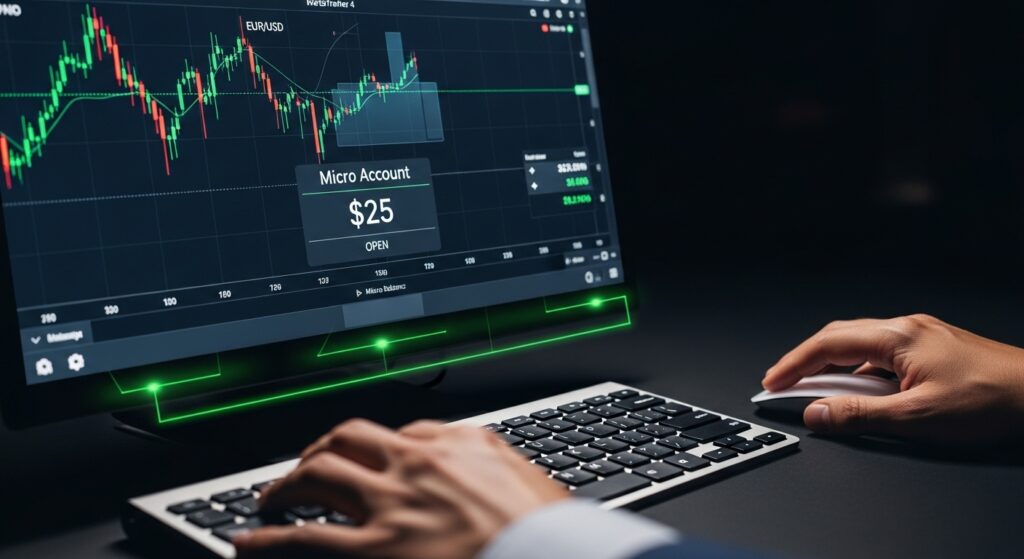
This guide covers everything you need to start trading forex with only $25: what type of account you need, how to choose the right broker, how to manage risk on a tiny account, realistic expectations for growth, and a step-by-step plan to get started today.
Ready to start trading forex with only $25 and build real skills without big risks?
Why Start Trading Forex With Only $25?
Most new traders assume they need thousands of dollars to start. They don’t. Here’s why starting small is actually an advantage:
Real trading experience without real risk — Demo accounts don’t teach you emotional discipline. A live $25 account creates real stakes without catastrophic exposure. When you risk $0.50 on a trade, you feel it. That emotional connection to real money is what builds trading discipline faster than any demo account.
Mistakes are cheap — Every trader makes mistakes in their first months. Overleveraging, revenge trading, ignoring stop losses — these are universal beginner errors. On a $25 account, these mistakes cost you a few dollars. On a $5,000 account, the same mistakes can be devastating.
Builds real confidence — Profitable trades on a real account, even small ones, build confidence differently than demo profits. Proving to yourself that you can execute a strategy with real money is a critical psychological milestone.
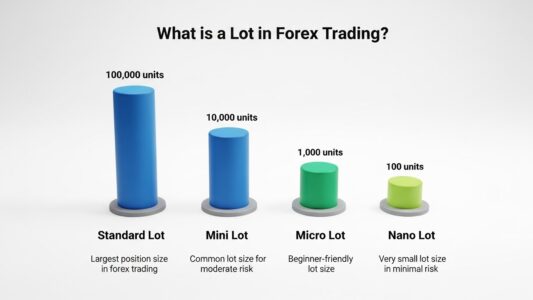
Micro lots make it viable — Modern brokers offer micro lots (0.01 lot = $0.10 per pip on EUR/USD), making proper risk management possible even on a $25 account.
What Type of Account Do You Need?
To start trading forex with only $25 you need either a micro account or a cent account.
Micro Accounts
Micro accounts let you start trading forex with only $25 using 0.01 lot sizes.
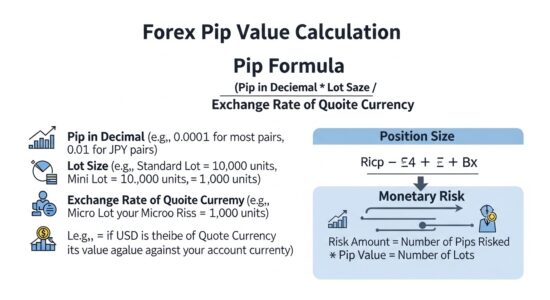
Micro accounts allow trading in micro lots (0.01 lot minimum). On EUR/USD, each pip is worth $0.10 with a micro lot. This means:
- $25 account × 2% risk = $0.50 risk per trade
- $0.50 ÷ 20-pip stop loss = $0.025 per pip needed
- Trade 0.02-0.03 micro lots to stay within proper risk limits
Micro accounts are offered by most international ECN brokers and are ideal for beginners building confidence with real money.
Cent Accounts
Cent accounts denominate your balance in cents rather than dollars. A $25 deposit shows as 2,500 cents in your account. Pip values are proportionally smaller, giving you even more flexibility for risk management on tiny balances.
Cent accounts are particularly popular with traders who want to practice real trading with very small amounts while learning their broker’s platform and execution quality.
How to Choose the Right Broker for a $25 Account
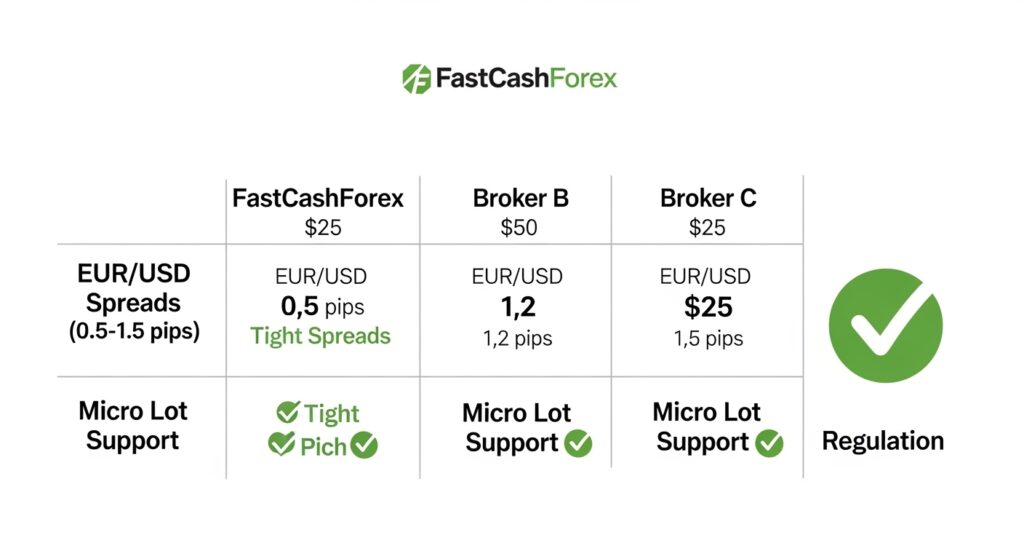
Not all brokers are suitable for $25 accounts. Here’s what to look for:
Minimum Deposit
Choose a broker with a $10-50 minimum deposit. Many international brokers accept $25 or less. Avoid brokers requiring $500+ minimums — they’re not designed for small account traders.
Micro Lot Support
Verify the broker supports 0.01 lot minimum position sizes. Brokers requiring 0.1 lot minimums are unsuitable — that’s 10x too large for proper risk management on $25.
Tight Spreads
When you start trading forex with only $25 and target small pip gains, spread costs eat significantly into profits. Look for:
- EUR/USD: 0.5-1.5 pips maximum
- Avoid brokers with 2+ pip spreads on majors
Regulation
Only open accounts with regulated brokers. In the US, brokers must be registered with the CFTC and be members of the NFA. International traders should look for brokers regulated by the FCA in the UK, ASIC in Australia, or CySEC in Cyprus.
No Scalping Restrictions
If you plan to scalp (open and close trades quickly), verify the broker explicitly permits scalping. Some brokers restrict minimum hold times which prevents scalping strategies.
Risk Management on a $25 Account
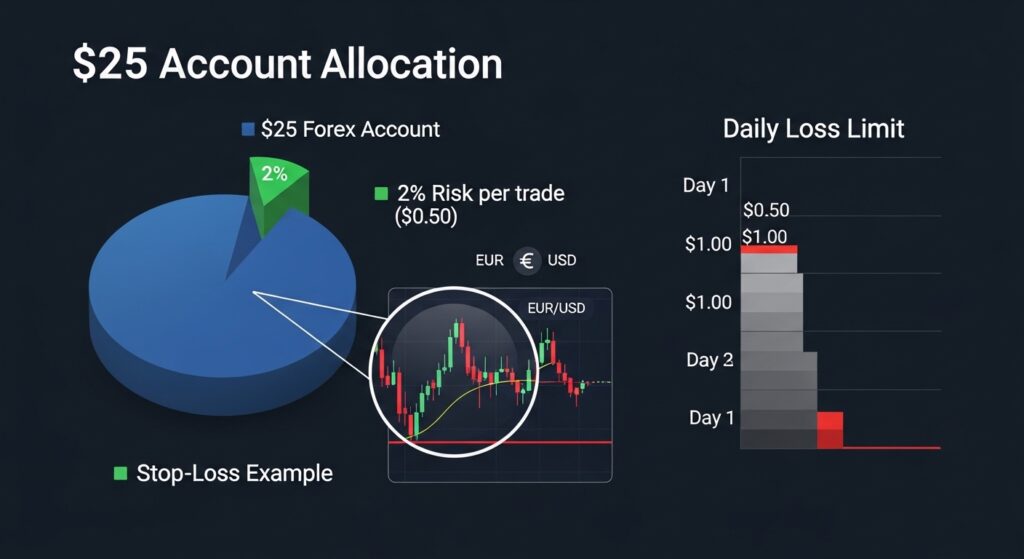
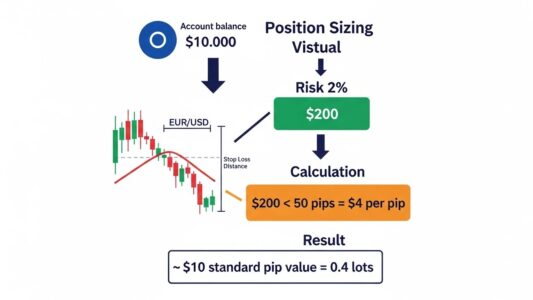
When you start trading forex with only $25, the 2% rule means $0.50 max risk per trade.
Risk management is even more critical on a small account because there’s no buffer. One bad trade without a stop loss can wipe out 20-30% of your account instantly.
The 2% Rule
Never risk more than 2% of your account on a single trade.
- $25 account × 2% = $0.50 maximum risk per trade
- With a 20-pip stop loss and 0.01 micro lots ($0.10 per pip): risk = $2.00 (too high)
- With a 20-pip stop loss and 0.002 lots ($0.02 per pip): risk = $0.40 (correct)
Use our position size calculator to calculate the exact lot size for every trade.
Always Use Stop Losses
Every trade must have a stop loss placed before you enter. Never trade without one — especially on a small account where a single losing trade without a stop can be catastrophic.
Daily Loss Limit
Set a daily loss limit of 6% ($1.50 on a $25 account). If you hit it, stop trading for the day. This prevents the common beginner pattern of revenge trading after losses — which turns small losses into account-destroying drawdowns.
Leverage Management
Most brokers offer high leverage (100:1, 200:1, even 500:1) on micro accounts. Ignore the high leverage options. Effective leverage of 5:1 to 10:1 is more than sufficient for learning. High leverage on a small account means a single losing trade can wipe out your entire balance.
Best Currency Pairs for a $25 Account
| Pair | Avg Spread | Why Perfect for $25 Accounts |
|---|---|---|
| EUR/USD | 0.5-1 pip | Highest liquidity, lowest costs |
| GBP/USD | 1-1.5 pips | Good volatility for small pip targets |
| USD/JPY | 0.8-1.2 | Stable trends, tight overnight spreads |
Stick to major currency pairs with the tightest spreads:
EUR/USD — Best choice for beginners. Tightest spreads, highest liquidity, predictable price action during London-New York session overlap. See our EUR/USD trading guide for specific strategies.
GBP/USD — More volatile than EUR/USD, suitable once you have 2-3 weeks of experience. Higher pip movement creates more opportunities but requires wider stops. See our GBP/USD trading guide.
USD/JPY — Tight spreads and smooth price action. Active during Asian session if you can’t trade London-New York hours. See our USD/JPY trading guide.
Avoid exotic pairs (USD/TRY, USD/ZAR, etc.) — spreads are too wide for small account trading.
Realistic Growth Expectations for a $25 Account
Be honest with yourself about what’s achievable. Here are realistic projections:
| Monthly Return | Starting Balance | After 3 Months | After 6 Months | After 12 Months |
|---|---|---|---|---|
| 5% per month | $25 | $28.94 | $33.47 | $44.77 |
| 10% per month | $25 | $33.28 | $44.29 | $78.24 |
| 20% per month | $25 | $43.20 | $74.65 | $222.70 |
Important: 5-10% monthly is considered excellent performance. Traders promising 50-100% monthly returns are either lying or taking enormous risks that will eventually blow their account. Consistent 5-10% monthly compounded over 1-2 years is a realistic and achievable goal.
The real value to start trading forex with only $25 is not the dollar profits — it’s the education and discipline you develop that prepares you to manage larger capital responsibly.
Step-by-Step: How to Start Trading Forex With $25
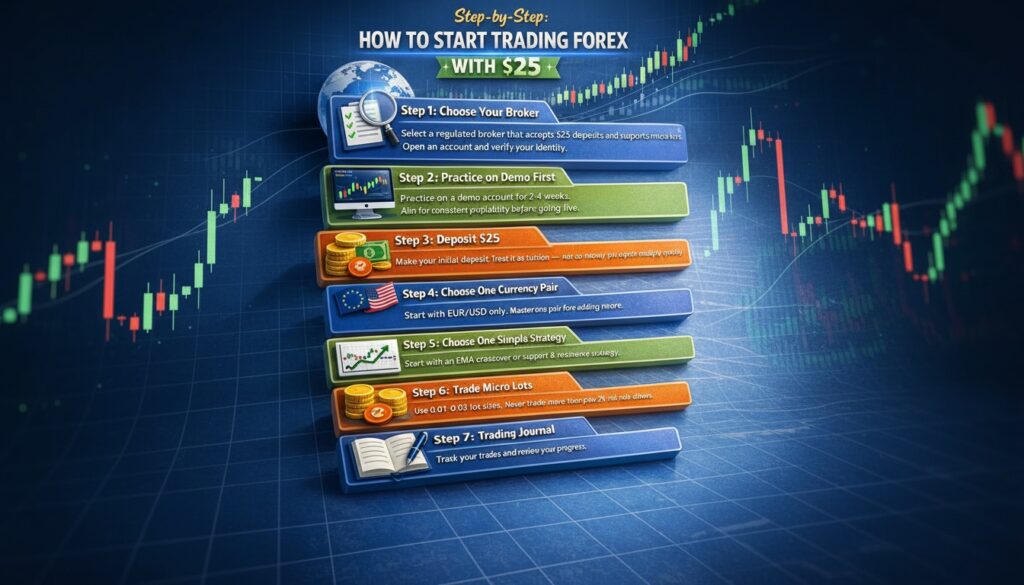
Step 1: Choose Your Broker
Pick brokers where you can start trading forex with only $25 with no hidden fees.
Select a regulated broker that accepts $25 deposits and supports micro lots. Open an account and verify your identity.
Step 2: Practice on Demo First
Before depositing real money, practice your chosen strategy on a demo account for 2-4 weeks. Aim for consistent profitability on demo before going live.
Step 3: Deposit $25
Start trading forex with only $25 by funding via card/wallet
Make your initial deposit. Treat it as tuition — not as money you expect to multiply quickly.
Step 4: Choose One Currency Pair
Start with EUR/USD only. Master one pair’s behavior before adding more.
Step 5: Choose One Simple Strategy
Start with a basic EMA crossover or support/resistance strategy. See our forex trading strategies guide for beginner-friendly approaches.
Step 6: Trade Micro Lots
Use 0.01-0.02 lot sizes. Never trade more than your 2% risk rule allows.
Step 7: Keep a Trading Journal
Record every trade — entry, exit, reason, result. See our trading journal guide for how to set one up properly.
Step 8: Review and Improve Weekly
Every weekend review your trades. What worked? What didn’t? What mistakes did you make? Continuous review and adjustment is what separates traders who improve from those who stay stuck.
Common Mistakes When Starting With $25
Overleveraging — Using high leverage because “I only have $25 so I need big positions to make money.” This is the fastest way to blow a small account.
No stop losses — “I’ll watch it and close manually.” You won’t. Use stop losses on every trade.
Trading too many pairs — Spreading attention across 5 pairs means mastering none. EUR/USD only until consistently profitable.
Expecting fast profits — $25 growing to $25,000 in 3 months is not a realistic goal. Consistent discipline and small compounding gains over 12-24 months is the real path.
Revenge trading — After 2-3 losing trades, increasing position size to “make it back.” This destroys accounts faster than anything else.
When to Scale Up From $25
Consider adding more capital when you can demonstrate:
- Consistent profitability over 3+ months
- Win rate above 50% with positive risk/reward ratio
- Strict adherence to stop losses and position sizing rules
- Emotional control — no revenge trading, no overleveraging
- A completed trading journal showing systematic improvement
When you’ve proven these on $25, adding $100, $500, or $1,000 is simply scaling up a proven process — not gambling on unproven skills.
Final Thoughts
Start trading forex with only $25 today—thousands of traders began exactly where you are
Start Trading Forex with only $25 — it’s one of the smartest decisions most new traders overlook. Instead of jumping in with large capital before they’re ready, a $25 account helps you experience real trading psychology, apply true risk management, and practice strategy execution—all at minimal cost.
Master the discipline on how to start trading forex with only $25 first. The capital can always be added later. The skills and habits you build on a small account are what determine success when the stakes are higher.
For a complete introduction to forex trading from the beginning, see our forex education hub and our guide on how much money you really need to start forex trading.
FastCashForex has been providing free forex education resources since 2010. This article is for educational purposes only and does not constitute investment advice. Forex trading involves substantial risk of loss.