Learn How to Make Fast Money by Learning diffrent Strategies in Forex Trading and Different Investment Options
How to Make Money in Trading
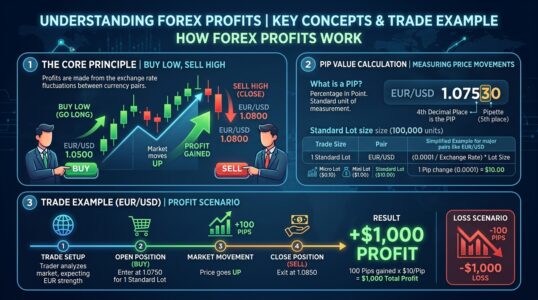
Figuring out how to make money in trading is not complicated in theory. You buy when prices rise and sell when they fall. Simple enough. The problem is the gap between knowing that and actually doing it consistently, with real money, under real market pressure. That gap is where most traders lose.
The forex market turns over more than six trillion dollars every single day. That volume creates real opportunity. But it also means your counterparty is often a bank, a hedge fund, or an institutional desk with decades of experience and technology you cannot match. Competing in that environment takes more than a good strategy. It takes discipline, a trading style that fits your life, and a risk approach that keeps you alive long enough to improve.
How to Make Money in Trading: What That Income Actually Looks Like
Most people come to forex with the wrong mental model of what the income looks like. It is not a salary. It does not arrive on a schedule. It is not guaranteed. Some months you lose money even when you trade well, simply because the market did not cooperate with your setups. That is normal.
The traders who succeed long term are not the ones who avoid losing months. They are the ones who understand that losses are part of the business and plan for them accordingly. They measure success by whether they followed their process, not just whether they made money on a given trade. The market rewards that kind of thinking over time. It punishes the trader who chases wins and ignores process.
Scalping: Small Profits, High Frequency
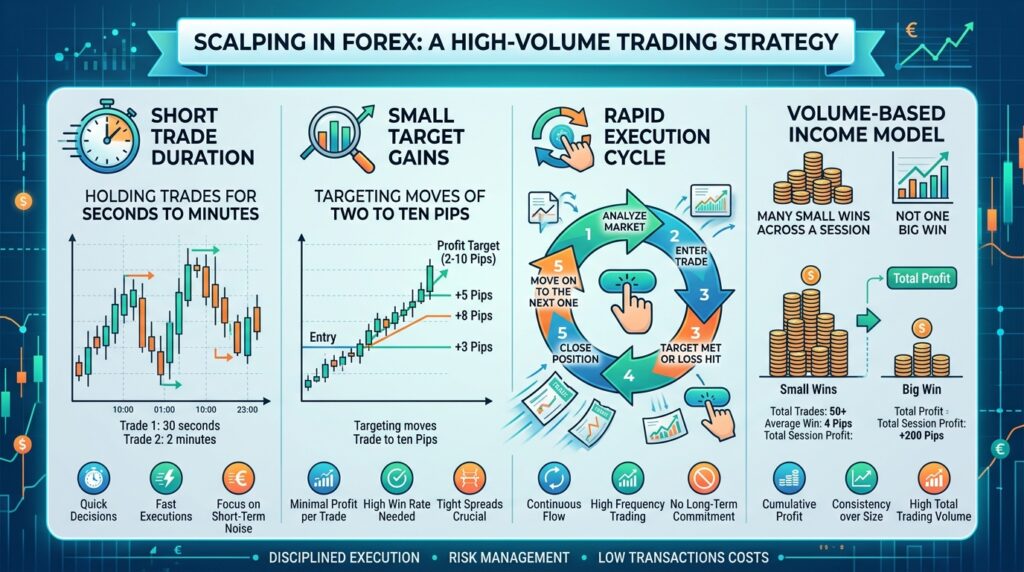
Scalping means holding trades for seconds to minutes. You target moves of two to ten pips, close the trade, and move on to the next one. The income model is volume — many small wins across a session rather than one big one.
It sounds easy. It is not. One bad trade where you ignore your stop can wipe out an entire morning of careful work. The pace is relentless. Execution has to be precise. And the broker matters enormously — tight spreads and fast order processing are not optional for scalpers, they are the baseline. The wrong broker makes this style unprofitable before you make a single mistake.
Our Forex Scalping Guide covers entry and exit rules, the best pairs to scalp, and exactly what to look for in a broker that genuinely supports this approach.
Day Trading: Full Sessions, No Overnight Risk
Day traders hold positions for minutes to several hours. Everything opens and closes within the same trading session. No overnight exposure, no waking up to find the market gapped against you while you slept.
The focus for most day traders is the London-New York overlap. That window produces the most consistent movement on major pairs because both major financial centers are active at the same time. Liquidity is deep, spreads are tight, and price moves with purpose rather than drifting. Trading outside that window is possible but harder.
You do need to be present. Day trading is not a set-and-forget style. If you cannot watch charts during market hours, this approach will not suit you. Our Forex Trading Sessions guide explains how each session behaves and which pairs move most during each window.
Swing Trading: Working With the Market’s Natural Rhythm
Swing trading is the style that works best for people who have jobs, families, or anything else that prevents them from watching charts all day. You hold trades for two days to two weeks. You are targeting fifty to several hundred pips rather than a few. The setups are built on technical analysis — trends, pullbacks, consolidations, breakouts — and the entries are planned in advance rather than reacted to in real time.
The practical advantage is time. You can do your analysis in the evening, place your trade with a stop loss and take profit already set, and let it run. You are not glued to a screen. The market does the work while you do other things.
The tradeoff is overnight exposure. Holding across multiple days means economic releases, central bank decisions, and geopolitical events can move the market hard while you are not watching. A stop loss is not optional in swing trading. It is the only thing that prevents a manageable loss from becoming a serious one. Our stop loss guide walks through exactly how to place them correctly.
Position Trading: The Long Game
Position trading means holding trades for weeks or months. Sometimes longer. This is how institutional traders and currency fund managers approach the market — they identify a macro trend driven by interest rate differentials or economic divergence and ride it until the fundamentals change.
For retail traders, this style requires serious capital. You will sit through large short-term drawdowns as part of the process. You need a genuine understanding of fundamental analysis, not just chart patterns. And you need the emotional discipline to hold through noise that would shake out a less experienced trader.
The payoff is favorable risk-to-reward. A well-executed position trade can return multiples of the risk taken. But it is the hardest style to learn and the one that demands the most patience.
Risk Management Comes First
Every profitable trader runs the same foundation regardless of style. They never risk more than they can afford to lose on a single trade. They size positions so a losing streak does not destroy the account before their edge plays out.
The standard framework is one to two percent of account equity per trade. That sounds conservative until you think about what it protects. With a one percent rule, twenty consecutive losing trades still leaves most of your account intact. Without it, five bad trades can be catastrophic. Our Forex Risk Management Guide covers position sizing, stop placement, and how to calculate risk on every trade before you enter.
Leverage deserves its own warning. Forex brokers offer leverage that lets you control positions far larger than your deposited capital. That amplifies profits and losses equally. It is the single most common reason traders with decent strategies still blow up their accounts. Understand it completely before you use it.
The Broker Matters More Than Most Traders Realize
Your broker affects your results directly. Spreads, execution speed, slippage, and support for your trading style all depend on who you trade with. A scalper at a broker with slow execution is at a structural disadvantage regardless of strategy quality. A swing trader at a broker that requotes consistently will miss entries their analysis correctly identified.
The CFTC and NFA regulate forex brokers in the United States. The FCA covers brokers in the United Kingdom. Trading with regulated brokers protects your capital and gives you recourse if something goes wrong. Our How to Choose a Forex Broker guide covers regulation, trading costs, platform quality, and execution — everything you need to evaluate before depositing.
The Part Nobody Wants to Talk About
The technical side of trading is learnable. Charts, indicators, entry rules, position sizing — these are skills. You can study them, practice them, and get good at them over time.
The psychology is harder. Cutting a losing trade quickly goes against every instinct you have. Holding a winning trade through pullbacks without panicking out is genuinely difficult. Watching a position move against you triggers a stress response that clouds judgment. This is why traders who understand their strategy intellectually still make emotional mistakes the moment real money is involved.
The solution is experience and repetition — starting with small sizes where the emotional stakes are low enough to learn from rather than just survive. A trading journal helps. Writing down your reasoning before you enter a trade and reviewing it honestly after forces a level of self-awareness that most traders never develop.
Making money in trading takes time to get right. The traders who treat it as a skill to develop rather than a shortcut to quick profits are the ones who eventually build accounts that grow consistently rather than fluctuate wildly and trend down.
Risk Warning: Forex trading involves a significant risk of loss and is not suitable for all investors. Leverage can work against you as well as for you. Trade only with money you can afford to lose, and make sure you fully understand the risks before opening a live account. This article is for educational purposes only and does not constitute financial advice.