Learn How to Make Fast Money by Learning diffrent Strategies in Forex Trading and Different Investment Options
Currency Trading: A Smart, Easy Start for Beginners
Currency trading is the simultaneous buying of one currency and selling of another, with the goal of profiting from changes in their exchange rates. It’s the largest financial market in the world by trading volume, moving more than $7.5 trillion every single day, and it never really stops — five days a week, traders somewhere on the planet are buying and selling currencies around the clock.
This guide breaks down what currency trading actually is, how the market works, who participates, and how to get started without making the expensive mistakes most beginners make.
Currency trading — also called forex trading or FX trading — is exchanging one country’s money for another’s, betting that the relative value of the two will shift in your favor. You’re not buying a single currency in isolation. You’re buying one and selling another at the same time.
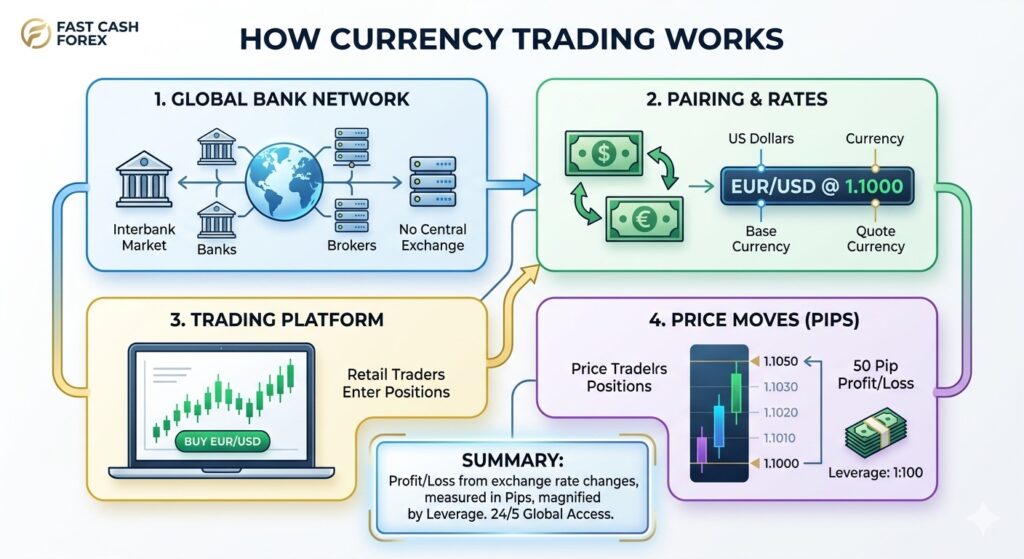
Every currency trade involves a pair, like EUR/USD (euro vs. US dollar) or GBP/JPY (British pound vs. Japanese yen). The first currency in the pair is the base currency. The second is the quote currency. The exchange rate tells you how much of the quote currency it takes to buy one unit of the base.
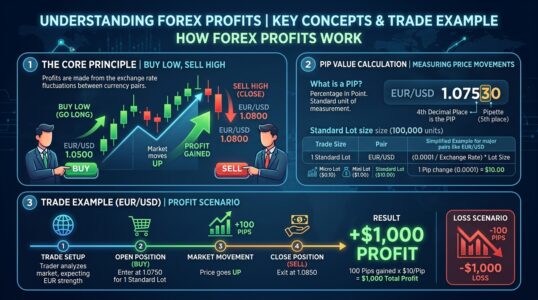
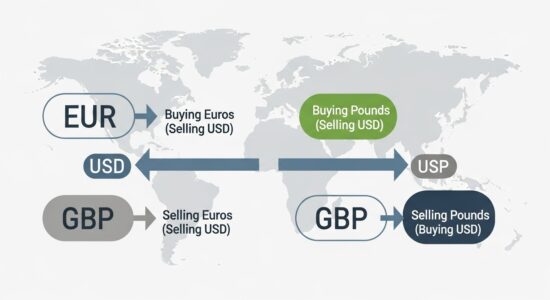
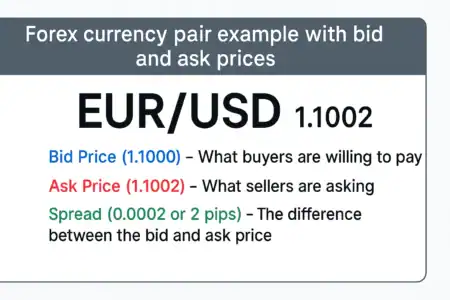
If EUR/USD trades at 1.1000, one euro costs 1.10 US dollars. If you think the euro will strengthen against the dollar, you buy. If you think it’ll weaken, you sell. Done correctly and consistently, currency trading produces profit. Done carelessly, it produces losses — and most beginners fall into the second category.
For a deeper look at the mechanics, our guide on what is forex trading covers history, terminology, and concepts in detail.
How Currency Trading Works
The currency market doesn’t operate like the stock market. There’s no central exchange, no NYSE for forex. Instead, currency trading happens through a global network of banks, brokers, and traders connected electronically — what’s called the interbank market.
Three things make this market different from stocks:
It’s decentralized, meaning trades happen directly between parties rather than on a public exchange. Different brokers may quote slightly different prices for the same pair at the same moment.
It’s continuous. The market follows the sun across major financial centers — Sydney opens Sunday evening, then Tokyo, then London, then New York. The London/New York overlap (8:00 AM to noon Eastern) is when volume peaks and pairs move the most.
It’s massive. Daily volume in currency trading exceeds the combined volume of every stock exchange on Earth. That kind of liquidity means you can enter and exit positions instantly, even with large size.
Profits in currency trading come from price movements measured in pips (the smallest standard price move). Buy EUR/USD at 1.1000, sell at 1.1050, and you’ve made 50 pips. The dollar value of those pips depends on your lot size — the standardized chunk of currency you’re trading. The position size calculator makes that math easy.
Who Participates in Currency Trading
Several different groups create that $7.5 trillion in daily volume.
Central banks like the Federal Reserve, European Central Bank, and Bank of Japan move currencies through monetary policy and, occasionally, direct intervention. When a central bank raises rates or signals a policy shift, currencies can move dozens of pips in seconds.
Commercial banks handle currency exchange for clients and trade for their own books. They form the core of the interbank market.
Hedge funds and institutional investors trade currencies as part of larger investment strategies, often holding positions for weeks or months.
Multinational corporations buy and sell currencies to handle international business — paying suppliers in different countries, hedging against exchange rate risk, repatriating overseas earnings.
Retail traders — individuals like you, working through brokers — make up the smallest slice of overall volume but the fastest-growing segment of the market. The 1990s opened currency trading to retail through electronic platforms, and the barrier to entry has dropped further every year since.
How to Start Currency Trading
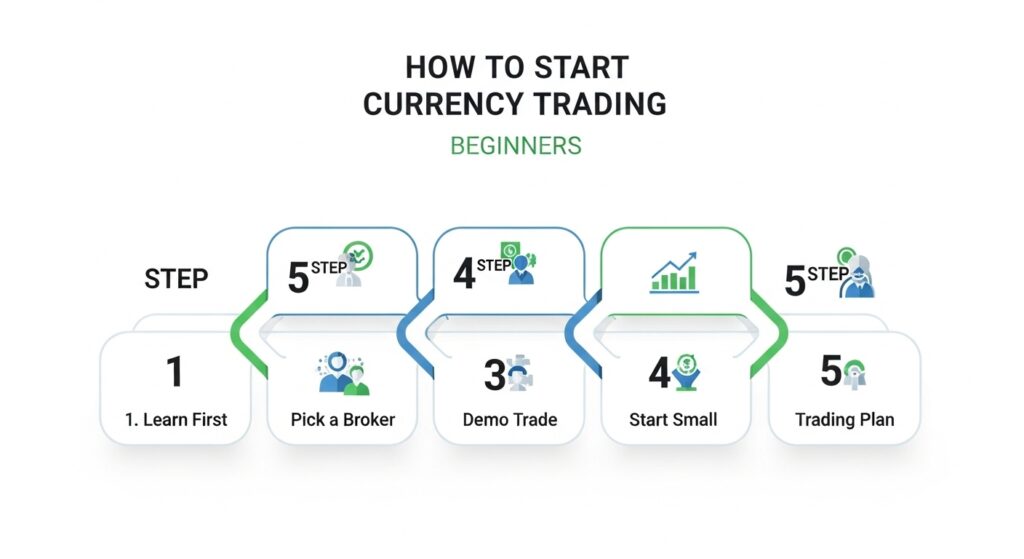
The traders who survive their first year almost all follow the same sequence. Skip steps and you join the 70-90% of retail traders who lose money.
1. Learn First
Currency trading has its own vocabulary and logic. Pips, lots, leverage, margin, spreads, swap rates — these aren’t optional terms. Read about how forex works, study risk management, and understand the basics before risking real money.
2. Pick a Regulated Broker
Your broker holds your money. That alone makes regulation matter. In the US, look for brokers regulated by the CFTC and NFA. In the UK, the FCA. In Australia, ASIC. Beyond regulation, compare spreads, test execution speed, and check customer service before funding the account. Our full broker selection guide walks through everything.
3. Trade a Demo Account
Every legitimate broker offers free demo accounts. Use one for at least a few weeks. If you can’t be consistently profitable on a demo, you won’t be on a live account. Demo trading isn’t a stepping stone to skip — it’s a filter.
4. Start Small with Real Money
When you go live, start with a small account and trade micro lots. Risk no more than 1-2% of your account on any single trade. The traders who survive aren’t the ones who took huge risks early — they’re the ones who built consistency before they built size. Our guide on how much money to start forex trading covers realistic starting amounts.
5. Build a Trading Plan
A plan tells you what to trade, when to trade, how much to risk, and what defines a setup worth taking. Without a plan, you’re guessing. Our currency trading tips post covers the essentials every beginner needs.
The Risks of Currency Trading
Currency trading offers real opportunity. It also carries real risk, and you owe it to yourself to understand both before funding an account.
Leverage is the most common killer. The same 100:1 leverage that makes currency trading feel exciting also means a 1% adverse move wipes out your stake. New traders see big leverage as opportunity. Experienced traders see it as a trap.
Volatility can hit without warning. A central bank surprise, a major economic release, or a geopolitical shock can move a pair 100+ pips in seconds. Even with a stop-loss, you can take a worse fill than expected during fast markets.
Counterparty risk matters because the market is decentralized. If your broker fails or acts dishonestly, your money is at risk — which is why regulation matters so much.
Psychology is the silent killer. Fear after losses. Greed after wins. Revenge trading. Most traders don’t lose because their analysis was bad. They lose because they couldn’t follow their own rules under pressure.
The base rate is brutal: industry estimates put losing rates at 70-90% of retail traders over time. That’s not a reason to avoid currency trading — it’s a reason to take it seriously and start small.
Currency trading rewards patience, discipline, and the willingness to learn from losses. It punishes everything else. The market isn’t going anywhere, so there’s no rush to jump in before you’re ready.
Take the time, do the work, and currency trading can become a real skill rather than a get-rich-quick scheme that ends in disappointment.
Disclaimer: Currency trading involves substantial risk of loss and isn’t suitable for everyone. The information here is for educational purposes only and shouldn’t be taken as investment advice. Past performance doesn’t predict future results. Never trade with money you can’t afford to lose.