The forex market moves more than $7.5 trillion every day, and most people assume the only way to participate is to sit at a screen and trade currencies yourself. That’s not true. There are several ways to invest in forex without becoming an active trader — some hands-off, some hybrid, some fully active. The right choice depends on your time, capital, risk tolerance, and how much control you want.
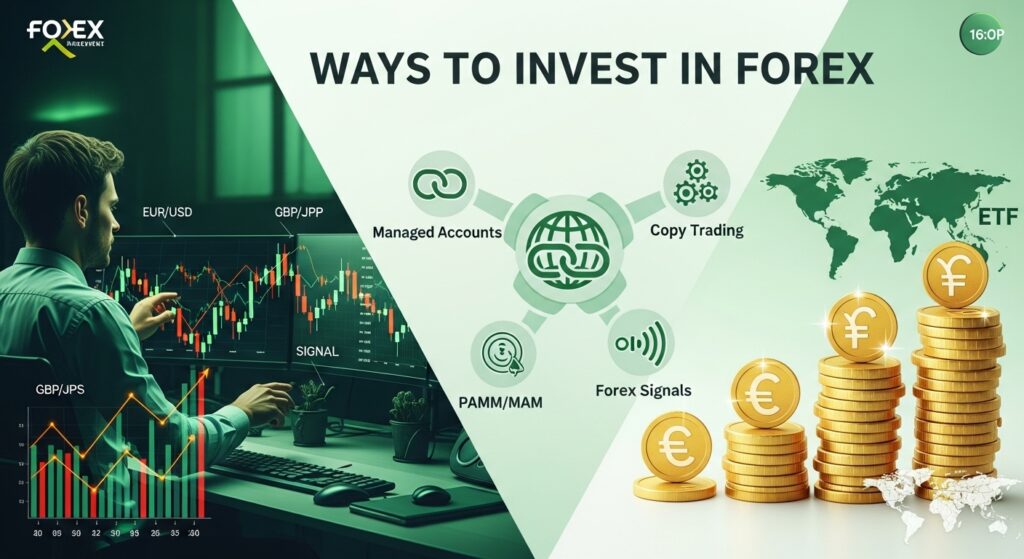
This guide breaks down six legitimate ways to invest in forex, what each one involves, and the catch with each (because every option has one).
Why Consider Different Ways to Invest in Forex?
Most beginners assume forex investing means opening a broker account and clicking buy and sell buttons. For some people, that’s the right path. For many others, it isn’t.
Self-directed trading demands time you may not have, education most people skip, and emotional discipline that takes years to build. The 70-90% retail trader loss rate isn’t because forex is rigged — it’s because most traders aren’t ready for what active trading actually requires.
The good news is that the modern forex industry offers several ways to invest in forex that don’t require you to become a full-time trader. Some give you exposure with minimal effort. Others let you learn while leveraging someone else’s experience. The trick is matching the right approach to your situation — and avoiding the scams that exist in every category.
1. Self-Directed Trading
The most common way to invest in forex is to do it yourself. You open an account with a regulated broker, fund it, and trade currency pairs based on your own analysis.
What you need: Time to learn, capital to risk, discipline to follow rules.
The upside: Full control. Lowest costs (no manager fees, no signal subscriptions). Skill that compounds over time. If you become consistent, you keep all the profits.
The catch: Steep learning curve. Most beginners lose money in the first year. It’s a multi-year commitment to become consistent, not a side income you turn on overnight.
If this is the path you’re considering, start with our forex trading guide and currency trading tips. Then practice on a demo account for at least a few weeks before going live.
2. Managed Forex Accounts
A managed forex account is exactly what it sounds like: you fund the account, but a professional money manager makes the trades on your behalf. You pay a management fee plus a performance fee on profits.
What you need: Significant starting capital (often $10,000 minimum, sometimes $50,000+). Trust in the manager.
The upside: Hands-off exposure to forex returns. You benefit from the manager’s expertise without needing to trade yourself.
The catch: This is the most scam-heavy category in retail forex. Many “managed account” services are unregulated, promise unrealistic returns (50%+ monthly), and either run Ponzi schemes or simply lose your money on bad trading. Even legitimate managers can have losing years — and the fees still apply.
How to evaluate a managed account safely:
Look for managers regulated by serious authorities — the CFTC and NFA in the US, the FCA in the UK. Ask for verified, audited track records (not screenshots, not internal claims). Be deeply suspicious of any service promising consistent monthly returns above 5-10%. Real fund managers report performance audited by third parties — if a service can’t or won’t provide that, walk away.
3. Copy Trading and Social Trading
Copy trading is the modern, more transparent version of managed accounts. You connect your account to a platform that lets you automatically copy the trades of experienced traders. When they buy, your account buys proportionally. When they exit, your account exits.
What you need: A broker or platform that supports copy trading (eToro, ZuluTrade, MetaTrader Signals, and others). A funded account.
The upside: Lower minimum capital than managed accounts (sometimes as low as $200). Full transparency — you can see the trader’s history, win rate, and drawdown before copying. You stay in control of your account and can stop copying anytime.
The catch: Past performance doesn’t guarantee future results. Many top-ranked traders on these platforms blow up eventually. Hot streaks attract followers right before reversals. You also pay platform fees and sometimes spread markups, which add up.
The smart way to use copy trading: Diversify across multiple traders rather than going all-in on one. Look at three-year track records, not three-month ones. Pay close attention to maximum drawdown, not just total return.
4. PAMM and MAM Accounts
PAMM (Percentage Allocation Management Module) and MAM (Multi-Account Manager) accounts are a step up from copy trading and a step down from full managed accounts. Multiple investors pool funds with one manager who trades on behalf of all of them, with profits and losses distributed proportionally.
What you need: A broker that offers PAMM/MAM (most major regulated brokers do). Usually $500-$5,000 minimum.
The upside: Professional management with relatively low minimums. Transparent performance reporting. Easy to enter and exit.
The catch: Same risks as any managed account — manager skill matters enormously, and past performance is no guarantee. Fees can be significant (often 20-30% of profits plus management fees).
PAMM accounts work best when the manager is regulated, has a long track record, and the broker hosting the account is itself reputable. The broker handles the accounting and transparency, which is what makes PAMM safer than direct managed accounts.
5. Forex Signals Services
A forex signal is a trade recommendation — usually a specific currency pair, entry price, stop-loss, and take-profit level. You receive these via email, app, or messaging service, and decide whether to act on them.
What you need: A subscription (free signals exist but are usually low-quality). A funded broker account. The discipline to either follow signals exactly or skip them entirely.
The upside: You learn from someone else’s analysis while keeping control of your trades. Cheaper than a managed account.
The catch: Most signal services are mediocre to fraudulent. The ones that actually work are usually expensive and limit subscribers to maintain edge. And even good signals only work if you follow them with discipline — most subscribers second-guess, modify, or skip the trades that turn out to be winners.
The realistic perspective: If you’re going to use signals, treat them as input to your own decisions, not as instructions to follow blindly. The trader who blindly copies signals usually does worse than either trading themselves or hiring an actual money manager.
6. Forex ETFs and Currency Funds
For investors who want forex exposure inside a regular brokerage account, currency ETFs and forex-focused funds offer the lowest-friction option of all.
What you need: A standard stock brokerage account. That’s it.
The upside: Trades like a stock. No leverage required. No 24-hour market to watch. Tax treatment is usually simpler than direct forex. Some funds focus on specific currencies (like the Invesco DB US Dollar Index Bullish Fund), others on emerging market currencies, others on currency-hedging strategies.
The catch: You don’t get the leverage that makes forex appealing to many retail traders. Returns are typically modest, similar to bond-fund returns. Some currency ETFs charge management fees that erode long-term returns.
This is the most boring way to invest in forex — and for some people, that’s exactly the point. It’s appropriate for investors who want a small allocation to currency markets as part of a diversified portfolio, not for traders looking to actively profit from currency moves.
How to Choose Among These Ways to Invest in Forex
The right approach depends on three honest answers:
How much time can you commit? If you can dedicate 5-10 hours weekly to learning and practice, self-directed trading is viable. If you can give 1-2 hours, copy trading or PAMM might fit. If you want hands-off, managed accounts or ETFs make more sense.
How much capital do you have? ETFs and copy trading work with small accounts ($200-$1,000). PAMM needs $500-$5,000. Quality managed accounts often need $10,000+.
What’s your risk tolerance? Active trading and signals can produce big swings. Managed accounts and ETFs tend to be steadier. If you’d panic at a 30% drawdown, you don’t belong in active leveraged trading.
There’s no shame in choosing a hands-off path. Many serious investors hold currency exposure through ETFs while never placing a single forex trade themselves. The goal is exposure that fits your life — not proving you can do what professional traders do.
A Final Warning
Whatever way you choose to invest in forex, the same red flags apply. Be suspicious of any service promising consistent high returns. Insist on regulated providers with verifiable track records. Never invest money you can’t afford to lose. And remember that forex investing — in any form — carries real risk of loss, including total loss of your investment.
The forex market offers real opportunity. It also has more scams than almost any other corner of finance. Spend the time to understand what you’re getting into before sending money anywhere. Per Investopedia, even sophisticated forex investors regularly experience losses — and that’s with proper preparation. Without it, the odds get much worse.
What to Read Next
- Currency Trading: A Smart, Easy Start for Beginners
- What is Forex Trading? Complete Beginner’s Guide
- Currency Trading Tips: 10 Essential Lessons to Save Money
- How to Choose a Forex Broker
- Investment Methods Guide
Disclaimer: Investing in forex involves substantial risk of loss and isn’t suitable for everyone. The information here is for educational purposes only and shouldn’t be taken as investment advice. Past performance doesn’t predict future results. Be especially cautious of managed accounts, signal services, and copy trading platforms promising unrealistic returns. Always verify regulation status before sending money to any forex service. Never invest money you can’t afford to lose.