Learn How to Make Fast Money by Learning diffrent Strategies in Forex Trading and Different Investment Options
Trend Trading Strategies Complete Guide
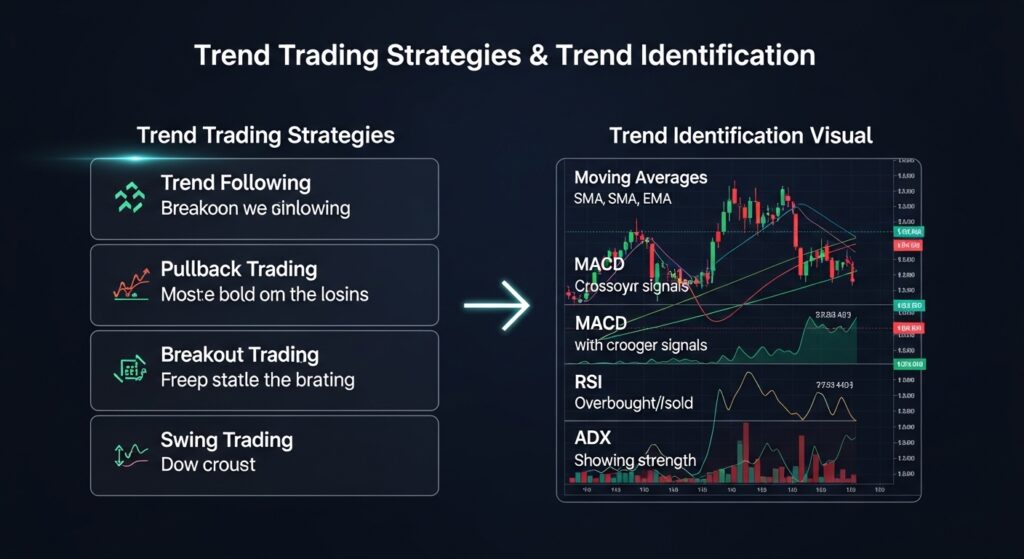
Trend trading Strategies: Trend Trading is one of the most profitable and reliable forex strategies. The concept is simple: identify a trend and trade in its direction until it ends. This guide covers everything you need to master trend trading.
Trend trading means identifying the market’s direction (up, down, or sideways) and taking positions that align with that direction.
Core principle: “The trend is your friend until it ends.”
Why Trend Trading Works
Market reality:
Markets trend 30-40% of the time
Trends can last weeks, months, or years
Largest profits come from catching trends
Fighting trends is the fastest way to lose money
Psychological advantage:
Trading with trend = trading with majority
Momentum on your side
Risk-reward naturally favorable
Less stressful than counter-trend trading
💡 KEY INSIGHT: Most successful professional traders are trend traders. They let profits run in trends and cut losses quickly when wrong.
Identifying Trends
Before trading trends, you must correctly identify them.
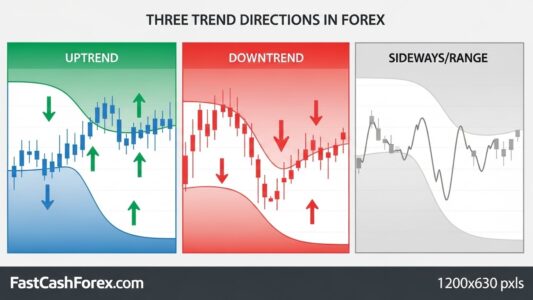
The Three Types of Trends
1. Uptrend (Bullish)
Series of higher highs and higher lows
Price consistently moves upward
Each rally higher than previous
Each pullback stops above previous low
2. Downtrend (Bearish)
Series of lower highs and lower lows
Price consistently moves downward
Each decline lower than previous
Each bounce stops below previous high
3. Sideways Trend (Range)
No clear higher highs/lows or lower highs/lows
Price oscillates between support and resistance
Horizontal movement
NOT for trend trading strategies
Trend Identification Methods
Method 1: Swing Points (Price Action)
For uptrend:
Mark recent swing highs and swing lows
Each swing high > previous swing high
Each swing low > previous swing low
Clear staircase pattern upward
For downtrend:
Each swing high < previous swing high
Each swing low < previous swing low
Clear staircase pattern downward
Method 2: Moving Averages
Simple trend rules:
Price above 50 MA + 200 MA = Uptrend
Price below 50 MA + 200 MA = Downtrend
50 MA above 200 MA = Strong uptrend
50 MA below 200 MA = Strong downtrend
Method 3: Trendlines
Uptrend line:
Connect two or more higher lows
Price bounces off trendline
Line slopes upward
Downtrend line:
Connect two or more lower highs
Price rejected at trendline
Line slopes downward
Multi-Timeframe Trend Analysis
Check trends across multiple timeframes for strongest setups.
Three-timeframe approach:
Timeframe
Purpose
Example
Higher (HTF)
Overall direction
Daily
Trading (TF)
Entry timing
H4
Lower (LTF)
Precise entry
H1
Ideal scenario:
Daily: Strong uptrend
H4: Pullback in uptrend
H1: Reversal signal from pullback
Action: Enter long (all timeframes aligned)
Conflicting trends:
Daily: Uptrend
H4: Downtrend
Action: Wait for H4 to align with daily
⚠️ WARNING: Never trade against higher timeframe trend. Daily trend beats H1 trend every time.
Trend Trading Strategies
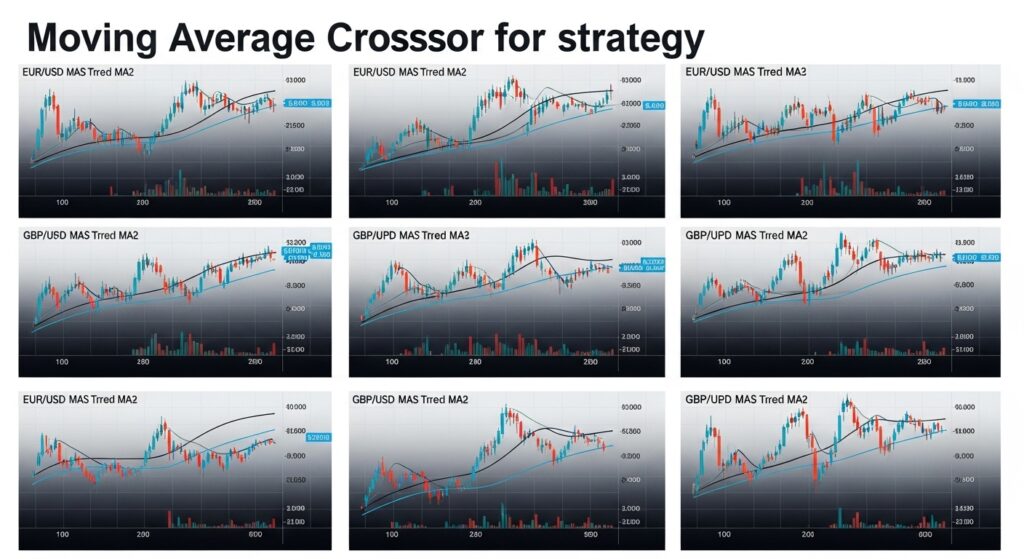
Strategy 1: Moving Average Crossover
Simple, objective, and effective for catching major trends.
Setup:
Apply 50 EMA (fast) and 200 EMA (slow)
Watch for crossovers
Entry signals:
Buy (Golden Cross):
50 EMA crosses above 200 EMA
Enter at crossover or pullback to 50 EMA
Stop-loss: Below recent swing low
Hold until 50 EMA crosses below 200 EMA
Sell (Death Cross):
50 EMA crosses below 200 EMA
Enter at crossover or pullback to 50 EMA
Stop-loss: Above recent swing high
Hold until 50 EMA crosses above 200 EMA
Advantages:
Completely objective (no subjectivity)
Catches majority of major trends
Simple to execute
Works on all timeframes
Disadvantages:
Lags (late entries and exits)
Multiple false signals in ranging markets
Gives back significant profits at trend reversals
Optimization:
Use on H4 or Daily for reliability
Skip signals in choppy markets
Add ATR filter (only trade when ATR expanding)
Expected performance:
Win rate: 30-40%
Average win: 3-5 times average loss
Profitable long-term despite low win rate
Strategy 2: Trendline Bounce Trading
Trade pullbacks to established trendlines.
Setup requirements:
Clear uptrend or downtrend
Valid trendline (3+ touches)
Trendline not broken recently
Entry process:
For uptrend:
Draw trendline connecting higher lows
Wait for price to pull back to trendline
Look for bullish reversal signal (hammer, engulfing, pin bar)
Enter when price bounces off trendline
Stop-loss: Below trendline (20-30 pips)
Take-profit: Previous high or use trailing stop
For downtrend:
Draw trendline connecting lower highs
Wait for price to rally to trendline
Look for bearish reversal signal
Enter when price rejected at trendline
Stop-loss: Above trendline
Take-profit: Previous low or trailing stop
Confirmation signals:
Candlestick reversal pattern
RSI or Stochastic confirmation
Volume increase on bounce
Price closes in direction of trend
Advantages:
Better risk-reward than breakout entries
Trade from logical support/resistance
Multiple opportunities per trend
Clear invalidation point (trendline break)
When to exit:
Trendline broken decisively
Price action weakening
Target hit
Time-based exit (trade taking too long)
Strategy 3: Pullback Trading with Moving Averages
Trade retracements to key moving averages in trending markets.
Popular MA pullback levels:
20 EMA: Aggressive (short-term trends)
50 EMA: Balanced (most popular)
200 EMA: Conservative (major trends only)
Strategy setup (50 EMA example):
Long setup (Uptrend):
Confirm uptrend: Price above 50 EMA + 200 EMA
Wait for pullback to 50 EMA
Price touches or comes near 50 EMA
Bullish reversal candle forms
Enter long at close of reversal candle
Stop-loss: 20-30 pips below 50 EMA
Target: Recent high or 1:2 R:R
Short setup (Downtrend):
Confirm downtrend: Price below 50 EMA + 200 EMA
Wait for rally to 50 EMA
Price touches or nears 50 EMA
Bearish reversal candle forms
Enter short at close
Stop-loss: 20-30 pips above 50 EMA
Target: Recent low or 1:2 R:R
Additional filters:
Only trade if 50 EMA and 200 EMA sloping in trend direction
Avoid if price too far from 50 EMA (wait for pullback)
Check RSI: Buy when RSI 40-50, Sell when RSI 50-60
Best on H1, H4, Daily timeframes
Advantages:
High win rate (60-70%)
Clear entry and exit rules
Excellent risk-reward
Works in all currency pairs
Strategy 4: Breakout Retest (Trend Continuation)
Trade when price breaks resistance (uptrend) or support (downtrend), then retests.
Setup for uptrend:
Identify clear uptrend
Price consolidates below resistance
Price breaks above resistance strongly
Price pulls back to test broken resistance (now support)
Enter long at retest
Stop-loss: Below retest low
Target: Measured move or next resistance
Setup for downtrend:
Identify clear downtrend
Price consolidates above support
Price breaks below support strongly
Price rallies to test broken support (now resistance)
Enter short at retest
Stop-loss: Above retest high
Target: Measured move or next support
Confirmation needed:
Initial break was strong (large candle)
Volume increased on break (if available)
Retest shows rejection (reversal candle)
No extended consolidation at retest
When to skip:
Weak initial breakout
Immediate return to range (false break)
Multiple retests (level losing strength)
No reversal pattern at retest
Strategy 5: Higher High/Lower Low Momentum
Trade when price makes clear new highs (uptrend) or lows (downtrend).
For uptrend:
Price makes higher high (breaks previous high)
Wait for pullback
Enter when price holds above previous high (now support)
Stop-loss: Below pullback low
Target: Next measured high or trail stop
For downtrend:
Price makes lower low (breaks previous low)
Wait for bounce
Enter when price fails below previous low (now resistance)
Stop-loss: Above bounce high
Target: Next measured low or trail stop
Entry refinement:
Don’t chase after breakout
Wait for 30-50% retracement
Enter on reversal candle
Use indicators for confirmation (RSI, MACD)
Advantages:
Trade strongest momentum
Clear market structure
Objective entry points
Excellent for trending markets
Trend Trading Risk Management
Position Sizing in Trends
Conservative approach:
First entry: 1% risk
Each subsequent entry: 0.5% risk
Maximum total exposure: 3% per trend
Scaling in:
Initial position: 50% of planned size
Add 25% at first successful test
Add final 25% at second test
Never add to losing positions
Stop-Loss Placement
Initial stop-loss options:
Method
Placement
Best For
ATR-based
2× ATR below entry
Volatile pairs
Structure
Below swing low
Clear swings
Trendline
Below trendline
Trendline trades
MA-based
Below 50 MA
MA strategies
Trailing stop methods:
Method 1: Fixed Pip Trail
Trail by fixed amount (50-100 pips)
Simple but can exit too early
Method 2: Swing Low/High Trail
Trail stop to each new swing low (uptrend)
Trail to each new swing high (downtrend)
Lets profits run, exits on reversal
Method 3: Moving Average Trail
Trail stop below 20 EMA (aggressive)
Trail stop below 50 EMA (balanced)
Protects profits while staying in trend
Profit Taking Strategies
Strategy 1: Partial Profits
Take 50% off at 1:2 R:R
Move stop to breakeven
Trail remaining 50%
Strategy 2: Scaling Out
Take 33% at 1:1 R:R
Take 33% at 1:2 R:R
Trail final 33%
Strategy 3: Trail Only
Never take profits manually
Trail stop only
Maximize trend profits
Accept giving back some gains
💡 TIP: Trend traders make money by letting profits run. Don’t take profits too early in strong trends.
Trend Trading Mistakes to Avoid
Common Errors
1. Counter-Trend Trading
Error: “Price has gone too far up, time to short”
Reality: Trends can go much further than expected
Fix: Only trade in direction of trend
2. Premature Profit Taking
Error: Taking profits at 1:1 R:R in strong trends
Reality: Missing 10:1, 20:1 moves
Fix: Use trailing stops, let winners run
3. Ignoring Higher Timeframes
Error: Trading M15 signals against daily trend
Reality: Daily trend wins every time
Fix: Always check HTF trend first
4. Trading Every Pullback
Error: Entering on every slight dip in uptrend
Reality: Many small losses, missing quality setups
Fix: Wait for pullback to key level (MA, trendline)
5. No Trend Confirmation
Error: Assuming trend continues without checking
Reality: Trading ranging market as trend
Fix: Confirm trend exists before trading
6. Too Tight Stops
Error: 10-pip stops in trending market
Reality: Stopped out by normal volatility
Fix: Use ATR-based stops, give trade room
7. Adding to Losers
Error: “Averaging down” in losing trend trade
Reality: Bigger losses, blown accounts
Fix: Only add to winning positions
Psychological Challenges
Challenge 1: Low Win Rate
Trend trading may win 30-40% of trades
Multiple small losses before big winner
Solution: Focus on R:R, not win rate
Challenge 2: Giving Back Profits
Trailing stops give back gains at trend end
Can be psychologically difficult
Solution: Accept this as cost of catching trends
Challenge 3: Missing Entries
Waiting for pullbacks, missing explosive moves
Fear of entering “too late”
Solution: Trend has many opportunities, wait for setup
Best Currency Pairs for Trend Trading
Trending Pairs
Strong trendders:
AUD/USD: Commodity-driven, clear trends
EUR/USD: High liquidity, smooth trends
GBP/JPY: Volatile, strong momentum
USD/CAD: Oil-driven, persistent trends
Choppy pairs (avoid for trend trading):
EUR/CHF: Prone to ranging
EUR/GBP: Often sideways
NZD/CAD: Whippy, unreliable trends
Best Timeframes
Ideal for trend trading:
Timeframe
Trend Duration
Suitable For
Daily
Weeks-months
Position traders
H4
Days-weeks
Swing traders
H1
Hours-days
Day traders
M15
Hours
Scalpers (not ideal)
Recommendation: Use H4 or Daily for highest reliability.
Complete Trend Trading System Example
Simple 50 EMA System
Setup:
Timeframe: H4
Indicators: 50 EMA, 200 EMA, RSI
Risk per trade: 1%
Entry rules (Long):
Price above 50 EMA and 200 EMA
50 EMA above 200 EMA
Price pulls back to 50 EMA
RSI dips to 40-50 zone
Bullish reversal candle at 50 EMA
Enter at close of reversal candle
Stop-loss:
30 pips below 50 EMA (or recent swing low)
Take-profit:
Trail stop: Move to breakeven at 1:1
Trail 50 pips behind price
Exit if price closes below 50 EMA
Position management:
Enter 50% position at first signal
Add 25% if profitable after 100 pips
Add final 25% if profitable after 200 pips
Expected results:
Win rate: 50-60%
Average R:R: 1:3
Profitable over 100+ trades
Trend Trading Checklist
Before every trend trade:
Pre-Trade Analysis
[ ] Higher timeframe trend identified
[ ] Current trend direction confirmed
[ ] Not overextended (use RSI or distance from MA)
[ ] Clear higher highs and higher lows (or lower)
[ ] Trend not nearing major resistance/support
Entry Confirmation
[ ] Price at key level (MA, trendline, S/R)
[ ] Reversal candle pattern present
[ ] Indicator confirmation (RSI, MACD)
[ ] Risk-reward minimum 1:2
[ ] Stop-loss logical (below structure)
Trade Management
[ ] Position size calculated (1% risk)
[ ] Stop-loss placed before entry
[ ] Trailing stop plan defined
[ ] Profit target or trailing method chosen
[ ] Ready to add to position if profitable
Conclusion: Trend is Your Friend
Trend trading is the foundation of successful forex trading. Master these principles:
Key principles:
Trade with the trend: Never fight higher timeframe direction
Wait for pullbacks: Don’t chase, let trades come to you
Let profits run: Trailing stops, not fixed targets
Cut losses quickly: Wrong trend? Exit and reassess
Be patient: Quality setups, not quantity
Reality check:
Trends are where big money is made
Requires patience and discipline
Lower win rate, higher reward per win
Psychological challenges (giving back profits)
Not exciting, but consistently profitable
Success formula:
Identify clear trend
Wait for pullback to key level
Enter with confirmation
Use trailing stop
Repeat
Most retail traders fail because they fight trends or take profits too early. Professional traders succeed by riding trends patiently and cutting losses quickly.