Learn How to Make Fast Money by Learning diffrent Strategies in Forex Trading and Different Investment Options
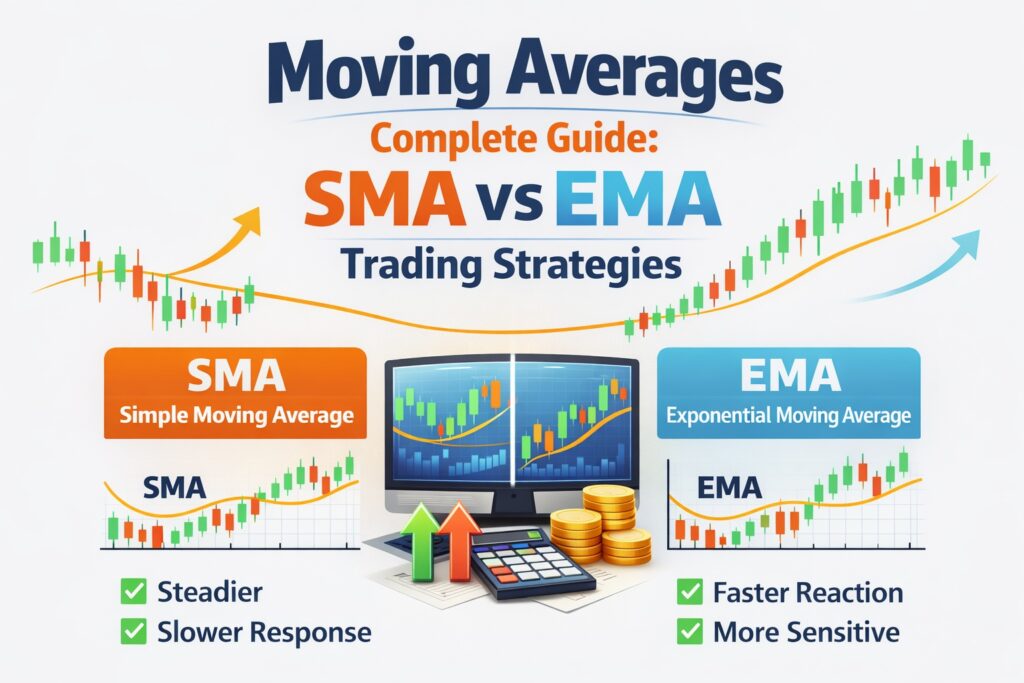
Moving Averages Complete Guide: SMA vs EMA Trading Strategies
Moving averages are among the most widely used technical indicators in forex trading. They smooth out price data to help traders identify trends, potential entry and exit points, and dynamic support and resistance levels. Understanding how to use moving averages effectively can significantly improve your trading decisions.
This guide explains what moving averages are, the key differences between Simple Moving Averages (SMA) and Exponential Moving Averages (EMA), proven crossover strategies, and the best settings for different trading styles.
A moving average calculates the average price of a currency pair over a specific number of periods, then plots this average as a line on your price chart. As new price data becomes available, the oldest data point drops off and the newest is added, causing the average to “move” with current price action.
The primary purpose of moving averages is to filter out short-term price fluctuations and highlight the underlying trend direction. When price is above the moving average, it suggests an uptrend. When price is below the moving average, it indicates a downtrend.
Moving averages serve three main functions in technical analysis:
Trend Identification: The direction and slope of a moving average reveals whether a market is trending up, down, or moving sideways. A rising moving average indicates an uptrend, while a declining moving average signals a downtrend.
Dynamic Support and Resistance: Moving averages often act as support levels during uptrends and resistance levels during downtrends. Traders watch for price bounces off moving averages as potential entry opportunities.
Crossover Signals: When different moving averages cross each other, or when price crosses a moving average, these events generate trading signals that many traders use to enter or exit positions.
Simple Moving Average (SMA)
The Simple Moving Average calculates the arithmetic mean of prices over a specified period. Each price point in the calculation receives equal weight regardless of when it occurred.
SMA Calculation:
To calculate a 20-period SMA, add the closing prices of the last 20 periods and divide by 20. As each new period completes, drop the oldest price and add the newest, then recalculate.
For example, a 20-period SMA on a daily chart uses the closing prices from the past 20 days. Tomorrow, the oldest day drops off, the new day is added, and the average recalculates.
SMA Characteristics:
Simple Moving Averages respond slower to price changes because they weight all data points equally. A price movement from 20 periods ago affects the SMA just as much as today’s price movement.
This slower response can be advantageous during choppy markets where you want to avoid reacting to every small price fluctuation. However, SMAs lag significantly during strong trending moves, potentially causing late entries and exits.
SMAs are commonly used for longer-term trend identification. Many institutional traders and traditional technical analysts prefer SMAs, which can make them self-fulfilling as support and resistance levels.
Exponential Moving Average (EMA)
The Exponential Moving Average gives more weight to recent prices while still considering older data. This weighting makes EMAs more responsive to current price action compared to SMAs.
EMA Calculation:
EMAs use a more complex formula that applies a weighting multiplier to recent prices. The exact calculation involves the previous EMA value, the current price, and a smoothing factor based on the number of periods.
The key point is that today’s price has significantly more influence on an EMA than a price from 20 periods ago, unlike an SMA where both have equal weight.
EMA Characteristics:
Exponential Moving Averages react faster to price changes, making them preferred by active traders who want earlier signals. An EMA will rise or fall more quickly as prices change direction.
This responsiveness comes with a tradeoff: EMAs generate more false signals during choppy, sideways markets. The faster reaction to price can trigger premature entries before a trend truly establishes.
EMAs are popular among day traders and swing traders who need to capture moves quickly. The 12-period and 26-period EMAs form the basis of the MACD indicator, one of the most widely used technical tools.
SMA vs EMA: Which Should You Use?
The choice between SMA and EMA depends on your trading style and objectives:
Use SMAs when:
You want to identify major, established trends and avoid market noise. SMAs excel at showing you the bigger picture without reacting to every minor price swing.
You prefer conservative entries with higher probability but potentially later signals. SMAs keep you out of choppy markets but may enter trends after they’re well established.
You’re position trading or swing trading with longer holding periods. The slower response of SMAs matches a patient approach to trading.
Use EMAs when:
You need earlier signals and can tolerate more false signals in exchange for faster entries. EMAs get you into trends sooner but require better risk management.
You’re day trading or scalping where timing matters significantly. The quicker response helps capture short-term moves.
You want dynamic support and resistance levels that adjust quickly to changing market conditions.
Using Both Together:
Many traders use both SMA and EMA combinations. For example, watching for an EMA to cross above an SMA can signal trend acceleration, while the SMA provides the broader trend context.
The key is understanding that no moving average type is universally “better.” EMAs suit active trading while SMAs suit patient trend following. Test both to see which matches your trading personality and timeframe.
Common Moving Average Periods and Their Uses
Traders use various moving average periods depending on their trading timeframe and strategy:
Short-Term Moving Averages (5-20 periods):
The 5-period and 10-period moving averages react very quickly to price changes. Day traders and scalpers use these for immediate trend direction on 1-minute to 15-minute charts.
The 20-period moving average is extremely popular across all timeframes. It represents roughly one trading month on daily charts and provides a good balance between responsiveness and reliability.
Medium-Term Moving Averages (50 periods):
The 50-period moving average is a standard tool for identifying intermediate trends. On daily charts, it shows the trend over approximately two and a half months.
When price crosses above the 50-period MA, it often signals a shift from short-term correction to resumed uptrend. Bounces off the 50-period MA during trends provide low-risk entry opportunities.
Long-Term Moving Averages (100-200 periods):
The 100-period and especially the 200-period moving average identify major trends. Institutional traders and long-term investors watch these levels closely.
The 200-period MA on daily charts represents roughly one year of trading. When price crosses this level, it signals a significant trend change. Markets often respect this MA as strong support or resistance.
Multiple Moving Average Systems:
Using multiple moving averages together provides richer information than any single MA. Common combinations include:
20/50/200 for complete trend context
50/100/200 for longer-term trading
9/21/55 Fibonacci-based system
12/26 as used in MACD
Moving Average Crossover Strategies
Crossover strategies generate clear, objective trading signals based on moving average intersections:
Golden Cross and Death Cross:
The Golden Cross occurs when a shorter-term moving average (typically the 50-period) crosses above a longer-term moving average (typically the 200-period). This signals a potential major uptrend beginning.
The Death Cross is the opposite: the shorter MA crosses below the longer MA, signaling a potential major downtrend. These signals work best on daily and weekly charts for position trading.
While these crosses are widely watched, they lag significantly. By the time a Golden Cross forms, a trend may be well underway. Use these for confirmation rather than early entry.
Dual Moving Average Crossover:
A faster approach uses two moving averages with a smaller period gap, such as 20 and 50, or 10 and 20.
When the faster MA crosses above the slower MA, enter a long position. When the faster crosses below the slower, exit longs or enter short positions.
This system generates more signals than the Golden/Death Cross but also produces more false signals during sideways markets.
Triple Moving Average System:
Adding a third moving average creates a filtering mechanism. For example, using 5, 10, and 20-period moving averages:
Enter long when the 5 crosses above the 10, and both are above the 20. This confirms the faster trend aligns with the intermediate trend.
Exit when the 5 crosses back below the 10, or when price closes below the 20.
The third MA acts as a trend filter, keeping you out of trades against the broader direction.
Moving Average Ribbon:
Some traders use multiple moving averages (6-8 different periods) creating a “ribbon” effect. When all MAs align in the same direction, it confirms a strong trend. When they compress together, it warns of choppy or sideways conditions.
Price and Moving Average Crossovers
Simple price crosses of moving averages also generate trading signals:
Price Crossing Above MA (Bullish):
When price closes above a key moving average (such as the 50 or 200), it signals potential upside momentum. This works best when price has been below the MA for an extended period.
The first close above doesn’t confirm a trend change. Wait for a second confirmation close above, or for price to pull back and bounce off the MA from above, turning it into support.
Price Crossing Below MA (Bearish):
When price closes below a key moving average after being above it, selling pressure may be increasing. This signal is most reliable when price has respected the MA as support multiple times before breaking it.
Similar to bullish crosses, wait for confirmation rather than acting on a single close below the MA.
False Breakouts:
Price often “whipsaws” around moving averages, crossing back and forth without establishing a clear trend. This happens most during low-volatility consolidations.
Require additional confirmation beyond just a price cross: look for volume increases, momentum indicator confirmation, or breaks of swing highs/lows alongside the MA cross.
Moving Averages as Dynamic Support and Resistance
Moving averages often act as support during uptrends and resistance during downtrends:
Support in Uptrends:
When a currency pair is trending higher, traders watch for price to pull back toward a rising moving average. If price bounces off the MA without breaking below, it confirms the uptrend’s health.
Popular support MAs include the 20, 50, and 200-period averages. Test which periods your chosen currency pairs respect most consistently.
Entry strategy: When price pulls back to a rising MA during an uptrend, look for bullish reversal candlestick patterns (hammer, bullish engulfing) at the MA level as entry triggers.
Resistance in Downtrends:
During downtrends, falling moving averages cap rallies. Price often rises toward a declining MA then reverses back down.
Short sellers watch for price rallies into resistance MAs as opportunities to enter short positions or add to existing shorts.
Multiple Bounces:
The more times price respects a moving average as support or resistance, the more significant that level becomes. After three or four successful bounces, the MA gains importance and attracts more trader attention.
However, nothing lasts forever. When a well-respected MA finally breaks, it often triggers strong momentum in the breakout direction as traders who were relying on that level scramble to exit.
Optimal Moving Average Settings for Different Trading Styles
Choose moving average periods based on your trading timeframe and style:
Scalping (1-minute to 5-minute charts):
Use very short moving averages: 5, 10, and 20-period EMAs for quick signals. Some scalpers use even faster settings like 3 and 8 periods.
EMAs work better than SMAs for scalping due to their faster response. Combine with price action and support/resistance for confirmation.
Day Trading (15-minute to 1-hour charts):
Popular day trading setups include 9/21 EMA crosses or 20/50 EMA combinations. The 20-period EMA on 15-minute charts is particularly popular.
For more conservative day trading, use 50 and 200-period SMAs on the 1-hour chart to identify the broader trend, then execute on faster timeframes.
Swing Trading (4-hour to daily charts):
Classic swing trading uses 50 and 200-period SMAs on daily charts. Enter when price bounces off the 50 SMA in the direction of the 200 SMA trend.
Alternatively, use 20 and 50-period EMAs for slightly faster signals while still capturing multi-day swings.
Focus on the 100 and 200-period SMAs on daily charts, or the 50-period SMA on weekly charts. These identify major trends that persist for months.
Position traders often use the 200-period daily SMA as their primary trend filter: only take longs when price is above it, only shorts when below.
Common Moving Average Mistakes
Avoid these frequent errors when using moving averages:
Using Moving Averages in Sideways Markets:
Moving averages perform poorly during consolidations and sideways ranges. They generate constant whipsaw signals as price crosses back and forth.
Before relying on MA signals, confirm a trending market exists. Use ADX, price structure analysis, or visual inspection to verify directional movement.
Over-Optimizing Settings:
Traders often test dozens of moving average combinations searching for the “perfect” settings. This leads to curve-fitting: settings that worked historically but fail in real-time.
Stick with standard, widely-watched periods like 20, 50, and 200. Their effectiveness comes partly from how many traders watch them, creating self-fulfilling reactions.
Trading Every Crossover:
Not all crossovers are equal. Taking every signal without context leads to poor results. Consider the broader trend, recent price action, and other confirming factors before acting on crossovers.
Ignoring the Lag:
All moving averages lag price by their very nature. They tell you what has happened, not what will happen. Recognize this limitation and use MAs for confirmation and trend context rather than as primary entry triggers.
Using Too Many Moving Averages:
Adding more and more moving averages doesn’t improve results. Too many lines create analysis paralysis and cluttered charts. Focus on 2-3 well-chosen MAs maximum.
Combining Moving Averages with Other Indicators
Moving averages work best as part of a complete trading system:
Moving Averages + RSI:
Use moving averages for trend direction and RSI for timing entries. Only take long trades when price is above the 50 or 200 MA and RSI shows oversold bounces (30-40 level). Only take shorts when below MAs and RSI shows overbought reversals (60-70 level).
Learn more about RSI in our complete RSI indicator guide.
Moving Averages + MACD:
The MACD itself is built from moving averages (12 and 26 EMAs). Combine MACD crossovers with price’s relationship to the 50 or 200 SMA for confirmation.
For example, MACD bullish crossovers above the zero line while price is above the 200 SMA create high-probability long setups.
Moving Averages + Support/Resistance:
When a moving average aligns with a horizontal support or resistance level, that zone becomes particularly powerful. Price often respects these confluences strongly.
Use moving averages to identify high-probability zones, then look for candlestick reversal patterns at those levels for precise entries.
Example: During an uptrend, when price pulls back to the 20 EMA and forms a bullish engulfing pattern, this creates a clear entry signal with defined risk (stop below the pattern).
Here’s a complete trading setup using moving averages:
Setup:
Place 20 EMA, 50 EMA, and 200 SMA on a daily EUR/USD chart. Look for trending conditions where all three MAs are aligned in the same direction with clear separation.
Long Trade Entry:
Wait for price to pull back to the 20 EMA during an uptrend (all MAs rising and stacked with 20 above 50 above 200). Watch for a bullish reversal candlestick pattern at the 20 EMA.
Enter long on the close of the bullish pattern candle. Place stop loss 10-20 pips below the 50 EMA to allow some breathing room.
Trade Management:
Set initial target at the previous swing high. Trail stop to breakeven once price moves 1:1 (profit equals initial risk).
If price reaches the target and uptrend remains intact (MAs still aligned), hold a portion and trail stop below the 20 EMA for extended gains.
Exit:
Exit when price closes below the 20 EMA, or if the 20 EMA crosses below the 50 EMA, signaling weakening momentum.
Risk Management:
Risk 1-2% of account capital per trade. The distance between entry (at 20 EMA) and stop (below 50 EMA) determines position size.
Moving averages are fundamental technical tools that help identify trends, provide entry and exit signals, and highlight dynamic support and resistance levels. While simple in concept, effective moving average trading requires understanding their characteristics and limitations.
Simple Moving Averages offer smooth, reliable trend identification with slower responses. Exponential Moving Averages provide faster signals but generate more noise. Neither is universally superior – choose based on your trading style and timeframe.
Crossover strategies provide clear, objective signals, but work best in trending markets and lag price action. Use moving averages as confirmation tools within a complete trading system rather than as standalone signal generators.
Test different moving average combinations on historical data and in demo accounts before risking capital. Focus on widely-watched periods like 20, 50, and 200 rather than searching for perfect settings. Combine moving averages with price action analysis, support and resistance, and other indicators for robust trading decisions.
Master moving averages as one component of your technical toolkit, and you’ll have a reliable method for navigating trending markets and improving your trade timing.
For a complete overview of technical analysis and how this indicator fits into a broader trading strategy, see our Technical Analysis Complete Guide