Learn How to Make Fast Money by Learning diffrent Strategies in Forex Trading and Different Investment Options
Trend Following Strategies: Complete Guide
Trend following is one of the most profitable and psychologically demanding trading approaches in forex. By identifying and riding established price trends, traders can capture large moves that dwarf the profits from range trading or swing trading strategies. This complete guide teaches you how to become a successful trend follower.
Trend following is a systematic trading approach that seeks to capture gains by riding established directional price movements. Rather than predicting market direction, trend followers react to what the market is already doing—identifying when a trend has begun and staying with it until clear signs of reversal appear.
Core principle: “The trend is your friend until it ends.”
The Trend Following Philosophy
Trend following rests on several key beliefs about market behavior:
Markets trend more than they range: While markets spend significant time in consolidation, the largest profits come from the relatively brief trending periods. A handful of strong trends per year can generate the majority of annual returns.
Prices move in persistent directions: Once momentum establishes itself in one direction, it tends to continue longer than most traders expect. This persistence creates the opportunity for substantial gains.
You don’t need to predict: Trend followers don’t forecast where markets will go. They simply respond to what’s happening now, entering when trends confirm and exiting when they end.
Cut losses short, let winners run: The exact opposite of most traders’ instincts. Trend following requires accepting many small losses while patiently holding the few winners that produce outsized returns.
Trend Following vs Prediction
The key distinction separating trend following from other approaches:
Predictive trading: Analyzes fundamentals, patterns, or indicators to forecast future price direction, then enters positions based on that prediction.
Trend following: Waits for price to establish a clear direction through actual movement, then enters in alignment with that confirmed trend.
This reactive rather than predictive approach removes the burden of being right about future direction. You’re simply joining what’s already happening.
Why Trend Following Works
Trend following has generated profits for decades across all markets. Several factors explain its persistent effectiveness.
Market Structure Creates Trends
Markets don’t move in straight lines—they trend. Several mechanisms drive this trending behavior:
Momentum feeds itself: Rising prices attract buyers, creating more demand that pushes prices higher. Falling prices trigger stops and margin calls, creating selling pressure that accelerates declines.
Information diffuses slowly: Not all market participants learn of important developments simultaneously. As news spreads gradually, waves of traders respond in sequence, creating sustained directional movement.
Institutional flows: Large players can’t enter or exit positions instantly without moving the market. Their gradual accumulation or distribution over days or weeks creates identifiable trends.
Behavioral patterns: Fear and greed don’t disappear. Traders repeatedly exhibit herding behavior, following trends once they become obvious, which extends those trends further.
The Commodity Futures Trading Commission (CFTC) tracks these market dynamics through Commitments of Traders reports, which reveal the positioning that often drives trend persistence.
Statistical Edge
Trend following strategies demonstrate a specific statistical profile:
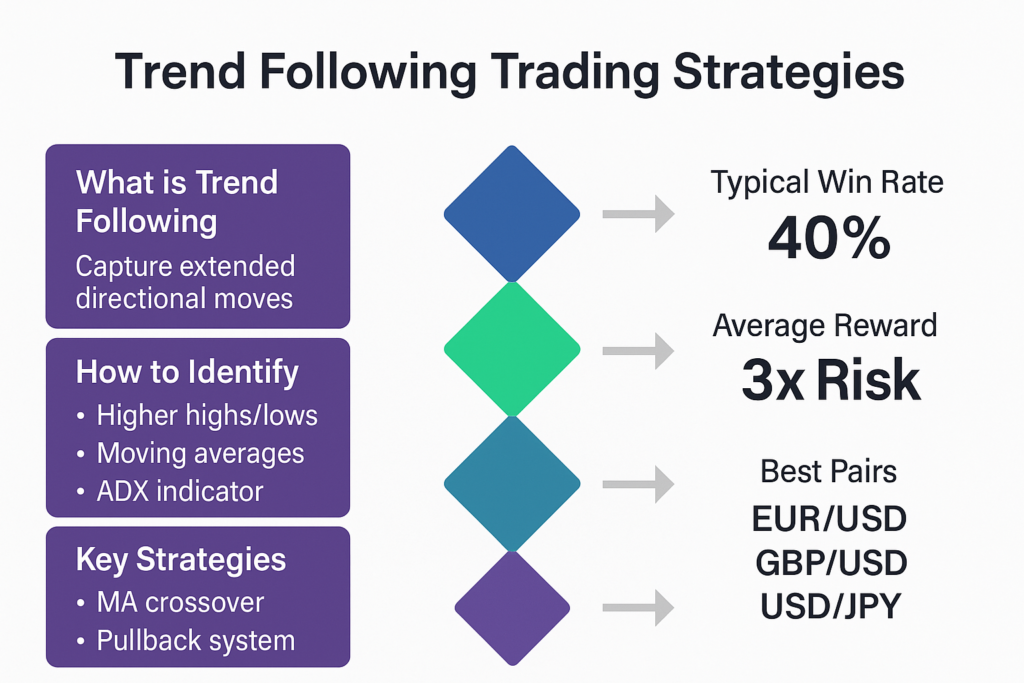
Win rate: 35-45% (most trades lose) Average win: 3-5 times average loss Profit factor: 1.5-2.5 (gross profit divided by gross loss) Maximum drawdown: 20-40% (psychologically challenging)
This profile means trend followers lose money more often than they make it, but the wins are large enough to produce net profits. The few trends that develop each year generate returns that exceed all the small losses from false starts and whipsaws.
Works Across Timeframes
Trend following principles apply whether you hold positions for hours, days, or months:
Intraday trends: Multi-hour directional moves during active trading sessions Swing trends: Multi-day moves capturing 200-500 pip swings Position trends: Multi-week or multi-month major trends of 1,000+ pips
The same identification and management principles apply regardless of timeframe, making trend following a scalable approach.
Identifying Forex Trends
Before you can follow trends, you must identify them. Several methods confirm when genuine trends exist.
The Three Trend Directions
Markets exist in one of three states at any given time:
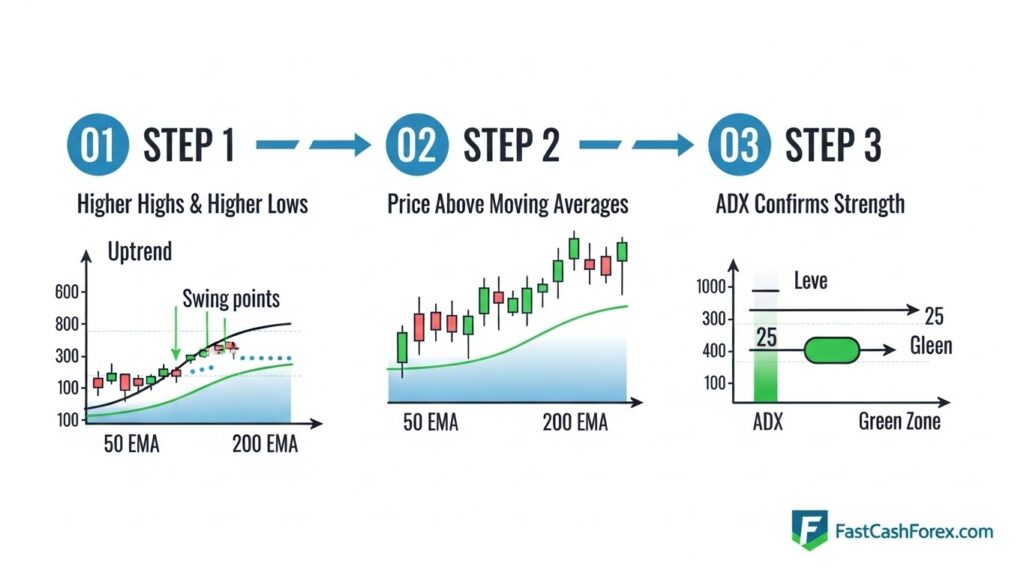
Uptrend: Series of higher highs and higher lows. Price consistently makes progress upward, with each pullback stopping above the previous pullback low.
Downtrend: Series of lower highs and lower lows. Price consistently makes progress downward, with each rally stopping below the previous rally high.
Sideways (no trend): Price oscillates between defined support and resistance without making directional progress. Highs and lows occur at roughly the same levels repeatedly.
Trend followers avoid sideways markets and focus exclusively on instruments showing clear uptrends or downtrends.
Higher Timeframe Direction
Always begin trend analysis on higher timeframes to identify the dominant market structure:
Daily chart: Shows the primary trend. This timeframe determines your directional bias. 4-hour chart: Shows secondary trend and potential entry setups within the daily trend. 1-hour chart: Provides precise entry timing once direction is confirmed.
Never trade against the daily trend direction. If the daily chart shows an uptrend, only take long positions. If it shows a downtrend, only take short positions. If it shows sideways action, wait for a breakout before entering.
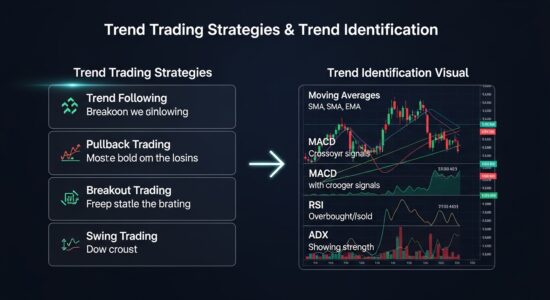
Moving Average Trend Identification
Moving averages provide objective trend confirmation:
Simple method: Price above 200 EMA = uptrend; price below 200 EMA = downtrend
Dual moving average: 50 EMA above 200 EMA = uptrend; 50 EMA below 200 EMA = downtrend
Triple moving average: 20 EMA > 50 EMA > 200 EMA = strong uptrend; inverse = strong downtrend
The more moving averages aligned in the same direction, the stronger the trend. Wait for at least the 50 EMA and 200 EMA to align before considering positions.
ADX Trend Strength
The Average Directional Index (ADX) measures trend strength without indicating direction:
ADX below 20: Weak or no trend (avoid) ADX 20-25: Emerging trend (watch for confirmation) ADX 25-40: Strong trend (ideal for trend following) ADX above 40: Very strong trend (already extended, be cautious on entry)
Combine ADX with directional indicators (DMI+/DMI-) to confirm both trend existence and direction. Only trade when ADX exceeds 25, confirming sufficient trend strength.
Trendline Analysis
Manual trendline drawing identifies trends through visual structure:
Uptrend line: Connect two or more higher lows with a line. As long as price stays above this line, the uptrend remains intact.
Downtrend line: Connect two or more lower highs with a line. As long as price stays below this line, the downtrend remains intact.
Trendline break: When price closes beyond the trendline on a higher timeframe (4H or Daily), the trend may be ending. This serves as a warning signal.
Trendlines work best on clean, obvious trends. Don’t force lines onto choppy, rangey price action.
Price Action Confirmation
Raw price structure provides the clearest trend confirmation:
In an uptrend: Each swing low should be higher than the previous swing low, and each swing high should be higher than the previous swing high.
In a downtrend: Each swing high should be lower than the previous swing high, and each swing low should be lower than the previous swing low.
Trend break: When price fails to make a new extreme (higher high in uptrend or lower low in downtrend) and then breaks the previous swing low (uptrend) or swing high (downtrend), the trend structure has broken.
Price action never lies. When the structure of higher highs and higher lows (or lower lows and lower highs) remains intact, the trend continues regardless of what indicators show.
Core Trend Following Strategies
Several proven approaches capture trending moves. Choose one that matches your personality and available time.
Strategy 1: Moving Average Crossover System
The classic and most straightforward trend following method.
Setup:
Apply 50 EMA (exponential moving average) and 200 EMA to Daily chart. These are the standard trend-following moving averages used by millions of traders worldwide.
Entry rules:
Long trade: Enter when 50 EMA crosses above 200 EMA (Golden Cross) Short trade: Enter when 50 EMA crosses below 200 EMA (Death Cross)
Entry timing: Don’t enter immediately on crossover. Wait for a pullback to the 50 EMA after the crossover, then enter when price bounces off the 50 EMA in the trend direction.
Stop loss: Place 50-80 pips beyond the 200 EMA on the side opposite your position.
Take profit: No fixed target. Trail stop using the 50 EMA. Exit when price closes on the wrong side of the 50 EMA.
Advantages:
Simple, objective, removes emotion. Works on any currency pair. Catches all major trends eventually.
Disadvantages:
Lags significantly—you’ll miss the first 20-30% of trends. Many whipsaws during ranging markets. Long periods without signals.
Best for: Beginners, part-time traders, those who prefer simple systems.
Strategy 2: Donchian Channel Breakout
A pure breakout-based trend following system popularized by the “Turtles.”
Setup:
Apply Donchian Channels (20-period high/low on Daily chart). The channel shows the highest high and lowest low over the past 20 days.
Entry rules:
Long trade: Price breaks above the upper Donchian Channel (20-day high) Short trade: Price breaks below the lower Donchian Channel (20-day low)
Entry timing: Enter immediately when price breaks the channel. Don’t wait for confirmation—the breakout is the confirmation.
Take profit: Trail stop at 20-period low (for longs) or 20-period high (for shorts).
Advantages:
Catches trends at the very beginning. Systematic with zero discretion. Trades both long and short. Proven over decades.
Disadvantages:
Many false breakouts. Frequent small losses. Requires discipline to keep taking signals after losses. Can enter at temporarily poor prices.
Best for: Systematic traders, those comfortable with low win rates, experienced traders who’ve mastered psychology.
Strategy 3: Higher Timeframe Pullback Entry
Combines trend identification with optimal entry timing.
Setup:
Identify trend on Daily chart using price action (higher highs and higher lows). Wait for pullback to key level on 4-hour chart.
Entry rules:
For uptrends:
Daily chart shows clear uptrend (higher highs and higher lows)
Price pulls back to previous resistance (now support)
4-hour chart shows reversal candle pattern (pin bar, engulfing)
Enter long at close of reversal candle
Stop loss: 20-30 pips below pullback low
Target: Previous swing high or beyond
For downtrends:
Daily chart shows clear downtrend (lower lows and lower highs)
Price rallies to previous support (now resistance)
4-hour chart shows reversal candle pattern
Enter short at close of reversal candle
Stop loss: 20-30 pips above rally high
Target: Previous swing low or beyond
Advantages:
Better entry prices than pure breakout methods. Higher win rate (55-65%). Tighter stops possible. Works with established trends only.
Disadvantages:
Requires discretion and skill in reading price action. Can miss explosive trends that don’t pull back. More subjective than pure mechanical systems.
Best for: Intermediate to advanced traders, those with pattern recognition skills, traders wanting better risk-reward ratios.
Strategy 4: Multi-Timeframe Trend Alignment
Only trades when all timeframes align in the same direction.
Setup:
Monitor three timeframes: Daily, 4-hour, and 1-hour. Apply 20 EMA and 50 EMA to each.
Entry rules:
Wait for all three timeframes to show the same trend direction:
All timeframes bullish: Price above both EMAs on Daily, 4H, and 1H charts All timeframes bearish: Price below both EMAs on Daily, 4H, and 1H charts
Entry trigger: When alignment occurs, enter on 1-hour chart at pullback to 20 EMA.
Stop loss: Below recent 1-hour swing low (longs) or above recent 1-hour swing high (shorts).
Take profit: Trail stop using 20 EMA on 4-hour chart.
Advantages:
Very high probability—trends with full alignment rarely fail immediately. Clear, objective criteria. Good risk-reward ratios.
Disadvantages:
Alignment happens infrequently. May miss early trend development. Requires patience waiting for all three timeframes to sync.
Best for: Conservative traders, those wanting high win rates, part-time traders who check charts 1-2 times daily.
Strategy 5: ADX Trend Filter System
Uses ADX to trade only when strong trends exist.
Setup:
Apply ADX (14) and DMI to Daily chart. Add 50 EMA and 200 EMA.
Entry rules:
Long conditions: Price above both 50 EMA and 200 EMA, ADX above 25, DMI+ above DMI- Short conditions: Price below both 50 EMA and 200 EMA, ADX above 25, DMI- above DMI+
Entry trigger: Enter at pullback to 50 EMA when all conditions met.
Stop loss: 50 pips beyond 50 EMA.
Take profit: Exit when ADX falls below 20 or DMI lines cross.
Advantages:
Trades only when trends are confirmed strong. Filters out choppy markets. Combines trend direction and strength.
Disadvantages:
Fewer signals than pure moving average systems. ADX lags, sometimes keeping you in dying trends. Requires monitoring multiple indicators.
Best for: Traders wanting quality over quantity, those who struggle with ranging markets, systematic traders.
Entry Techniques for Trend Trades
Even after identifying a trend, entry timing significantly impacts results. Several techniques optimize entry points.
Pullback Entry
The most conservative approach: wait for price to retrace against the trend before entering.
In an uptrend:
Identify uptrend on Daily chart
Wait for pullback to support (previous resistance, Fibonacci 50% or 61.8%, or rising trendline)
Look for reversal confirmation on 4H or 1H chart
Enter at close of reversal candle
Stop: Beyond pullback low
In a downtrend:
Identify downtrend on Daily chart
Wait for rally to resistance (previous support, Fibonacci levels, or descending trendline)
Disadvantages: Strong trends sometimes don’t pull back, causing missed opportunities.
Breakout Entry
Enter immediately when price breaks key resistance (uptrend) or support (downtrend).
Process:
Mark significant support/resistance on Daily chart
Wait for strong close beyond level (20+ pips)
Enter on close of breakout candle or on retest
Stop: Inside the breakout level
Target: Measured move or next S/R level
Advantages: Catches trends at inception, doesn’t miss explosive moves, clear entry trigger.
Disadvantages: Higher risk on individual trades, lower win rate (50-60%), more false breakouts.
Continuation Entry
Join trends already in progress after brief consolidations.
Pattern recognition:
Trend clearly established (higher highs and higher lows, or lower highs and lower lows)
Price consolidates in flag, pennant, or horizontal range
Breakout from consolidation in trend direction
Enter on breakout
Stop: Opposite side of consolidation
Target: Measured move equal to pre-consolidation trend leg
Advantages: Good risk-reward ratios, confirms trend continuation, entry near support in uptrends or resistance in downtrends.
Disadvantages: Requires pattern recognition, consolidations sometimes lead to reversals instead of continuations.
Stop Loss Placement for Trends
Proper stop placement balances protection against premature exit from potentially profitable trends.
Initial Stop Loss
Your initial stop determines position size and maximum risk. Several methods work:
Technical stop: Place beyond recent swing high (shorts) or swing low (longs). Typically 30-80 pips depending on volatility.
ATR stop: Place 2 × ATR (14-period) from entry. Adjusts automatically to volatility. In low volatility pairs, might be 40 pips; in high volatility pairs, might be 100 pips.
Percentage stop: Risk 1-2% of account equity. Calculate position size to ensure that distance from entry to stop equals exactly your risk tolerance.
Never use arbitrary round numbers like “always 50 pips.” Stops must relate to market structure or volatility, not random distance.
Once a trend develops in your favor, move stops to lock in profits while giving the trend room to continue.
Method 1: Moving Average Trail
Trail stop beneath 20 EMA (uptrend) or above 20 EMA (downtrend) on 4H or Daily chart. Exit when price closes beyond the moving average.
Advantages: Objective, gives trends room to breathe, stays in strong trends for long periods.
Disadvantages: Can give back significant profits during reversals, requires patience watching paper profits shrink during pullbacks.
Method 2: Swing Point Trail
Move stop to below each new swing low (uptrend) or above each new swing high (downtrend).
Advantages: Locks in more profits, exits trends earlier at the first sign of structure break.
Disadvantages: Gets stopped out of trends that are still intact but pulling back naturally.
Method 3: ATR Trail
Trail stop at 2-3 × ATR from current price, adjusting as price moves in your favor.
Advantages: Adjusts to volatility changes, purely systematic, no discretion required.
Disadvantages: Can be whipsawed in choppy extensions of trends, might exit too early in smooth trends.
Method 4: Parabolic SAR
Use Parabolic SAR indicator dots as trailing stop. Exit when price touches the SAR dots.
Advantages: Visual and automatic, accelerates with trend momentum, simple to implement.
Disadvantages: Can be too tight in early trend development, produces frequent whipsaws.
Recommendation: Use moving average trail (20 EMA) for most trend following. It balances staying in real trends while exiting when structure clearly breaks.
When to Exit Manually
Sometimes exit before your stop is hit if clear reversal signals appear:
Trend structure break: Price fails to make new high (uptrend) or new low (downtrend), then breaks previous swing point.
Momentum divergence: Price makes new extreme but momentum indicator (RSI, MACD) fails to confirm.
Opposite signal: Your entry system generates a signal in the opposite direction.
Major resistance/support: Price reaches obvious long-term resistance (uptrend) or support (downtrend) where reversals commonly occur.
Manual exits require experience and judgment. Beginners should stick to mechanical trailing stops until they develop market reading skills.
Position Sizing for Trends
Trend following requires specific position sizing approaches due to lower win rates and larger stops.
Fixed Percentage Risk
Risk the same percentage of equity on every trade, regardless of stop distance.
Formula: Position size = (Account equity × Risk %) ÷ (Stop distance in pips × Pip value)
Example:
Account: $10,000
Risk per trade: 1.5%
Risk amount: $150
Stop distance: 75 pips
Pip value target: $150 ÷ 75 = $2 per pip
Position size: 0.2 standard lots
This ensures consistent risk exposure regardless of how wide stops need to be for each specific trade.
Reduce position size in high volatility periods, increase in low volatility.
Method:
Calculate average ATR over past 20 days. Compare current ATR to this average:
If current ATR < average: Use full position size If current ATR > average by 20%: Reduce position size by 20% If current ATR > average by 50%: Reduce position size by 40%
This prevents overleveraging during volatile periods when stops are naturally wider.
Pyramid Sizing
Add to winning positions as trends develop, increasing exposure to confirmed trends.
Approach:
Initial entry: 0.5% risk (half normal size) After 1:1 risk-reward achieved: Add 0.5% risk After 2:1 risk-reward achieved: Add 0.5% risk Maximum total exposure: 1.5% risk
Rules:
Only add to winners, never to losers
Always move initial stop to breakeven before adding
Each addition should be smaller than the previous
Never exceed total risk tolerance across all entries
Advantages: Maximizes profit from strong trends, limits exposure to failed trades.
Disadvantages: Adds complexity, requires discipline to follow rules, reduces profits if trend reverses after additions.
Anti-Martingale (Fixed Ratio)
Increase position size as account grows, decrease as it shrinks.
Method:
Recalculate position size for every trade based on current account equity. As equity increases, position sizes automatically increase proportionally. As equity decreases during drawdowns, position sizes automatically decrease.
This creates geometric growth during winning periods while providing automatic risk reduction during losing periods.
Example:
Account at $10,000: Risk 1.5% = $150 per trade
Account grows to $12,000: Risk 1.5% = $180 per trade
Account drops to $9,000: Risk 1.5% = $135 per trade
Risk Management for Trend Following
Trend following generates unique risk profiles requiring specific management approaches.
Accept Lower Win Rates
Trend following typically produces 35-45% win rates. This means most trades lose money. You must psychologically accept that:
More than half your trades will be losers. This is normal and expected. A string of 5-7 consecutive losses doesn’t mean your system is broken—it means you’re experiencing normal statistical variance.
Your job is to keep losses small. Every small loss is the price you pay for the chance to catch the occasional large trend that produces 5-10 times your average loss.
One winner can erase ten losers. A single 500-pip trend capture can offset ten 50-pip false starts. This is why you never skip signals—you don’t know which one will be the big winner.
The National Futures Association (NFA) emphasizes in its investor education that understanding win rates versus profit expectations is crucial for trend trading success.
Maximum Drawdown Tolerance
Trend following systems experience significant drawdowns—periods where equity declines from peak levels.
Typical drawdown ranges:
Conservative trend systems: 15-25% maximum drawdown Aggressive trend systems: 30-50% maximum drawdown
Managing drawdowns:
Psychological preparation: Know in advance that 20-30% drawdowns will occur. If you can’t tolerate watching your account shrink by this amount, trend following isn’t suitable for you.
Position size appropriately: Risk 0.5-1.5% per trade maximum. Lower risk produces gentler drawdowns but slower growth.
Don’t abandon system during drawdowns: Most traders quit their trend system during drawdowns, right before the next major trend begins. Drawdowns are the price of admission to catch trends.
Diversify across pairs: Trade 4-6 currency pairs simultaneously. Rarely will all pairs trend simultaneously, reducing drawdown magnitude.
Time-Based Risk
Trend following requires patience—holding positions through pullbacks and consolidations.
Holding periods:
Intraday trends: 2-8 hours Swing trends: 3-10 days Position trends: Weeks to months
The longer your intended holding period, the larger your stops must be and the fewer trades you’ll take.
Psychological challenges:
Watching paper profits shrink during pullbacks. Holding through overnight gaps and weekend risk. Sitting in break-even trades for days waiting for trend development.
Most traders exit winners far too early because they can’t psychologically tolerate watching profits fluctuate. Trend following demands you let winners run, which feels uncomfortable.
Portfolio Risk
Limit total portfolio exposure to manage aggregate risk:
Single trade risk: 0.5-1.5% of account equity Total exposure: Maximum 6-8% of account equity across all open positions Correlation management: Avoid excessive exposure to correlated pairs (EUR/USD + GBP/USD both long = doubled USD exposure)
If risking 1% per trade with maximum 8 positions open, you’d risk 8% in total if all positions lost simultaneously. This rarely occurs if trading diverse pairs, but the math defines maximum possible loss.
Not all pairs trend equally well. Some characteristics make certain pairs more suitable.
Major Pairs – Best for Trends
EUR/USD:
Characteristics: Tight spreads, high liquidity, trending and ranging periods Trending frequency: Moderate (40-50% of time) Best for: All trend following strategies Average trend duration: 2-4 weeks
GBP/USD:
Characteristics: Larger daily ranges, volatile, strong trends Trending frequency: High (50-60% of time) Best for: Aggressive trend following Average trend duration: 1-3 weeks Note: Wider stops required due to volatility
USD/JPY:
Characteristics: Smooth trends, risk-sentiment driven Trending frequency: Moderate-High (45-55% of time) Best for: Conservative trend following Average trend duration: 3-6 weeks Note: Often forms extended trends
AUD/USD:
Characteristics: Commodity-correlated, clear trends Trending frequency: Moderate (40-50% of time) Best for: Position trend following Average trend duration: 2-4 weeks
Cross Pairs – Strong Tenders
EUR/JPY:
Characteristics: Large ranges, persistent trends Trending frequency: High (50-60% of time) Average trend: 400-800 pips Note: Requires wider stops (100+ pips)
GBP/JPY:
Characteristics: Very volatile, explosive trends Trending frequency: Very High (55-65% of time) Average trend: 600-1200 pips Note: Not for beginners—requires experience and strong psychology
AUD/JPY:
Characteristics: Risk-on/risk-off proxy, trending Trending frequency: Moderate-High (50-60% of time) Average trend: 400-700 pips
Pairs to Avoid for Trend Following
EUR/CHF:
Why: SNB intervention, often range-bound, sudden spikes Result: False breakouts, limited trend development
USD/CHF:
Why: Often ranges, inverse correlation to EUR/USD means redundancy Result: Fewer independent trend opportunities
Exotic pairs:
Why: Wide spreads, low liquidity, erratic movement Result: Costs eat into profits, stop running common
Recommendation: Focus on 4-6 major or major-cross pairs. EUR/USD, GBP/USD, USD/JPY, and AUD/USD provide sufficient diversification for most trend followers.
Fundamental Awareness for Trend Traders
While trend following is primarily technical, awareness of fundamentals improves trade selection.
Interest Rate Differentials
Currencies with rising interest rates tend to trend upward against currencies with stable or falling rates.
Application:
If the Federal Reserve is raising rates while the ECB holds steady, expect USD strength against EUR. This fundamental backdrop supports selling EUR/USD and increases the probability of sustained downtrends.
Monitor central bank policy directions. Trade in alignment with rate differential trends whenever possible.
Economic Divergence
When one economy strengthens while another weakens, currency trends develop.
Example:
Australian economy accelerating (rising GDP, falling unemployment) Japanese economy stagnating (weak GDP, deflation concerns) Expected result: AUD/JPY uptrend
Indicators to monitor:
GDP growth rates Employment data Manufacturing PMI Consumer confidence Trade balances
You don’t need to forecast—simply recognize when divergence exists and expect it to persist for weeks or months.
Stay aware of scheduled events (elections, referendums, central bank meetings) that could trigger or reverse trends. Avoid entering new trend trades immediately before major scheduled events—wait for the event outcome and resulting price action.
Combining Trend Following with Other Strategies
Trend following integrates well with complementary approaches.
Trend Following + Breakout Trading
Use breakout signals to enter trends at their inception.
Combined approach:
Identify consolidation or range on Daily chart
Wait for breakout in direction of higher timeframe trend (Weekly)
Enter on breakout or retest
Manage as trend following trade (trail stop, let winners run)
This captures trends from the very beginning while the higher timeframe trend provides directional bias.
Only enter trend trades when momentum confirms direction
Exit when momentum divergence warns of exhaustion
Example: Uptrend identified on Daily chart. Only take long entries when RSI on 4H chart is above 50, confirming bullish momentum. Exit if RSI makes bearish divergence (price makes higher high but RSI makes lower high).
Trend Trading Psychology
The psychological demands of trend following exceed those of most trading approaches.
Patience During Drawdowns
Trend following produces inevitable periods of consecutive losses. Markets range more than they trend, meaning many trend-following attempts fail before a genuine trend develops.
Mental preparation:
Accept that 8-12 consecutive losing trades can occur even with a sound system. This doesn’t indicate system failure—it indicates you’re experiencing the ranging market periods that always occur between trends.
Solution: Track historical performance. When you see your system has historically recovered from similar drawdown periods, you’ll have confidence to continue trading through current drawdowns.
Letting Winners Run
The hardest psychological challenge: watching paper profits shrink during pullbacks without exiting.
Natural instinct: Lock in profits quickly to feel successful and avoid the pain of watching gains evaporate.
Trend following requirement: Hold through pullbacks of 30-50% of your profits, trusting your trailing stop will eventually exit when the trend genuinely ends.
Solution: Remove discretion. Use mechanical trailing stops (20 EMA, Parabolic SAR) so you’re not tempted to exit early. Only check trades once daily to avoid emotional reactions to intraday fluctuations.
Taking All Signals
After losses, traders often skip the next signal, fearing another loss. This is deadly for trend followers because you never know which signal will produce the big winner.
Problem: Skip three signals after losses, and one of those three might have been the 500-pip trend that would have made your quarter.
Solution: Think in probabilities, not individual trades. Your edge comes from taking every signal, knowing that over 100 trades, your few winners will exceed your many losers. Missing even one major trend can destroy annual returns.
Ignoring Predictions
Trend followers must resist the urge to predict market direction.
Wrong mindset: “I think EUR/USD will go up because of X, Y, Z, so I’ll look for long trend trades.”
Correct mindset: “EUR/USD is currently trending down based on price action, so I’ll look for short trend trades until the trend structure breaks.”
Trade what you see, not what you think. The market doesn’t care about your predictions. Your job is to respond to what’s happening, not forecast what will happen.
Avoid these errors that sabotage trend trading success.
Mistake 1: Trading Against the Trend
The single most common and costly mistake: taking counter-trend trades.
Manifestation:
Selling into uptrends because “it’s overbought” or buying into downtrends because “it’s oversold.” These contrarian positions occasionally work, reinforcing the behavior, but overall they fight the most powerful force in markets.
Solution: If the daily trend is up, only take long trades. If the daily trend is down, only take short trades. If there’s no clear trend, don’t trade that pair.
Mistake 2: Using Stops That Are Too Tight
Attempting to minimize risk by using tight stops results in getting stopped out of trades that would have eventually succeeded.
Problem:
50-pip stop in a currency pair that regularly makes 80-pip pullbacks means you’ll be stopped out during normal trend breathing, missing the eventual 300-pip move.
Solution: Base stops on market structure and volatility, not arbitrary tight distances. Use 1.5-2 × ATR or place stops beyond recent swing points. Accept that proper stops might be 80-120 pips in volatile pairs.
Mistake 3: Taking Profits Too Early
Exiting winners prematurely because you fear giving back paper profits.
Problem:
Taking 100 pips on a trade that runs 400 pips means you captured only 25% of the available move. Do this consistently, and you’ll never compensate for your losing trades.
Solution: Use mechanical trailing stops. Trust the system to exit when the trend truly ends, not when your emotions say “this is enough.”
Mistake 4: Overtrading in Ranging Markets
Taking every signal even when markets clearly aren’t trending.
Problem:
Trend following systems generate signals continuously, but only some occur during genuine trends. Trading every signal in ranging markets produces string after string of losses.
Solution: Add trend filters (ADX > 25, price above/below 200 EMA) to only trade when trends are confirmed. Skip signals when ADX is below 20, indicating no trend exists.
Mistake 5: Inconsistent Position Sizing
Varying position size based on confidence or recent results.
Problem:
Taking small size on winners (because you’re cautious after losses) and large size on losers (because you’re confident after wins) produces the exact opposite of what’s needed.
Solution: Use fixed percentage risk (1-1.5%) for every trade. Remove discretion from position sizing entirely. The system, not your feelings, should determine size.
Mistake 6: Abandoning System During Drawdowns
Quitting the system after a string of losses, right before the next major trend begins.
Problem:
Most traders experience their worst drawdown immediately before their best winning streak. Abandoning the system during drawdowns guarantees you miss the recovery.
Solution: Track your system’s historical performance. When you see it has always recovered from similar drawdowns, you’ll have confidence to continue during the current drawdown.
Mistake 7: Adding Indicators and Complexity
Continually adding indicators and rules to avoid losses, making the system increasingly complex.
Problem:
Each new filter might avoid one recent loss but also filters out some future winners. Complexity doesn’t improve results—it usually degrades them while making the system impossible to follow consistently.
Solution: Keep systems simple. Once you have a profitable approach, resist the urge to modify it after every loss. Track performance over 100+ trades before making any changes.
Trend Following Performance Expectations
Set realistic expectations for what trend following can achieve.
These ranges assume proper risk management (1-2% risk per trade) and assume you trade through drawdowns without stopping.
Higher returns correlate with higher risk and larger drawdowns. A trader targeting 50% annually should expect 30-40% maximum drawdowns.
Win Rate Expectations
Typical win rates: 35-45%
This means you lose money on more than half your trades. If this reality troubles you psychologically, trend following isn’t appropriate for your personality.
Higher win rate strategies typically capture less of each trend (entering later and exiting earlier) but feel more comfortable psychologically.
Time to Profitability
Most trend following traders require 12-24 months to become consistently profitable.
Year 1: Learning system, developing discipline, surviving psychological challenges, experiencing first major drawdown, possibly breaking even or small loss.
Year 2: Consistency improves, emotional control develops, first profitable year, but still making mistakes.
Year 3+: System mastery, psychological strength, consistent profitability, compounding growth begins.
Don’t expect overnight success. Trend following rewards patience and persistence, not quick wins.
Drawdown Reality
Maximum drawdowns by approach:
Conservative (0.5% risk per trade): 15-20% Moderate (1% risk per trade): 20-30% Aggressive (2% risk per trade): 30-50%
Every trend following system experiences significant drawdowns. The question isn’t whether you’ll face a 25% drawdown—it’s whether you’ll have the discipline to keep trading when it happens.
Traders who can’t tolerate 20-30% equity declines should not employ trend following strategies.
Tools and Resources for Trend Followers
Several tools enhance trend following implementation.
Trading Platforms
MetaTrader 4/5:
Advantages: Free, widely available, supports automated trading, excellent for backtesting Use for: Indicator-based trend systems, automated trend following, historical testing
TradingView:
Advantages: Superior charting, clean interface, multi-timeframe analysis, alert system Use for: Discretionary trend following, price action analysis, pattern recognition
Indicators and Studies
Essential indicators:
Moving averages (20, 50, 200 EMA) ADX and DMI (trend strength and direction) ATR (volatility measurement for stops) Donchian Channels (breakout identification)
Optional indicators:
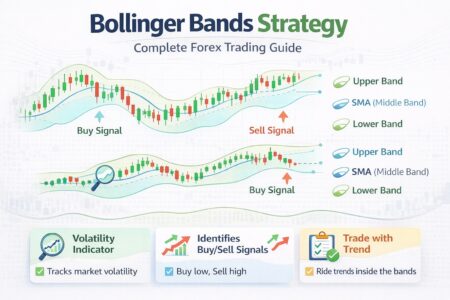
Parabolic SAR (trailing stops) Bollinger Bands (volatility and extremes) MACD (momentum confirmation)
Avoid indicator overload. Three to five indicators maximum. More creates analysis paralysis and conflicting signals.
Journaling and Tracking
Document every trade:
Required information:
Date and time of entry/exit Currency pair Direction (long/short) Entry price Stop loss price Exit price Profit/loss in pips Profit/loss in dollars Win or loss Setup type Notes on what happened
Analysis:
Review monthly:
Win rate by setup type
Average winner vs average loser
Maximum consecutive losses
Largest winner and loser
Current drawdown from equity peak
This data reveals whether your system is performing as expected or needs adjustment.
Central bank rate decisions Non-farm payrolls GDP releases CPI inflation data Central bank speeches
Don’t enter new trend trades within 24 hours of major scheduled events. Existing positions might be held through events or reduced in size depending on your risk tolerance.
Complete Trend Following System Example
Here’s a complete, actionable trend following system you can implement immediately.
System: Daily EMA Crossover with ADX Filter
Timeframe: Daily chart for trend identification, 4H chart for entry timing
Indicators:
50 EMA (exponential moving average) 200 EMA ADX (14-period)
Trend identification:
Uptrend: Price above 200 EMA, 50 EMA above 200 EMA, ADX > 25 Downtrend: Price below 200 EMA, 50 EMA below 200 EMA, ADX > 25
Entry rules:
Long entry:
Uptrend conditions met on Daily chart
Wait for pullback to 50 EMA on 4H chart
Enter when 4H candle closes above 50 EMA
Stop loss: 60 pips below 50 EMA
Risk: 1% of account equity
Short entry:
Downtrend conditions met on Daily chart
Wait for rally to 50 EMA on 4H chart
Enter when 4H candle closes below 50 EMA
Stop loss: 60 pips above 50 EMA
Risk: 1% of account equity
Exit rules:
Trailing stop: Trail stop using 50 EMA on Daily chart
Exit trigger: Close position when Daily candle closes on wrong side of 50 EMA
Manual exit: Exit if ADX falls below 20 (trend weakness) or if price closes beyond 200 EMA (trend structure break)
Position management:
Move stop to breakeven once profit equals initial risk (1:1) Never add to losing positions Optional: Scale out 50% at 2:1 risk-reward, trail remaining 50%
Win rate: 40-45% Average win: 180 pips Average loss: 60 pips Risk-reward: 1:3 Trades per month: 3-6 across all pairs Expected annual return: 20-35% Maximum drawdown: 20-25%
Implementation:
Set up alerts on TradingView for when price approaches 50 EMA on 4H chart during trends. Check charts once in morning and once in evening. This system requires 30-60 minutes daily maximum.
Conclusion: The Trend Follower’s Edge
Trend following offers one of the few provably profitable approaches to forex trading. Its edge comes not from prediction or complex analysis, but from a simple truth: trends persist longer than most traders expect, and a handful of large trends each year can produce returns that dwarf the many small losses from false starts.
Success requires:
Patience: Waiting for clear trends rather than forcing trades in ranging markets
Discipline: Taking every signal regardless of recent losses, following your system without deviation
Emotional control: Letting winners run through uncomfortable pullbacks, accepting that most trades lose
Realistic expectations: Understanding that 40% win rates and 25% drawdowns are normal and expected
Systematic approach: Removing discretion and emotion through mechanical rules and consistent execution
Trend following isn’t easy—if it were, everyone would do it successfully. The psychological demands exceed those of nearly every other trading approach. But for traders who can master these challenges, trend following provides a systematic, logical, proven method for extracting consistent profits from forex markets.
The question isn’t whether trends exist or whether trend following works—decades of evidence confirm both. The question is whether you have the temperament, discipline, and patience to follow trends consistently even when it’s psychologically difficult.
Master these principles, test your system thoroughly, and commit to taking every signal regardless of recent results. The trends will come. Your job is to be ready when they do.