Learn How to Make Fast Money by Learning diffrent Strategies in Forex Trading and Different Investment Options
Why US Forex Traders Should Use US Brokers
US forex traders face a critical decision when choosing where to open a trading account: use a heavily regulated US broker or pursue offshore alternatives promising higher leverage and looser restrictions. While international brokers may seem attractive, the regulatory protections offered by US brokers provide essential safeguards that far outweigh any perceived advantages of offshore trading.
Where you deposit your trading capital matters significantly. The broker holding your funds should operate under strict oversight with transparent business practices. Trading forex involves substantial risk even under the best circumstances – exposing your capital to additional broker-related risks is unnecessary and potentially devastating.
US brokers operate under the most stringent regulatory framework in the global forex industry. This oversight protects US forex traders from fraud, ensures fair dealing practices, and provides legal recourse if problems arise. International brokers, even those regulated in their home countries, offer no meaningful protection to US residents.
US Brokers Regulatory Framework
The United States maintains a comprehensive regulatory structure governing retail forex trading through two primary agencies:
Commodity Futures Trading Commission (CFTC)
The CFTC is a federal agency responsible for regulating commodity futures and options markets, including retail forex. The CFTC establishes rules for broker operations, capital requirements, and customer protection standards.
All forex brokers serving US clients must register with the CFTC as Retail Foreign Exchange Dealers (RFEDs). This registration requires meeting substantial financial requirements and submitting to ongoing regulatory oversight.
National Futures Association (NFA)
The NFA operates as a self-regulatory organization under CFTC oversight. All CFTC-registered brokers must also join the NFA and comply with its membership requirements.
The NFA conducts regular audits of member firms, enforces compliance rules, investigates customer complaints, and provides arbitration services for dispute resolution.
Regulatory Requirements for US Forex Broker
Brokers face comprehensive operational requirements designed to protect customer interests:
Capital Requirements
US brokers must maintain minimum adjusted net capital based on the size of their operations. These requirements ensure brokers have sufficient financial resources to meet customer obligations even during adverse market conditions.
Monthly unaudited and annual audited financial statements must be filed with regulators. This transparency allows regulatory oversight of broker financial health.
Customer Fund Protection
Customer deposits must be segregated from broker operating funds. This segregation prevents brokers from using customer money for company expenses or trading activities.
Daily reconciliation of customer funds ensures accurate accounting and immediate detection of any discrepancies.
Reporting Requirements
US brokers file detailed operational reports on daily, monthly, and quarterly schedules. These reports include:
Total customer funds on deposit
Number of active retail and institutional accounts
Percentage of profitable vs non-profitable customer accounts
Geographic distribution of customers
Risk exposure metrics
This extensive reporting provides regulators with real-time visibility into broker operations.
Enforcement and Penalties
Failure to comply with NFA and CFTC requirements results in substantial consequences. Regulatory violations can lead to:
Significant monetary fines
Suspension of trading privileges
Permanent license revocation
Criminal prosecution in cases of fraud
The NFA’s public disciplinary actions database maintains transparency about broker compliance histories.
Key Trading Restrictions for US Forex Traders
US regulations impose specific trading restrictions designed to limit excessive risk-taking:
Leverage Limitations
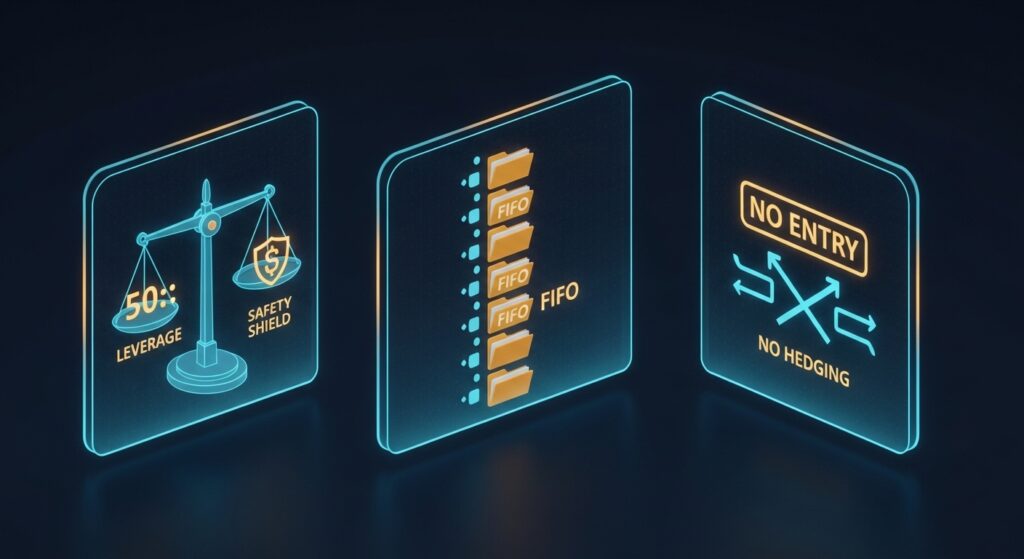
Maximum leverage is capped at 50:1 for major currency pairs and 20:1 for minor pairs. While this reduces position sizing flexibility compared to international brokers offering 500:1 or higher leverage, it also limits the potential for catastrophic account losses.
High leverage amplifies both gains and losses. The 50:1 limit still allows meaningful position sizing while providing some protection against complete account wipeout from adverse market movements.
First In First Out (FIFO) Rule
The FIFO rule requires closing positions in the order they were opened. When you hold multiple positions in the same currency pair, you must close the oldest position first.
On MetaTrader 4 and other platforms, you can select which position to close in the interface. However, the actual order sent to the broker’s counterparty follows FIFO rules. Your net position remains the same regardless of which specific lot is closed first.
No Hedging Allowed
US regulations prohibit holding both long and short positions on the same currency pair simultaneously in a single account. This restriction prevents certain hedging strategies popular with some US forex traders.
US forex traders accustomed to hedging must adapt their strategies or maintain separate accounts at different brokers (though this creates additional complexity).
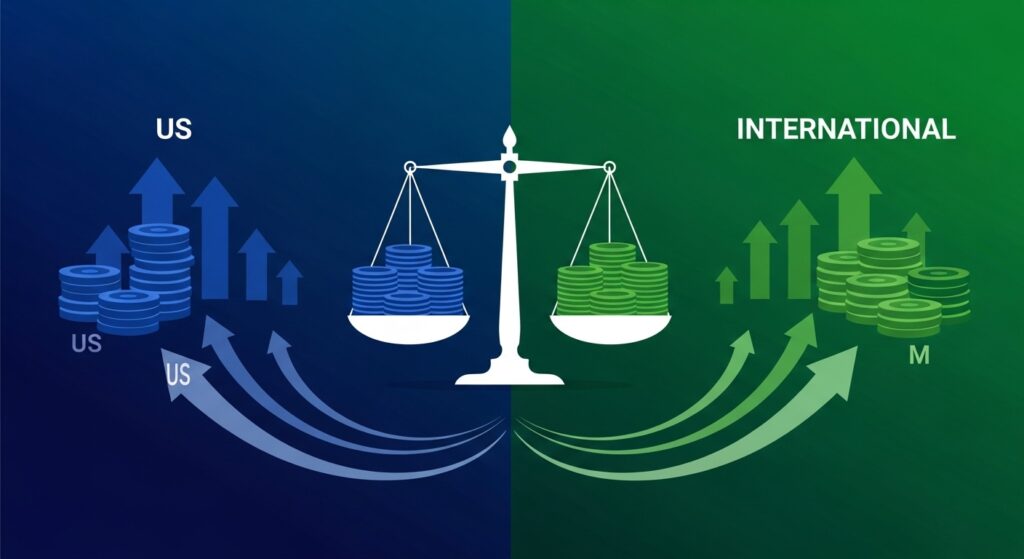
US Brokers vs International Brokers
Understanding the tradeoffs between US and international brokers helps inform your decision:
US Broker Advantages:
Strong regulatory oversight protects against broker fraud and financial mismanagement. Segregated customer funds, regular audits, and enforcement actions create a safer trading environment.
Legal recourse through NFA arbitration provides practical dispute resolution. US courts recognize and enforce arbitration awards against regulated brokers.
Transparent business practices with clear fee disclosure and fair dealing requirements. US brokers cannot engage in many deceptive practices common with unregulated brokers.
Tax reporting compliance as US brokers provide required tax forms. This simplifies year-end tax preparation.
US Broker Disadvantages:
Limited leverage (50:1 maximum) reduces position sizing flexibility compared to international offerings of 500:1 or higher.
Wider spreads due to regulatory compliance costs. International ECN brokers often provide tighter pricing.
Trading restrictions (FIFO, no hedging) limit certain strategies. These rules don’t exist with most international brokers.
Fewer broker choices as many international brokers refuse US clients. Limited competition can mean less innovation.
International Broker Risks for US Forex Traders:
No regulatory protection if problems arise. Foreign regulators (FCA, ASIC, CySEC) have no jurisdiction over US resident claims.
Broker violates US law by serving US clients without registration. You’re not breaking laws by trading offshore, but the broker is operating illegally.
Tax complications as international brokers may not report to the IRS. US forex traders remain responsible for accurate reporting regardless.
Potential fund access issues if the broker suddenly stops serving US clients due to regulatory pressure.
How US Forex Traders Should Choose a Broker
When selecting among US-regulated brokers, consider these factors:
Verify NFA Registration
Always confirm NFA membership before opening an account. Use the NFA’s BASIC database to verify registration status and review any disciplinary history.
Check that the broker shows active registration as both a Retail Foreign Exchange Dealer (RFED) and Futures Commission Merchant (FCM).
Compare Trading Costs
Evaluate total trading costs including spreads, commissions, and any account fees. Calculate costs based on your typical trading volume and style.
For active US forex traders making numerous daily trades, even small spread differences add up significantly. Less active US forex traders may prioritize other factors over minimal cost differences.
Platform and Tools
Determine whether you need specific platforms like MetaTrader 4/5 or can work with proprietary platforms. Only certain US brokers offer MetaTrader access.
Evaluate charting capabilities, available indicators, order types, and mobile app quality. Test demo accounts before committing capital.
Customer Service
Quality customer support matters especially when issues arise. Test response times and knowledge levels before opening accounts.
Look for 24/5 support availability matching forex market hours. Phone, email, and live chat options provide flexibility for different situations.
Educational Resources
Newer US forex traders benefit from brokers offering comprehensive educational materials. Quality brokers provide webinars, articles, video tutorials, and market analysis.
More experienced US forex traders may prioritize execution quality and costs over educational content.
That guide covers current NFA-registered brokers including OANDA, Forex.com, Interactive Brokers, TD Ameritrade, and others with detailed feature comparisons.
Understanding the FIFO Rule in Practice
The First In First Out rule deserves additional explanation as it affects position management:
When you buy a currency pair contract and later buy another contract at a different price, you’ve opened two separate positions. If you decide to close your most recent purchase, you can select that specific position in the MetaTrader 4 interface or other platform.
However, the order sent to the broker’s counterparty will offset using FIFO rules – meaning your oldest position closes first. Your net position remains identical regardless of which specific lot is technically closed.
For US forex traders accustomed to managing positions without FIFO restrictions, this requires adjustment. However, most trading strategies remain effective under FIFO rules with minor adaptations.
Tax Implications
US brokers simplify tax reporting by providing Form 1099 documentation. Forex profits are typically reported as capital gains using Form 6781 for Section 1256 contracts or as ordinary income depending on the specific instruments traded.
International brokers may not provide proper tax documentation, leaving you responsible for accurately tracking all trades and calculating gains/losses. The IRS requires reporting all foreign financial accounts, adding complexity when using offshore brokers.
Consult with a tax professional familiar with forex taxation as rules can be complex and depend on your specific situation.
The Bottom Line for US Forex Traders
While international brokers may advertise attractive features like high leverage and looser trading restrictions, US forex traders benefit significantly from choosing NFA-registered brokers. The regulatory protections, fund safety, and legal recourse available through US brokers far outweigh any perceived advantages of offshore trading.
Trading forex successfully requires skill, discipline, and sound risk management. Unnecessary risks from inadequate broker oversight only make an already challenging endeavor more difficult.
Choose a properly regulated US broker, focus on developing your trading skills, and avoid the false appeal of unregulated offshore alternatives. Your capital deserves proper protection.