Learn How to Make Fast Money by Learning diffrent Strategies in Forex Trading and Different Investment Options
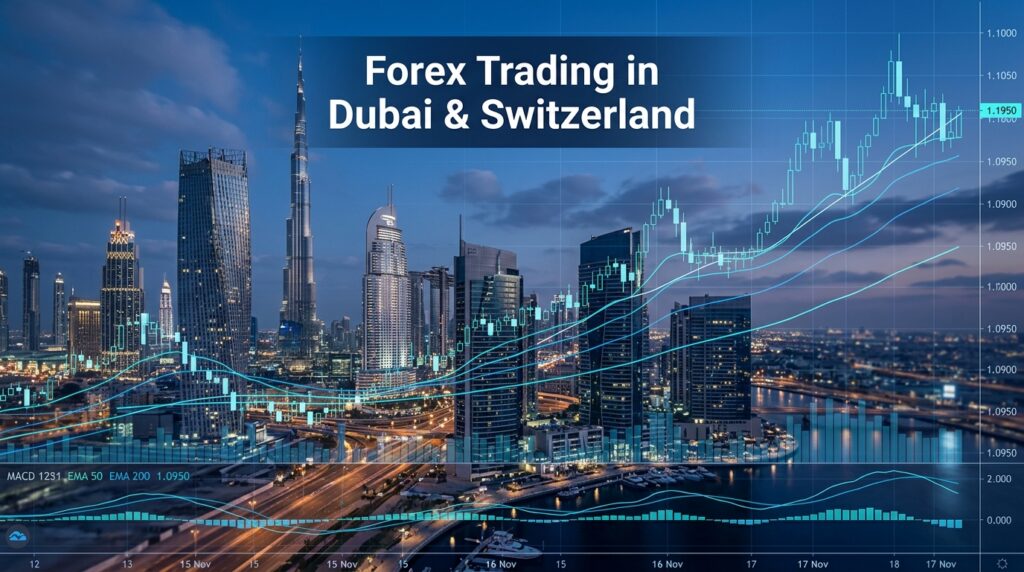
Forex Trading in Dubai and Switzerland: Complete 2026 Guide
Forex trading in Dubai and Switzerland represents two of the most sophisticated forex environments in the world. Both jurisdictions attract serious traders and institutional capital for different reasons: Dubai offers a tax-favorable climate, Islamic account options, and access to GCC and MENA markets, while Switzerland provides one of the most tightly regulated financial systems globally, the world’s most stable currency, and a centuries-long tradition of banking excellence.
Whether you are based in the UAE, Switzerland, or looking to trade through brokers licensed in either jurisdiction, understanding the regulatory environment, tax implications, and account options in each market will directly impact your broker selection and trading strategy. This guide covers everything you need to know.
Forex Trading in Dubai and Switzerland: Why These Two Markets Matter
Dubai has established itself as the leading financial hub in the Middle East and one of the fastest-growing forex trading centers in the world. The UAE’s strategic position between European and Asian market sessions, combined with world-class financial infrastructure and a large expatriate professional population, makes Dubai a natural center for forex activity.
The city is home to two major financial free zones, each with its own independent regulatory authority, plus a federal regulator covering the broader UAE market. Understanding which regulator governs your broker — or your chosen trading entity — is the first step in evaluating any Dubai-based forex operation.
UAE Forex Regulators
DFSA — Dubai Financial Services Authority The Dubai Financial Services Authority regulates financial services within the Dubai International Financial Centre (DIFC). The DFSA is widely regarded as the most rigorous retail forex regulator in the region, with standards comparable to the FCA in the UK. Brokers authorized by the DFSA must maintain minimum capital requirements, segregate client funds, and adhere to strict conduct of business rules. When evaluating a broker operating from Dubai, DFSA authorization is the gold standard. Verify broker authorization directly on the DFSA register.
FSRA — Financial Services Regulatory Authority (Abu Dhabi) The FSRA operates within the Abu Dhabi Global Market (ADGM) free zone and provides equivalent-level regulation to the DFSA. FSRA-authorized brokers are subject to comprehensive oversight covering capital adequacy, client fund protection, and financial crime prevention. Several major international brokers maintain ADGM licenses as their UAE operating base. Check FSRA-licensed firms at adgm.com
SCA — Securities and Commodities Authority The SCA is the federal regulator covering mainland UAE financial services outside the DIFC and ADGM free zones. SCA oversight is less commonly used by major international forex brokers but governs many locally operating firms and financial advisers.
For retail traders, prioritize brokers holding a DFSA or FSRA license. These provide the strongest regulatory protection available in the UAE market.
Tax Environment for Forex Traders in the UAE
The UAE’s tax environment remains highly favorable for forex traders, though it has changed in recent years and the older claim that “all forex traders pay zero tax” is no longer universally accurate.
Personal income tax: The UAE still does not levy personal income tax on individuals. Retail forex traders operating as private individuals are not subject to income tax on their trading profits. This remains one of the most significant financial advantages of trading from the UAE.
Corporate tax (introduced June 2023): The UAE introduced a federal corporate tax of 9% for business profits exceeding AED 375,000 per year. This applies to entities registered as businesses — not to individual retail traders. Traders operating through a formal trading company or fund structure may fall under corporate tax rules depending on how profits are classified.
VAT: The UAE introduced 5% VAT in 2018. Financial services that are fee-based may attract VAT, but margin-traded forex transactions are typically VAT-exempt under UAE VAT law.
Practical implication: For the vast majority of retail forex traders in the UAE trading personal accounts, the tax environment remains extremely favorable. Always consult a UAE-based tax adviser if you are operating at significant volume or through a corporate structure, as the 2023 corporate tax rules introduced nuance that varies by situation.
Islamic Forex Accounts in Dubai
One of the most important topics for forex trading in Dubai — and across the GCC and MENA region — is Sharia-compliant trading. Islamic finance principles prohibit riba (interest), which creates a direct conflict with the standard forex swap (rollover) system, where overnight positions incur interest charges.
What is an Islamic forex account? An Islamic forex account, also called a swap-free account, eliminates overnight interest charges on open positions held past the market close. Instead of swap charges, some brokers may apply an administration fee for positions held for extended periods, though the most compliant Islamic account structures avoid any interest-like replacement fees entirely. For a complete breakdown of how Islamic accounts work, see our Islamic Forex Accounts guide.
Why Islamic accounts matter for GCC traders The GCC population is predominantly Muslim, and the UAE specifically has a significant Muslim majority. For these traders, operating through an account that eliminates riba is not a preference — it is a religious requirement. Brokers that offer well-structured Islamic accounts with genuine swap-free conditions are significantly more competitive in the Dubai and wider GCC market.
What to look for in a swap-free account Not all Islamic accounts are equivalent. When evaluating swap-free options, verify that the account eliminates swap charges on all instruments (not just major currency pairs), that there are no hidden replacement fees that replicate interest in a different form, and that the broker’s Islamic account structure has been reviewed by a Sharia supervisory board or qualified Islamic finance scholar.
Major international brokers including Pepperstone, IC Markets, XM, and Exness all offer Islamic account options, though the exact structure and fee arrangements vary. For a complete overview of broker account types and how to compare them, see our How to Choose the Right Forex Broker guide.
Dubai as a Forex Trading Hub: Practical Advantages
Beyond regulation and tax, Dubai offers several structural advantages for forex traders.
Market session overlap: Dubai Standard Time (GST, UTC+4) means Dubai traders have natural access to both the Asian market session close and the early European session open. This covers EUR/USD, GBP/USD, and USD/JPY during their highest-volume periods without requiring late-night or early-morning trading.
Capital availability: Dubai attracts high-net-worth individuals and institutional capital from across the Gulf, South Asia, and East Africa. This has created a deep ecosystem of professional forex traders, introducing brokers, and fund managers operating in the city.
DIFC infrastructure: The Dubai International Financial Centre operates as a common law jurisdiction with its own courts, providing a familiar legal environment for international businesses and traders. Broker disputes can be resolved through the DIFC Courts, offering a level of legal certainty uncommon in the broader Middle East.
Currency exposure: UAE-based traders often hold wealth in multiple GCC currencies, creating natural interest in currency pairs involving the AED, SAR, and other regional currencies, as well as gold — a traditional store of value in the region and a tradeable instrument on most major forex platforms.
Forex Trading in Switzerland: Market Overview
Switzerland occupies a unique position in global finance. It is home to some of the world’s oldest and most respected banking institutions, operates the Swiss National Bank (one of the most independently influential central banks globally), and hosts the headquarters of major international financial organizations.
For forex traders, Switzerland offers a combination of world-class regulation, extreme financial stability, and one of the most liquid currency pairs in the world: USD/CHF.
FINMA is the federal regulator overseeing all Swiss financial market participants, including banks, insurance companies, and forex brokers. FINMA is consistently ranked among the strictest financial regulators globally, with requirements that exceed even EU standards in several areas. Confirm Swiss broker authorization at finma.ch.
Key FINMA requirements for forex brokers include substantial minimum capital requirements (significantly higher than most other jurisdictions), comprehensive client fund segregation, detailed reporting obligations, and strict anti-money laundering controls. Brokers authorized by FINMA provide an exceptionally high level of client protection.
Swiss-licensed forex brokers operate under the Swiss Banking Act or the Financial Services Act (FinSA), which came fully into force in 2020 and introduced MiFID II-equivalent protections for Swiss retail clients.
The Swiss Franc: A Safe Haven Currency
The Swiss franc (CHF) is one of the world’s most important safe haven currencies. During periods of global financial stress — market crashes, geopolitical crises, or major central bank policy shifts — capital tends to flow into CHF, causing it to strengthen rapidly and significantly.
For forex traders, this creates both opportunity and risk. USD/CHF and EUR/CHF are among the most technically predictable major pairs during normal market conditions but can move violently during risk-off events. EUR/CHF in particular experienced one of the most dramatic single-day moves in forex history in January 2015 when the Swiss National Bank abruptly removed the EUR/CHF floor it had maintained since 2011 — a reminder of the tail-risk embedded in CHF trading.
Understanding the safe haven characteristics of CHF is essential for traders holding positions in Swiss franc pairs around major global events. For foundational knowledge on how currency pairs work and how to interpret exchange rates, see our What Is Forex Trading guide.
Switzerland’s Tax Environment for Forex Traders
Switzerland’s tax treatment of forex trading depends heavily on whether trading income is classified as capital gains or self-employment income.
Private investors: Switzerland does not tax private capital gains. If Swiss tax authorities classify your forex trading as private investment activity — rather than professional trading — your profits are generally tax-free at the federal level. Cantonal rules vary.
Professional traders: If trading is deemed a professional activity — assessed by factors including trading frequency, leverage usage, holding periods, and whether trading income represents a primary income source — profits may be taxed as self-employment income. Swiss tax authorities apply a multi-factor test to make this determination.
Practical guidance: Casual to moderate forex traders in Switzerland are typically classified as private investors and do not owe tax on trading profits. High-frequency traders or those deriving primary income from trading should seek advice from a Swiss tax professional regarding their specific situation.
Comparing Dubai and Switzerland for Forex Traders
Factor
Dubai (UAE)
Switzerland
Primary Regulator
DFSA / FSRA / SCA
FINMA
Regulatory Rigor
High (DFSA/FSRA)
Very High
Personal Income Tax
None
None on capital gains (conditions apply)
Corporate Tax
9% over AED 375k
Varies by canton and classification
Islamic Accounts
Widely available
Available from international brokers
Currency of Note
AED (pegged to USD)
CHF (safe haven)
Market Session
Asian/European overlap
European session primary
Key Advantage
GCC market access, tax environment
Regulatory strength, institutional quality
Both jurisdictions attract serious traders and both offer structural advantages that make them worth understanding regardless of where you are physically located. Many traders choose brokers with licenses in both regions — maintaining DFSA authorization for UAE regulatory compliance and FINMA authorization for its additional credibility signal.
Choosing a Forex Broker for UAE and Swiss Trading
Whether you are based in Dubai or Switzerland — or simply want a broker with strong regulatory standing in either jurisdiction — the selection criteria are consistent with best practices for broker evaluation globally.
Regulation first: For UAE-based traders, a DFSA or FSRA license provides the highest level of protection. For Swiss traders, FINMA authorization is the equivalent standard. Many major international brokers also hold FCA (UK) and ASIC (Australia) licenses, which provide equivalent protection for traders who prefer using a broker’s internationally regulated entity.
Islamic account quality: For GCC traders requiring Sharia-compliant accounts, verify that the swap-free account structure is genuinely interest-free — not simply a relabeled interest charge. Ask the broker specifically whether their Islamic account structure has received Sharia advisory review.
Leverage: UAE retail traders through DFSA-regulated entities are subject to leverage limits aligned with international standards. Swiss traders through FINMA-regulated brokers face similar professional-grade oversight. Offshore entities may offer higher leverage, but this comes with significantly reduced regulatory protection.
Spreads and execution: For active traders in the Dubai or Zurich time zones, execution quality during the European session open (8:00–10:00 AM CET) is particularly important, as this is when spread widening is most common. For a full explanation of how leverage and trading costs work together, see our Understanding Leverage in Forex guide.
Account types: Both markets attract professional and semi-professional traders. If your capital level qualifies, VIP and institutional account tiers offer tighter spreads and dedicated account management — particularly relevant for traders in the UAE, where high-net-worth traders are common. See our VIP Forex Accounts guide for full details on when a premium account makes financial sense.
Forex trading in Dubai and Switzerland represents two of the most developed, well-regulated, and financially sophisticated trading environments available anywhere in the world. Dubai’s combination of no personal income tax, strong DFSA and FSRA regulation, Islamic account availability, and GCC market positioning make it one of the most attractive bases for retail and professional forex traders in the MENA region. Switzerland’s FINMA oversight, banking tradition, and unique CHF safe haven dynamics make it a critical market for anyone trading major pairs or seeking the highest available regulatory standards in Europe.
For traders in either jurisdiction, the foundation remains the same: choose a well-regulated broker, understand the tax rules specific to your situation and trading classification, and match your account type to your capital level and trading style.
Risk Warning: Forex trading involves substantial risk of loss and is not suitable for all investors. Regulatory and tax rules are subject to change. The information in this article is for educational purposes only and does not constitute financial, legal, or tax advice. Always verify current regulations directly with the relevant authority (DFSA at dfsa.ae, FSRA at adgm.com, FINMA at finma.ch) and consult a qualified professional for advice specific to your situation.