Learn How to Make Fast Money by Learning diffrent Strategies in Forex Trading and Different Investment Options
Investing in Dubai: The Complete Guide for Foreign Investors
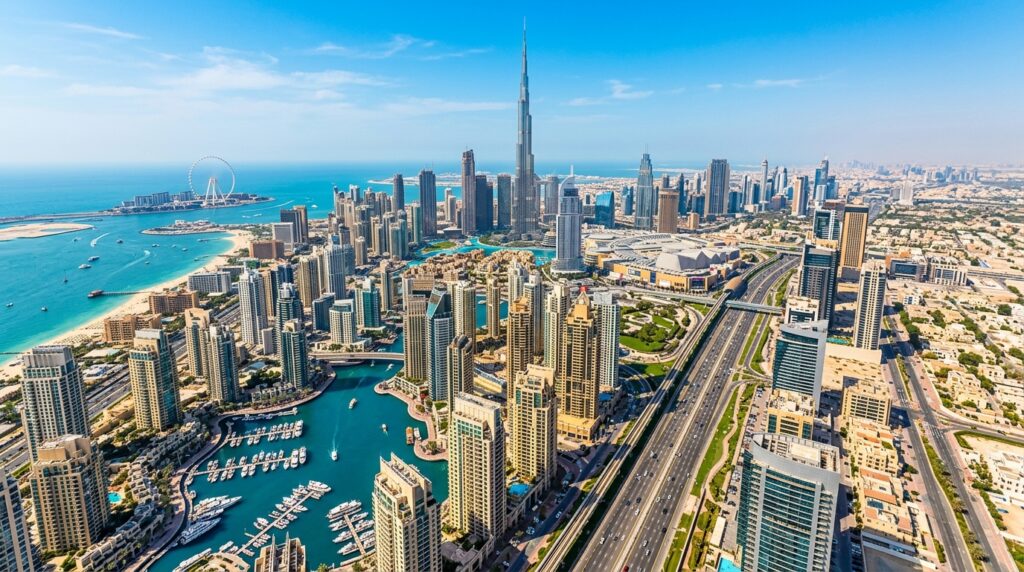
Investing in Dubai has transformed itself from a regional trading port into one of the world’s most sought-after destinations for foreign investment. Zero personal income tax, zero capital gains tax, zero property tax, 100% foreign ownership in designated zones, world-class infrastructure, and a government that has consistently made attracting international capital a strategic priority — the investment case for Dubai is not subtle. It is one of the clearest propositions in global finance.
The numbers reflect that. Real estate deals in Dubai topped AED 753.6 billion in 2024, a 36% rise year on year. In the first quarter of 2025 alone, residential sales reached AED 120 billion, with foreign investors accounting for more than 44% of all transactions. Dubai is not just attracting regional GCC capital — investors from India, the UK, Russia, China, the United States, and across Europe are consistently among the most active buyers in the market.
This guide covers the key investment channels available to foreign investors: the financial free zones, the broader free zone ecosystem, real estate, and the residency pathways that make long-term investment in Dubai particularly compelling.
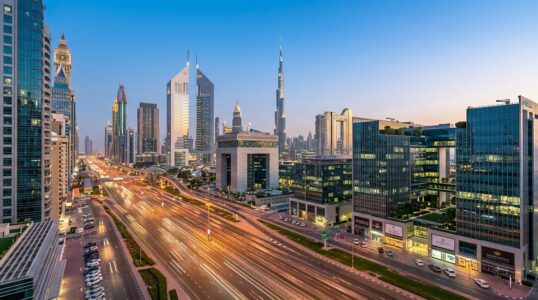
The Dubai International Financial Centre, established in 2004, is the financial hub of the entire Middle East, Africa, and South Asia region. What began as an ambitious project to capture the region’s vast pool of capital — high-net-worth individuals across the Gulf had historically sent trillions of dollars to foreign institutions due to limited local options — has become one of the top ten global financial centres by any measure.
The DIFC operates under its own legal framework based on English common law, with an independent court system that adjudicates disputes according to internationally recognised standards. This legal architecture gives foreign firms and investors a level of certainty that is rare in the region and is a primary reason whywhy every major investment bank, asset manager, and financial services firm has a DIFC presence.
The benefits for businesses operating within the DIFC include 100% foreign ownership, zero tax on profits, no restrictions on capital repatriation, and access to the DFSA — the Dubai Financial Services Authority — which is the independent regulator whose standards are recognised internationally. The DIFC technology community alone grew 38% year on year to over 1,200 firms by 2024, and the centre now houses more than 600 fintech companies, creating the kind of network density that accelerates deal flow, partnership formation, and talent access.
Dubai’s Free Zone Ecosystem
Beyond the DIFC, Dubai runs over 30 specialist free zones. Each one is built around a specific industry, and all of them carry the same core advantages: 100% foreign ownership, tax exemptions, and streamlined licensing. The difference is focus.
Dubai Internet City has been the region’s technology hub since it opened in 2004. Microsoft, IBM, Oracle, Cisco, and HP all base their regional operations there. It is not just a business address — the 50-year legal guarantees on ownership and taxation make it a long-term commitment that offshore structures in less stable markets simply cannot replicate.
Dubai Media City operates on the same tax-free terms and serves the communications and entertainment industry. Over 1,300 companies are registered there, covering broadcasting, publishing, film production, and media services. For anyone operating in content or media across the GCC, it is the natural base.
Dubai South is a different proposition entirely. It sits around Al Maktoum International Airport, which the UAE government is building to become the world’s largest aviation hub. The zone covers 145 square kilometres — roughly twice the size of Manhattan — and brings together logistics, aviation, manufacturing, and residential communities under one roof. The government has committed $32 billion to infrastructure there through 2030. For investors thinking about where Dubai’s next decade of growth is concentrated, Dubai South is the clearest answer.
Real Estate Investment in Dubai
Dubai’s real estate market offers foreign investors something genuinely rare: full freehold ownership rights in designated zones, no property tax, no capital gains tax, and rental yields that consistently outperform comparable markets in Western Europe, the United States, or Australia.
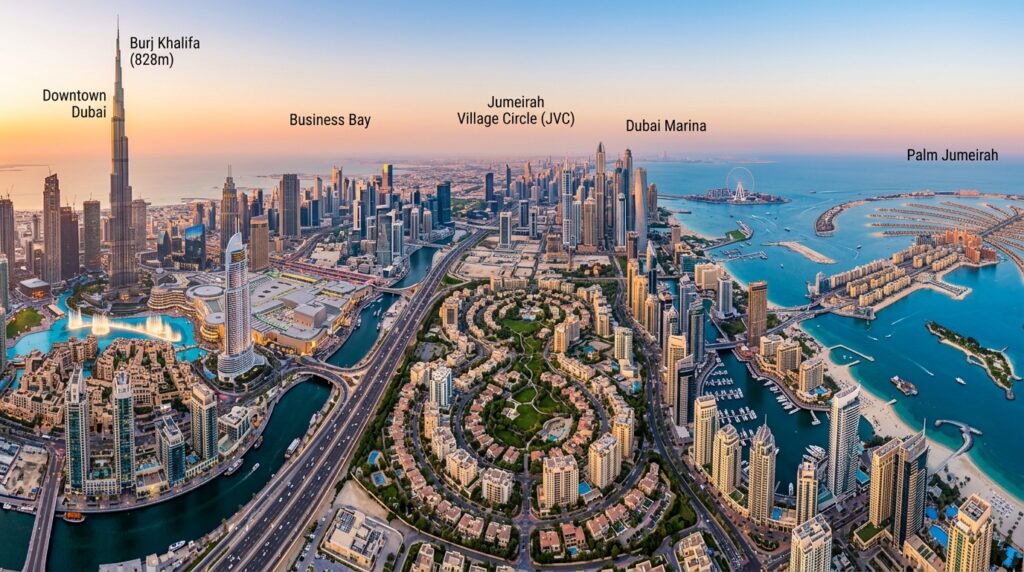
Foreigners can purchase property outright in Dubai’s freehold areas — Downtown Dubai, Dubai Marina, Business Bay, Palm Jumeirah, Jumeirah Village Circle, and dozens of others — with full legal ownership of the unit, the right to sell or lease, and the right to pass the property to heirs. There is no cap on how many properties a foreign investor can own. Freehold properties in prime areas averaged 12.3% annual appreciation in 2024, with rental yields in areas like Jumeirah Village Circle consistently delivering 7–9%. For investors comparing options across global markets, our global real estate investors guide covers the broader landscape of where international capital is flowing.
Financing is available to foreign buyers for investing in Dubai. Local banks including Emirates NBD offer mortgages up to 50% loan-to-value for non-residents, with dedicated foreign investor programmes and English-speaking relationship managers. The purchase process involves a 4% registration fee payable to the Dubai Land Department, a real estate commission of approximately 2%, and the standard legal and transfer documentation. All transactions are secured through RERA-regulated escrow accounts.
The sweet spot for most international investors is the AED 1–5 million range, which covers quality properties in established areas including Business Bay, Dubai Marina, and emerging zones with strong appreciation potential. Off-plan purchases — buying during construction at below-market prices — are widely used by experienced Dubai investors to lock in value before handover, with appreciation of 15–30% between purchase and completion common in high-growth zones.
For a broader view of real estate investing as an asset class, including how Dubai compares to other markets, see our dedicated guide.
The Golden Visa Advantage
One of the most significant changes to Dubai’s investment landscape in recent years is the UAE Golden Visa programme, which ties long-term residency directly to investment thresholds. A property investment of AED 2 million or more qualifies for a 10-year renewable UAE residency visa, with no requirement to spend a minimum number of days in the country. A lower threshold of AED 750,000 qualifies for a standard investor residency visa.
The Golden Visa has expanded considerably beyond its original scope. As of 2025, eligibility has been extended to cover professionals in artificial intelligence, climate technology, healthcare, education, and digital content creation, alongside the traditional investment and property routes. For foreign investors who want the legal stability and lifestyle access of UAE residency alongside their investment returns, the Golden Visa makes Dubai a genuinely compelling long-term base in a way that few other markets can offer.
Why Investing in Dubai Still Makes Sense
The fundamentals that made Dubai attractive to foreign investors two decades ago have not weakened — they have deepened. The legal framework is more mature, the financial infrastructure is more sophisticated, the real estate market is more transparent, and the residency pathways are more accessible. What was once a speculative frontier market is now a proven, regulated investment destination with institutional-grade infrastructure and a government track record of delivering on its commitments.
For investors comparing international options, Dubai’s combination of tax efficiency, legal certainty, yield potential, and residency benefits is difficult to match. Markets like Jordan offer their own compelling case — see our investing in Jordan guide — but Dubai’s scale, liquidity, and integration into the global financial system place it in a category of its own in this region.
This article is for informational purposes only and does not constitute investment, legal, or financial advice. All investments carry risk. Tax treatment depends on individual circumstances and the laws of your country of residence. Always seek independent professional advice before making investment decisions.