Learn How to Make Fast Money by Learning diffrent Strategies in Forex Trading and Different Investment Options
Invest in Abu Dhabi: A Guide to the Industrial Sector and Economic Zones
To invest in Abu Dhabi is to enter one of the most deliberately built industrial economies in the world. The Government of Abu Dhabi treats the industrial sector as the primary engine for long-term economic prosperity — a cornerstone of the Abu Dhabi Economic Vision 2030 alongside real estate, technology, renewable energy, and healthcare. For international investors, that commitment translates into infrastructure, regulatory support, and economic zones that are genuinely built for business rather than just marketed that way.
The results are visible in the numbers. The UAE consistently ranks among the top global destinations for foreign direct investment, with a significant share of that capital flowing into Abu Dhabi’s industrial ecosystem. Manufacturing, logistics, heavy industry, and specialized sectors including aluminum, steel, petrochemicals, advanced materials, and food technology have all seen sustained growth as the government pushes to reduce dependence on oil revenue and build a diversified, high-value economy.
The case for Abu Dhabi as an investment destination is built on several advantages that set it apart from other regional markets. Geography is the starting point. Situated at the crossroads of East and West, the emirate provides efficient access to markets across the Middle East, Asia, Africa, and Europe, with a catchment of over 4.5 billion consumers within reach of its logistics network.
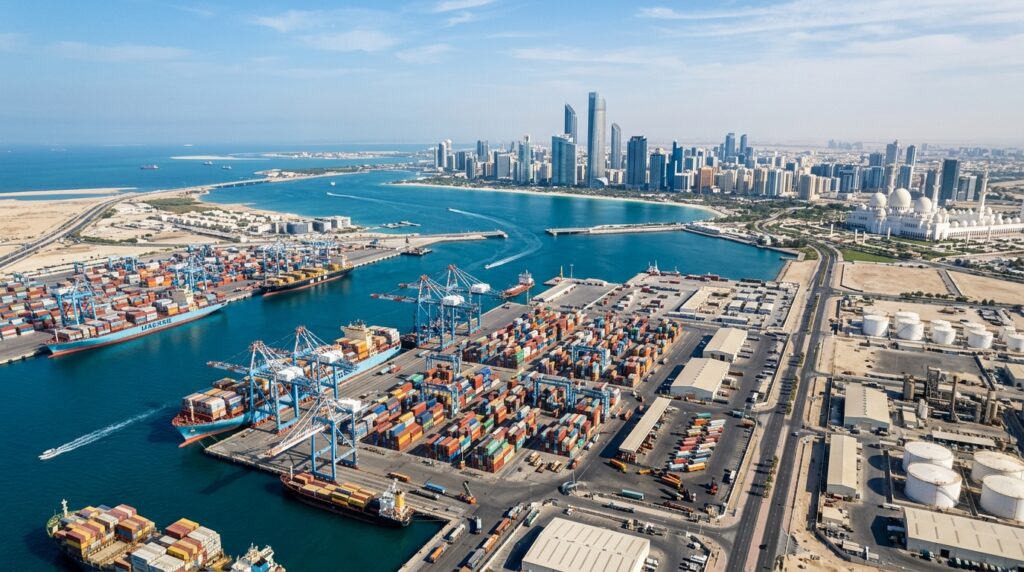
The infrastructure supporting that geographic position is genuinely world-class. Abu Dhabi operates a multi-modal transportation network that includes advanced deep-water ports and specialized logistics hubs managed by AD Ports Group. Energy supply — a critical factor for manufacturing and heavy industry — is reliable and cost-effective, giving industrial operators a structural cost advantage compared to many competing locations.
Political and economic stability matter enormously for long-term investment decisions, and Abu Dhabi scores well on both. The emirate maintains a stable governance structure with a strong track record of honoring investment commitments and a clear, publicly documented long-term development agenda. This is reinforced by an expanding network of Comprehensive Economic Partnership Agreements and double taxation treaties that give businesses based in Abu Dhabi preferential access to key international markets.
Those who invest in Abu Dhabi also benefit from consistent GDP growth supported by both state-led investment programs and a growing private sector. Hydrocarbon wealth provides the financial foundation, but the deliberate push toward non-oil sectors means the investment environment is increasingly driven by manufacturing output, logistics revenue, and technology rather than energy prices alone.
The KEZAD Group: Abu Dhabi’s Industrial Zone Framework
The management of Abu Dhabi’s industrial and economic zones is consolidated under the KEZAD Group — Khalifa Economic Zones Abu Dhabi — which operates as part of AD Ports Group. This consolidation matters because it means streamlined services, a single point of contact for zone-related matters, and consistent standards across facilities that were previously managed by separate entities.
KEZAD absorbed the zones formerly known as ICAD (Industrial City of Abu Dhabi), ZonesCorp, and KPIZ into a unified framework. The centerpiece is the Khalifa Industrial Zone, a large-scale multi-purpose economic zone encompassing manufacturing, logistics, trade, and commercial activities. Within the KEZAD umbrella, the Industrial City of Abu Dhabi — covering ICAD I, II, and III — caters to industries ranging from advanced machinery and chemicals through to construction materials and textiles. The Al Ain Industrial City serves as the zone for light and medium manufacturing in the eastern region, focused primarily on agricultural processing and consumer goods production.
KEZAD offers both free zone and non-free zone setups, giving investors flexibility in how they structure their operations depending on ownership preferences, export requirements, and sector-specific needs.
Specialized Industrial Clusters
Beyond the KEZAD zones, Abu Dhabi operates several specialized industrial clusters. The Al Ruwais Industrial Complex, developed primarily through ADNOC Downstream, remains the center of the emirate’s oil refining, petrochemicals, and fertilizer industries. The strategic direction at Al Ruwais has shifted toward higher-value products and new energy solutions including blue ammonia and hydrogen, reflecting Abu Dhabi’s position at the intersection of conventional energy and the global energy transition.
Closer to Abu Dhabi city, the Mussafah Industrial Area functions as a hub for smaller and mid-sized enterprises across automotive services, engineering, and construction materials. Managed by the Abu Dhabi Municipality, Mussafah serves the service and supply chain businesses that support the broader industrial economy.
How to Invest in Abu Dhabi: Establishing an Industrial Project
Abu Dhabi has invested significantly in simplifying the process of setting up an industrial project. The system operates through a modernized Single Window approach — commonly called the One Stop Shop — designed to reduce the time and complexity involved in navigating multiple government entities.
The primary industrial license comes from the Department of Economic Development (ADDED), which manages core licensing and regulatory approvals. For operations within the specialized economic zones under KEZAD, the zone authority handles land allocation, utility connections, and facility permits directly. The process has moved substantially onto digital platforms, reducing setup timelines and improving transparency for investors working through the system from outside the UAE.
For those looking to invest in Abu Dhabi, the government’s long-term commitment to consolidating these services — and the ongoing development of zone infrastructure — means that establishing an industrial project here is more efficient than in most comparable markets in the region.
Risk Warning: International investing carries significant risks including political instability, currency fluctuation, and regulatory uncertainty. This article is for informational purposes only and does not constitute financial or investment advice. Always consult a qualified advisor before making investment decisions.