Jordan has quietly emerged as one of the Middle East’s most stable and investor-friendly destinations. With a strategic location at the crossroads of Europe, Asia, and Africa, a pro-business government, and a growing set of international trade agreements, Jordan offers real opportunities for foreign investors looking to diversify into emerging markets.
This guide covers everything you need to know before you invest in Jordan — from key sectors and government incentives to risks and practical steps for getting started.
Why Invest in Jordan?
Jordan’s investment case rests on foundations that set it apart from most markets in the region. The country is one of the Middle East’s most politically stable, governed under the Hashemite monarchy of King Abdullah II alongside a democratically elected parliament — a combination that has allowed Jordan to navigate regional conflicts and economic shocks more steadily than its neighbours.
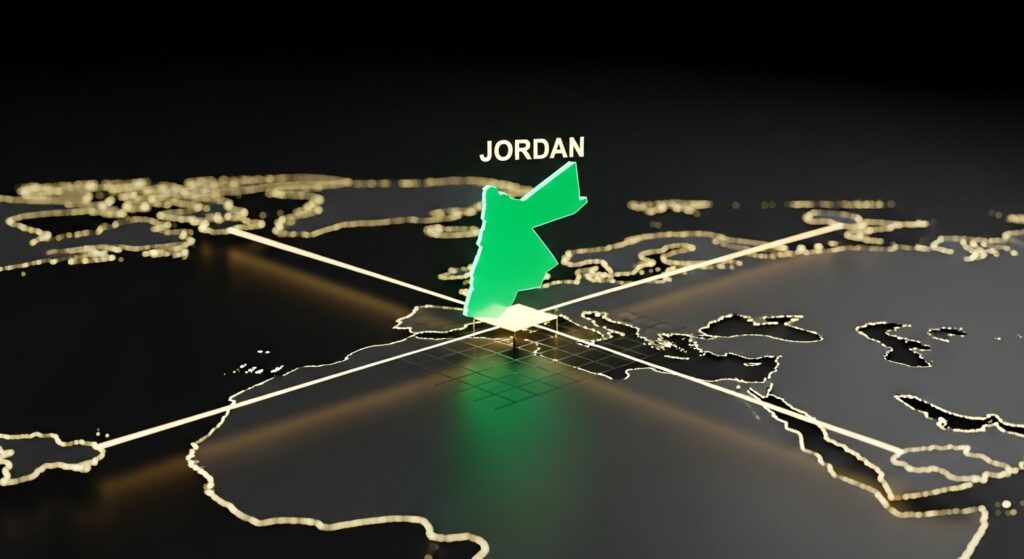
Geography adds another layer. Sitting at the convergence of Europe, Asia, and Africa, Jordan serves as a natural logistics and trade hub. The Port of Aqaba — the country’s only seaport — connects directly to Red Sea shipping lanes, and modern highways link Jordan to Saudi Arabia, Iraq, Syria, and Israel. Major international companies including Maersk and APM Terminals have already committed capital to Aqaba, with a $230 million decarbonised terminal project currently underway.
The economic numbers back the narrative. Jordan’s foreign direct investment reached $2.02 billion in 2025, a 25.1% increase on 2024, and the IMF projects real GDP growth of 2.9% for 2026. Jordan’s trade agreements give investors duty-free access to both the U.S. market through its Qualifying Industrial Zones agreement and to EU markets — an unusual combination that makes it an attractive base for export-oriented businesses.
Investment Incentives and Tax Benefits
The Jordanian government actively encourages foreign investment through a range of incentives:
The Jordanian government offers income tax exemptions of 25%, 50%, or 75% for up to ten years depending on the project’s location and sector, along with full customs duty exemptions on imported fixed assets and equipment. Revenues generated from exports are tax-exempt, and capital, profits, and salaries can be repatriated freely with no restrictions. Company registration is handled through a streamlined process that typically completes within seven working days.
Jordan’s government introduced new measures in 2024 designed to simplify procedures for investors, covering sectors including tourism, industry, mining, and energy, with identified opportunities worth $3 billion. International Trade Administration
For the official investment portal and current incentive details, visit Invest in Jordan.
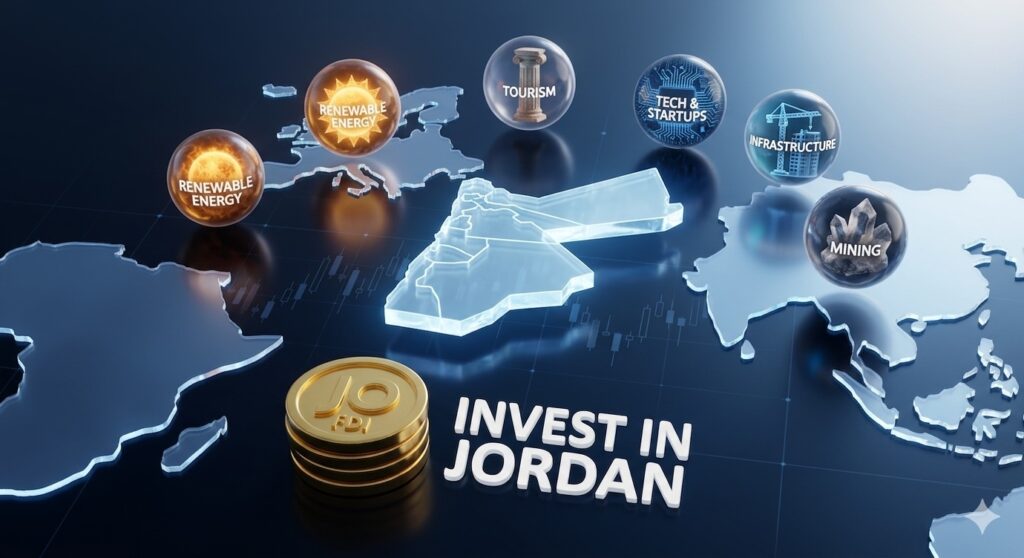
Top Sectors to Invest in Jordan
Renewable Energy
Jordan is a regional leader in renewable energy. With abundant solar resources and new legislation supporting private-sector participation, the country aims to become a regional hub for green hydrogen, attracting significant feasibility investment. International Trade Administration The government’s energy strategy also includes a $6 billion national water desalination project with multiple investment opportunities for international partners.
Tourism
Jordan’s tourism sector is one of the strongest investment opportunities in the country. With over 100,000 archaeological sites, six UNESCO World Heritage sites including Petra, and a strategic location, the government’s Economic Modernization Vision targets attracting $3.8 billion in tourism sector investment by 2033. Untourism
Wadi Rum: Adventure Tourism Investment
Wadi Rum, Jordan’s iconic red desert, is one of the fastest-growing adventure tourism destinations in the Middle East. UNESCO-listed and made famous internationally as a filming location for major Hollywood productions, Wadi Rum attracts hundreds of thousands of visitors annually seeking desert camping, hiking, and unique eco-tourism experiences.
For investors, Wadi Rum represents a high-growth opportunity in boutique hospitality — luxury desert camps, eco-lodges, and adventure tourism operators are all in strong demand. The Jordanian government actively supports tourism investment in the region through streamlined licensing and tax incentives.
For travelers planning to visit Wadi Rum or Aqaba before making an investment decision, see our Wadi Rum travel guide on AdmaTravel.
Technology and Startups
Jordan has a growing technology ecosystem anchored by a young, highly educated population. Amman has produced internationally recognized tech companies — including Replit, co-founded by Jordanians — and the government actively supports entrepreneurship through digital economy initiatives.
Real Estate and Infrastructure
Jordan’s real estate market offers opportunities in residential, commercial, and industrial properties. Free zones and industrial estates — including fully operational parks in Aqaba and Zarqa — provide infrastructure for manufacturing and logistics operations.
Mining and Natural Resources
Mining and Natural Resources represent significant opportunities for those looking to invest in Jordan. According to the International Trade Administration, the country is focused on developing underutilized reserves of copper, gold, lithium, uranium, and natural gas. Jordan is actively seeking international technology and strategic investment to modernize its energy and mining sectors.
The Dead Sea: Wellness, Mining, and Skincare Export

The Dead Sea is more than just a tourist destination; it is a unique economic engine. Its mineral-rich waters and mud are the foundation of a multi-million dollar global wellness industry. For those looking to invest in Jordan, the extraction and export of Dead Sea minerals for pharmaceutical and cosmetic use represent a high-growth niche.
These minerals are world-renowned for treating skin conditions and promoting longevity. For a deeper look at how these natural elements are used in premium skincare formulations, see our detailed analysis on Dead Sea Minerals Skincare at VivantBeauty.
Risks to Consider Before You Invest in Jordan
No investment destination is without risk. Before you invest in Jordan, be aware of the following:
The most immediate concern is regional geopolitical risk. Jordan borders Israel, Syria, Iraq, and Saudi Arabia, and ongoing conflicts in the region — including the war in Gaza — create uncertainty that can affect trade flows, tourism volumes, and investor sentiment. Jordan has historically managed this exposure well, but it remains a real variable.
Structural unemployment is another challenge, particularly among youth and women. This constrains domestic consumer demand and creates social pressures that investors in consumer-facing sectors need to factor in. Water scarcity adds a long-term constraint on certain industries — Jordan is one of the most water-poor countries in the world, and agricultural or water-intensive investments carry specific risks that others do not.
On the currency side, the Jordanian Dinar’s peg to the U.S. Dollar provides stability but removes monetary policy flexibility. And while the government has worked to improve the business environment, investors still flag tax regime instability and inconsistent interpretation of regulations as practical challenges worth understanding before committing capital.
How to Start Investing in Jordan
The starting point is identifying which sector aligns with your investment goals and qualifies for the most relevant incentives — the structures vary considerably between renewable energy, tourism, mining, and technology. From there, the official Invest in Jordan portal provides current opportunities, an interactive investment map, and details on partnership projects. Before proceeding, working with a Jordanian legal and financial advisor who knows the local regulatory environment is essential rather than optional. Company registration is handled through the Jordan Investment Commission and typically completes within seven working days. Once registered, the Ministry of Investment can confirm which tax and customs exemptions apply to your specific project.
For broader context on global investing strategies, see our guides on Global Real Estate Investors, Alternative Investments, and Investment Methods.
Jordan’s Economic Modernization Vision 2033
One of the most important developments for investors considering Jordan is the government’s ambitious Economic Modernization Vision (EMV) 2033. Launched by King Abdullah II, this 10-year plan aims to attract $60 billion in investments and create one million new jobs by 2033.
The plan’s priorities cover digital transformation and expansion of the technology sector, an energy transition targeting 50% renewable energy by 2030, water security through desalination and smart water infrastructure, tourism development aimed at doubling revenues, export diversification to reduce dependence on remittances and aid, and private sector growth through reduced bureaucracy and greater industry participation. Projects aligned with these pillars tend to receive faster approvals, stronger incentives, and greater government backing.
The EMV represents a generational commitment to economic reform and creates a clear roadmap for investors looking to align with government priorities. Projects aligned with EMV goals tend to receive faster approvals, stronger incentives, and greater government support.
For investors, this means Jordan is not just open for business today — it has a clear, government-backed plan for growth over the next decade.
Bottom Line
Jordan offers a compelling case for investors seeking Middle East exposure with relative political stability, strong government incentives, and growing international trade access. The key sectors — renewable energy, tourism, technology, and mining — all have genuine long-term potential. As with any emerging market investment, thorough due diligence and local expertise are essential before committing capital.
Risk Warning: International investing carries significant risks including political instability, currency fluctuation, and regulatory uncertainty. This article is for informational purposes only and does not constitute financial or investment advice. Always consult a qualified advisor before making investment decisions.